The Moment
Orange Town, still in the East Blue, still the first arc of the whole series. Buggy the Clown and his pirates have taken the town apart for sport, and the one person still standing between them and total destruction is not Luffy, not Zoro, not any of the crew watching from the sidelines — it's the town's mayor, an old man named Boodle, alone in medieval-style armor with a spear he can just about still swing.
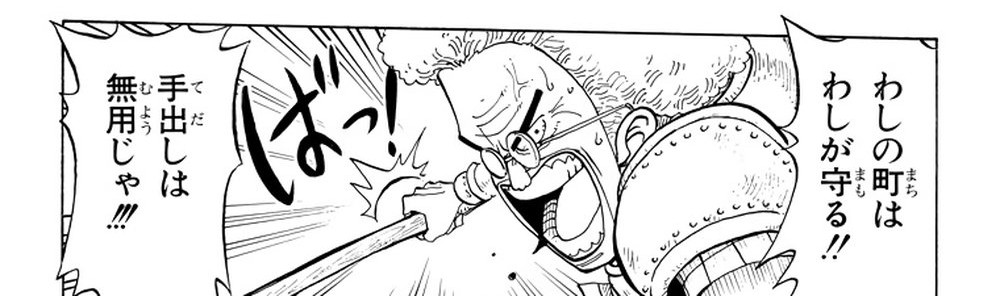
A few pages earlier, Boodle had already staked his claim on the fight in the plainest terms Japanese has:
「これはわしの戦いじゃぞ!!」
Kore wa washi no tatakai ja zo!!
VIZ: "THIS IS MY BATTLE!"
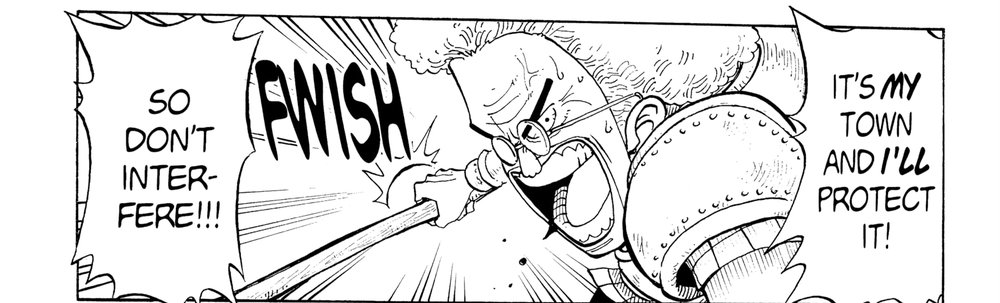
Then, taking a hit meant for Luffy's crew and refusing to yield an inch of ground:
「わしの町は/わしが守る!!」
Washi no machi wa / washi ga mamoru!!
VIZ's English edition prints: "IT'S MY TOWN AND I'LL PROTECT IT!" (Vol. 2, p.146).
Grant the rendering its due first: it's a clean, punchy line, true to the beat, and "my town" / "I'll protect it" lands the exact defiance the panel needs. Nothing is mistranslated. But listen to what the Japanese does that the English simply cannot: わし (washi) appears twice in one short sentence, and every single time it appears — here and dozens of times elsewhere across this same arc — it is quietly doing a job no English pronoun can touch. It is telling the reader, instantly and for free, that the man refusing to move is old.
The Original
Start with the menu Japanese actually offers for "I." Standard Japanese has several first-person pronouns in active use — 私 (watashi, neutral-polite), 僕 (boku, softer masculine), 俺 (ore, rough masculine) — and they split along two axes: formality and gender. わし splits along a third axis entirely: age. Say わし in contemporary fiction and, gender aside, you have said one thing above all else: old.
The word itself is almost certainly a worn-down descendant of わたくし/わたし, the same erosion pattern that gave standard Japanese あたし and, going further, あたい — each step dropping a syllable and sliding the register somewhere new. There is a kanji for it — 儂 — built from the 亻 ("person") radical plus 農 supplying sound, not meaning (in some southern Chinese topolects the same character already served as a first- or second-person pronoun; Japanese borrowed it purely for its reading and grafted it onto native washi). Manga almost never bothers printing 儂. The kana わし reads instantly as "old man" without asking anyone to parse a character most native speakers themselves would struggle to write from memory.
This is 役割語 (yakuwarigo) — "role language" — Japanese fiction's habit of using vocabulary and grammar, not just description, to cast a character. わし occupies the elder slot in a whole wardrobe of first-person role-language: 拙者 (samurai-era self-deprecation), 小生 (bookish self-effacement), おいら (rustic, boyish informality) — a cluster this site has tracked across other series. Each one announces something about the speaker before the sentence's actual content arrives.
And Oda doesn't stop at the pronoun. わし is chronically paired with the sentence-final copula じゃ (an old-fashioned/dialectal だ), and Boodle's dialogue leans on both, hard: 「町長じゃ!!!」("THAT'S WHO!")、「手出しは無用じゃ!!!」("SO DON'T INTERFERE!!!"). Pronoun plus copula, stacked on nearly every line — Oda is not being subtle. Grammatically, none of this is exotic: わし slots into any sentence a normal Japanese pronoun would (it isn't tested as JLPT vocabulary at all, since pronoun choice sits outside the exam's scope), but learners typically meet it early — around N4–N3 — in manga and anime dialogue, well before anyone explains the sixty-plus years of implied backstory riding on it.
VIZ's Choice
Six representative appearances of わし from this arc and one echo two volumes later, spoken by two different older-register speakers, side by side with the official English:
| Vol. / p. | Speaker | Japanese | VIZ English |
|---|---|---|---|
| 2 / 82 | Boodle | わしはこの町の長さながらの | I'M THE MAYOR OF THIS TOWN... |
| 2 / 121 | Boodle | 町長のわしがなぜ指をくわえて我が町が潰されるのを見ておらねばならんのじゃ!!! | WHAT KIND OF MAYOR STANDS BACK AND WATCHES HIS TOWN BE DESTROYED!? |
| 2 / 146 | Boodle | これはわしの戦いじゃぞ!! | THIS IS MY BATTLE! |
| 2 / 146 | Boodle | わしの町はわしが守る!! | IT'S MY TOWN AND I'LL PROTECT IT! |
| 9 / 196 | Genzo (Cocoyasi Village) | わしらは心を決めておる!!! | OUR MINDS ARE MADE UP!! |
| 11 / 99 | unnamed bystander, Whiskey Peak | わしのも!! | SO'S MINE !! |
Read down the right column and something unusual happens compared to this site's other pronoun and register articles: there is no scatter, no convergence-onto-the-wrong-formula. It's total, uniform flattening. Every single わし becomes some form of the plain English "I" — "I'm," "my," "I'll," "our," "mine." Nothing is wrong with any individual choice. But stack them and the pattern is stark: a word that changes almost nothing about what is said and everything about who is saying it disappears without a trace, every time, because English's "I" has no dial to turn for age.
The Vol. 11 line is worth pausing on separately: it isn't Boodle at all, just an anonymous man in a crowd shouting that his money's gone, sandwiched between neighbours who say 「おれもだ!」("MINE TOO!"), 「私も!!」("AND MINE !!"), and 「おれのも!!!」("MINE IS GONE TOO !!!"). Four Japanese speakers, four different first-person pronouns, one single reaction shot — and English's "mine," "mine too," and "so's mine" cannot register that one of those four just marked himself as older than the other three by word choice alone.
The Gap
One "I" for every age, everywhere. English's single first-person pronoun cannot carry what Japanese distributes across half a dozen words. A reader who meets Boodle only through the English text — no art, just dialogue — has no way to know he's old before someone calls him "mayor" or "old man." The pronoun that would have told them instantly, on every single line, tells them nothing.
The pronoun can vanish twice over, in the same sentence, on top of the flattening. 「町長のわしがなぜ指をくわえて我が町が潰されるのを見ておらねばならんのじゃ!!!」 literally opens with "I, the mayor" as the aggrieved first-person subject watching his town get crushed "with my finger in my mouth" (an idiom for helpless bystanding). VIZ restructures the whole thing as a rhetorical question — "WHAT KIND OF MAYOR STANDS BACK AND WATCHES HIS TOWN BE DESTROYED!?" — trading Boodle's personal lament for a generic question about mayors-in-the-abstract, and swapping "I"/"my town" for the third-person "his town." Both わし and its older, equally marked cousin 我が ("my," used here for "my town") disappear in the same breath — not mistranslated, just restructured into a sentence shape that no longer needs a first person at all.
The copula's echo goes silent too. じゃ, closing out nearly every one of Boodle's lines, has no English equivalent whatsoever. So even the rhythm that doubles down on Boodle's age — pronoun and copula, reinforcing each other line after line — collapses into a single unmarked "I" doing the work Japanese split across two separate words.
The pattern repeats invisibly across every series this site covers. Swap わし for 拙者 (the archaic-samurai "I" a talking ninja hound uses in Naruto) or 小生 (the bookish, self-effacing "I" of a Demon Slayer villain) or おいら (the rustic, boyish "I" of a country-boy recruit) and the same collapse happens every time: distinct role-language, one "I." わし is simply the elder-tier entry in a wardrobe English can't try on.
What If
No option is free; here's the menu and its prices.
- "This here's my town, and I aim to protect it!!" — folksy, gunslinger-adjacent phrasing gestures at an older, rougher speaker the way English westerns do. Cost: borrows a specific American frontier voice that has nothing to do with Boodle's Japanese seaside-mayor persona.
- "My town — and an old man still has the arm to defend it!!" — smuggles Boodle's age into the sentence itself, compensating for what わし alone can't carry. Cost: adds content the original line never states outright; わし doesn't have to say "old," and this translation makes it say so anyway.
- Lean on address terms elsewhere in the scene — VIZ already does this once, rendering 「小童共...」as "YOU YOUNG WHIPPER-SNAPPERS..." Cost: compensation only works on lines with an addressee; an isolated わし line spoken to no one in particular still reads completely age-neutral.
- Keep VIZ's plain "I" and let the art carry the load — trust Boodle's afro, glasses, and armor to supply what the pronoun no longer can. Cost: works fine on the page, fails the instant the line is quoted in text without the panel — exactly the position every reader of this article has been in for the last several paragraphs.
Take-away
わし doesn't change what a sentence says. It changes who you hear saying it — and that second channel, running underneath the words on every single line, is exactly the channel English's one-size-fits-all "I" cannot carry.
Three rules of thumb to carry off this page:
- When a first-person pronoun shifts, ask what changed — not what was said. わし, 俺, 僕, 私 can all sit in an identical sentence and mean the same thing while telling you something completely different about the speaker. That second layer is the one translation tends to lose first.
- Watch for paired markers. わし alone is already coded; わし plus じゃ is Oda double-underlining the point. When two role-language markers stack on one line, expect the loss in translation to be proportionally larger, not smaller.
- A vanished pronoun can be a bigger tell than a mistranslated one. When a first-person line gets restructured into a third-person or rhetorical shape (as at Vol. 2, p.121), check whether the person speaking got quietly swapped for a type of person — the mayor's personal grief for mayors-in-general.
For the opposite failure — one Japanese word scattering across five different English ones instead of collapsing into a single flat pronoun — see the karmic tie buried in 因縁, or browse the One Piece translation notes index.
Every Japanese and English line quoted above is a byte-exact capture from the cited editions — ONE PIECE Vol. 2, 9 & 11 (Japanese) and One Piece (VIZ Media) at the corresponding panels — via our bilingual page database; see Sources below.