The Moment
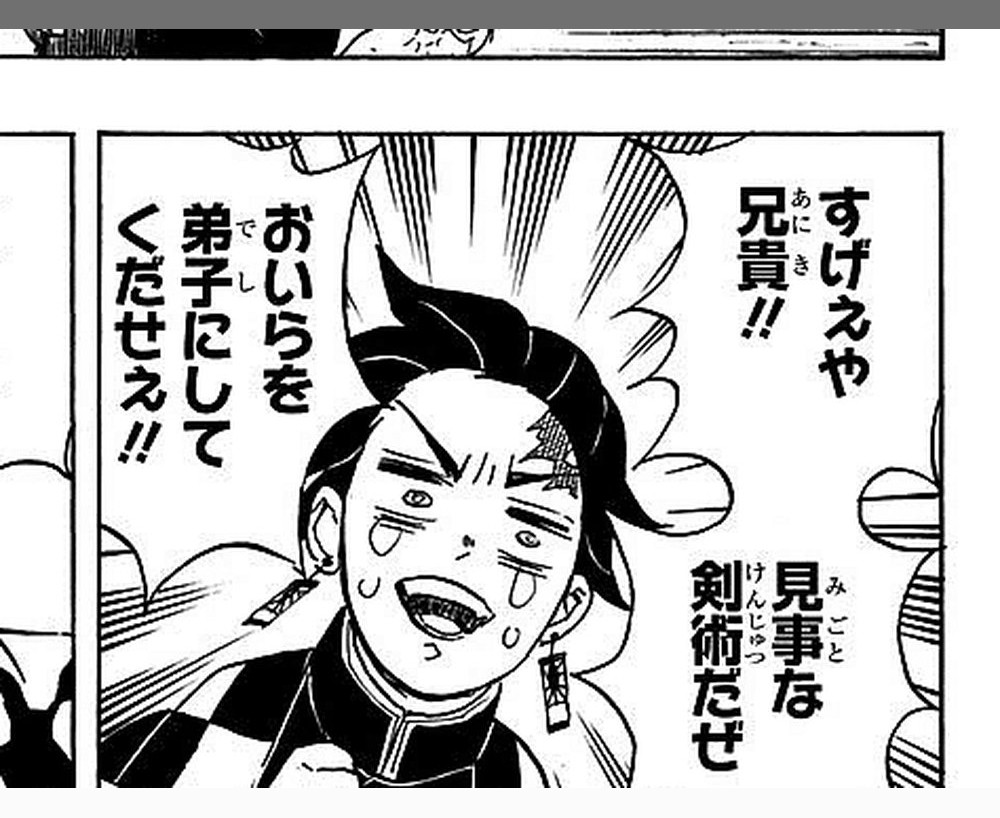
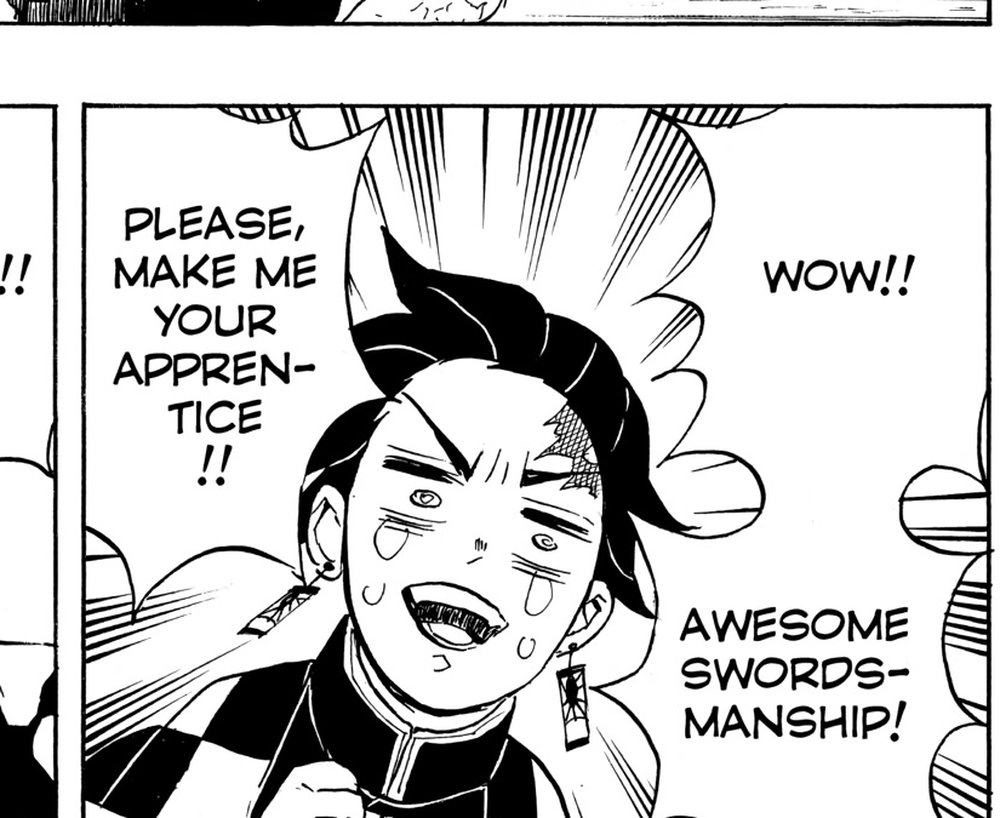
Volume 7. A train car, ordinary passengers dozing on the benches — until a swordsman named Rengoku strides down the aisle and, without breaking stride, kicks a stranger's bare foot off the seat with a single crack of sound (「ズギャッ」, sfx). The car startles. And an unnamed boy who watched the whole thing — checkered collar, scruffy hair, tears of pure hero-worship already welling up — gasps 「すげえや兄貴!!」("WOW!!"), 「見事な剣術だぜ」("AWESOME SWORDSMANSHIP!"), and then, fists balled at his chest:
「おいらを弟子にしてくだせぇ!!」
Oira o deshi ni shite kudasee!!
VIZ's English edition prints: "PLEASE, MAKE ME YOUR APPRENTICE!!" (Vol. 7, p.45).
Grant the rendering its due first: it's a clean, idiomatic plea, and the whole three-bubble run — "WOW!! AWESOME SWORDSMANSHIP! PLEASE, MAKE ME YOUR APPRENTICE!!" — captures the pitch of breathless fanboy enthusiasm perfectly. Rengoku answers in kind two panels over, promising to make him a fine swordsman, and the whole car erupts: a second boy pipes up with his own 「おいらも!!」 — "ME TOO!!" — and a third, drawn with a hawkish, beaked face, adds 「おいどんも!!」 — "AND ME!!" Three country kids, three separate first-person pronouns, one breathless chorus. Here's what the English can't keep: every one of those three pronouns is doing character work — おいら, おいら, おいどん — that "me," "me too," and "and me" simply cannot.
The Original
おいら (oira) carries no kanji — it's pure kana, and its shape is a fossilized contraction: 俺ら (ore-ra), "we," the plural of 俺 (ore) built with the group-marking suffix ら. Centuries of Edo shitamachi (downtown-commoner), sailor, and rural speech slurred おれら down to おいら, and — unusually among Japanese first-person pronouns — the word kept a foot in both camps. Older usage and dictionaries still register a plural sense, but in modern fiction おいら is almost always singular, "I," with the old plural sitting inside it like a grammatical echo: a lone kid's "I" that still faintly sounds like "one of us."
Grammatically, there is nothing exotic here. おいら takes を, も, の exactly like 僕 or 俺 — おいらを (as in our line), おいらも, おいらの — every particle behaves like clockwork. The entire charge of the word lives outside the grammar, in who picks it up: a rough-mannered boy, a sailor, a rural laborer, a comic-relief sidekick. Never a polished, city-bred speaker describing himself with dignity.
That makes おいら textbook 役割語 (yakuwarigo) — "role language," fiction's habit of assigning speech patterns to character types regardless of who actually talks that way in real life. It sits at the loose, casual, unpolished end of the first-person spectrum — the mirror image of the archaic dignity in 拙者 and 小生, this collection's other two entries in the same pronoun wardrobe. Where those pronouns lower the speaker on purpose, with visible formal effort, おいら doesn't perform humility at all; it just sounds like nobody ever taught the speaker to reach for anything fancier — which, for a starstruck kid on a train, is exactly the point.
The third boy sharpens that point further. 「おいどんも!!」 uses おいどん (oidon), おいら's more geographically specific cousin, historically tagged to Kyushu/Satsuma speech — the dialect period dramas reach for with figures like Saigō Takamori. So the panel isn't just "country-boy chorus"; it's two distinct flavors of rural "I" standing side by side, one generic and one regionally pinned, both instantly legible to a Japanese reader and both invisible once they cross into English.
VIZ's Choice
Every confirmed occurrence of おいら (the pronoun itself, not the unrelated word おいらん, "courtesan," which shares the same three kana) across the volumes on file:
| Vol. / p. | Japanese | VIZ English |
|---|---|---|
| 7 / 45 | おいらを弟子にしてくだせぇ!! | PLEASE, MAKE ME YOUR APPRENTICE!! |
| 7 / 45 | おいらも!! | ME TOO!! |
| 3 / 187 | おいら今日大根みたいな | ...LOOKED LIKE A RADISH! |
Only three occurrences on file, and the first two sit one panel apart — which is itself the finding. おいら isn't scattered across the story the way 因縁 is in One Piece; it clusters in exactly the kind of scene it was built for: a crowd of unnamed, enthusiastic country boys reacting to something impressive, plus (a few volumes earlier) a comedy strip where a single boy's guard drops. VIZ's renderings are all locally sound — "PLEASE, MAKE ME YOUR APPRENTICE!!," "ME TOO!!," and the two-bubble punchline "...LOOKED LIKE A RADISH!" — and every one reads as natural, funny English. None of them register that a specific, class-marked "I" was doing work in the Japanese.
Worth noting for completeness: the third boy's 「おいどんも!!」 ("AND ME!!") sits directly beside the second row of this table, sharing the panel and the joke, but it isn't おいら — it's the Kyushu-flavored cousin おいどん. It doesn't belong in a table of おいら occurrences, but leaving it out of the scene would miss the real finding: this panel isn't testing one rural pronoun, it's staging three, and English renders all three the same way.
The Gap
English pronouns are register-blind, full stop. "I" is spoken identically by a duke, a dockhand, and a cartoon dog; there is no everyday English first-person word that flags "this speaker is a rough, unschooled country kid" the way おいら does before the sentence even finishes. Whatever characterization the pronoun carries has to be rebuilt, if at all, from surrounding slang and spelling — the pronoun itself brings nothing on its own.
A chorus of distinct dialects becomes one uniform crowd. Three boys, three separate first-person forms — おいら, おいら, おいどん — collapse into "me," "me too," and "and me": three grammatically different English phrasings that all sound equally polished. The Japanese panel says "here are three flavors of unrefined country kid, and listen closely, they're not even saying it the same way"; the English panel says "here is an enthusiastic crowd" — true, but a whole register poorer, and blind to the fact that the third kid's dialect doesn't even match the first two.
Mid-scene register-switching disappears without a trace. A few volumes earlier, in one of the book's bonus comedy strips, an unnamed boy drawn in Tanjiro's signature checkered haori tells a doctor 「俺は四角四面な所があるのですがどうしたらいいでしょうか」 — "IN SOME WAYS I'M TOO SERIOUS. WHAT SHOULD I DO?" — composed, standard 俺, a formal complaint to a professional. Two panels later, confessing something far more embarrassing, the same boy drops to 「おいら今日大根みたいな」 — "...LOOKED LIKE A RADISH!" (the punchline of a joke about the shape of that day's toilet visit) — and the pronoun itself does the blushing. That dip, buttoned-up 俺 to babyish おいら, inside one four-panel gag, is invisible in English, where both moments are simply "I."
What If
No fix is free; here's the menu and what each option costs.
- "Ah, take me on too, mister!!" — the dropped-g cadence and "mister" read as unschooled, deferential country speech in English. Cost: "mister" imports an American backwoods flavor rather than the specific unpolished-Japanese-boy signal おいら carries — the wrong regionalism, just a regionalism.
- "Lemme be your disciple too!!" — "lemme" signals a speaker who talks fast and rough, cheaply and legibly. Cost: reads more streetwise-modern than rural-humble; the Edo-commoner warmth underneath おいら doesn't survive.
- "Make me yer student, will ya?!" — "yer" plus the tag question keeps the plea shape and roughens the diction. Cost: sounds closer to a work song than a starstruck kid's shout; the enthusiasm dims under the dialect spelling.
- Keep VIZ's clean line, but graduate the dialect spelling across the three boys — "PLEASE, MAKE ME YOUR APPRENTICE!!" / "ME TOO!!" / "AN' ME TOO, Y'HEAR!!" for おいどんも, instead of the uniform "AND ME!!" Cost: only pays off if the whole page commits to graded dialect spelling, which VIZ's house style generally avoids — one stylized line among two plain ones can read like an error rather than a choice.
Take-away
おいら is a small pronoun doing a large job: without adding a single new fact to a sentence, it tells a Japanese reader exactly what kind of kid is talking — rough, unschooled, probably rural, definitely not putting on airs. English's one general-purpose "I" can carry a great many things, but a class-and-region accent baked into the pronoun itself isn't one of them.
Three rules of thumb to carry off this page:
- A kana-only pronoun is often a register pronoun. 俺, 僕, 私 all write with kanji or are borrowed katakana-free defaults; おいら, おいどん, あたい, and their cousins tend to skip kanji entirely and skip formality just as completely.
- When a crowd speaks in one panel, listen for whether they're all saying "I" the same way. A scene can stage several first-person forms at once precisely to sound like several different people — one flattening English "me" per speaker erases that staging.
- A pronoun can flip mid-scene as a joke. Watch for a character's composed 俺 giving way to a childish おいら (or the reverse) inside a single conversation — that's characterization happening in real time, not inconsistency.
For this same story's other first-person role-language pronoun — a demon who talks like a failed Meiji novelist — see This Insignificant Self's Prey: 小生. For the Buddhist send-off snarled instead of prayed by a very different demon slayer, see Temple Word, Gutter Grammar: 往生しやがれ, and for the nose Tanjiro never actually claims credit for, see A Nose for Trouble He Never Claimed: 鼻が利く. おいら's martial-register opposite lives one work over: Naruto's ninja dog Pakkun growls 拙者, the archaic samurai's humble "I," out of the same yakuwarigo wardrobe pointed at the opposite end of the formality scale. Or browse the Demon Slayer translation notes index.
Every Japanese and English line quoted above is a byte-exact capture from the cited editions — 鬼滅の刃 Vol. 3 & Vol. 7 (Japanese) and Demon Slayer: Kimetsu no Yaiba Vol. 3 & Vol. 7 (VIZ Media) at the corresponding panels — via our bilingual page database; see Sources below.