The Moment
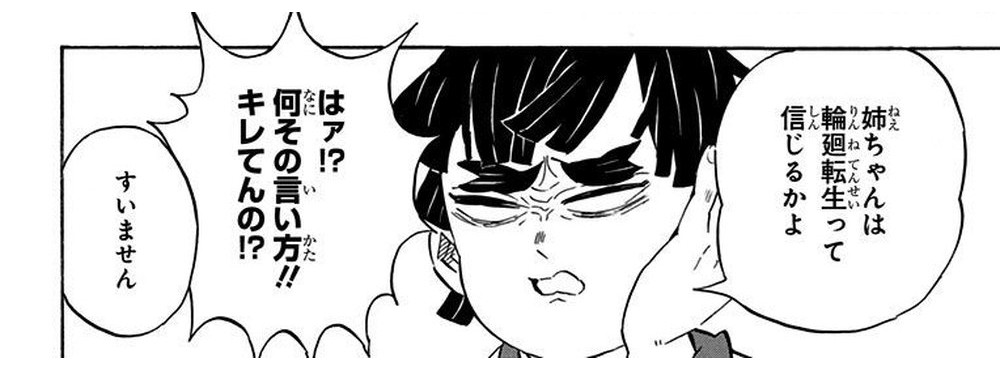
Volume 23's closing chapter jumps generations forward. A caption two pages earlier reads simply 現代・東京 — "MODERN-DAY TOKYO" — and the story that follows belongs to nobody who ever swung a blade. Toko Agatsuma (18) and her younger brother Yoshiteru (17) are ordinary high schoolers walking home, and the family resemblance to their famous ancestor Zenitsu Agatsuma shows up in exactly one sibling. Toko has just finished scolding Yoshiteru about his grades — captioned mid-lecture as 我妻燈子(18) — and a beat later he's grumbling about the whole family line: 「うちの家系はみんな大人しい女ばっかなのに」("THE OTHER WOMEN IN OUR FAMILY ARE SO QUIET AND POLITE...")「なんで姉ちゃんだけとっ突然変異したんだ...」("...BUT MY BIG SISTER IS SOMETHING ELSE ENTIRELY!")— Toko, apparently, is the family's one loud "mutation." Needling her further, he asks:
「姉ちゃんは輪廻転生って信じるかよ」
Nee-chan wa rinne tensei tte shinjiru ka yo
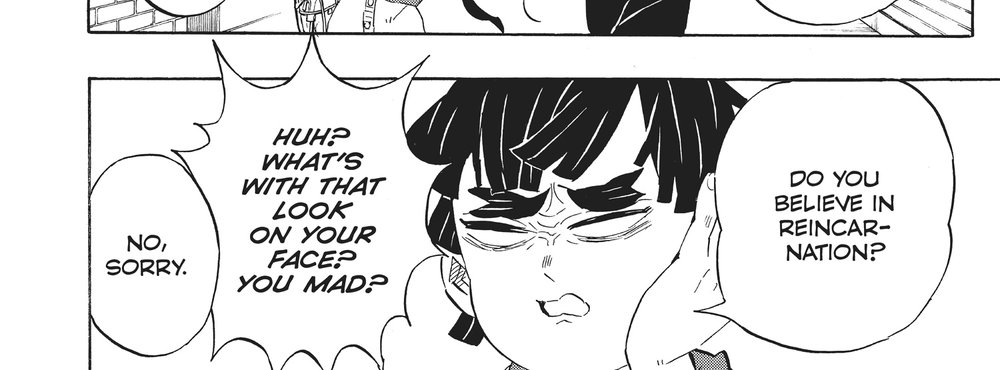
VIZ's English edition prints: "DO YOU BELIEVE IN REINCARNATION?" (Vol. 23, p.198).
Grant the rendering its due: "reincarnation" is the correct gloss, the line is clean, and it's exactly the kind of stray, quotable sentence that gets lifted out of a manga panel and shared without context. But look at what happens one beat later, still on the same page: Toko rounds on him — 「はァ!?何その言い方!!キレてんの!?」("HUH? WHAT'S WITH THAT LOOK ON YOUR FACE? YOU MAD?")— reacting not to the topic of reincarnation but to how he asked. VIZ's tidy, neutral question gives her nothing to be angry at. The Japanese line was never neutral to begin with.
The Original
輪廻転生 (rinne tensei) welds two Buddhist compounds into one. 輪廻 (rin'ne): 輪 "wheel" + 廻 "to circle, revolve" — Japanese Buddhism's word for saṃsāra, literally "wandering on," the wheel of existence that keeps turning from death to death. 転生 (tensei): 転 "to turn, change" + 生 "life, to be born" — literally "changing lives," the actual event of being reborn into the next one. Put together, the compound doesn't just label a fact ("reincarnation"); it names the whole mechanism — an unbroken cycle, driven by karma, that only enlightenment (解脱, gedatsu) can stop.
One printing quirk is worth pausing on. Dictionaries give 輪廻転生 as a fixed four-kanji compound read りんねてんしょう (rinne tenshō) — that older on'yomi for 生 shows up in other solemn Buddhist compounds. But this panel's own furigana spells it りんねてんせい (rinne tensei) — the reading a 21st-century teenager actually reaches for, the same てんせい in every 異世界転生 (isekai tensei, "reborn in another world") light novel on a convenience-store shelf. The letterer picked the casual reading over the textbook one, in a chapter about literal teenagers — and it's the right call for this scene's register.
The grammar carrying the word is plain colloquial: X-って信じる, "to believe in X," with って doing informally what と would do in writing. And 姉ちゃんは isn't just a topic marker sitting in front of a noun — in Japanese family speech, addressing someone by their kinship role (姉ちゃん, "onee-chan") is how you say "you" to them. English has no equivalent move; "sister, do you believe—" sounds like the start of a eulogy, not a jab between siblings walking home from school. Layer on 〜かよ, the masculine, needling question ending — "you actually...?", "seriously?" — and the whole sentence is aimed like a slingshot at one specific person, not lobbed out as a survey question.
VIZ's Choice
Only one clean hit for 輪廻 surfaces across the volumes on file, so there's no scatter table to draw here — just one translator's single decision, made twice at once. VIZ solved the doctrinal half of the sentence (輪廻転生 → "reincarnation," accurate) and dropped the two grammatical halves that made it personal: 姉ちゃんは (the addressee) and かよ (the dare). What's left reads like a line off a fortune-cookie slip — portable, quotable, universal — which is exactly why this is the kind of Demon Slayer panel that gets screenshotted on its own. But the manga didn't write a universal question. It wrote a needle aimed at Toko, in a scene where her reaction to being needled is the whole point of the next three panels.
The Gap
The addressee disappears. 姉ちゃんは names exactly who is being asked — his own sister, mid-walk, right next to him. "DO YOU BELIEVE IN REINCARNATION?" could be aimed at anyone, including the reader over the character's shoulder; it reads like a chapter epigraph, not a question inside a family.
The dare evaporates. かよ carries the same charge as "you actually...?" — it's what makes Toko snap 「はァ!?何その言い方!!キレてんの!?」 one line later. Ask a person a flat, neutral question, and "what's with that tone?!" makes no sense as a reply. VIZ's version leaves her anger looking unmotivated, when the Japanese planted its cause one clause earlier.
The register runs backward. The manga's own furigana chooses the casual reading of 転生 — the isekai-anime てんせい, not the sutra's てんしょう — keeping this exchange planted in teenage slang even while it names real doctrine. English's only word for the concept, "reincarnation," is a five-syllable Latinate noun with no equally casual understudy; the translation can't help but sound more formal than the Japanese, on top of losing the address and the dare.
What If
- "Hey, do YOU believe in reincarnation, big sister?" — restores the addressee and gestures at the challenge with "hey." Cost: "hey" is invented texture standing in for what かよ actually does grammatically.
- "You actually believe in that reincarnation stuff, sis?" — keeps the goading edge and the family address in a natural English register. Cost: "that reincarnation stuff" is bulkier than the four tight kanji it's translating.
- "Big sister actually believes in reincarnation?" — keeps 姉ちゃん as a third-person address term the way the Japanese does, spoken to her face. Cost: reads oddly in English, where talking about someone in the third person while looking at them isn't a standard move — though that mismatch is itself the whole point.
- "DO YOU BELIEVE IN REINCARNATION, SIS?" — the cheapest fix: keep VIZ's line, append the missing address. Cost: still flattens かよ's edge, but at least restores whose question this actually is.
Take-away
輪廻転生 is a heavy word riding light grammar, and here the grammar is doing more work than the noun. Three rules of thumb to carry off this page:
- Watch for kinship terms doing the job of "you." 姉ちゃん, 母さん, 兄貴 — when Japanese addresses someone by role instead of pronoun, translating the role away can turn a private conversation into a public announcement.
- かよ (and its cousins かい, だろ) are dares, not questions. If a translation reads neutral but the next line is an angry reaction, check whether a question-ending got smoothed out on the way.
- A word's furigana can outvote its dictionary entry. 輪廻転生's own page prints the pop-culture reading (てんせい) over the liturgical one (てんしょう) — the printed reading is the real one for that panel, dictionary be damned.
For the companion Buddhist send-off verb — the one that tells a spirit to leave rather than asking whether anyone believes it will — see 成仏してください and the epitaph that points the wrong way elsewhere on this site. For the karmic machinery that supposedly keeps the wheel turning in the first place, see One Piece's 因縁 and the karmic tie English splits five ways. Or browse the full Demon Slayer translation notes index.
Every Japanese and English line quoted above is a byte-exact capture from the cited editions — 鬼滅の刃 Vol. 23 (Japanese) and Demon Slayer: Kimetsu no Yaiba Vol. 23 (VIZ Media) at the corresponding panels — via our bilingual page database; see Sources below.