The Moment
Volume 7, deep in the Forest of Death — stage two of the Chūnin Selection Exams, the one where rookie teams hunt each other for scrolls and the finish line is a tower in the middle of a jungle that eats the careless. Team 7 has picked up an unlikely guide: Kabuto Yakushi, the silver-haired veteran who has failed this exam so many times he knows its ecology by heart. And for three straight pages he has been delivering a lecture with a thesis: the last stretch is the deadliest. Teams like theirs will already be lying in wait — 「塔付近には同じ穴のムジナがもう罠をはってるだろうな」, "...SO THERE ARE GOING TO BE A LOT OF DESPERATE CHARACTERS SETTING SNARES FOR THE UNWARY AROUND THAT TOWER." — and the ones who hunt at the tower door are, in his words, 「最悪の敵だよ……!」 — "...AND THE WORST!!"
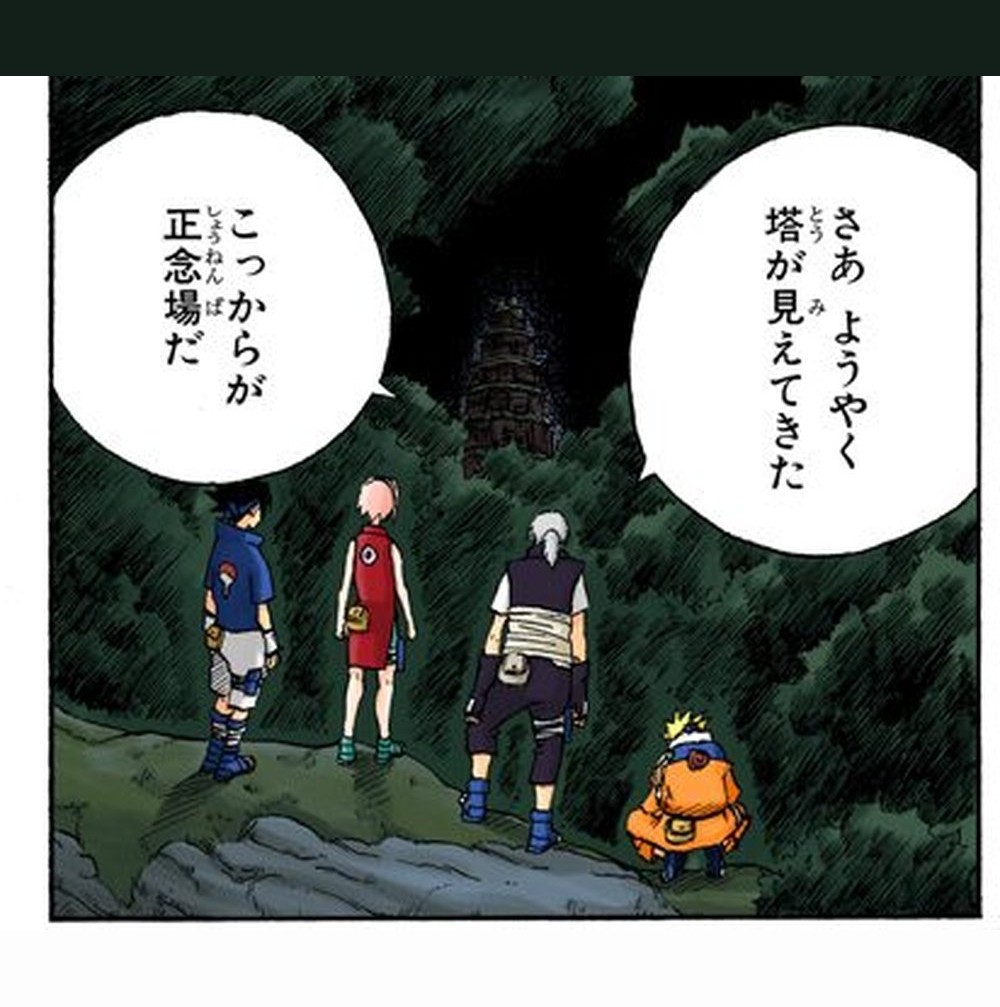
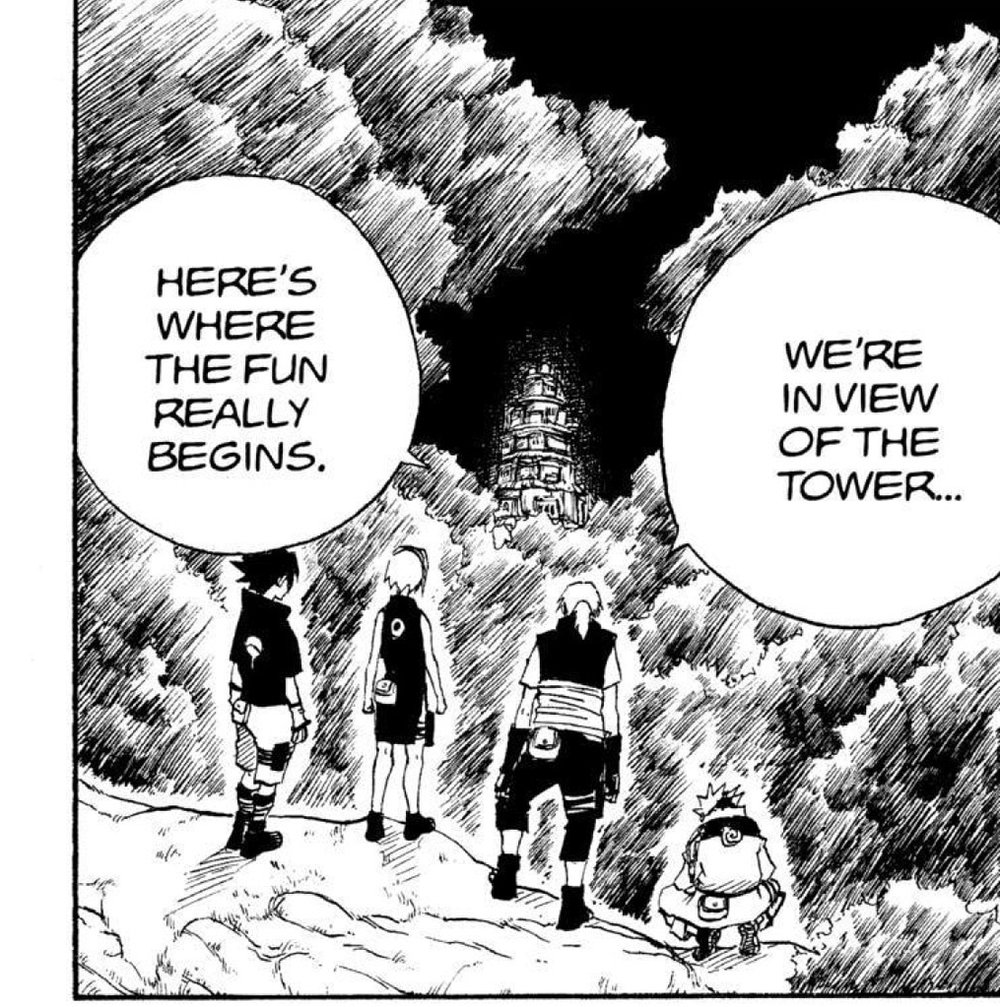
Then the trees open. The tower rises out of the canopy in the night rain. 「さあようやく塔が見えてきた」 — "WE'RE IN VIEW OF THE TOWER..." — and Kabuto caps the whole briefing with one short line:
「こっからが正念場だ」
Kokkara ga shōnenba da
VIZ's English edition prints: "HERE'S WHERE THE FUN REALLY BEGINS." (Vol. 7, p.139).
Grant the rendering its due. English really does mark danger with ironic "fun" — "this is where the fun begins" is a certified action-movie stock line, dry bravado before the shooting starts — and "HERE'S WHERE" faithfully keeps こっから's ground-underfoot deixis: the danger is a place, and they are standing at its edge. The line is punchy, it fits the bubble, and no reader trips over it.
But listen to what happens one bubble later. Naruto — who has understood none of the gravity and all of the excitement — whoops 「よっしゃあああ!!いくぜェェエ!!」, "THEN LET'S GET TO IT!!", and charges. Two panels after that: 「さっそく敵…!?」 — "AN ENEMY... SO SOON?!" — and a kunai is already in the air. The word Kabuto used was not a thrill. It was a warning, and the page vindicates it before it even ends.
The Original
Take 正念場 (shōnenba) apart — all three characters earn their place.
正 (shō) is "right, correct" — the 正 of 正しい.
念 (nen) is "mindfulness, fixed attention" — and the kanji is a small poem: 今 "now" sitting on top of 心 "heart-mind." The mind held on the present moment. You already own this character from 残念 ("regret" — attention left behind), 念のため ("just to be sure" — attention to spare), 念じる ("to concentrate a wish").
Together, 正念 is Buddhist technical vocabulary: samyak-smṛti, "right mindfulness," the seventh limb of the Eightfold Path (八正道). And in Pure Land practice there is a phrase that shows how high the stakes of the word can go: 臨終正念 (rinjū shōnen) — holding right mindfulness at the moment of death, the last and hardest test of a lifetime's practice.
Then the theater got hold of it. 場 (ba) is "place" — and in kabuki and jōruri, a scene. The 正念場 is the crucial scene: the one where the lead actor must summon everything and reveal the true core of the role — the 性根 (shōne), "the root of the character" — which is why the same theater word is also written 性根場 with those characters. Whichever spelling you start from, the meaning converges: the scene that cannot be faked. An actor can coast through an entrance or a crowd scene; the 正念場 is where the audience finds out what he actually is.
Modern Japanese kept the word and generalized the stage. NHK says a cabinet facing a no-confidence vote 正念場を迎える ("arrives at its shōnenba"); a team enters the final innings of a pennant race and the sports page declares the 正念場; a student's last winter before entrance exams is one long 正念場. The grammar of Kabuto's line could not be simpler — こっから is relaxed spoken contraction of ここから ("from here"), and だ is the plain copula a senior uses with kids — but the noun it delivers is weighty, faintly ceremonial, and dead serious. As vocabulary, 正念場 is commonly listed around JLPT N1; everything else in the sentence is N5.
VIZ's Choice
正念場 appears exactly once in the Naruto volumes we have on file, so there is no scatter to chart — instead, look at how one register choice reshapes the whole exchange:
| Speaker | Japanese | VIZ English |
|---|---|---|
| Kabuto | さあようやく塔が見えてきた | WE'RE IN VIEW OF THE TOWER... |
| Kabuto | こっからが正念場だ | HERE'S WHERE THE FUN REALLY BEGINS. |
| Naruto | よっしゃあああ!!いくぜェェエ!! | THEN LET'S GET TO IT!! |
In the Japanese, the page is built on a gap. Kabuto — measured, twice-failed, the one who just spent three pages cataloguing how teams die within sight of the goal — names the coming stretch with the gravest "now it counts" word the language owns. And Naruto, who hears only adventure, erupts with stretched vowels and double exclamation marks. The comedy — and the characterization — live in the distance between those two registers: the wary professional and the oblivious rookie.
VIZ's choice closes the distance. "HERE'S WHERE THE FUN REALLY BEGINS." hands Kabuto the same eager register Naruto is about to use, so "THEN LET'S GET TO IT!!" arrives as agreement instead of comic obliviousness. Two different temperatures become one. The translator was not napping — ironic "fun" is a genuine English idiom for approaching danger, and it keeps the line cool. But it is bravado where the Japanese is vigilance, and it costs the scene its second voice.
The Gap
The gravity inverts into a grin. 正念場 is a summons: gather yourself; this stretch decides. "THE FUN REALLY BEGINS" relishes the same danger it should be warning about. English's ironic "fun" keeps the information — danger ahead — but replaces the solemnity with a smirk, and a careful senior's caution becomes an action hero's quip.
The test of worth disappears. A 正念場 is, by construction, the scene where what you really are gets shown — the actor's core, the practitioner's mindfulness at the brink, the rookie team's true strength at the tower door. That is precisely the right word for an exam arc, and the Japanese reader hears it. "Fun" tests nothing and reveals nothing; the stakes shrink from what are we made of? to here comes the action.
The staged contrast collapses. The Japanese page plays grave warning against reckless enthusiasm — こっからが正念場だ against よっしゃあああ!!いくぜェェエ!! — and lets the reader feel who understands the forest and who doesn't. Once the warning itself is "fun," Naruto's whoop confirms instead of contrasts, and the panel's quiet joke — the one that pays off two panels later when the first kunai flies — goes missing in English.
What If
No rendering is free; here is the menu and its prices.
- "THIS IS WHERE THE REAL TEST BEGINS." — keeps VIZ's sentence shape and restores the test-of-worth at the word's core; doubly apt in the middle of an exam. Cost: almost too on-the-nose inside the Chūnin Exams, and the theatrical grandeur thins out.
- "FROM HERE ON, IT'S THE MOMENT OF TRUTH." — English's nearest idiom, and a telling cousin: it entered English from the bullring, another ritual arena where everything converges on one decisive act. Cost: a "moment" is a point in time, while 正念場 is a stretch of ground still to be crossed — and the phrase runs formal against こっから's casual snap.
- "THIS IS WHERE IT GETS SERIOUS." — natural bubble English that keeps the register shift from stroll to crisis, and keeps the warning a warning. Cost: generic; the mindfulness and the show-what-you're-made-of nuance both evaporate.
- "EVERYTHING WE'VE GOT, FROM HERE ON." — translates the summons to total concentration rather than the danger. Cost: freer than the original, and it says out loud what the Japanese keeps folded inside a single noun.
Notice the shared problem: English can render the danger (fun, serious, hairy) or the decisiveness (moment of truth, do-or-die) — but the third ingredient, the composed, gathered mind that 正念 demands, has no idiomatic seat in English at all. Mindfulness became a household English word only recently, and it moved in wearing yoga clothes, not armor.
Take-away
正念場 is what happens when a language builds its crisis vocabulary out of theology and theater: a sutra's word for right mindfulness, staged as the scene an actor cannot fake, applied to any stretch of life where your real worth is about to show. VIZ's "HERE'S WHERE THE FUN REALLY BEGINS." gets the danger across and loses everything else — the summons, the test, and the gap between the one man on the page who understands the forest and the boy who doesn't.
Three rules of thumb to carry off this page:
- When you meet 正念場, translate the vigilance, not just the excitement. The word is a warning to gather yourself — if your English draft could be delivered with a grin and a cracked knuckle, it has changed speakers.
- Collect Japanese's crisis-as-a-place trio. 修羅場 (the asura's battlefield), 土壇場 (the execution mound), 正念場 (the scene of right mindfulness): three ordeals, three kinds of ground underfoot. English personifies crisis as an enemy to face; Japanese gives you terrain to stand on.
- Watch the 念 family. 今 over 心 — the mind on the now — powers 残念, 念のため, 念じる, 無念, and the Buddhist 正念. Whenever it surfaces, some quality of attention is in play, and it is usually the first thing translation drops.
For the first stop on that terrain — the asura's battlefield 修羅場, and the veteran's boast VIZ flipped into present-tense panic — read our sister piece on shuraba, or browse the Naruto translation notes index.
Every Japanese and English line quoted above is a byte-exact capture from the cited editions — NARUTO―ナルト― Vol. 7 (Japanese) and Naruto (VIZ Media) at the corresponding panels — via our bilingual page database; see Sources below.