The Moment
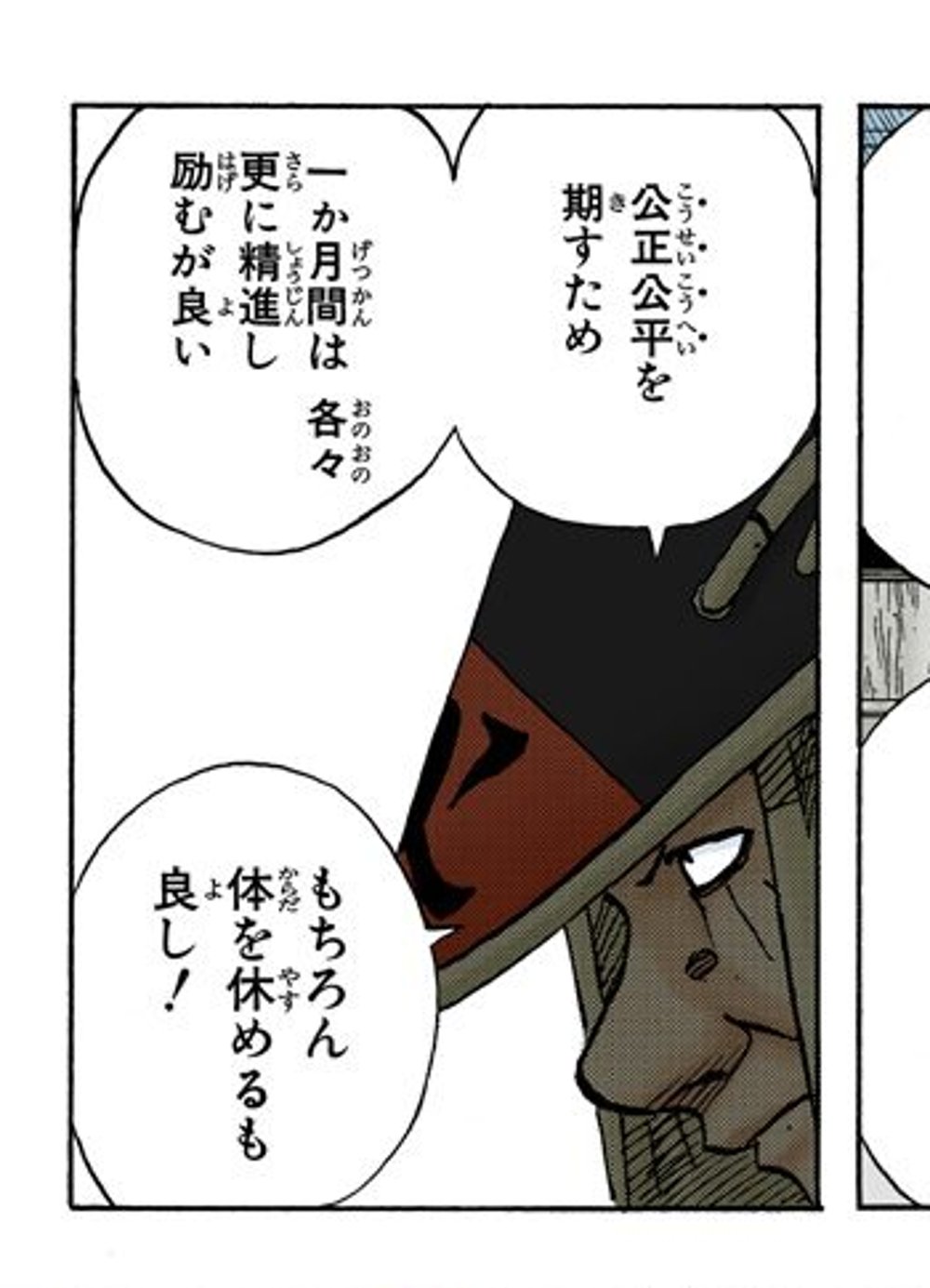
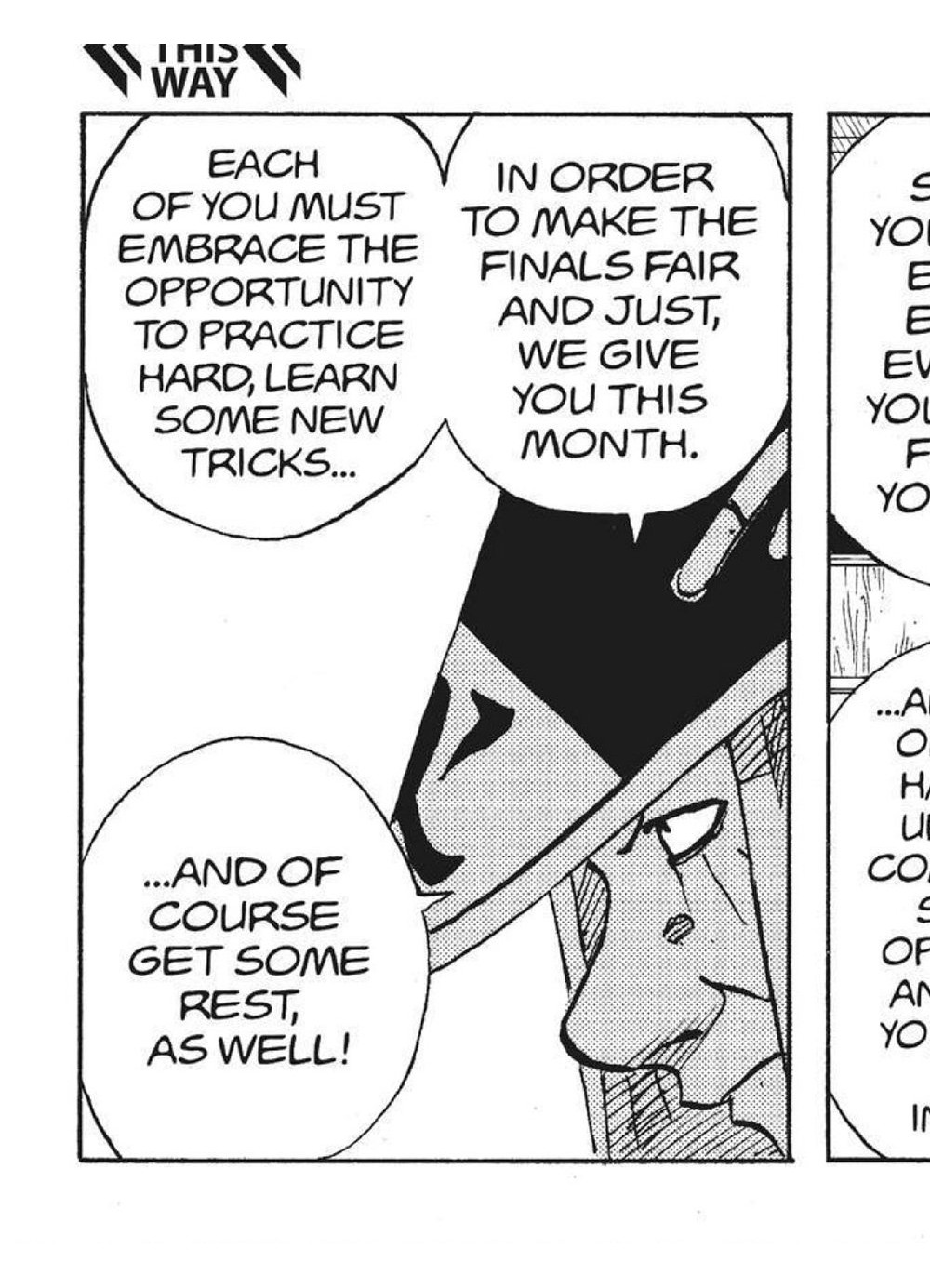
Volume 10. The Forest of Death has just finished eating a third of the Chunin Exam field, and the survivors — bruised, bandaged, still catching their breath — are gathered before the man everyone in the village calls 儂 in his own mouth and "jiji" behind his back: the Third Hokage. He has spent the previous page explaining, in the roundabout way that makes Kiba grumble 「このジジイいっつも遠回しに言いやがって」 ("THIS OLD GEEZER, HE ALWAYS BEATS AROUND THE BUSH..."), why the finals need a full month's delay — fairness, preparation, a chance to study the enemies they've just seen fight. Then he lays out what that month is actually for:
「公正公平を期すため一か月間は各々更に精進し励むが良い」
Kōsei kōhei o kisuru tame, ikkagetsukan wa onoono sarani shōjin shi hagemu ga yoi.
VIZ's English edition prints: "IN ORDER TO MAKE THE FINALS FAIR AND JUST, WE GIVE YOU THIS MONTH. EACH OF YOU MUST EMBRACE THE OPPORTUNITY TO PRACTICE HARD, LEARN SOME NEW TRICKS..." (Vol. 10, p.133), followed a beat later by "...AND OF COURSE GET SOME REST, AS WELL!"
Grant the rendering its due, and grant it generously. "EMBRACE THE OPPORTUNITY" is a genuinely well-chosen phrase — warmer and more active than a flat "practice hard," and it happens to land closer to shōjin's devotional flavor than the translator likely intended. "LEARN SOME NEW TRICKS" catches 励む's forward energy. As a public address from an old man granting his exam-worn shinobi a month of legitimate rest-and-training, the English reads exactly as gracious as the occasion calls for.
And two panels later, the payoff: Naruto, hand raised in a fist, refuses the very rest the Hokage just offered — 「1か月...休んでる場合じゃないってばよマジでラジで!」, "JUST ONE MONTH... THERE'S NO WAY I'LL HAVE THE LUXURY OF ANY RELAXATION!" The Hokage said 精進 and rest. Naruto hears only the first half.
The Original
Take 精進 (shōjin) apart, because both halves point somewhere specific.
精 (sei/shō) means "refined essence; purity; to polish." You already own it from 精米 (seimai, rice polished free of bran), 精神 (seishin, spirit or mind — the refined part of a person), and 精巧 (seikō, exquisite craftsmanship). It is a character about removing what doesn't belong.
進 (shin/jin) means "to advance, to progress" — the 進 of 前進 (zenshin, "advance") and 進化 (shinka, "evolution").
Put together, 精進 is closer to "to advance while polishing oneself" than to plain "try hard." It is the standard Japanese translation of the Sanskrit vīrya — "energy, diligence" — the fourth of the 六波羅蜜 (roku-haramitsu), the six pāramitā or "perfections" a bodhisattva cultivates on the road to enlightenment:
- 布施 (fuse) — dāna, generosity
- 持戒 (jikai) — śīla, moral discipline
- 忍辱 (ninniku) — kṣānti, patience
- 精進 (shōjin) — vīrya, diligent effort
- 禅定 (zenjō) — dhyāna, meditative concentration
- 智慧 (chie) — prajñā, wisdom
The same character also survives in 正精進 (shō-shōjin), "right effort," the sixth limb of the Eightfold Path — one step before 正念 (shōnen), "right mindfulness," the seventh limb this hub has already covered in the scene where Kabuto tells Team 7 they've reached their 正念場. The two words are neighbors on the same doctrinal ladder: 正念 is the composed attention you hold once you arrive; 正精進 is the sustained effort that gets you there.
The grammar carrying all this theology is almost aggressively plain: 各々 ("each of you") + 更に ("further, more") + 精進し励む ("apply yourself in shōjin and strive") + が良い — a dignified permission-injunction, "it would be good if you were to…," softer and more magnanimous than a bare command. A Hokage addressing a crowd of exhausted genin reaches for exactly this register: not しろ ("do it"), but you would do well to.
VIZ's Choice
精進 surfaces twice in the volumes we have on file — once as public ceremony, once as a private, remembered scolding. Side by side:
| Vol. / p. | Speaker & scene | Japanese | VIZ English |
|---|---|---|---|
| 10 / 133 | The Third Hokage, addressing the Chunin Exam finalists | 一か月間は各々更に精進し励むが良い | EACH OF YOU MUST EMBRACE THE OPPORTUNITY TO PRACTICE HARD, LEARN SOME NEW TRICKS... |
| 38 / 61 | Asuma, remembered by Shikamaru at Asuma's own grave | 精進しろよ! | YOU NEED TO WORK HARDER! |
The second occurrence needs its own scene-setting. In Volume 38, long after Asuma's death, Shikamaru sits across a shogi board from his father, extending a lesson Asuma once taught him: if Konoha's shinobi were shogi pieces, Shikamaru is the knight (桂馬) — nimble, expendable, built to sacrifice. His father asks who, then, is the king (玉) worth protecting. Shikamaru answers: 「それが〝玉〟さ...これからの子供達 木ノ葉をになう」, "THEY'RE THE BLACK KING... THE CHILDREN WHO WILL CARRY KONOHA ON THEIR SHOULDERS." His father checkmates him a moment later, impressed — 「よく分かってるじゃねーか」, "you do get it, don't you." And over an image of Asuma's own memorial stone — his name-kanji 猿飛 visible on the marker, his lighter left as an offering beside it — the panel gives us the words Shikamaru is really hearing in that moment, the ones that taught him the lesson in the first place: 「てめーが玉を守るにはまだまだ力が足りねーな!精進しろよ!」, "YOU'RE NOT YET STRONG ENOUGH TO PROTECT THE BLACK KING! YOU NEED TO WORK HARDER!"
Two appearances, two registers as far apart as Japanese grammar allows — Sarutobi's ceremonial が良い versus Asuma's bare しろよ — and VIZ actually preserves some of that gap: "EMBRACE THE OPPORTUNITY" is gracious where "YOU NEED TO" is blunt. What neither line preserves is the word underneath both deliveries. Ceremony or scolding, public decree or graveside memory, 精進 comes out the same way: a coach's vocabulary, with the six perfections nowhere in the room.
The Gap
Effort loses its vector. 精進 names effort aimed at something — purification, the wearing-away of what doesn't belong — not effort measured only in quantity. "PRACTICE HARD" and "WORK HARDER" both answer how much; neither answers toward what. The Hokage is not just telling genin to grind; he is using the vocabulary of ascetic discipline to describe a training month, and that vocabulary choice is itself part of his authority — the same word a monk or a craftsman would use about a lifetime's practice, aimed for one month at shuriken and jutsu.
The other rooms disappear. 精進料理 (temple food) and 精進潔斎 (ritual purification) show that shōjin governs diet and conduct as much as willpower — a whole regime of the body, not a training montage. A Japanese reader who has ever eaten at a temple, or heard a public figure's apology speech promise 今後精進してまいります ("I will endeavor to do better"), carries a faint echo of incense and bland tofu into this panel. "Practice" opens onto a gym. It never opens onto a kitchen.
Two speech acts collapse toward one tone. Sarutobi's が良い is permission graciously granted; Asuma's しろよ is a command with no cushion at all — as different in Japanese as a decree from a bark. VIZ's two lines keep a little of that gap ("embrace the opportunity" is warmer than "you need to") but both still read as stock English encouragement, generically upbeat and generically stern. The distance between a village leader's public magnanimity and a dead sensei's remembered impatience narrows more than the Japanese allows.
What If
The menu and its prices, for the Hokage's line:
- "Each of you would do well to devote yourselves further to your training." — keeps が良い's gentle permission-injunction, and "devote yourselves" gestures at shōjin's directed effort. Cost: wordier than VIZ's brisk line, and the purification sense stays implicit at best.
- "Use this month to refine your skills — spare nothing." — leans on 精's "polish" root rather than the Buddhist frame. Cost: "refine" reads craftsman-like, not devotional; the six perfections stay invisible either way.
- For Asuma's line: "You call that discipline? Sharpen yourself!" — keeps the bare imperative's force while nodding at cultivation over raw strength. Cost: "sharpen" risks landing literal — a blade, not a self.
- Keep "WORK HARDER!", restore the aim: "You've still got polishing to do before you can guard that king!" — Cost: cute wordplay on 精 that risks sounding twee at a graveside memory, where the Japanese is plain and blunt.
Every option pays the same tax: English can buy intensity (hard, harder) or it can buy direction (polish, refine, purify) — but not both at once, because English never built a single verb that does what a bodhisattva's fourth perfection does in one syllable-pair.
Take-away
精進 is what happens when a technical term for one rung of enlightenment — vīrya, the fourth of six perfections — spends a thousand years in daily use and comes out the other side sounding like a coach's pep talk, while still quietly meaning "clear something away, not just push harder." A Hokage's public grace and a dead sensei's private bark both reach for the same word; English answers both with generic encouragement, and the perfections go unmentioned twice.
Three rules of thumb to carry off this page:
- Ask what the effort is for, not just how much of it there is. 精進 is a vector — purification, refinement — where "work hard" is only a magnitude.
- Collect 精's polishing family. 精米, 精神, 精巧, 精進 — whenever this radical shows up, something is being refined, not merely exerted.
- When a word appears twice in wildly different registers and lands the same way both times in English, that's the tell. The gap between ceremony and scolding survived in Japanese; check whether your translation let it survive too.
精進's neighbor on the Eightfold Path, 正念 — the "right mindfulness" VIZ turned into simple "fun" — gets its own treatment in our piece on Kabuto's 正念場. For the Buddhist battlefield hiding inside a schoolboy's boast, see our piece on 修羅場, and for the four-character verdict that ends an argument before it starts, our piece on 問答無用 — or browse the full Naruto translation notes index.
Every Japanese and English line quoted above is a byte-exact capture from the cited editions — NARUTO―ナルト― Vol. 10 & Vol. 38 (Japanese) and Naruto (VIZ Media) at the corresponding panels — via our bilingual page database; see Sources below.