The Moment
Four hundred years before the Straw Hats ever anchor here, the island of Jaya belongs to a village that worships a snake. The explorer Mont Blanc Noland — leading a fleet from the North Blue kingdom of Lvneel in search of a fabled city of gold — has just done the one thing the village cannot forgive: he has killed their living god by accident. A villager's voice rises out of the storm:
「神を殺しやがったァ???」
Kami o koroshiyagatta ā???
VIZ: "HE KILLED A GOD!!" (Vol. 31, p.49.) The village's answer is immediate and ritual — 「血を流せ!!!祭壇で血を流せー!!!」, "SHED BLOOD!! SHED BLOOD ON THE ALTAR!!" — an appeasement offering aimed at a god they believe they have just enraged.
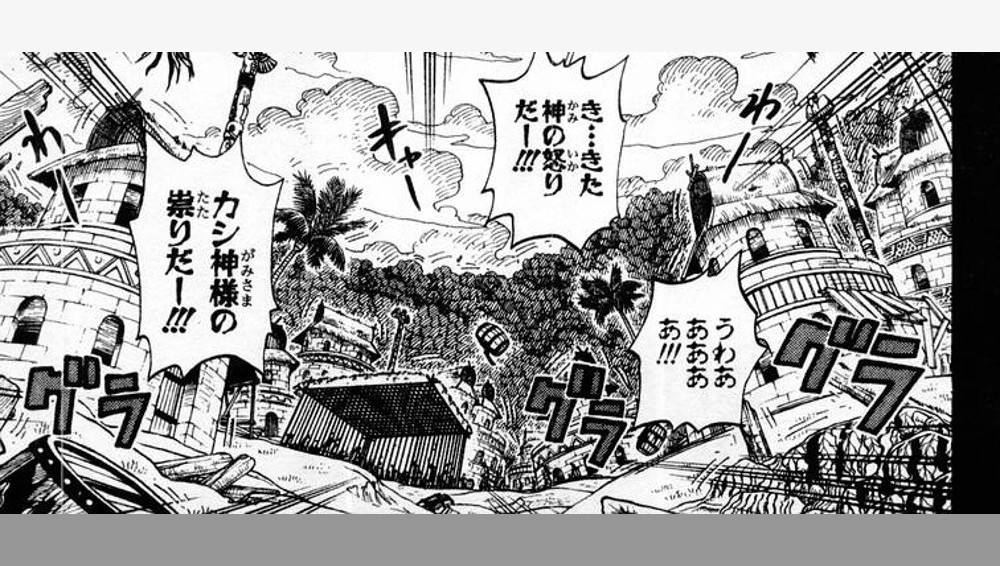
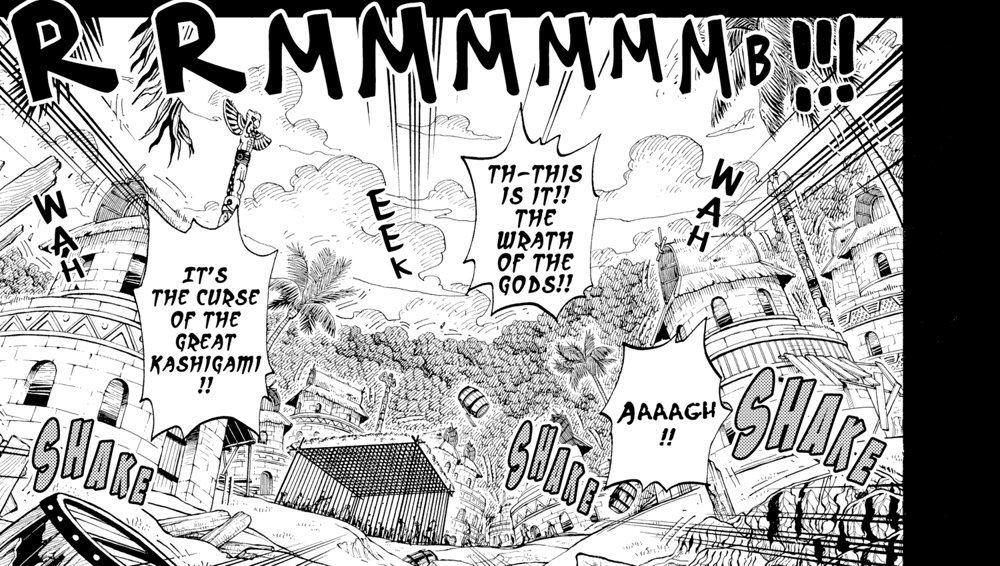
Some time later, at dawn, while Noland's own exhausted crew sleeps through the aftermath, the ground moves. Not a tremor — an earthquake big enough to crack towers and swallow streets. Villagers scatter through the wreckage, and two of their voices land in the very same panel, a beat apart. One reaches for the plain, universal phrase:
「き...きた神の怒りだー!!!」
Ki… kita kami no ikari dā!!!
"TH-THIS IS IT!! THE WRATH OF THE GODS!!"
The other reaches for the specific, doctrinal word — the one this article is about:
「カシ神様の祟りだー!!」
Kashigami-sama no tatari dā!!
VIZ's English edition prints: "IT'S THE CURSE OF THE GREAT KASHIGAMI!!" (Vol. 31, p.62.)
Grant the rendering its due first: "curse" is not a wrong word to reach for, and "IT'S THE CURSE OF THE GREAT KASHIGAMI!!" is exactly as urgent, exactly as capitalized and exclamation-pointed, as the panicked Japanese beside it. The problem isn't the energy. It's that nine pages earlier, this very chapter opened with its own title page reading 「祟り」 — rendered by VIZ, on its own contents page, as "CURSE." English has now used its one curse-word twice in one chapter for a concept this hub's companion article already spent an entire piece proving means something else.
The Original
祟り (tatari) is the noun form of the verb 祟る (tataru), "for a kami or spirit to inflict affliction." Take the kanji apart, because the radicals are doing real theological work:
祟 is built from 出 (deru, "to emerge, to come forth") stacked over 示 — the altar/spirit radical that also sits inside 神 (kami, "god"), 社 (yashiro, "shrine"), 祭 (matsuri, "festival"), and 祝 (iwau, "to bless"). Kanji dictionaries gloss the combination directly: a god (示) manifesting (出) to cause calamity. There is no mouth anywhere in this character, no one speaking a spell — only something supernatural coming forth on its own.
Compare that, radical for radical, to 呪 in this hub's companion word 呪い (noroi, "a laid curse"): 呪 is 口 (kuchi, "mouth") over an old pictograph of a kneeling reciter — cursing as something a person says. The two kanji are practically diagrams of the distinction: 呪 puts a mouth in the middle of the word; 祟 puts an altar.
The grammar follows the kanji. 祟る almost never takes a human subject — its subject is the kami, the spirit, or occasionally a place. A person can be 祟られる (tatarareru, "afflicted by tatari"), passive, on the receiving end, but Japanese has no ordinary way to say a person 祟る's someone the way they can 呪う someone. Malice, in this word, only ever flows downward from the offended party; it is never something a human being picks up and aims.
The line itself layers a proper noun onto that grammar: カシ神様 (Kashi-gami-sama) is 神様 (kami-sama, "the honorable god") with a name, Kashi, attached — and note that the villagers keep the honorific さま even while blaming the god for the earthquake tearing their island apart. の祟りだ is the bluntest possible diagnosis: "[deity]'s tatari, this is" — no verb of causing, no admission of what provoked it, just the noun stated as a fact already in progress. Neither 祟り nor its verb 祟る appears on the core JLPT vocabulary lists, but both sit comfortably in N1-adjacent territory — common wherever Japanese fiction, horror, or festival custom needs a word for a consequence nobody invited.
VIZ's Choice
祟り appears twice in the pages we have on file for this arc — once as the chapter's own title, once inside the earthquake scene it names:
| Vol. / p. | Japanese | VIZ English |
|---|---|---|
| 31 / 48 (chapter title) | 〝祟り〟 | CURSE |
| 31 / 62 | カシ神様の祟りだー!! | IT'S THE CURSE OF THE GREAT KASHIGAMI!! |
Two for two, "curse" — a small, internally consistent convergence, the same pattern this hub's companion article found for 呪い, which rendered "curse(d)" in six straight appearances across Volumes 11 and 31. Put the two findings side by side and the real story appears: within a single tankōbon, VIZ's English text uses the word "curse" for at least eight separate Japanese lines built from two different kanji, two different grammatical subjects, and two incompatible theologies. Chapter 279's cursed sword, forged by a smith three generations deep in inherited malice, and Chapter 288's earthquake, a snake-god's unplanned reflex to being killed by an accidental intruder, share nothing except the English noun now sitting on top of both. A reader working only from the English text has no way to notice that One Piece just told two completely different kinds of ghost story back to back — because the word never changed.
The Gap
"Curse" imports exactly the caster that 祟り exists to exclude. English "curse" — verb or noun — defaults to an agent performing an act: someone recites a hex, signs a pact, points a finger. 祟る's grammatical subject is the kami itself, and the kami does not cast anything; the affliction functions closer to a natural law than an act of will, the automatic price of an offense already committed. "IT'S THE CURSE OF THE GREAT KASHIGAMI!!" quietly re-installs a caster — as though Kashigami sat down and worked a hex — where the Japanese diagnosis is closer to "the god's wrath has arrived," no incantation required, nothing but a broken taboo and its consequence.
It collides head-on with this hub's own findings on 呪い. The companion article on Zoro's cursed blade tracked 呪い/呪われる rendering as "curse(d)" six times out of six in the volumes on file — real convergence, because "curse" genuinely is 呪い's best available English cognate. 祟り now claims the identical word, in the identical volume, and this chapter's own title page reads 「祟り」, rendered "CURSE" on VIZ's contents page nine pages before this very panel. A reader who has just finished a chapter about Zoro's cursed sword and opens Chapter 288 meets "curse" again — with no way to know that Zoro's sword and Kashigami's earthquake are theological opposites: one a hex a person may have laid, the other a god's uninvited reflex.
The register of blame flattens. カシ神様の祟りだ still carries さま, the honorific, even mid-panic — the villagers are afraid of their own god, not accusing an outside enemy the way "curse" implies. "Curse" reads as an attack arriving from outside; 祟り is closer to a household argument that turned violent — the affliction comes from the very deity the villagers otherwise worship, honor, and are, in this exact scene, trying to appease with blood on the altar.
What If
For the villager's line, the menu and its prices:
- "IT'S THE GREAT KASHIGAMI'S WRATH!!" — drops "curse" entirely, so it no longer collides with 呪い's word, and "wrath" keeps the sense of an angry, reactive deity. Cost: "wrath" alone loses 祟り's specific doctrinal weight — it could describe any angry god, cursing or not, where 祟り names a distinct theological category.
- "THE GREAT KASHIGAMI IS PUNISHING US!!" — spells out the offense-then-automatic-penalty logic that 祟り compresses into one noun. Cost: turns a one-word diagnosis into a full clause, losing the clipped, panicked cadence of the original scream.
- "IT'S THE GREAT KASHIGAMI'S VENGEANCE!!" — "vengeance" signals a wronged party striking back, which fits a village that just killed its own god. Cost: "vengeance" implies a deliberate decision to retaliate, while 祟り is closer to automatic consequence than a choice the kami makes.
- Keep "curse," flag the chapter title: since Chapter 288 is itself named 「祟り」 and VIZ renders that title "CURSE" too, an editor could note the distinction once, at the chapter head, rather than chasing it panel by panel. Cost: pushes the real fix into apparatus outside the story rather than into the translation itself.
Take-away
祟り is the mirror case to 呪い: where that article found one word translating perfectly and still losing something, this one finds a word translating identically to a different word — and losing the boundary between them. "Curse" is a container built for deliberate magic; 祟り describes magic nobody performed, only provoked.
Three rules of thumb to carry off this page:
- When you meet 祟り, ask who broke the rule, not who cast the spell. The affliction is retribution, not sorcery — a consequence following an offense, automatically, the way a bruise follows a fall.
- Watch 祟る's subject. If a god, a spirit, or a place is doing the afflicting, you're in 祟り territory; if a person is doing the cursing, you're back in 呪い's. The grammar itself keeps the two apart even when the English translation doesn't.
- Don't let "curse" swallow both halves of Japanese folk religion. 呪い is malice a person chooses; 祟り is consequence a kami didn't have to choose. English's one word can carry either meaning — just never both at once, and never in the same sentence.
For the sibling word this article keeps circling back to — the deliberately laid hex behind a different pirate's cursed sword, and the six-for-six convergence on "curse" that set up this whole collision — see 呪い and the curse word English already owned, or browse the One Piece translation notes index.
Every Japanese and English line quoted above is a byte-exact capture from the cited editions — ONE PIECE Vol. 31 (Japanese) and One Piece (VIZ Media) at the corresponding panels — via our bilingual page database; see Sources below.