The Watch
Welcome to the second issue of VIZ Translation Watch — jpn.fan's recurring, data-driven look at how the official English edition of Demon Slayer handles the lines Japanese and English can't say the same way.
Here's the method, in full, because the method is the point. We hold a bilingual page database of every VIZ-published Demon Slayer volume on file — Volumes 1 through 23 — each panel pair scored for translation risk across axes like semantic shift, register loss, and wordplay. For this issue we pulled the highest-scoring pairs not already covered by an existing article on this hub, added our own hand-picked candidates built off famous lines and known set phrases, and shortlisted about a dozen promising angles.
Then we did the part a scoring model can't do: for every candidate, we opened the actual printed pages — Japanese and English both — and checked that the two lines really are the same panel, the same speaker, the same moment. Demon Slayer's corpus adds its own extra trap on top of the usual alignment noise: VIZ's English pagination runs a page ahead of the Japanese original in stretches of Volumes 5, 18, 19, 20, and 22, so a pair the database labels "page 34" can genuinely be printed on English page 35 instead. We hit this directly: a striking-looking Volume 18 occurrence of Akaza's signature phrase 至高の領域 turned out, once we opened the real English page at the corrected offset, to carry different wording than the database recorded for it at all — not just a page off, but a rendering we couldn't confidently reconcile with the corpus text against the printed page. We're not printing that one. It's flagged here instead of quietly folded into the count below.
Of roughly a dozen candidate expressions we chased this issue — Muzan's keigo threats to his subordinates, Douma's excessive courtesy, "-desu/-masu" breakdowns, 呼吸 breathing-style terminology, several more — most either weren't locatable verbatim on the page (a phrase like 教育的指導, "educational guidance," famous from Muzan's Upper Rank meeting in fan discussion, never turned up as printed dialogue anywhere in our corpus), were already covered by an earlier article on this hub (頂戴, 参る, and 申す・申し上げる each have their own piece here already), or turned out to be VIZ holding a term so consistently there was no real gap to report (全集中の呼吸, "Total Concentration Breathing," never wavers across 23 volumes). Five held up. Here they are.
Find One — 生殺与奪の権 becomes a fighting tip
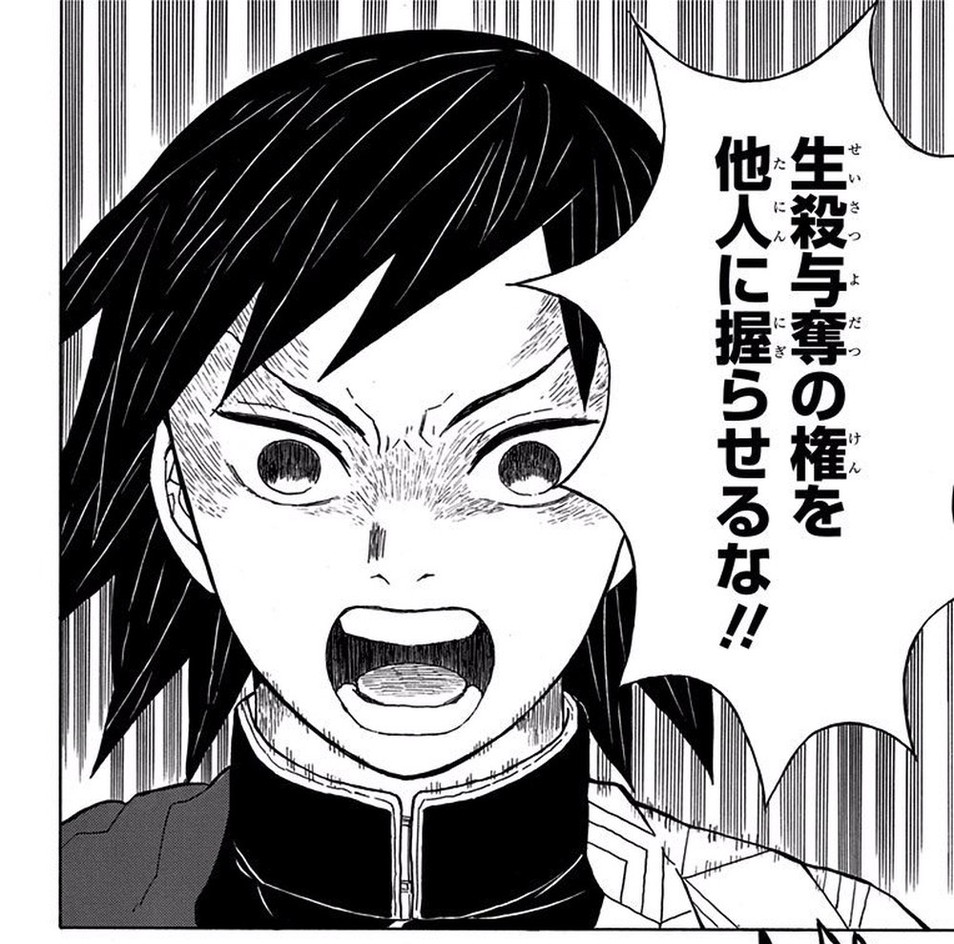
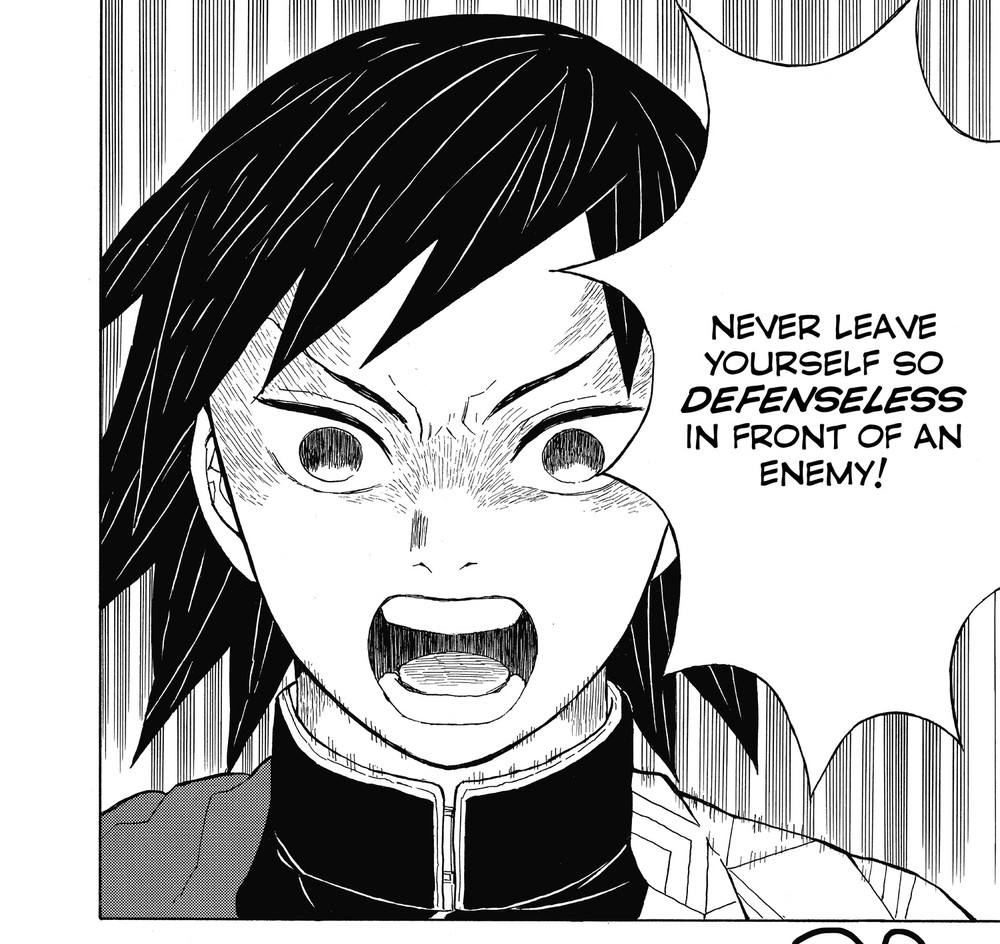
Chapter 1. Tanjiro has just found his family slaughtered and his sister Nezuko turned into a demon. Giyu Tomioka, a Demon Slayer Corps swordsman passing through, stops Tanjiro from a hopeless final stand and delivers the line that opens the entire franchise:
「生殺与奪の権を他人に握らせるな!!」 Seisatsu yodatsu no ken o tanin ni nigiraseru na!!
VIZ (Vol. 1, p.38): "NEVER LEAVE YOURSELF SO DEFENSELESS IN FRONT OF AN ENEMY!"
Grant the rendering its due: it's clear, forceful, and does exactly what a shouted panel needs to do — get a devastated kid to raise his guard. But look at what 生殺与奪 actually is: a four-character compound — 生 "life," 殺 "kill," 与 "give," 奪 "take" — historically the term for the total, sovereign power a ruler holds over a subject's life and death. 権 (ken) means "authority, right." Giyu isn't telling Tanjiro to be less careless in a swordfight; he's reaching for the oldest, heaviest Japanese phrase for total control over someone's fate, and aiming it at one very specific failure: letting despair leave you open to 他人 — "another person," anyone at all, not specifically an "enemy" — deciding whether you live or die. "NEVER LEAVE YOURSELF SO DEFENSELESS IN FRONT OF AN ENEMY" is genuinely good fight-scene advice. It just isn't quite the same claim: it converts a line about autonomy in general into a line about combat readiness in particular — appropriate to the panel it appears in, since Giyu is also, in that moment, giving combat advice — at the cost of the broader, near-philosophical claim the Japanese makes. Worth knowing: this exact four-character phrase has escaped the manga entirely inside Japan, circulating online as freestanding life advice, the way English speakers might quote a movie line about self-reliance with no memory of the scene it came from.
Find Two — 至高の領域 becomes four different things
Akaza's signature phrase for the state of martial perfection he's chasing — 至高の領域 (shikou no ryouiki), literally "the domain reaching the highest point" — recurs across his fight with Kyojuro Rengoku and its aftermath. It never gets one settled English name.
Mid-fight, Akaza offers Rengoku a chance to become a demon and explains why refusing dooms him:
「至高の…領域に近い」 → "...TO THE EDGE OF PERFECTION." (Vol. 8, p.34) 「杏寿郎なぜお前が…至高の領域に踏み入れないのか教えてやろう」 → "LET ME TELL YOU, KYOJURO, WHY YOUR POWER WILL NEVER TRULY REACH PERFECTION." (Vol. 8, p.35)
Nine volumes later, Tanjiro trains alone, replaying Akaza's words in his head, and the phrase resurfaces on a single page in two places at once:
「至高の…領域に近い」 → "...NEARLY TO THE DOMAIN OF SUPREMACY." (Vol. 17, p.158, main narration)
— and, one panel below it, inside a literal recap thumbnail of the Volume 8 fight, VIZ's letterer pulls back in the old Volume 8 caption text rather than the fresh wording used one panel away: "...TO THE EDGE OF PERFECTION."
Then, working through what the phrase might mean, Tanjiro's thoughts break it into a labeled schematic — 「至高の領域」 rendered flatly as "DOMAIN OF SUPREMACY" (Vol. 17, p.167).
Three distinct English phrasings for one repeated Japanese term across two volumes — and the most telling data point isn't the nine-volume gap (translators reasonably forget their own earlier wording that far out); it's that two different phrasings for the identical four words sit on the same page in Volume 17. The recap inset is a direct visual quote of the Volume 8 panel, complete with its old caption; the fresh narration one panel away, translating the identical Japanese, coins something new. That's not a translator forgetting — that's two passes on the same page never checking each other. 至高の領域 is Akaza's entire philosophy in four words, the goal that turned him into a monster and the thing Rengoku refuses to trade his humanity for. English readers meet it as three different phrases that don't obviously rhyme with each other the way the repeated Japanese clearly does.
(For the rest of this exact fight, from the demon's side — see A Dying Demon's Highest Compliment: 正々堂々.)
Find Three — 柱 stays "Hashira," on purpose, every time
Not every gap in this issue is a loss. 柱 (hashira) literally means "pillar, post, structural column" — the word Demon Slayer uses for its nine strongest swordsmen, the load-bearing supports of the entire Corps. VIZ never translates it. Not once, in any volume we checked:
- 「黒刀の剣士が柱になったのを見たことがない!」 → "I'VE NEVER SEEN A SWORDSMAN WITH A BLACK SWORD BECOME A HASHIRA!" (Vol. 7, p.36)
- 「貴様には柱としての自覚が足りぬ」 → "YOU DON'T TAKE BEING A HASHIRA SERIOUSLY ENOUGH!" (Vol. 15, p.96 — Obanai Iguro, confronting Giyu Tomioka)
- 「そのような生半の覚悟で柱になる者などおらぬ」 → "NO ONE BECOMES A HASHIRA WITH SUCH HALF-HEARTED RESOLVE." (Vol. 20, p.14)
"Hashira" is romanized, capitalized, and treated as a proper title across the full run. What's lost is legible only to a Japanese reader: 柱 is a live, working metaphor every time it appears — these nine swordsmen are literally called "the pillars," the thing keeping the roof from caving in — and a Japanese reader hears that architectural image every time the word is used, layered underneath its use as a rank. An English reader gets a proper noun that could, for all the word itself tells them, mean anything — "Hashira" carries no more inherent meaning than "Jedi" until the story explains it. But translating it — "Pillar Taro," "the Water Pillar" — reads clumsy in English in a way 柱-as-rank doesn't in Japanese, where it's already a natural, dignified extension of an ordinary word. Keeping it as a loanword is a real choice with a real cost, and on the evidence here, it's one VIZ made once and never wavered from — which is more than can be said for 至高の領域 two panels up.
Find Four — a repeated chant loses its rhythm
Early in the story, mid-collapse during a brutal training stretch, Tanjiro rallies himself out loud:
「頑張れ炭治郎頑張れ!!」 Ganbare Tanjirou ganbare!!
VIZ (Vol. 3, p.165): "YOU CAN DO THIS, TANJIRO... SO DO IT!"
頑張れ (ganbare) is about as basic as Japanese gets — the imperative of 頑張る, "to persevere, to do one's best" — and Tanjiro doesn't just say it once, he wraps it around his own name: 頑張れ, [name], 頑張れ, a call-and-response chant with himself as both speaker and audience. VIZ's rendering is a fair, natural piece of English — "you can do this... so do it" builds and releases in one satisfying beat — but it trades the chant's actual shape (the same word, twice, bookending his name like a drumbeat) for a two-clause build-and-release structure that plays to English's strengths instead. What survives completely intact is the content: self-belief, refusal to break, direct self-address by name. What doesn't survive is the specific rhythm of the repetition — the sense that Tanjiro is reciting something rather than reasoning something out. It's a small, honest cost: English "you can do this" is what a coach says to an athlete; Japanese 頑張れ, repeated, is closer to a mantra muttered with each footfall.
Find Five — a wordless sound with nowhere to land
Nezuko Kamado spends most of the series with a bamboo muzzle clenched in her teeth, unable to speak — which means her entire vocal range, for long stretches of the story, is represented by one recurring piece of kana: ん, the moraic nasal, stretched with a long vowel mark into んー or んんー. It isn't onomatopoeia in the usual sense (a sound effect for something happening in the world); it's an attempt to spell an inarticulate, closed-mouth human vocalization using a syllable a reader can actually voice.
Startled by Tanjiro shouting her name right after a fight, Nezuko reacts:
「んーー...」
VIZ (Vol. 7, p.111): "MMMF" (with a small caption below it: "SURPRISED BY THE LOUD VOICE.")
"MMMF" is a completely reasonable, in-context solution — English comics have their own long tradition of ad hoc muffled-speech spellings, and VIZ leans on that tradition here, adding an explanatory caption the Japanese panel doesn't need because the art alone carries it for a reader used to ん as a legitimate, voiceable syllable. What's genuinely different is the system underneath: んー is built from the same phonetic inventory as every other word on the page — a Japanese reader parses it as language, just wordless language — while "MMMF" is a one-off invented spelling with no grammar connecting it to anything else in English. Worth being honest about the limits of this find: our corpus is full of んー-type utterances, but most turned up with no reliable English pairing at all (the aligner simply can't match a wordless sound to anything), and one promising-looking hit turned out, on inspection of the actual page, to belong to an entirely different, unrelated character recovering at the Butterfly Estate — not Nezuko. This is one clean, hand-verified instance, not a mapped pattern across the whole series.
VIZ's Choice
Five verified findings, five different shapes:
| Find | Japanese | VIZ English | What Shifted |
|---|---|---|---|
| 生殺与奪の権 (Vol. 1, p.38) | 生殺与奪の権を他人に握らせるな!! | NEVER LEAVE YOURSELF SO DEFENSELESS IN FRONT OF AN ENEMY! | A classical claim about ceding autonomy to anyone, narrowed to combat advice against enemies |
| 至高の領域 (Vol. 8 / Vol. 17) | 至高の…領域に近い / 至高の領域 | edge of perfection / will never truly reach perfection / nearly to the domain of supremacy / domain of supremacy | One repeated philosophical term rendered three different ways, twice on the same page |
| 柱 (Vol. 7, 15, 20) | 柱になった / 柱としての自覚 / 柱になる者 | HASHIRA (every time) | Deliberately kept as a loanword — the "pillar" metaphor stays invisible, but the title stays perfectly consistent |
| 頑張れ炭治郎頑張れ (Vol. 3, p.165) | 頑張れ炭治郎頑張れ!! | YOU CAN DO THIS, TANJIRO... SO DO IT! | A two-beat self-chant rebuilt as a one-beat build-and-release |
| んーー (Vol. 7, p.111) | んーー... | MMMF | A phonetically legible wordless syllable replaced by an invented, one-off spelling |
Two of five are genuine losses in the usual sense (Finds One and Two). One is arguably VIZ's best call in the whole issue (Find Three). The last two (Finds Four and Five) are smaller — rhythm and texture rather than meaning — the kind of gap that's real but wouldn't change a single plot beat for an English-only reader.
Take-away
Three rules of thumb, carried over and sharpened from last issue:
- A repeated Japanese term is a promise of consistency the English translation doesn't automatically inherit — check every occurrence, not just the first, especially for a character's signature phrase (至高の領域 is Akaza's whole worldview in four words; it deserved one settled English phrasing and didn't get one).
- Not translating is sometimes the correct translation. VIZ's flat refusal to render 柱 as "Pillar" looks, on paper, like a missed opportunity — in practice it's the one term in this issue held with total discipline across 23 volumes, and the obvious alternative would likely read worse.
- The size of a gap doesn't track the size of the stakes. The single most famous line in the franchise (生殺与奪の権) survives its translation basically intact in effect, even as it loses its historical register; a one-syllable startled noise (んー) has, structurally, nowhere honest to go in English at all.
This hub has already mapped Akaza's fight with Rengoku from the demon's side — see A Dying Demon's Highest Compliment: 正々堂々 — and Giyu's own prickly diction elsewhere in A Selfish Request, From Where I Stand: 手前勝手. Browse the Demon Slayer breathing-style dictionary for more on how VIZ handles this series' other load-bearing vocabulary, or the Demon Slayer translation notes index for the rest of this hub's deep-dives. Next issue: we run the same scan against the next unclaimed slice of the corpus and find out how many of the next dozen candidates hold up.
Every Japanese and English line quoted above is a byte-exact capture from the cited editions — Demon Slayer: Kimetsu no Yaiba Vol. 1, 3, 7, 8, 15, 17 & 20 (Japanese) and Demon Slayer: Kimetsu no Yaiba (VIZ Media) at the corresponding panels — via our bilingual page database; see Sources below.