The Moment
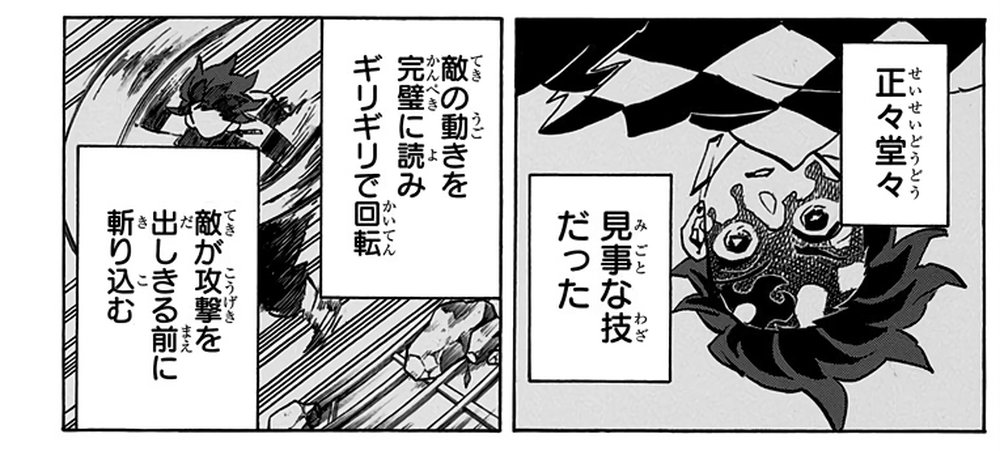
The ruins of the Swordsmith Village, mid-collapse. Akaza — Upper Rank Three, the demon who killed Kyōjurō Rengoku and is now, panels earlier, trying the same annihilating technique again ("AKAZA IS TRYING TO USE THE ANNIHILATION TECHNIQUE HE USED AGAINST RENGOKU!!" someone shouts) — is fighting Tanjirō Kamado, Genya Shinazugawa, and Muichirō Tokitō at once, backed by Mitsuri Kanroji, while a wounded Giyū Tomioka is dragged clear of the blast radius. It doesn't go Akaza's way. A finishing strike lands — fast, spinning, timed to the exact edge of his own reach — and Akaza, for the first time in the volume, stops fighting and starts narrating his own death, one panel at a time:
「勝負はついた...俺は負けた...あの瞬間完敗した」
Shōbu wa tsuita… ore wa maketa… ano shunkan kanpai shita
"The fight is over. I lost. In that moment, I suffered total defeat."
Then, two panels later, the word this whole piece is about — alone in its own narration box, no verb, no subject, just a verdict:
「正々堂々」
Seisei-dōdō
followed immediately by:
「見事な技だった」
Migoto na waza datta
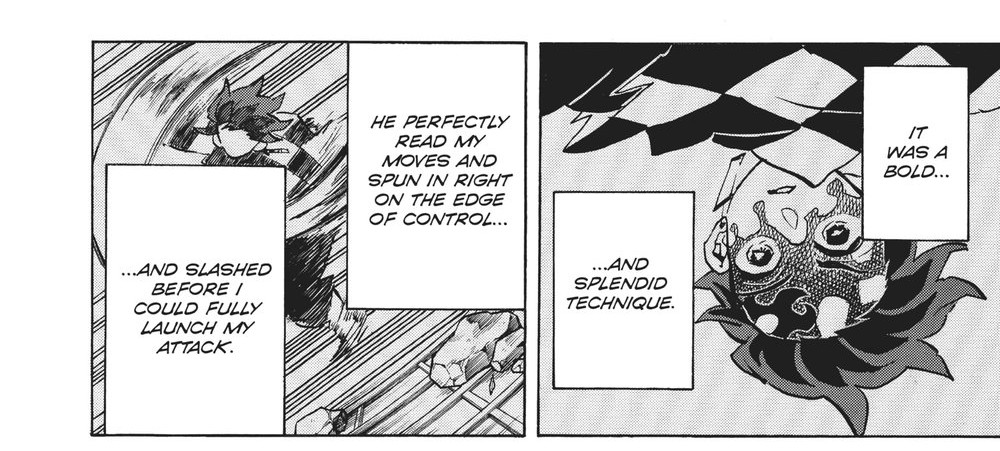
Here is where a corpus-driven approach to this article would have gone wrong. Our bilingual page database — the machine-aligned dataset behind this whole site — pairs 「正々堂々」on this exact page with the English string "IT WAS FAIR AND SQUARE.", flagged with full (1.0) confidence. It's a plausible guess: "fair and square" is the obvious, dictionary-clean English for 正々堂々, and it's so plausible that we almost wrote this whole article around it. But the real VIZ Media page — Volume 18, p.104, one page ahead of the Japanese numbering from around p.32 onward — does not say that. It reads:
"IT WAS A BOLD..."
"...AND SPLENDID TECHNIQUE."
Two boxes, matching the Japanese's two boxes — 正々堂々 in one, 見事な技だった in the other — but "fair and square" appears nowhere on the page. Grant the real rendering its due: "bold... and splendid technique" scans well, keeps the reverent, almost formal cadence of a professional's post-mortem on his own defeat, and "splendid" is a fair match for 見事. What it quietly does, though, is substitute a compliment about daring for a compliment about integrity — and that substitution is the whole story this article has to tell.
The Original
正々堂々 fuses two already-complete words, each built the same way: by doubling. 正 (sei) is "correct, right, just" — the character in 正しい (tadashii, "correct"); reduplicated into 正々 (seisei), it means "scrupulously fair, without a shred of crookedness." 堂 (dō) is literally "hall" — the character in 講堂 (a lecture hall) or 議事堂 (a parliament building) — but by extension "imposing, dignified, unashamed"; reduplicated into 堂々 (dōdō), it's the everyday word for standing tall without flinching (堂々とした態度, "a dignified bearing"). Neither doubled half needs the other to mean something; 正々堂々 simply stacks them into one adverb: openly, fairly, head held high, nothing hidden.
The phrase's oldest recorded ancestor isn't even Japanese. Sun Tzu's Art of War advises a general: 無邀正正之旗、勿撃堂堂之陣 — do not intercept a banner flying 正正 (in perfect order); do not attack a formation standing 堂堂 (imposingly disciplined). It's military caution, describing an army so well-ordered that a head-on attack against it is folly. Japanese absorbed the phrase and flipped its use — from a warning about an enemy too disciplined to safely attack, into a badge of honor you claim for your own conduct. 正々堂々と戦う, "to fight fair and square," is the phrase every kendo dojo, every sumo referee, and every schoolyard argument about cheating reaches for, twenty-five centuries later.
Grammatically there's nothing complex happening: 正々堂々 sits as a bare predicate noun in a narration box with the copula dropped (「正々堂々[だった]」), which is exactly why it lands like a stamped verdict rather than a spoken sentence. As vocabulary, JLPT guides typically shelve it at N2 — not because 正 or 堂 are hard (both are elementary), but because the yojijukugo form and its classical-Chinese pedigree push the whole compound up a register.
VIZ's Choice
Here is every confirmed occurrence of 正々堂々 across the corpus, with what our automatic aligner claimed versus what the cited page images actually show:
| Vol. / p. (JP → EN) | Japanese | Corpus auto-pairing | Real printed VIZ text (page-verified) |
|---|---|---|---|
| KnY 18 / p.33 → p.34 | 正々堂々真正面から打ち砕かれた | (unpaired — no English candidate in the corpus) | "HE CAME AT ME HEAD-ON AND COMPLETELY DEMOLISHED..." |
| KnY 18 / p.103 → p.104 | 正々堂々 | "IT WAS FAIR AND SQUARE." | "IT WAS A BOLD..." (→ "...AND SPLENDID TECHNIQUE.") |
| Naruto 8 / p.162 (cross-work) | 正々堂々...勝負!! | "LET'S DO THIS... FAIR AND SQUARE!" | (confirmed — matches) |
Read down that middle-to-right gap on the Demon Slayer rows and you're looking at the real finding twice over. First, at p.33/34, Akaza is still mid-battle, realizing an opponent has "grasped something" and closed the speed gap: 「数百年間の武術の粋を正々堂々真正面から打ち砕かれた」— "hundreds of years of martial arts, shattered 正々堂々, head-on." VIZ's real line keeps 真正面から ("head-on") and 打ち砕かれた ("completely demolished") and simply drops 正々堂々 — the fairness claim isn't mistranslated here, it's omitted, with "head-on" left to imply everything the missing word used to say outright.
Second, at p.103/104 — the death scene — 正々堂々 does get translated, just not as "fair and square." It becomes "bold," continued into "...and splendid technique" one box later. And the third row is the control: elsewhere in this network's corpus, in Naruto Volume 8, Ino Yamanaka squares up against Sakura Haruno in the Chūnin Exam prelims and says exactly the four-character phrase this article is about — 「正々堂々…勝負!!」— and VIZ's real, verified page prints "LET'S DO THIS... FAIR AND SQUARE!" No omission, no substitution, the idiom lands whole. That panel proves the translation choice isn't a house style avoiding the phrase; "fair and square" is sitting right there in VIZ's own toolkit. Akaza's death, twice, is simply not where it got used.
The Gap
The reduplication vanishes without a trace, in two different ways. At p.34, 正々堂々 is cut entirely, its meaning folded (optimistically) into "head-on." At p.104, it survives as a word but not as itself — "bold" carries none of 正々々's doubled, formal insistence on fairness; it's a single adjective standing in for a four-character compound built from two intensified halves.
VIZ's own reflex translation sits one panel away, unused. This isn't a case where English simply has no tool for the job — the Naruto panel proves the tool exists and gets reached for elsewhere in exactly this publisher's output. Something about Akaza's death scene specifically steered the translation away from "fair and square" toward "bold," and the result is that the two most tonally similar moments in this network's corpus — two duelists agreeing to a clean fight — sound like they're using different vocabularies for the same idea, when the Japanese uses the identical phrase for both.
A military compliment collapses into a compliment about nerve. 正々堂々's whole weight comes from its Sun Tzu ancestry: an unimpeachable, disciplined order that cannot safely be attacked. When Akaza applies that phrase to the strike that kills him, he's saying his killer's technique was flawless and honest — mastery plus integrity, in one word. "Bold" keeps only courage. A technique can be bold and still be a lucky, reckless gamble; 正々堂々 specifically rules that reading out. Akaza is not praising an opponent for taking a risk. He's certifying, with his dying words, that nothing was stolen from him.
What If
- "IT WAS FAIR AND SQUARE... A MAGNIFICENT TECHNIQUE." — restores VIZ's own reflex idiom (confirmed elsewhere in this corpus) to the exact panel it's missing from. Cost: flatter rhythm across the panel break than "bold... and splendid," and echoes the Naruto panel closely enough that a reader who's seen both might feel the repetition.
- "HE BEAT ME HONESTLY. A MAGNIFICENT TECHNIQUE." — keeps the moral claim (honesty, not just daring) in plain, contemporary English. Cost: "honestly" is duller than 正々堂々's ceremonial doubling, and none of the Sun Tzu-derived martial grandeur survives.
- "IT WAS A CLEAN, HONORABLE KILL." — compresses both panels into one beat, keeping the honor claim explicit. Cost: merges two separate narration boxes into a single sentence, losing the pause the original panel break is built around.
- For the earlier occurrence: "HE CAME AT ME FAIR AND SQUARE, HEAD-ON, AND COMPLETELY DEMOLISHED..." — keeps 正々堂々 explicit rather than silently dropping it. Cost: stacks two near-synonymous directness phrases ("fair and square" plus "head-on") that read as redundant in English even though the Japanese comfortably chains 正々堂々 and 真正面から back to back.
Every option pays because Japanese is willing to stack two intensifiers — fairness and directness — where English, once it's already said one of them, starts to feel like it's repeating itself.
Take-away
正々堂々 is Japanese's oldest compliment for a clean fight, descended from a warning about an army too disciplined to safely attack. When a dying demon uses it on the technique that killed him, he isn't being polite — he's certifying, in his own moral vocabulary, that his death cost him nothing but the fight itself. English owns a near-perfect echo of the phrase's doubled structure, "fair and square," and even uses it elsewhere in this exact publisher's catalogue. It just isn't there when Akaza needs it.
Three rules of thumb to carry off this page:
- 正々堂々 is a two-part reduplication, not one idea said twice for emphasis. 正々 (fairness) and 堂々 (dignity) are each doing separate work; a translation that keeps only one has kept half the compliment.
- When you meet a Japanese doubled compound, check whether English's nearest phrase is also doubled — and don't assume it will be used just because it exists. "Fair and square" is real, available, and demonstrably in VIZ's own vocabulary; that doesn't guarantee it survives to the scene that most needs it.
- Trust the page image over any automated pairing — including this network's own. The corpus entry behind this very article guessed "fair and square" with full confidence, and the real printed panel said something else. When a translation claim sounds too perfect, that's exactly when it's worth opening the book.
This is far from the only four-character phrase Demon Slayer's translation notes track down: see 一刀両断, the old English verb VIZ's "one clean stroke" keeps almost saying, 縦横無尽, the four-character compound compressed into a single stray adjective, and 自暴自棄, another classical-Chinese-rooted compound VIZ keeps answering the same way. For the very human boy hiding inside this article's demon, see the sister piece on 骨を折る and the passive voice VIZ collapses into "punishment", from three chapters earlier in the same volume. Browse the full Demon Slayer translation notes index for more.
The Japanese lines quoted above are byte-exact captures from 鬼滅の刃 Vol. 18 (Japanese edition) via our bilingual page database. Where this article's corpus entry carried an English pairing that didn't match the real printed page — see VIZ's Choice above — the English quotations instead reflect a direct, verified reading of the cited Demon Slayer: Kimetsu no Yaiba Vol. 18 (VIZ Media) page images, at p.34 and p.104; see Sources and References for the underlying corpus citations.