The Moment
Volume 1, the survival exercise. The evening before, Kakashi ended his team briefing with one last instruction — 「それと朝めしはぬいて来い...吐くぞ!」, "AND DON'T HAVE BREAKFAST BEFOREHAND... UNLESS YOU ENJOY THROWING UP." (p.120) — and his three brand-new genin, being twelve and terrified, obeyed.
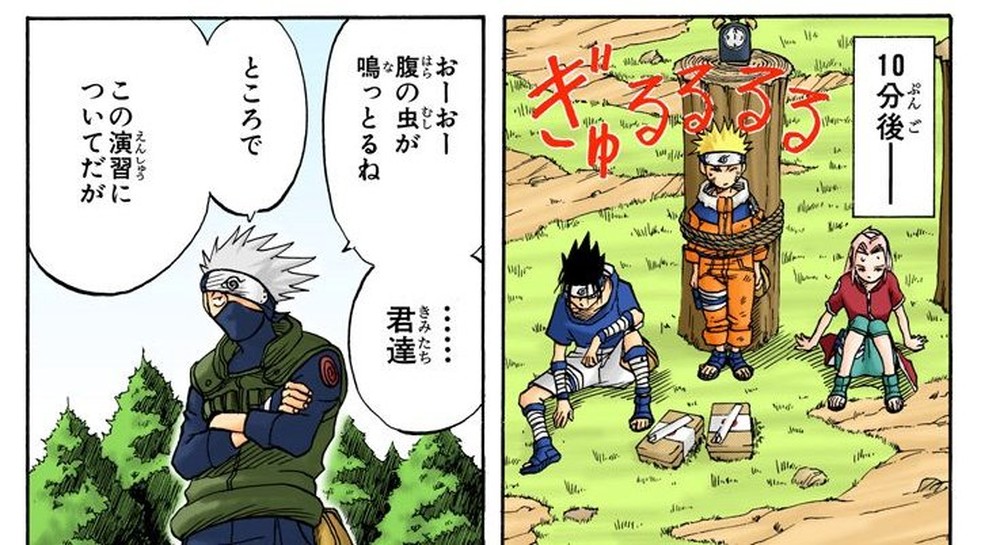
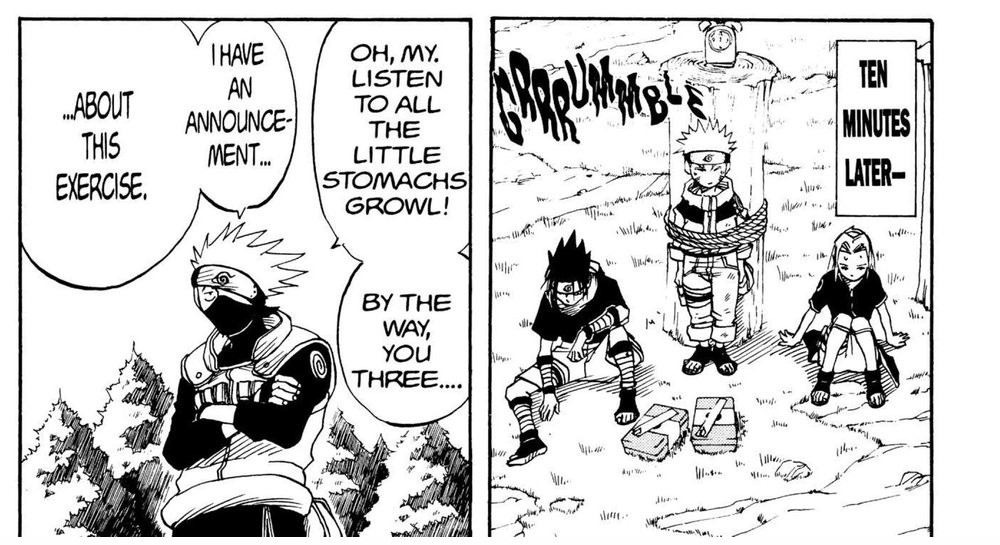
Cut to noon. The alarm clock on the stump rings, the bell test is over, and the practice field looks like a lost battle: Naruto lashed to a training post, Sasuke and Sakura slumped in the grass on either side, two untouched lunch boxes at their feet, and a giant stomach-rumble — ぎゅるるるる in screaming red — rattling across the panel. Kakashi stands over the wreckage, arms folded, and delivers the day's kindest cruelty:
「おーおー腹の虫が鳴っとるね」
Ō ō, hara no mushi ga nattoru ne
VIZ's English edition prints: "OH, MY. LISTEN TO ALL THE LITTLE STOMACHS GROWL!" (Vol. 1, p.185) — and then, in the same breath, 「ところで……君達」「この演習についてだが」: "BY THE WAY, YOU THREE...." — "I HAVE AN ANNOUNCEMENT... ...ABOUT THIS EXERCISE."
Grant the rendering its due, because this is good work. "OH, MY." catches Kakashi's mock courtesy dead-on. "LITTLE" supplies the condescension his sentence-final ね carries. And "GROWL" is even an animal verb — English's own small zoomorphic joke about digestion. The line is funny in exactly the way the scene needs.
But read the Japanese literally and something is living in it. Kakashi doesn't say their stomachs are making noise. He says the worms in their bellies are crying.
The Original
Take the idiom apart:
腹 (hara) is the belly — and in Japanese body-culture the belly is never just plumbing. It is the seat of feeling and truth: anger is 腹が立つ ("the belly rises"), honesty is 腹を割る ("splitting the belly open"), resolve lives there too. Whatever English files under "heart" or "gut," Japanese routes through the hara.
虫 (mushi) is "bug, worm, insect" — the kanji a pictograph of a crawling creature.
鳴る/鳴く share the character 鳴: a mouth (口) beside a bird (鳥). This is the kanji Japanese reserves for the cries of creatures — birds 鳴く, cats 鳴く, autumn crickets 鳴く. So 腹の虫が鳴る does not report a gurgle; it reports a voice. The worm in your belly is crying out, like a cricket in a cage, and Kakashi's 鳴っとる (a drawled contraction of 鳴っている — more on that drawl below) means it is crying right now, listen.
Here is the part that surprises learners: this is not Kakashi being colorful. 腹の虫が鳴る is the plain, dictionary-standard way to say your stomach is growling. Japanese speakers say it without picturing anything — the way English speakers say "my stomach is growling" without picturing a dog. But the fossil record underneath is completely different, because the worm is not a one-off metaphor. It is a tenant with a lease, and it has a whole family of jobs (see the table below).
One register note: the 〜とる ending has a folksy, old-timer flavor. From a jōnin in his twenties, 鳴っとるね is a put-on avuncular drawl — grandpa-voice deployed at three starving children he personally ordered not to eat breakfast. The cruelty is in the coziness.
VIZ's Choice
腹の虫 appears just this once in the volumes we have on file, so instead of a scatter of renderings, look at the one choice closely — and at the family of idioms the choice quietly disconnects.
VIZ had two dead metaphors to choose between. English's: the stomach growls — the organ itself personified as a grumbling animal. Japanese's: the worm in the belly cries — the organ sublet to a resident creature. The translation swaps the Japanese fossil for the English one, which is exactly what makes it read so naturally — even the sound effect cooperates, ぎゅるるるる becoming a hand-lettered GRRRUMBLE. "ALL THE LITTLE STOMACHS" spreads the tease across all three genin, and "LITTLE" keeps Kakashi looking down from a great, amused height. Locally, nothing is wrong.
What disappears is the creature — and the creature has a résumé:
| Idiom | Literally | What it means |
|---|---|---|
| 腹の虫が鳴る | the belly worm cries | your stomach is growling |
| 腹の虫が治まらない | the belly worm won't settle | you can't swallow your anger |
| 虫の居所が悪い | the worm is in a bad spot | someone woke up cranky |
| 虫の知らせ | a tiding from the worm | a premonition, a bad feeling |
| 虫が好かない | my worm doesn't take to him | instinctive dislike |
| 疳の虫 | the tantrum worm | a baby's inconsolable crying |
One creature, six jobs. A Japanese reader who hears Kakashi's tease already owns the whole table; an English reader gets a growl with no owner.
The Gap
The tenant is evicted. English personifies the organ; Japanese sublets it. "LISTEN TO ALL THE LITTLE STOMACHS GROWL!" keeps the noise and loses the noisemaker — and since the swap is invisible (both lines are perfectly idiomatic), the English reader never learns a swap occurred. This is the quietest kind of translation loss: nothing reads wrong, something just stops being there.
The family thread snaps. The worm is load-bearing vocabulary. A learner will meet 虫の知らせ in a tragedy, 虫の居所が悪い in an office comedy, 腹の虫が治まらない in every revenge arc — and each one, met through English ("premonition," "bad mood," "still furious"), arrives as an unrelated expression. The Vol. 1 growl was the cheapest possible introduction to the whole creature, and English couldn't make the introduction.
Hunger and anger share a worm. The same 腹の虫 that cries for lunch refuses to settle when you've been wronged. That double duty isn't a coincidence; it's the hara doing what the hara does in Japanese — hosting the emotions English scatters between heart, gut, and temper. The organ that grumbles is the organ that seethes. English stomachs, by contrast, only ever want lunch — so the tease loses its echo of every future scene where a belly worm rages instead of growls.
And one loss no translator could be blamed for: the boy tied to the post — the loudest belly on the field — is the boy with an actual creature sealed inside his belly. No one would claim Kishimoto planted 腹の虫 as foreshadowing; it is simply the ordinary idiom for a growling stomach. But Japanese keeps whispering, in its idioms, that bellies have occupants — and this is a series about a boy whose belly really does. The English line can't whisper any such thing.
What If
The menu, with prices:
- "MY, MY. THE WORMS IN YOUR BELLIES ARE CRYING." — keeps the tenant, the creature-verb of 鳴く, and the mock courtesy. Cost: without the shared folklore, English hears parasites — clinical and faintly gross where the Japanese is cozy.
- "WELL, WELL. YOUR STOMACHS ARE SINGING FOR THEIR SUPPER." — replaces Japanese folklore with English nursery folklore (little Tommy Tucker sang for his). Like-for-like at the level of kind of expression. Cost: singing is charming where ぎゅるるるる is humiliating; the tease goes soft.
- "OH, MY. LISTEN TO YOUR BELLIES COMPLAIN." — "complain" gives the belly a voice and a grievance, halfway to a resident. Cost: it is still the organ talking, not a creature in it.
- Keep VIZ, smuggle the worm: "OH, MY. THE LITTLE CRITTERS IN YOUR BELLIES ARE NOISY." — Cost: reads as Kakashi inventing a whimsical joke, when in Japanese he is reaching for the most ordinary idiom in the drawer. Making the normal sound quirky is its own mistranslation.
Every option must choose: idiomatic English with the creature deleted, or the creature preserved at the price of sounding like folklore English never had. VIZ chose the first, and for a gag panel that is probably right. The article you are reading is the second choice.
Take-away
Three rules of thumb to carry off this page:
- When a feeling is involuntary, look for the 虫. Hunger, temper, hunches, revulsion, a baby's tantrum — whatever you didn't decide to feel, Japanese delegates to the worm. Collect 虫 idioms as one creature with many jobs, not as a list of unrelated phrases.
- 鳴く is a creature verb. The kanji 鳴 (mouth + bird) marks its subject as something alive and calling — birds, insects, and belly worms. When Japanese lets something 鳴く, the language has just told you it's an animal.
- Dead metaphors still pick sides. English personifies the organ (stomachs growl); Japanese sublets it to a tenant. Translation between two dead metaphors reads seamless — and that seamlessness is exactly where cultural anatomy quietly goes missing.
The belly is not the only organ doing off-label work in this series: for the liver that Japanese uses where English says "heart" and "nerve," see the engraving VIZ moved off the liver in 肝に銘じる — and for a Buddhist battlefield hiding inside an everyday word, the carnage folded into 修羅場. Or browse the Naruto translation notes index.
Every Japanese and English line quoted above is a byte-exact capture from the cited editions — NARUTO Vol. 1 (Japanese) and Naruto Vol. 1 (VIZ Media) at the corresponding panels — via our bilingual page database; see Sources below.