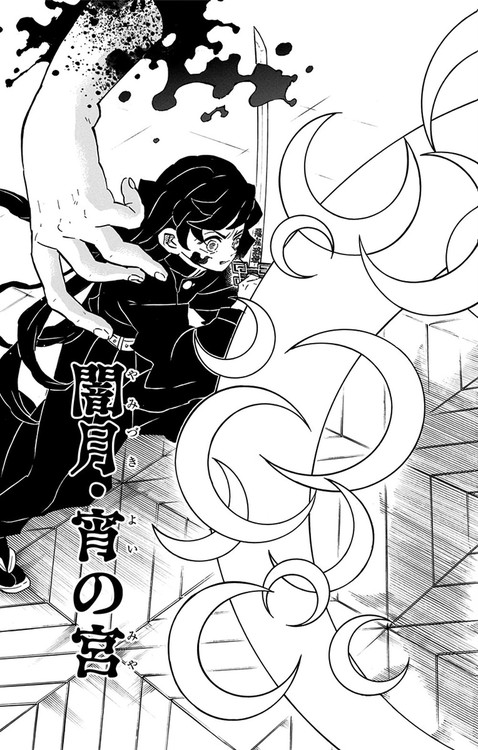
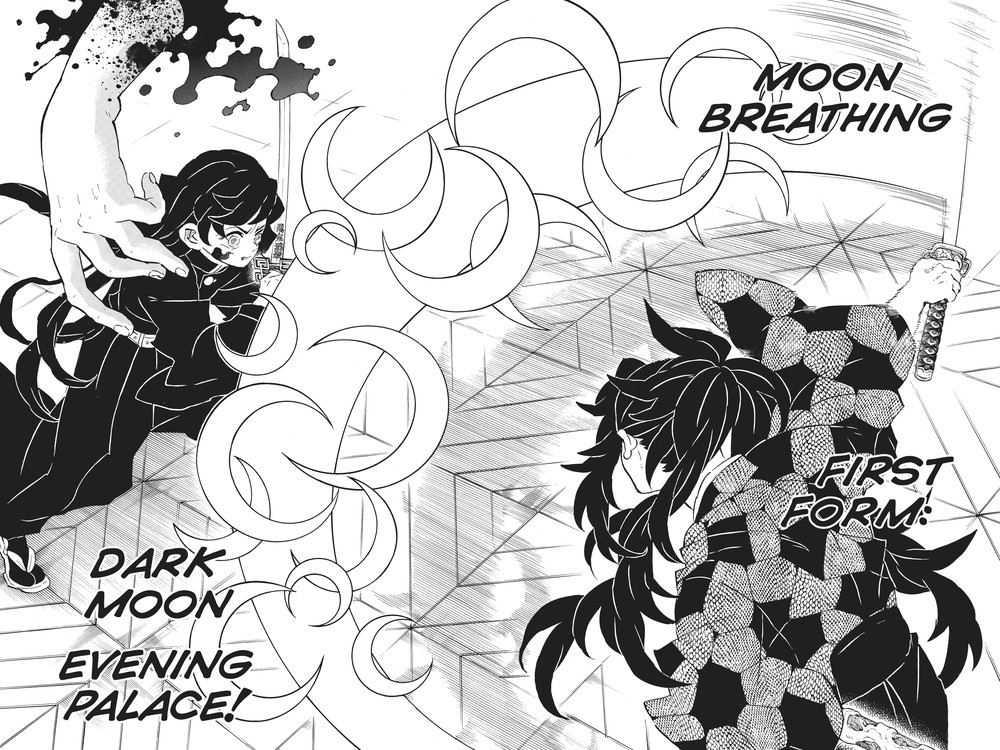
The corpus OCR renders this line as 「ふーっ」間月・音の宮 — 間 standing in for 闇 (both share the 門 gate radical, an easy machine-reading slip) and 音 standing in for 宵 (a stretch on paper, but the two look far more alike in Gotouge's jagged brush lettering than in print type). The panel itself removes any doubt: page 103 spells out 月の呼吸 壱ノ型 in full furigana (つき, こきゅう, いち, かた) one panel before the name reveal, and page 104 gives 闇月・宵の宮 with やみづき / よいのみや written beside every character. Both readings are corpus-verified against the raw scan, not assumed from the technique's fan-standard romanization.
As the style's opening form, 闇月・宵の宮 does something Water Breathing's Form One pointedly doesn't: it reaches straight for classical court vocabulary. 宵 and 宮 both belong to the register of waka poetry describing the imperial palace at dusk — a far cry from "Water Surface Slash," which names a piece of physics. That gap is the whole point of Moon Breathing's naming convention: Kokushibo was a swordsman for roughly four centuries after his transformation, working alone with no school and no living peers to keep his vocabulary current, and the style he built reads like it was composed by someone who had nothing left to do but read classical poetry between kills.
The panel this technique is drawn on is a double-page spread: Shinobu's demon-transformed body lunges in from the left edge as Kokushibo, mid-draw on the right, opens the numbered-form callouts that will carry through the rest of the fight. It's a strange place for the vocabulary of dusk and palaces — the scene is a chaotic four-way battle against three Hashira at once — which is exactly the tension Moon Breathing runs on throughout the corpus: brutal, overwhelming violence delivered in the register of a man who still thinks of himself, six centuries too late, as a courtier.