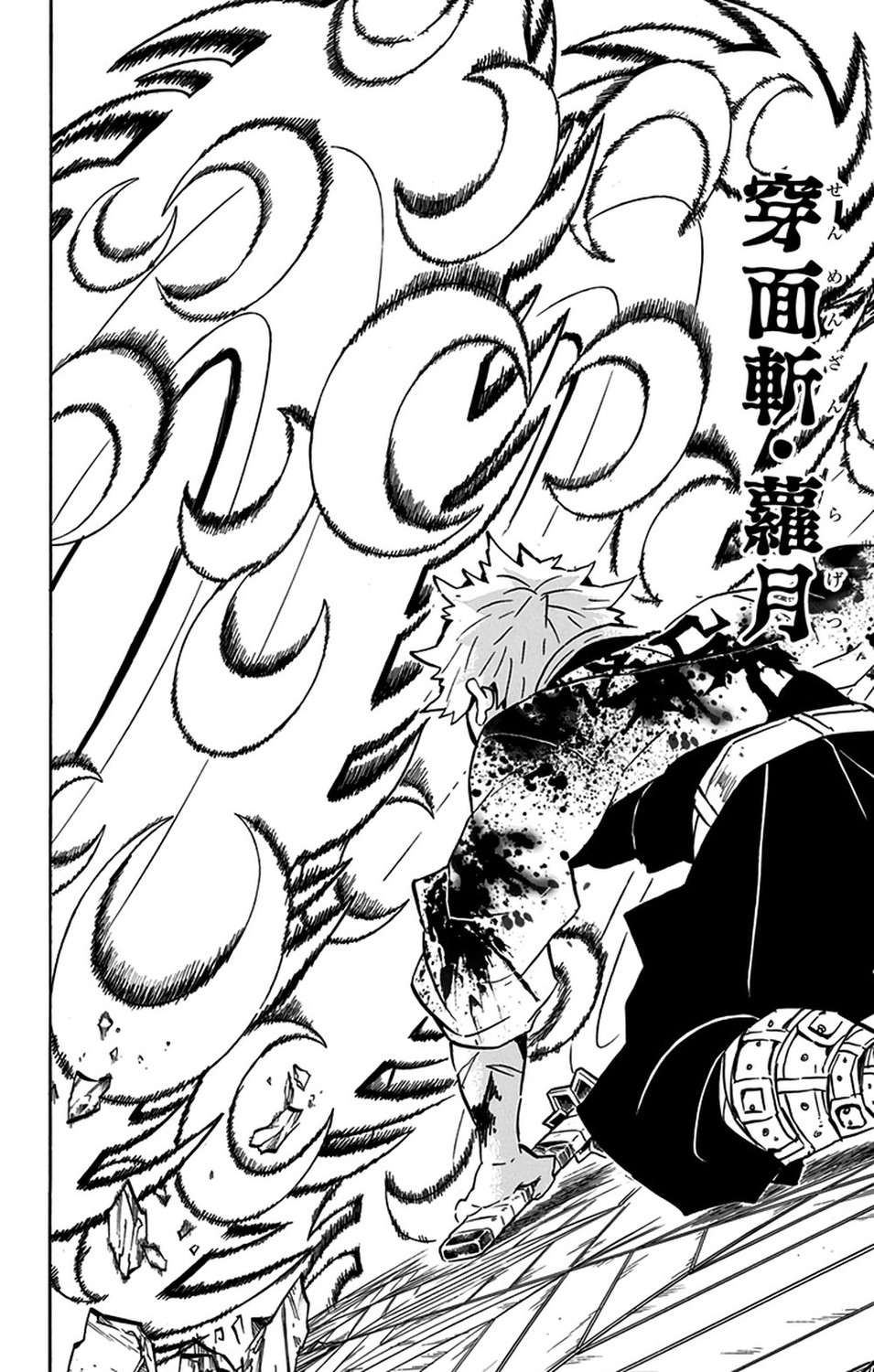
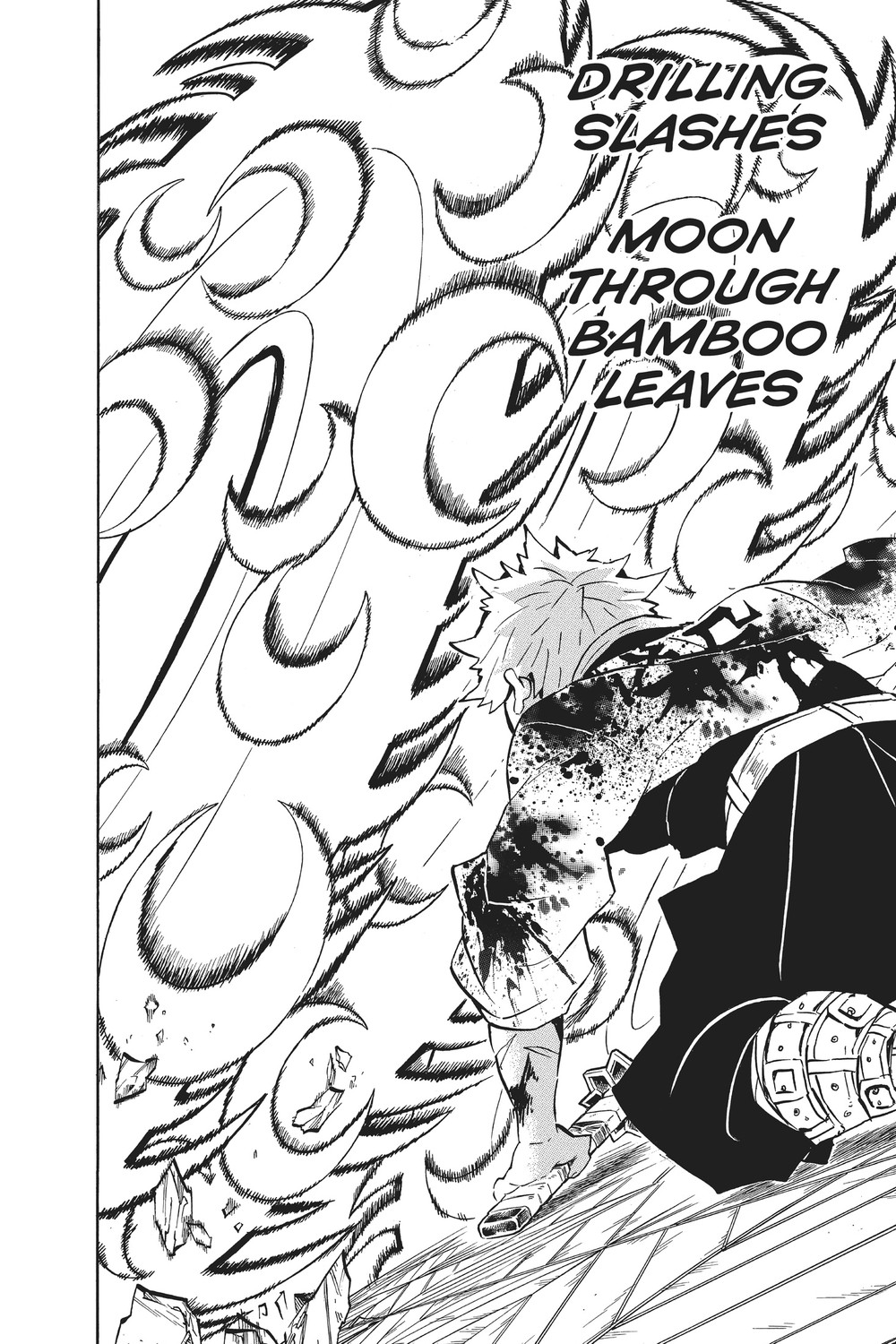
VIZ's "Moon Through Bamboo Leaves" is the most interpretive translation in this dictionary's Moon Breathing set. 蘿 (ra) is a genuinely obscure character denoting trailing vines or lichen-like plants in classical Japanese — not bamboo specifically, which would normally be 竹 or 笹. The likely reasoning: 蘿月 isn't a standard dictionary compound either way, so the translator had to construct an image from the character's connotation (moonlight glimpsed through a tangle of hanging vegetation) rather than from a fixed idiom, and "bamboo leaves" reads more evocatively in English than the more accurate but flatter "vine-moon" or "moss-moon." It's a reasonable creative call, but readers relying on the English name alone would come away with the wrong plant.
The corpus's stored translation for this pair — "MOON BREATHING TENTH FORM: DRILLING SLASHES - MOON THROUGH BAMBOO LEAVES" — is worth flagging even though it isn't wrong exactly: the "MOON BREATHING TENTH FORM:" portion is real VIZ text, but it's printed on the preceding page as Sanemi is sent flying (paired there with Kokushibo's title-card panel), not on the splash page carrying 穿面斬・蘿月 itself. The corpus field concatenates both into one string. Direct image inspection confirms the splash page containing the actual technique name reads only "DRILLING SLASHES" / "MOON THROUGH BAMBOO LEAVES," with the "TENTH FORM: MOON BREATHING" callout occupying its own separate page one panel earlier. The corpus's page-056 pair has a second, unrelated error worth noting for transparency: it stores the Japanese title-card fragment 拾ノ型 ("Tenth Form") against the English "TENTH FORM: WANING MOON-SWATHS!" — reusing Ninth Form's name in error. The real printed VIZ text for that panel, confirmed by image, is simply "TENTH FORM:" paired with "MOON BREATHING-ING" on the same page.
Tenth Form is also where Moon Breathing's naming visibly starts working harder for its effects than Water Breathing's early, plain-spoken forms (compare this hub's water-breathing-form-1 entry, whose "Water Surface Slash" survives translation almost untouched). By the time Kokushibo reaches double digits, four forms deep into an unbroken combo against four Hashira, the names are stacking obscure kanji, invented compounds, and interpretive English — evidence of a solo swordsman four centuries into refining a style nobody else was ever meant to standardize or simplify for teaching.