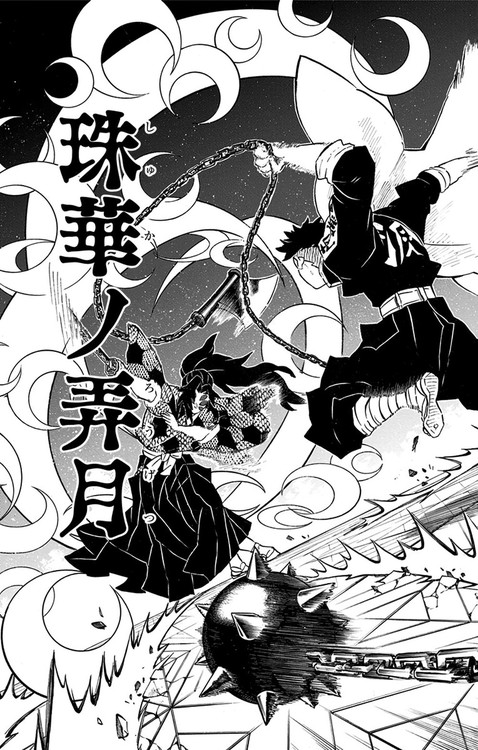
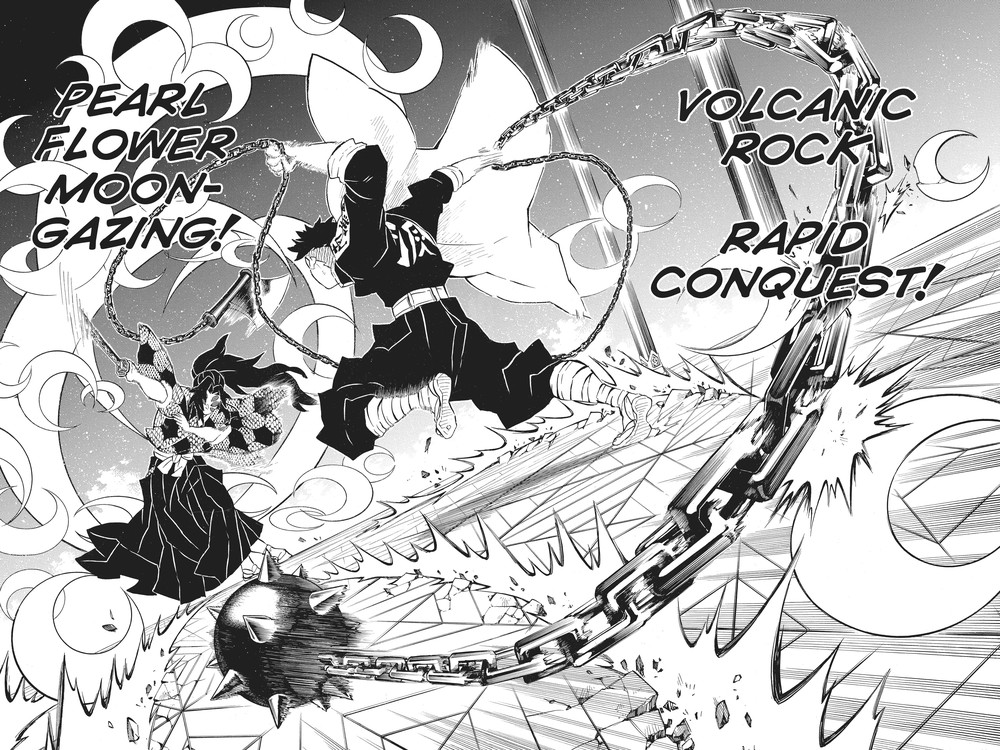
弄月 is not Gotouge's invention. It's an attested term from the shared Sino-Japanese literary vocabulary — the same register that gives Japanese 花鳥風月 ("flowers, birds, wind, and moon," shorthand for the beauties of nature that a cultivated person appreciates) — describing the specific pastime of leisurely moon-viewing, often paired with drinking or poetry, sometimes toying with the moon's reflection rather than the moon itself. Grafting that phrase onto a mid-combat chain-sickle strike is a small joke at Kokushibo's expense that the manga never comments on directly: an attack that shreds the air into competing arcs, named for an idle evening's entertainment.
The corpus OCR only captured a fragment of the full callout — 球華! (with 球 "ball/sphere" swapped in for the near-identical 珠 "pearl," and the ノ弄月 portion dropped entirely, likely lost where the bubble crosses the art). The full name, 珠華ノ弄月 with furigana しゅか/ろうげつ, is legible directly on the raw page once you look past the OCR pass — worth flagging here since the visible kanji is the more reliable source than the extracted text for this particular panel.
Structurally, this is one of the more pointed panels in the corpus for showing what "Upper Rank One" actually means in practice: the two-page spread splits Kokushibo's Second Form against Gyomei's Stone Breathing Fourth Form in mirrored panels, captioned "SECOND FORM: MOON BREATHING" and "FOURTH FORM: STONE BREATHING" side by side — laid out to make clear that Kokushibo is trading blows with the strongest Hashira one-handed, essentially as an afterthought, while also engaging Genya and the others elsewhere on the same page.