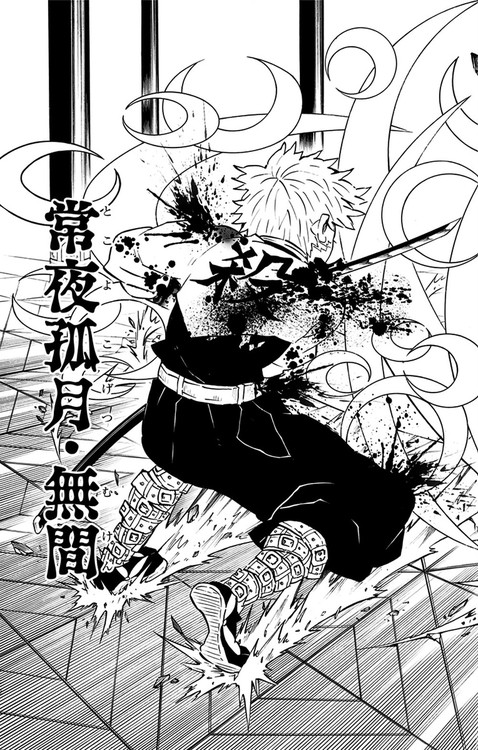
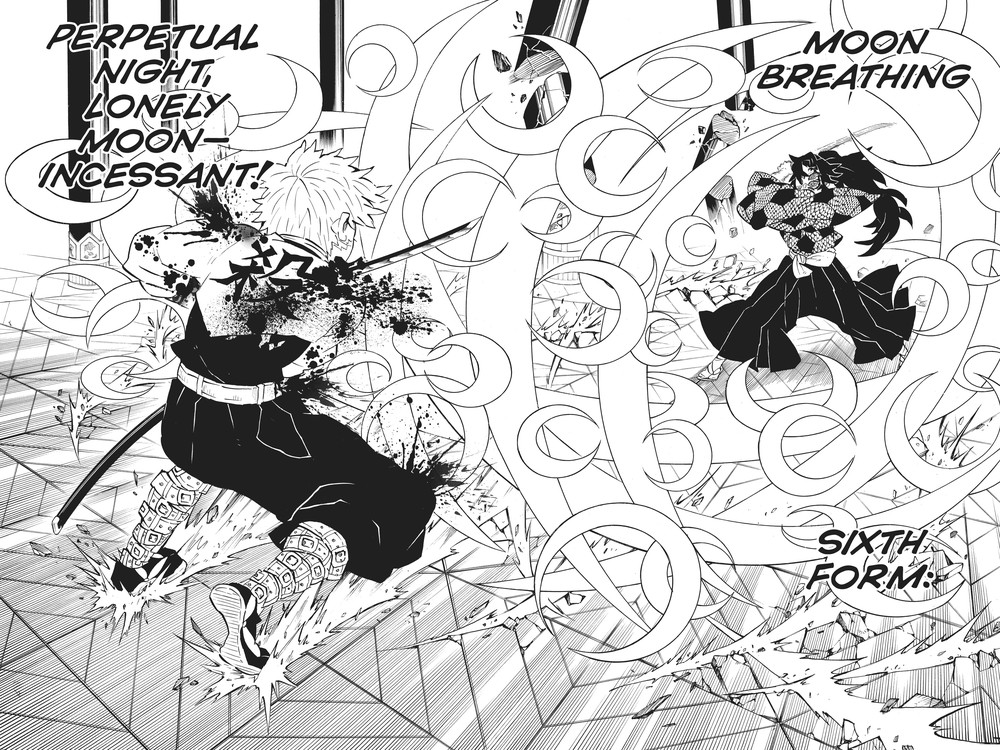
常夜 is doing quiet double duty here. Read literally, its two kanji just say "eternal night" — a plain enough image for a Moon Breathing form. But the furigana とこよ is not the literal reading of 常夜; it's the reading that belongs to a different, homophonous word, 常世, which in Japanese myth names the land across the sea where the dead and the immortal both dwell (the term survives into modern vocabulary mostly in poetry and Shinto contexts). Writing 常夜 while voicing it とこよ lets Gotouge have both meanings in one word: the surface image of endless night, and the buried mythological resonance of the land of the dead — appropriate for a demon technique wielded by a man who has been dead to his own family for roughly four hundred years.
無間 carries the heavier weight of the two halves. On its own it simply means "without interval" or "unceasing," and VIZ's "INCESSANT!" is a perfectly literal, unforced translation of exactly that. But 無間 is also, unmistakably, the first half of 無間地獄 — the Buddhist hell of uninterrupted suffering, the lowest and worst of the eight hot hells, reserved in traditional cosmology for the gravest offenses (killing a parent, for instance). This site doesn't yet carry a dedicated Demon Slayer glossary entry built around that term, but readers who know it from elsewhere in Buddhist-inflected pop culture will likely feel the echo the moment they see 無間 standing alone in a Kokushibo attack name: a technique that translates as merely "unceasing" on the surface, sitting one syllable away from naming the hell built entirely out of that same idea.
Unlike Forms Three and Five, this occurrence has no pagination headache — Vol. 19 p.144 lines up cleanly with its VIZ English counterpart at the same page number, callout for callout. The panel it's drawn on shows the technique landing on Genya specifically: blood spray across his face, his brother Sanemi's name torn out of him twice (兄貴!!, "Nii-san!!") as he loses his bearings mid-fight, unable to see past the collapsing pillars around him. It's one of the few Moon Breathing panels in this stretch where the poetry of the name and the damage of the technique share the same beat.