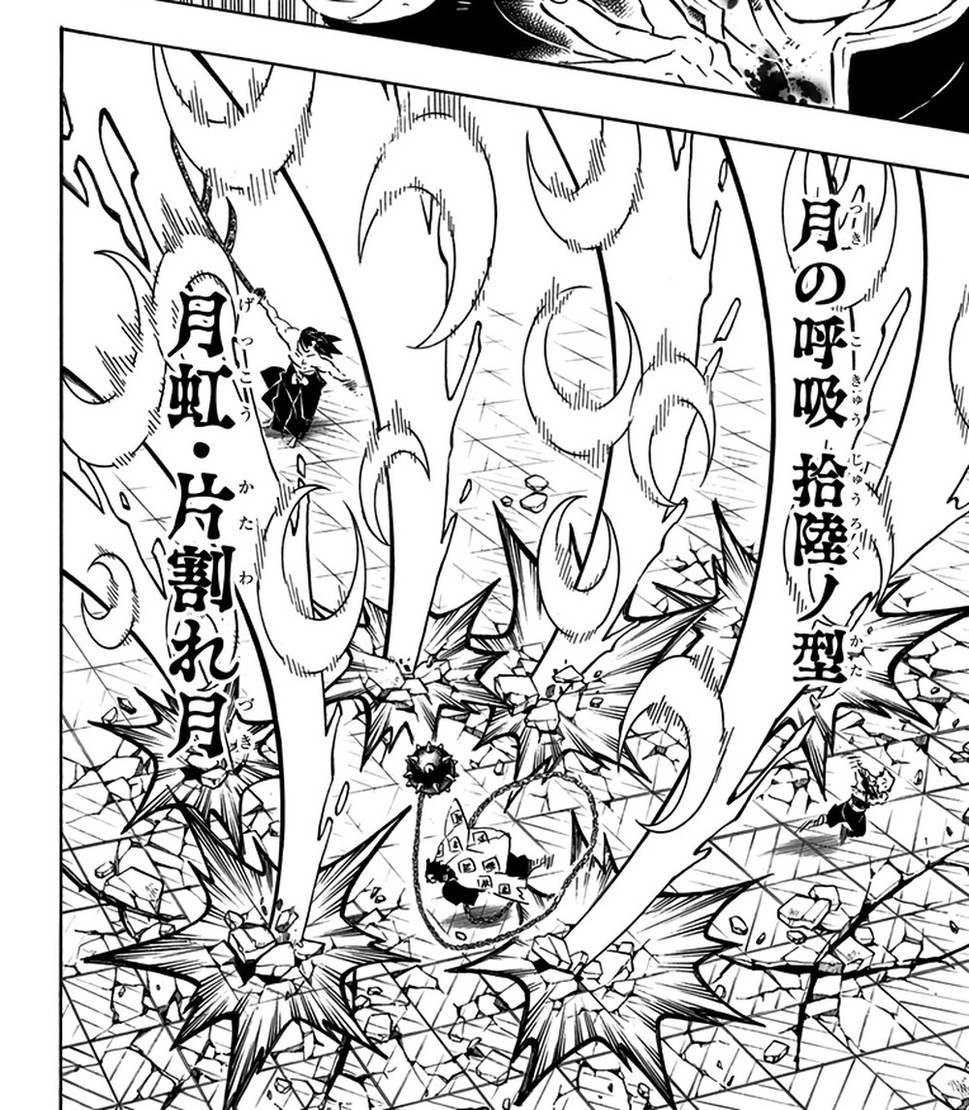
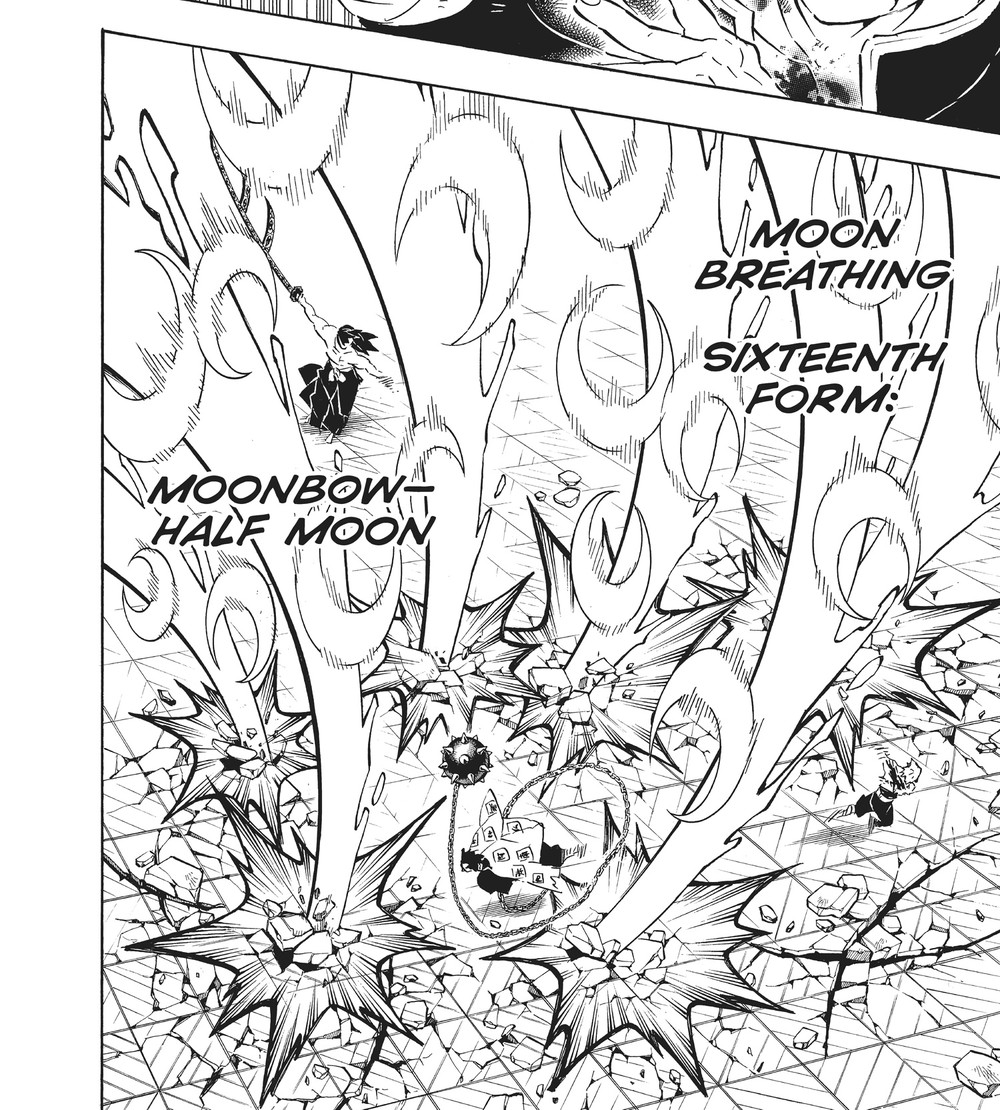
Sixteenth Form is the ceiling — the highest numbered technique named anywhere in the entire Demon Slayer canon. Every other breathing style tops out at twelve forms because every other style is a living curriculum: Water, Flame, Wind, Sound, all of them were built to be taught, refined across generations of Demon Slayer Corps swordsmen, tested against real demons by real students, and eventually formalized into a fixed, memorizable set. Moon Breathing has no such ceiling because it was never taught to anyone. Michikatsu Tsugikuni — Kokushibo, six centuries ago Yoriichi's twin brother — has been the style's only practitioner for roughly four hundred years, meaning every form past what would be a normal style's twelfth is not a technique that survived a standardization process. It's a personal addition, made by one swordsman, alone, with no peer to spar against, no student to demand the move actually be teachable, and no tradition insisting a curriculum stop at a round number. Fourteenth Form (this hub's other high-numbered Kokushibo entry) already breaks the usual ceiling; Sixteenth Form breaks it by four more, and the fight this dictionary's corpus captures it in is explicitly Kokushibo's final battle — four hundred years of solitary refinement, spent all at once against four Hashira simultaneously, with nobody left who could have told him where to stop.
月虹 (gekkou, "moonbow") is the more remarkable of this entry's two naming choices precisely because it isn't invented imagery — it's a real term for a real, exceptionally rare phenomenon. A moonbow forms exactly like a solar rainbow: moonlight refracting and reflecting through airborne water droplets, typically near waterfalls or during light rain under a bright moon. The physics are identical to a daytime rainbow, but moonlight is roughly 400,000 times dimmer than sunlight, so a moonbow's colors are almost always too faint for the human eye's cone cells to register as full color — most witnesses see it as a pale, silvery-white arc, with the same spectrum only revealed by long-exposure photography. That a swordsman training in isolation for four centuries would eventually name a technique after one of the rarer things visible in a night sky is a small, well-chosen piece of world-building: Moon Breathing's whole naming register draws on the moon's phases, its light, its reflections, and 月虹 is the rarest entry in that catalog, sitting at exactly the kind of vanishingly uncommon threshold this technique's own form-number occupies within the series.
片割れ月 ("half moon," built from 片割れ, "one half of a broken pair") closes the pairing on a note of incompleteness rather than fullness — worth noting against Fourteenth Form's 天満 ("heaven-filling"), which claims the opposite kind of totality. Paired together in one technique name, a moonbow (light glimpsed only under narrow, fleeting conditions) and a half moon (a disc that is, by definition, only half of itself) make Sixteenth Form's imagery quietly elegiac in a way "Catastrophe" two forms earlier is not: less an attack that ends things all at once, more an attack named for what's visible only briefly, only partially, only if the conditions are exactly right — a fitting note for the technique that also happens to be the last and highest-numbered one Moon Breathing ever names on the page.