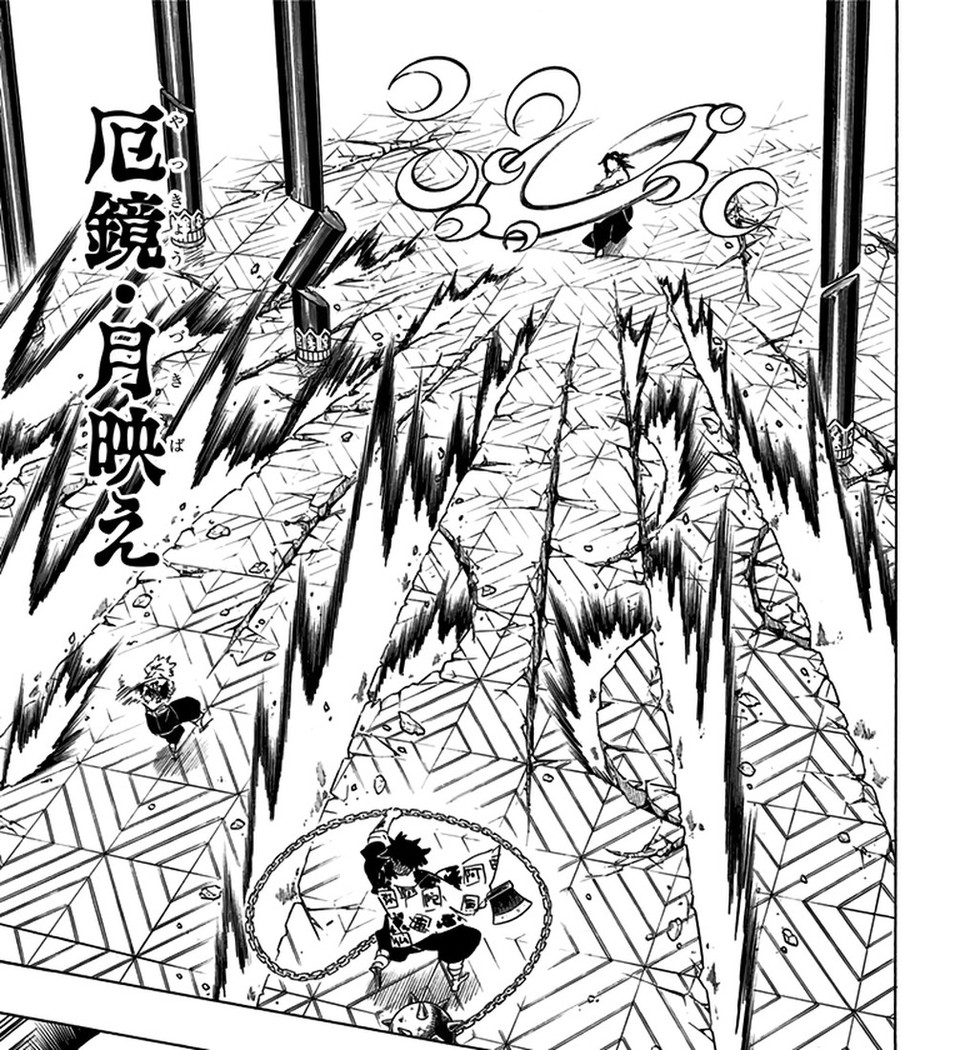
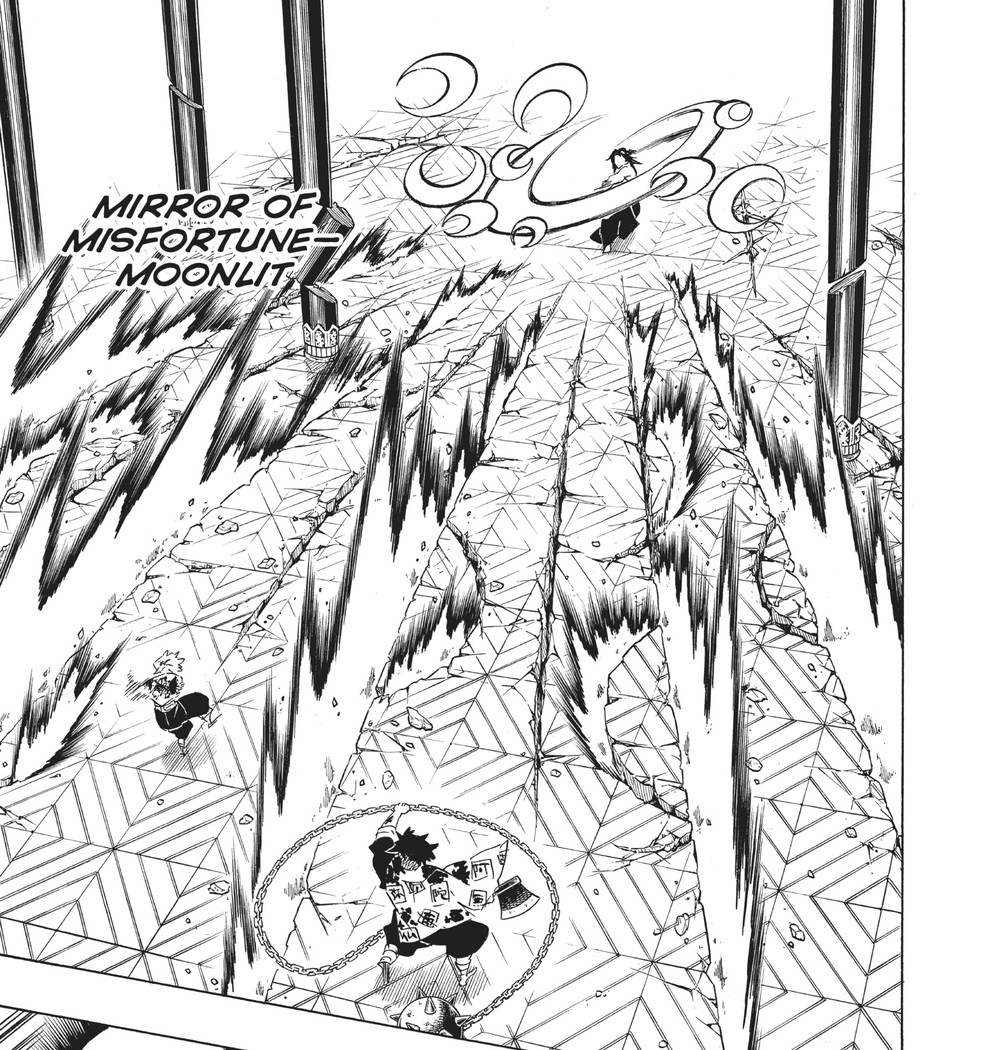
The corpus OCR badly mangles this name — the bilingual pair for page 52 stores the Japanese as "厄鏡;月映" (semicolon in place of the interpunct, and the final え dropped entirely). Direct inspection of the raw page image resolves both problems: the dot is a normal ・ separator, and the furigana above 映え clearly spells つきばえ in full. This is worth flagging because 厄鏡・月映え is the first form in this dictionary's Moon Breathing set where the corpus's own OCR, not VIZ's translation, is the thing that needed correcting — a useful reminder that byte-exact capture and byte-exact accuracy are not the same claim.
月映え as a compound doesn't otherwise exist as a fixed term in Japanese; Gotouge is coining a technique name the way most of Moon Breathing's higher forms do, stacking a plain noun (厄鏡, "ill-omened mirror," evoking old folklore about mirrors that show curses or doubled reflections) against a more lyrical verb-derived noun (月映え, "moon-glow"). VIZ's "Mirror of Misfortune, Moonlit" keeps that two-part structure intact rather than fusing it into a single English noun phrase, which is the right call — the technique's visual effect (an attack that seems to double and extend itself, per Sanemi's reaction) reads as a mirror trick, and the translation's comma-separated clauses preserve that "first the object, then its lit condition" logic.
Seventh Form sits early in a stretch of Moon Breathing that gets more numerically ambitious as the fight goes on — this dictionary's other Kokushibo entries reach Fourteenth and Sixteenth Form, forms that don't exist in any other breathing style in the series. Compared to those, Seventh Form's naming is still relatively restrained: two nouns, a comma, done. It reads like the style's technique-naming convention hasn't yet strained to keep up with four hundred years of a single swordsman inventing forms nobody else ever learns or standardizes — that strain shows up more visibly a few forms later.