The Moment
Chunin Exam preliminaries, third match: Kankuro barely bothers to engage, sending out a figure wrapped head to toe in bandages that the crowd — and his opponent — take for granted is his own body. Misumi Tsurugi, the bespectacled Sound genin who has modified his body for infiltration work, seizes what he thinks is Kankuro and starts talking:
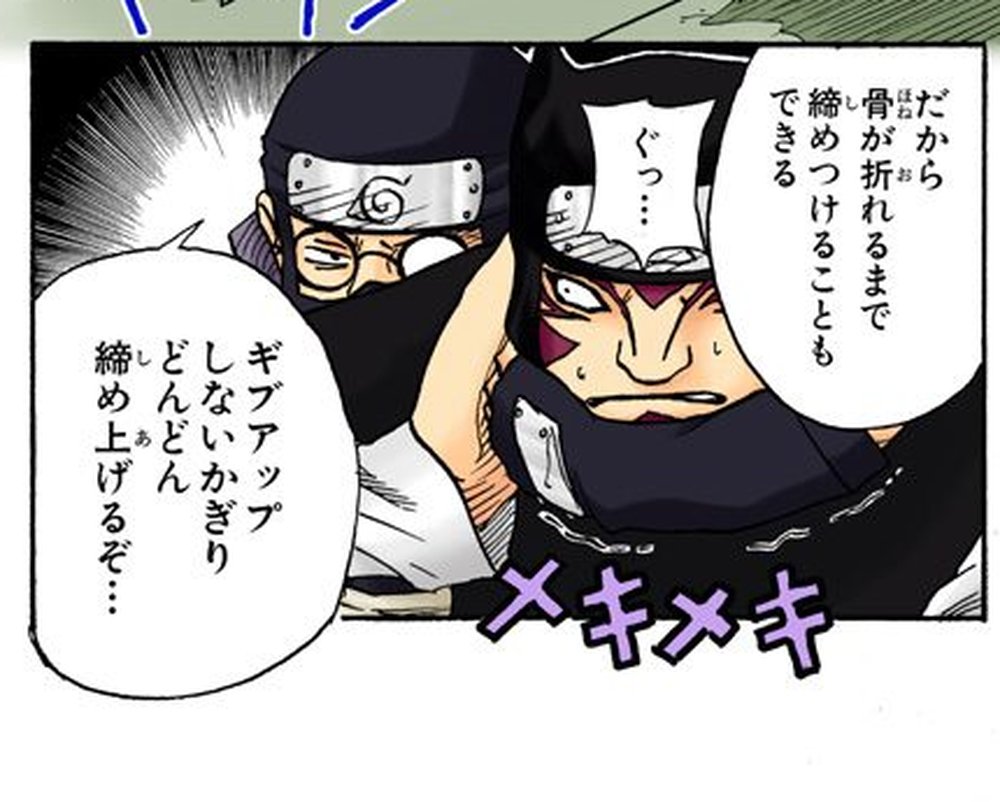
「オレは情報収集の為..どこでも忍びこめる体に改造している あらゆる関節をはずしダニャグニャになった体をチャクラで自在に操れるのさ だから骨が折れるまで締めつけることもできる」
Ore wa jōhō shūshū no tame… doko demo shinobikomeru karada ni kaizō shite iru. Arayuru kansetsu o hazushi guniagunia ni natta karada o chakura de jizai ni ayatsureru no sa. Dakara hone ga oreru made shimetsukeru koto mo dekiru.
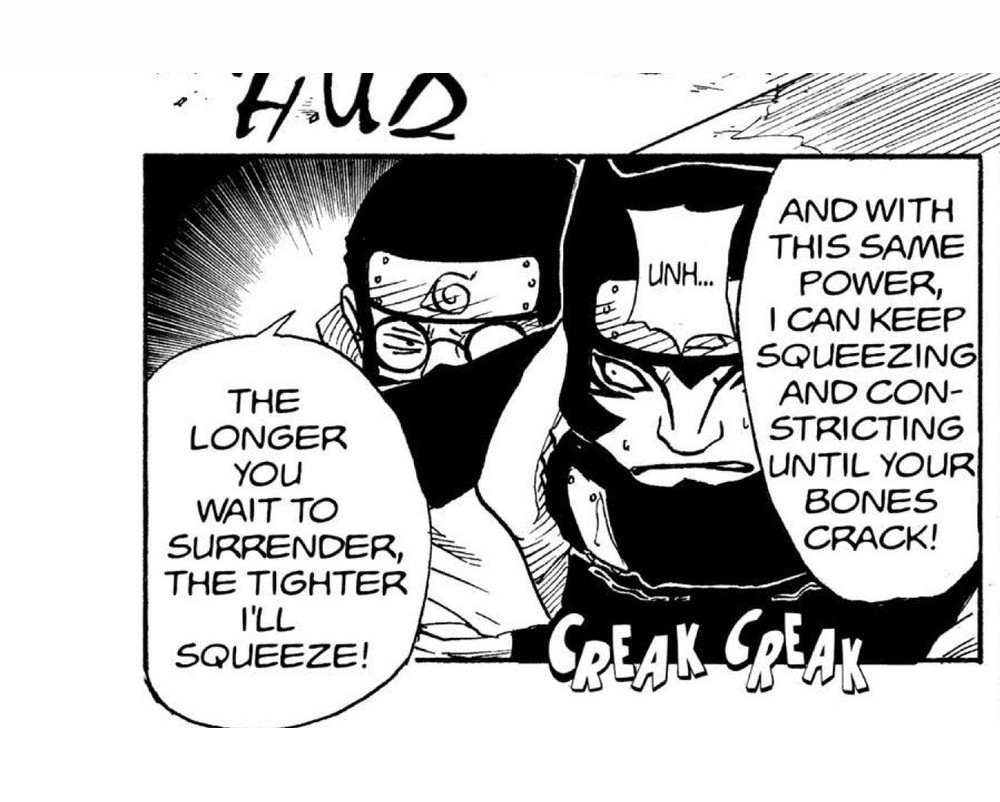
VIZ's English edition prints: "IN ORDER TO GATHER INTELLIGENCE, I'VE HAD MY BODY ALTERED SO THAT IT CAN INFILTRATE EVEN THE SMALLEST SPACE. I CAN DISLOCATE EVERY JOINT AND MANIPULATE MY LIMP BODY BY THE POWER OF CHAKRA ALONE! AND WITH THIS SAME POWER, I CAN KEEP SQUEEZING AND CONSTRICTING UNTIL YOUR BONES CRACK!" (Vol. 8, p.138).
Grant the rendering its due: it's a clean, escalating monologue, exactly the kind of villain show-and-tell shonen fight scenes run on, and "BONES CRACK" lands with the right amount of menace. A page later Misumi doubles down — 「すぐ首の骨をへし折る!」, "...THEN I'LL SNAP YOUR NECK LIKE A TWIG!" — trading 折れる for the more violent transitive へし折る, an active "I will wrench this and break it," no longer a bone simply giving out but a bone he is personally about to snap.
Then the crowd's reaction, three pages after the boast:
「首の骨が折れてる...」
Kubi no hone ga oreteru…
VIZ: "HE BROKE HIS NECK!" (Vol. 8, p.141) — a bystander's shocked gasp, next to Naruto's own "WHAT?!" Off-panel, Kankuro shrugs: 「勢いあまって殺しちまったじゃねーか...」, "HE JUST WOULDN'T GIVE UP... SO I KILLED HIM." Gaara, watching from a distance with the 愛 tattoo plain on his forehead, only sighs: 「フン...くだらん...」, "WHAT A WASTE."
And then, two pages later, the floor drops out from under all of it: 「こ...これは傀儡人形!!」 — "I-IT'S JUST A DOLL... A MARIONETTE!!" Misumi never had Kankuro. He spent the entire fight crushing a wooden puppet's neck, boasting about a kill that was never a kill, and Gaara's "what a waste" reads, in hindsight, like the line already knew.
The Original
骨 (hone) is "bone" — a kanji most learners meet early. 折れる (oreru) is the intransitive half of a pair every intermediate textbook drills: 折る (oru), "to break/snap/fold [something]," against 折れる (oreru), "[something] breaks/snaps/folds," agentlessly, on its own. [骨 が 折れる] literally states a bone entering a broken condition with nobody named as the breaker — and Japanese uses that exact same agentless construction whether the bone belongs to a task ("this job is such backbreaking work my bones are breaking") or to an actual body ("his neck bone has broken"). The idiom 骨が折れる freezes the first reading into a fixed metaphor: [X は] 骨が折れる, "X is a real pain, X takes serious effort" — a rock-hard rice cracker of a task, nothing literal about it. As vocabulary, 骨 and 折れる are individually N4–N3; the set idiom is usually shelved around N2, precisely because knowing the parts doesn't hand you the metaphor for free.
Across the room from 折れる sits its transitive cousin, 骨を折る (hone o oru) — literally "to break a bone," idiomatically "to take pains, to go to great trouble [for someone]." Same skeletal image, opposite grammatical voice: 折れる's sentence has a sufferer (a bone that gives out); 折る's sentence has an actor (someone who breaks a bone — figuratively their own — by working hard). It's the kind of minimal pair Japanese loves and English idiom mostly doesn't bother with: one root image, two set phrases, and whether you're the body taking the damage or the will doing the breaking depends entirely on which half of the transitive/intransitive pair you reach for. (骨を折る gets its own close reading elsewhere on this network, as the same image resurfaces in Demon Slayer.)
English, for what it's worth, isn't starting from zero here. "Backbreaking work" runs on the identical metaphor — labor so punishing it could snap your spine. The idiom exists. It just never gets called up for duty on this particular page, because neither Japanese line quoted above is speaking idiomatically to begin with.
VIZ's Choice
Both appearances of 骨が折れる on file, side by side:
| Vol. / p. | Japanese | VIZ English |
|---|---|---|
| 8 / 138 | だから骨が折れるまで締めつけることもできる | AND WITH THIS SAME POWER, I CAN KEEP SQUEEZING AND CONSTRICTING UNTIL YOUR BONES CRACK! |
| 8 / 141 | 首の骨が折れてる... | HE BROKE HIS NECK! |
Unlike a scattering word like 因縁, there's no inconsistency to chart here — both renderings are straightforwardly, correctly literal, because both Japanese lines are literal. What's worth studying instead is the small grammatical jump between them. Line one keeps Japanese's agentless shape: "YOUR BONES CRACK" names no breaker, just as 骨が折れるまで names none — the bones are the grammatical subject of their own failure, even inside a live threat. Line two switches voice entirely: "HE BROKE HIS NECK!" supplies an agent — "he" — that the Japanese 首の骨が折れてる never states. Japanese reports the neck as a fact in a broken state (折れてる, the ている form of a state having been reached); English, faced with a killing blow, reaches instinctively for an actor and a transitive verb, because "his neck has broken" as a bare report of violence reads oddly passive in English in a way it doesn't in Japanese. VIZ isn't wrong to make that jump — it's what natural English does — but the jump is real, and it's invisible unless you're holding the Japanese next to it.
The Gap
The idiom never shows up as an idiom. Every learner meets 骨が折れる as the word for "what a hassle" long before they meet it in a manga panel, and the one Naruto scene where it appears uses it exclusively for its literal, pre-metaphor meaning — a hard lesson in the difference between a phrase's dictionary entry and its behavior in the wild.
English's own cousin idiom sits unused. "Backbreaking work" is sitting right there, built on the same body-breaks-from-effort image, and it never gets called into service, because there's no metaphor on the Japanese side for it to translate. The idiom's shadow passes right over this scene without ever landing.
The grammar of blame appears and disappears. Japanese states the threat and the outcome with the identical agentless construction — [X が 折れる] — refusing, both times, to grammatically name a breaker even while a very specific someone is doing the breaking. English can hold that agentless shape for the threat ("YOUR BONES CRACK") but drops it for the report ("HE BROKE HIS NECK"), quietly adding a "he" the Japanese sentence never supplies.
The punchline undercuts the violence, and VIZ can't front-load a warning. "HE BROKE HIS NECK!" reads, on first pass, like a manga killing a named side character mid-tournament. Two pages later, both languages reveal it was a puppet's neck, not a person's — and English has no way to soften the shock in advance any more than the Japanese does, because the whole scene is built to let the reader believe it for a beat.
What If
- "...UNTIL YOUR BONES GIVE OUT!" — keeps the intransitive, agentless "the bones simply fail" construction even mid-threat. Cost: "give out" reads closer to exhaustion than violence, softening the menace "CRACK" keeps sharp.
- "HIS NECK'S GIVEN WAY..." (for the page-141 gasp) — preserves the clinical, agentless observation register of 折れてる, a state noticed rather than an act reported. Cost: a touch genteel for a shouted reaction mid-tournament.
- "I'LL GRIND YOU DOWN TILL SOMETHING SNAPS!" — trades the specific noun 骨 for a vaguer threat-verb. Cost: loses the anatomical bluntness of "bone," and severs the direct callback to the neck-break three pages later.
- Lean into the idiom's ghost on purpose: "I'LL WORK YOU TILL YOUR BONES ACHE" — a wink at the phrase's real-world figurative cousin, deployed literally. Cost: too cute for the moment; the pun undercuts a threat the Japanese isn't winking at all.
Take-away
骨が折れる is proof that knowing an idiom's dictionary meaning isn't the same as knowing how to read it on the page. The one time it appears in the Naruto corpus, it means exactly what its four characters say and nothing that the JLPT vocabulary list says — bones, a threat, then a body on the ground that turns out to be made of wood.
Three rules of thumb to carry off this page:
- A set idiom's dictionary gloss is a default, not a guarantee. 骨が折れる "means" backbreaking effort right up until a scene needs it to mean backbreaking bones — context decides which reading is live, not the phrase itself.
- Watch 折れる and 折る trade places. The intransitive form puts a bone (or a task) in the grammatical hot seat; the transitive form puts a person there. Same root, opposite responsibility — and 骨を折る flips the same image into "to take pains," one door down from this article.
- When Japanese won't name the agent, ask why. [骨 が 折れる] describes damage without a culprit even mid-fight; English usually can't resist supplying one. That gap is small, structural, and easy to miss unless you're translating both directions at once.
Naruto's other body-idiom entries chase the same question through different limbs — teeth in 歯が立たない, hands in 手に負えない, the mouth in 口を割る — and this one adds bone to the set, with the twist that it's the only body part on the list that shows up meaning exactly what it says. For more of what the Chunin Exam prelims hide from English, browse the full Naruto translation notes index.
Every Japanese and English line quoted above is a byte-exact capture from the cited editions — NARUTO―ナルト― Vol. 8 (Japanese) and Naruto (VIZ Media) at the corresponding panels — via our bilingual page database; see Sources below.