The Moment
Snowbound, years before Chopper ever meets either of them: a masked doctor drops down a family's chimney to treat a dying man for free, waves off a bounty hunter with a warning shot of his own, and slips back out into the snow to needle a rival across a bridge. The panel just before ours names him outright: 「Dr.ヒルルク登場から!!!」 — "Dr. Hiluluk, entering from the chimney!!!" A handful of pages of backstory establish exactly what kind of doctor he is: 「見くびってもらっちゃ困る おれァ病人から金は取れねェんだよ」— "Don't underestimate me — I don't take money from a sick person." He treats for free, dodges the ruler's officially licensed "Isshii-20" quacks, and gets hunted for the trouble: 「おれは“医者狩り”などには捕まらねェ」— "I won't get caught by any 'doctor hunters.'"
Then he runs into the island's other real doctor, on a bridge in falling snow: the 133-year-old, silver-haired Dr. Kureha. She opens with a diagnosis of her own — 「腕のない医者ほど恐いものはこの世にないね」— "There's nothing more frightening in this world than a doctor with no skill" — all but accusing him of turning ordinary colds into medical disasters with his home-brewed cures. Hiluluk doesn't take it lying down. He turns the accusation around, aimed straight back at her:
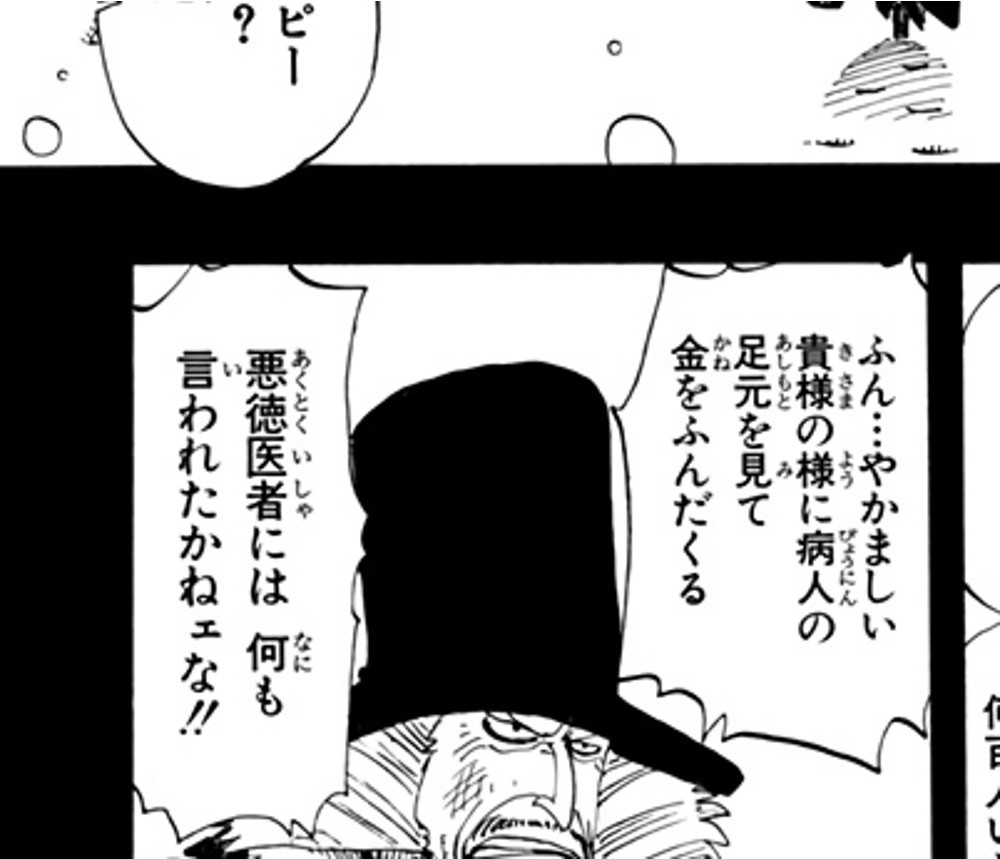
「ふん…やかましい 貴様の様に病人の足元を見て金をふんだくる悪徳医者には何も言われたかねェな!!」
Fun… yakamashii. Kisama no yō ni byōnin no ashimoto o mite kane o fundakuru akutoku isha ni wa nani mo iwaretakanē na!!
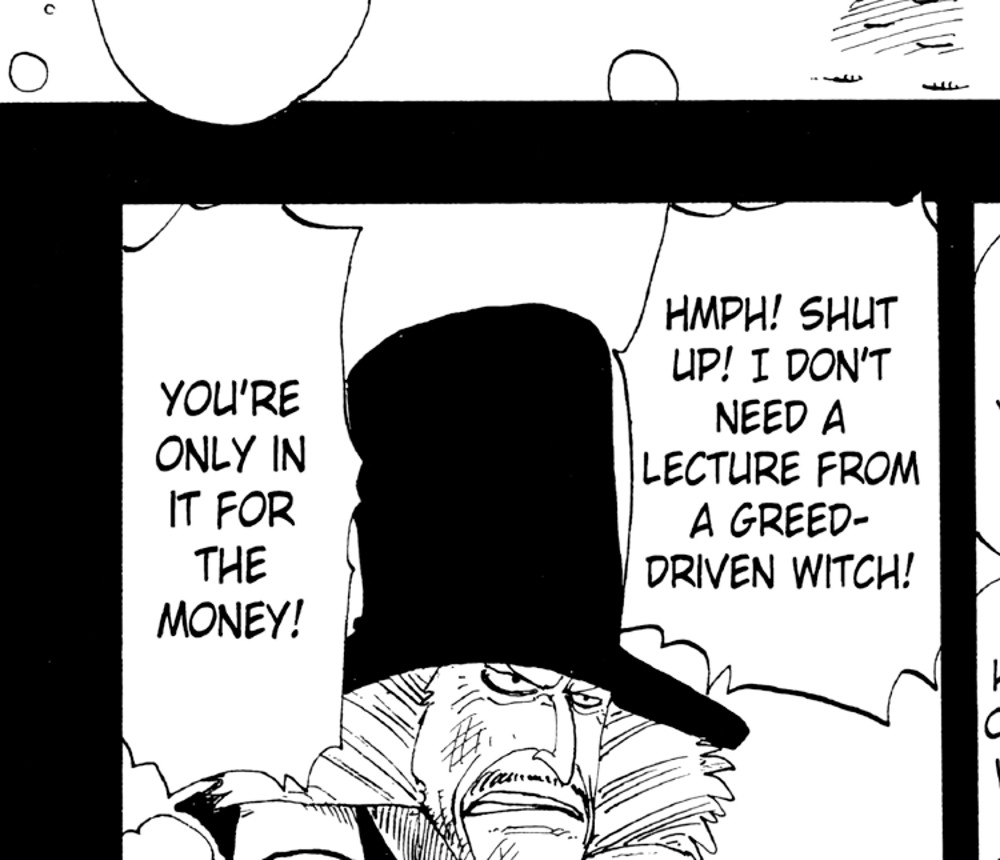
VIZ's English edition — the sentence re-lettered across the same panel's two word balloons — reads: "HMPH! SHUT UP! I DON'T NEED A LECTURE FROM A GREED-DRIVEN WITCH! YOU'RE ONLY IN IT FOR THE MONEY!" (Vol. 16, p.101).
Grant the rendering its due: it's snappy, it fits two normal-sized balloons, and "greed-driven witch" lands as a real insult — Kureha does, moments later in the same scene, cheerfully own being blunt about payment (「そいつはあたしのスタイルさ」— "That's my style"). But the specific mechanism of Hiluluk's insult — the thing he says she actually does, not just what she supposedly is — never makes it into English. He isn't only calling her greedy. He's describing an action: she looks at a sick man's feet, and grabs his money.
The Original
Take the idiom apart, because every piece of it stays visible on the surface.
足元 (ashimoto) = 足 (ashi, "foot/feet") + 元 (moto, "base, root; the place something originates from") — "the ground right under your feet; your footing; where you stand." 見る (miru) is the plain dictionary verb "to look at." Put together, literally: to look at [someone's] feet/footing. Nothing here has drifted into pure abstraction the way, say, 猫の手も借りたい ("I'd even borrow a cat's paws," for "I'm desperately busy") has worn down from image to cliché — a Japanese speaker reaching for 足元を見る is still, faintly, picturing an actual downward glance.
The idiom's home is the Edo-period post road. Before rail or car, a traveler crossing Japan on foot — along the Tōkaidō, say, between Edo and Kyoto — covered the distance one weary stage at a time, and by the time he reached a post town his feet told the whole story: blistered, swollen, unsteady. 駕籠かき (kagokaki), palanquin-bearers, and 馬子 (mago), packhorse drivers, waiting at these stations made a business of reading exactly that story. A traveler whose feet had visibly given out had no leverage left; he would pay whatever fare was named rather than walk another mile on ruined feet. 足元を見る — literally, checking a traveler's feet — became shorthand for the whole transaction: notice the weakness, then price it.
The image outlived the transport it describes. Modern Japanese still reaches for 足元を見る whenever one party in a deal — a repair shop, a landlord, a scalper, a doctor — is accused of pricing not by the service but by how badly the other side needs it. Grammatically the idiom is nothing exotic — [PERSON の 足元 を 見る], "to look at [person]'s feet" — but the idiomatic sense (exploit a vulnerable position) rather than the literal one (check someone's shoes) is advanced usage: the kind of idiom that shows up in N2–N1 reading passages and business-Japanese guides rather than a beginner's textbook. It keeps productive company, too: 足元を固める ("to solidify one's footing," i.e., secure your position before acting), 足元にも及ばない ("not even within reach of someone's feet," i.e., hopelessly outclassed), 足元に火がつく ("fire catches at your feet," i.e., danger closing in). Wherever 足元 shows up, the same root idea is at work: your feet are where your position — strength or weakness — actually lives.
VIZ's Choice
We have exactly one occurrence of 足元を見る on file across the volumes indexed here, so there's no scatter table to build. Instead, look closely at the single choice VIZ made — and at what got trimmed to make it fit.
The Japanese is one continuous sentence, hand-lettered into a single balloon in the original: "Hmph... shut up. From a corrupt doctor who, like you, looks at a sick man's feet and grabs his money — I don't want to hear anything!!" VIZ's English edition splits it into two separate balloons in the same panel, in reading order: "HMPH! SHUT UP! I DON'T NEED A LECTURE FROM A GREED-DRIVEN WITCH!" then "YOU'RE ONLY IN IT FOR THE MONEY!" Read together, they land as two short punches instead of one long one — a smart lettering call. Long vertical Japanese sentences routinely get broken into shorter horizontal English bites so a balloon doesn't overflow its art.
But watch what happens to 足元を見て金をふんだくる specifically — one continuous action in Japanese, "look-at-feet-then-grab-money." Two separate English adjectives absorb it: "greed-driven" (a disposition) and "only in it for the money" (a motive). Both are accurate summaries of what a person who does that would be like. Neither one is the doing. Nothing in the English asks the reader to picture Kureha's eyes traveling down to a patient's feet before she names her price — the idiom's whole reason for existing.
The Gap
Diagnosis becomes character trait. Japanese narrates an action — glance at the feet, size up the weakness, charge accordingly, in that order. English narrates a personality — greedy, money-driven. "Witch" and "only in it for the money" describe who Kureha supposedly is; 足元を見る describes what she supposedly does, in this specific moment, to this specific kind of victim. The verb-shaped idiom becomes an adjective-shaped insult.
The buried pun on "feet" evaporates. Hiluluk's insult targets a doctor lecturing him about medicine, and the people he accuses her of exploiting are 病人 — literally sick patients, people who may quite literally be too weak on their feet to walk out and find someone cheaper. The idiom's built-in body part brushes against the literal bodies in the sentence, a bit of authorial texture a Japanese reader half-registers without needing to name it. "Greed-driven witch" has no feet in it anywhere — there's nothing left to notice.
A specific tactic flattens into generic greed. 足元を見る isn't vague avarice; it's a named bargaining tactic — price-gouging a captive customer, the palanquin-bearer's trick. "Greed-driven witch" could describe almost any villain in the story. The Japanese insult is narrower and more damning: Hiluluk isn't saying Kureha simply likes money. He's accusing her of a cold, specific calculation — wait until someone is desperate, then set the fare.
What If
No option is free; here is the menu and its prices.
- "...From a doctor who reads a sick man's feet and charges him for it — I don't need that lecture!!" — keeps the literal downward glance and the specific transaction. Cost: longer, harder to fit into two normal-width balloons.
- "HMPH! SHUT UP! YOU'RE THE ONE WHO PREYS ON SICK MEN'S WEAKNESS FOR A PROFIT!" — punchy, keeps the exploitation mechanism in one balloon. Cost: "weakness" is still abstract; the feet, and the gesture of checking them, are gone.
- "...From someone who sizes up a patient's weak spot and names her price accordingly!!" — keeps the sequence (notice weakness, then charge) that is the idiom's core logic. Cost: drops the concrete body part — the same trade VIZ's own line already makes, just phrased differently.
- Keep VIZ's two balloons, sharpen the second: "HMPH! SHUT UP! I DON'T NEED A LECTURE FROM A GREED-DRIVEN WITCH! — ONE WHO READS A DYING MAN'S FEET FOR HER FEE!" — Cost: cramped, and "reads... feet" needs a beat of cultural context (the palanquin-bearer's trick) an English reader doesn't have, so it risks landing as merely odd rather than pointed.
Take-away
足元を見る is a verb describing an act of exploitation-through-observation, not an adjective describing greed. When you meet it in translation, ask what the subject just did, not what they're supposedly like — the whole idiom is a sequence: look, calculate, charge.
Three rules of thumb to carry off this page:
- 足元を見る names a mechanism, not a mood. "Take advantage of," "exploit," and "greed-driven" all report the verdict; the Japanese stages the moment of judgment itself.
- 足元 is a productive root. 足元を固める (secure your footing), 足元にも及ばない (hopelessly outclassed), 足元に火がつく (danger closing in) — wherever 足元 shows up, your feet stand in for your position, strength, or weakness.
- A concrete idiom can survive centuries after its literal occasion disappears. Nobody bargains with palanquin-bearers anymore, but every Japanese speaker still glances, metaphorically, at someone else's feet before naming a price.
For another line where a body part carries an idiom straight through One Piece and English has to rebuild it in the abstract, see 手も足も出ない, "not even a hand or a foot will come out," for being utterly overwhelmed, or 腰が抜ける・腰抜け, the collapsing hips behind "coward". Browse more at the One Piece translation notes index.
Every Japanese and English line quoted above is a byte-exact capture from the cited edition — ONE PIECE Vol. 16 (Japanese) and One Piece Vol. 16 (VIZ Media) at the corresponding panel — via our bilingual page database; see Sources below.