The Moment
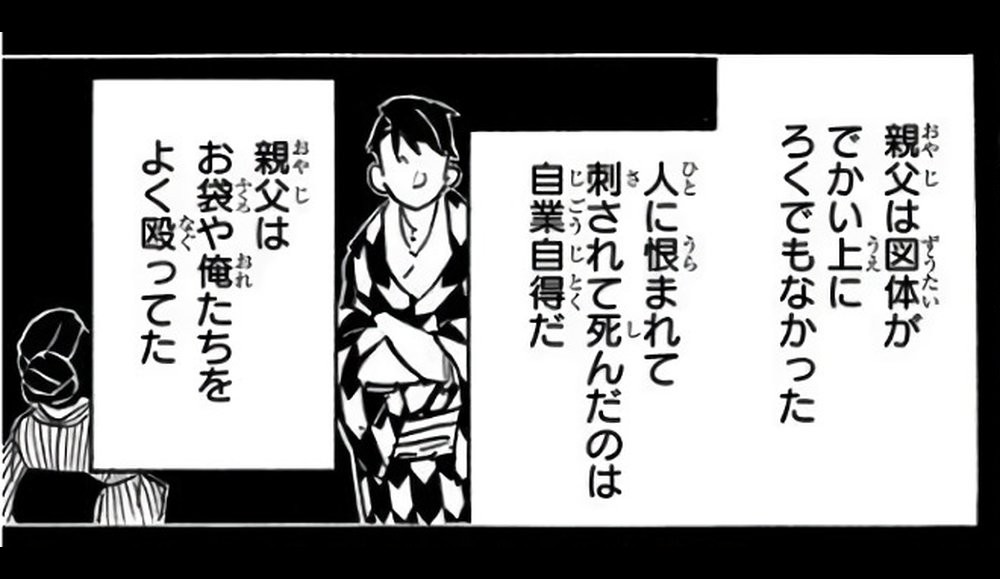
Volume 13, Chapter 115 — "To Be a Hashira." A new Hashira has just been confirmed, and the manga pulls back into a private memory: a boy growing up faster than his tiny mother, in a house ruled by a father twice her size. The narration is spare, almost clinical, right up until it reaches him:
「親父は図体がでかい上にろくでもなかった」
Oyaji wa zūtai ga dekai ue ni roku demo nakatta.
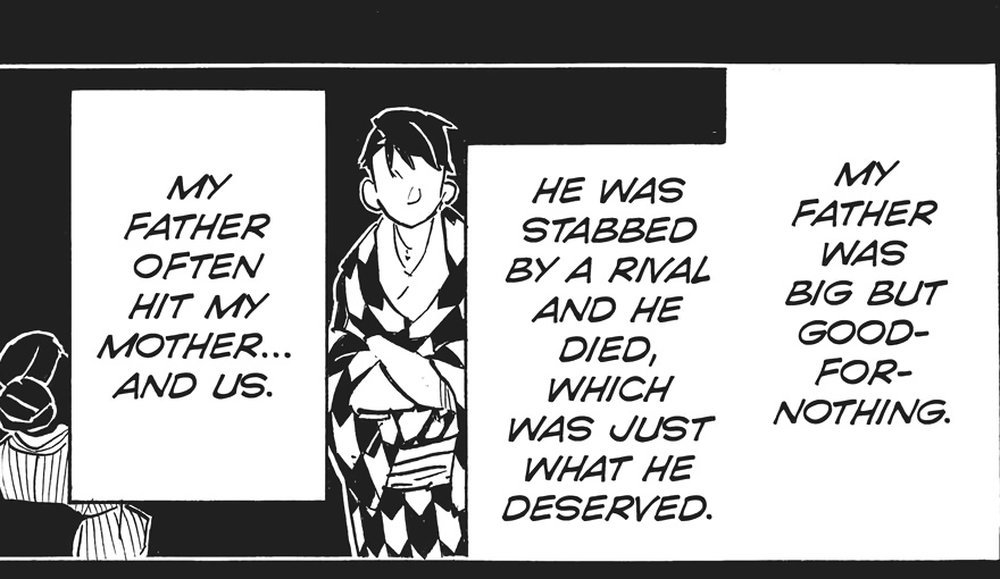
VIZ's English edition prints: "MY FATHER WAS BIG BUT GOOD-FOR-NOTHING." (Vol. 13, p.173).
Grant the rendering its due: it's compact, it scans, and "good-for-nothing" is a fair match for ろくでもない. But sit the two sentences side by side and something has gone quiet. The Japanese doesn't report a father's size and then, separately, his worthlessness — it reaches for a noun, 図体, that already carries the sneer before ろくでもなかった even arrives. "Big" is a fact. 図体 is a verdict.
The flashback belongs, page by page, to Sanemi Shinazugawa — the man this chapter has just watched become the Wind Hashira — recalling the house he grew up in: a mother "so small" (体の小さな人) he outgrew her almost as soon as he could walk, and a father whose one remarkable trait, size, wasn't remarkable at all. Two pages later the same flashback turns into the night that ended that childhood — his mother turned demon, his little brother Genya screaming 人殺し ("MURDERER!!") at him in the dark — but it opens here, with a settled, retrospective contempt for a man whose only notable feature Japanese refuses to dignify.
The Original
図体 splits cleanly: 図 (zu), "a drawn figure, shape, or diagram" — the same 図 in 地図 (chizu, "map") and 図面 (zumen, "blueprint") — plus 体 (tai), "body." Neither character alone demands size or judgment; 図 is just a shape drawn or traced, 体 is just a body. Put together, 図体 literally means something like "the figure a body draws" — the visible bulk or silhouette a person's frame amounts to.
But usage narrowed the compound hard. In practice 図体 is reserved almost entirely for BIG frames, and its dictionary gloss is blunt about the attitude that comes attached: body size, most often used to belittle a large body. It is not the word for "body" you'd use in a hospital, a gym, or a compliment. It is the word for a body that is, in some sense, too much — too big for the room, too big for the job, too big to be taken entirely seriously.
The set phrase in our headline pairs the noun with でかい — the rough, spoken cousin of 大きい ("big"), the kind of word a truck driver or a delinquent uses, not a word you'd find in a school essay. And the sentence structure performs an escalation of its own: 図体がでかい上にろくでもなかった, "his frame was huge, and ON TOP OF THAT he was good-for-nothing" — 上に (ue ni) stacking a second charge onto a first, as if the size alone were already most of the indictment. As vocabulary, 図体 sits around JLPT N1 — not because 図 or 体 are exotic (both are taught by N4) but because the word's specific, disparaging collocation is the kind of native idiom no textbook drills.
VIZ's Choice
図体 surfaces three times in the Kimetsu no Yaiba volumes we have on file. Side by side:
| Vol. / p. | Japanese | VIZ English |
|---|---|---|
| 13 / 173 | 親父は図体がでかい上にろくでもなかった | MY FATHER WAS BIG BUT GOOD-FOR-NOTHING. |
| 14 / 161 | 図体に見合わぬ筋力...特異体質 | ...HAS A SPECIAL CONSTITUTION. HER PHYSIQUE BELIES HER MUSCLE DENSITY. |
| 19 / 185–186* | この武器を手足の如く扱える筋力あの重量の図体で/これ程の身軽さ俊敏さ/俄かには信じ難し | HE'S HEAVILY BUILT AND HAS THE STRENGTH TO WIELD THIS WEAPON LIKE AN EXTENSION OF HIS OWN BODY... WITH SO MUCH LIGHTNESS AND AGILITY. IT'S UNBELIEVABLE. |
*The Vol. 19 line runs one page later in the English edition (p.186) than in the Japanese (p.185) — a routine pagination offset between the two editions at this point in the volume; it's the same scene, just shifted by a page, and the corpus's auto-aligned English text for p.185 turns out to be a garbled merge rather than the real bubbles, which we tracked down on p.186 instead.
Not scatter this time — convergence. Sanemi's father is "big." The demon studying Kanroji Mitsuri calls her body a "physique." Kokushibō, marveling at Gyōmei Himejima mid-swing, calls him "heavily built." Three completely different speakers, three completely different tones — contempt, clinical analysis, grudging awe — and English settles every single one on a neutral size-word. 図体 disappears as a specific choice and reappears as an unmarked fact.
Look at what's genuinely lost in each case. Sanemi's line needs "GOOD-FOR-NOTHING" to do the sneering that 図体 was already doing for free — read honestly, the Japanese says something closer to "my father had a big, worthless-looking body, and was ALSO good-for-nothing," a double contempt collapsed to one. The Upper Rank Four demon isn't offering clinical analysis so much as amazement laced with disdain — this scrawny-looking girl shouldn't hit like that — and "PHYSIQUE BELIES HER MUSCLE DENSITY" reads like a lab report. And Kokushibō's astonishment at Gyōmei only makes sense as astonishment if you already know 図体 smuggles in the assumption that big should mean slow: the word is doing the setup for the joke, and English's "heavily built" just states the punchline as a fact.
The Gap
English's neutral size-words carry no built-in verdict. "Big," "massive," "heavily built" are observations; calling someone big is not, by itself, an insult. 図体 never needs help — the noun is the insult, no adjective required. Every VIZ rendering here reaches for a fact-word to translate a judgment-word, and the judgment has to either ride on some other word in the sentence (ろくでもない, in Sanemi's line) or vanish outright (in the other two).
There is no English word that means "a big body, and the bigness is itself the complaint." "Hulking," "bulky," "brawny" all come close, but each one imports its own specific flavor — menace, clumsiness, muscle — rather than 図体's open-ended, all-purpose derision. A translator has to either borrow one of those words and risk the wrong flavor, or default to something neutral and lose the derision completely. VIZ chose the neutral path all three times in Kimetsu — though, tellingly, not in every VIZ manga.
図体's built-in assumption is the whole joke in the Kokushibō line, and English states it as observation instead. "HE'S HEAVILY BUILT... WITH SO MUCH LIGHTNESS AND AGILITY" reads as two facts laid side by side. あの重量の図体で...これ程の身軽さ俊敏さ reads as a contradiction resolved: he has that huge, ought-to-be-clumsy frame, and STILL moves like that. The word supplies the "ought to be clumsy" half of the equation for free; English has to reconstruct it, if it bothers to at all.
The pattern isn't unique to Kimetsu — and one VIZ translator got closer than the others. In One Piece Vol. 25, a pirate mocks defeated brutes who begged for their boss: あの図体で/血まみれの顔に涙とハナ水たれ流して — "WITH THOSE COMICAL BODIES AND... BLOODY FACES AND SNOT STREAMING FROM THEIR NOSES." In Naruto Vol. 14, Jiraiya needles the scarred interrogator Ibiki Morino: 成長したのはその図体だけかァ!? — "IS THAT HULKING BULK OF YOURS THE ONLY THING THAT'S MATURED?!" "Hulking bulk" is the one rendering in our whole sample that actually reaches for a size-word carrying its own built-in judgment — closer to what 図体 is doing than any of the three Kimetsu lines managed. Same idiom, same publisher, a different translator's hand — a reminder that the gap isn't inevitable, just usual.
What If
For Sanemi's line, the menu and its prices:
- "My father was a big lump of nothing." — fuses size and worthlessness into one contemptuous image, closer to how 図体 pre-loads its own judgment. Cost: "lump" tips toward comic where the Japanese is flat and bitter.
- "My father was a great hulking waste of a man." — borrows English's one size-word that carries its own built-in judgment, the way Naruto's translator did for Jiraiya. Cost: more ornate than 親父's blunt, spoken register.
- "All that size on my father, and not one good thing to show for it." — spells out the size-≠-worth logic the Japanese leaves implicit. Cost: wordy; loses the punch of two adjectives landing back-to-back.
- Keep VIZ's "big," restore the bite: "MY FATHER WAS A HULKING GOOD-FOR-NOTHING." — merges the sentence's two separate charges into one compound epithet. Cost: drops the 上に escalation — the sense that size is singled out first, deliberately, before the second charge lands.
Take-away
図体 isn't a bigger word for "body" — it's a verdict wearing a body's clothes. Japanese reserves it for frames that are big without being anything else: without strength that matches, without grace that matches, without a person inside who's earned the size. English's "big," "physique," and "heavily built" report the measurement and let the judgment go.
Three rules of thumb to carry off this page:
- When you meet 図体, assume contempt is already spoken for. Unlike 体格 or 身体, this word doesn't need an insulting adjective attached — it arrives pre-loaded, and a sentence that pairs it with one more insult (as Sanemi's does) is stacking, not introducing, the judgment.
- 図体's real partner is disappointment, not size. Watch for 図体に似合わず and 図体に見合わぬ — "for all that size," "size that doesn't match" — the word is built to set up a letdown, or (rarely, as with Gyōmei) an expectation-defying surprise.
- Test a translation by asking whether "big" alone would do. If a plain size-word captures everything the Japanese sentence says, the translation has quietly swapped 図体 for 体格 — accurate on the measurement, silent on the sneer.
For more Demon Slayer body-and-appearance idioms English couldn't carry across whole, see the complexion under constant watch in 顔色, the nose that simply "works" in 鼻が利く, and the liver that sits and the hips that give out in 肝が据わる・腰を抜かす — the very same battle, a few pages later, where Kanroji Mitsuri's own 図体に見合わぬ筋力 line above takes place. Or browse the Demon Slayer translation notes index.
Every Japanese and English line quoted above is a byte-exact capture from the cited editions — 鬼滅の刃 Vol. 13, 14 & 19 (Japanese) and Demon Slayer: Kimetsu no Yaiba (VIZ Media) at the corresponding panels — via our bilingual page database; see Sources below.