The Moment
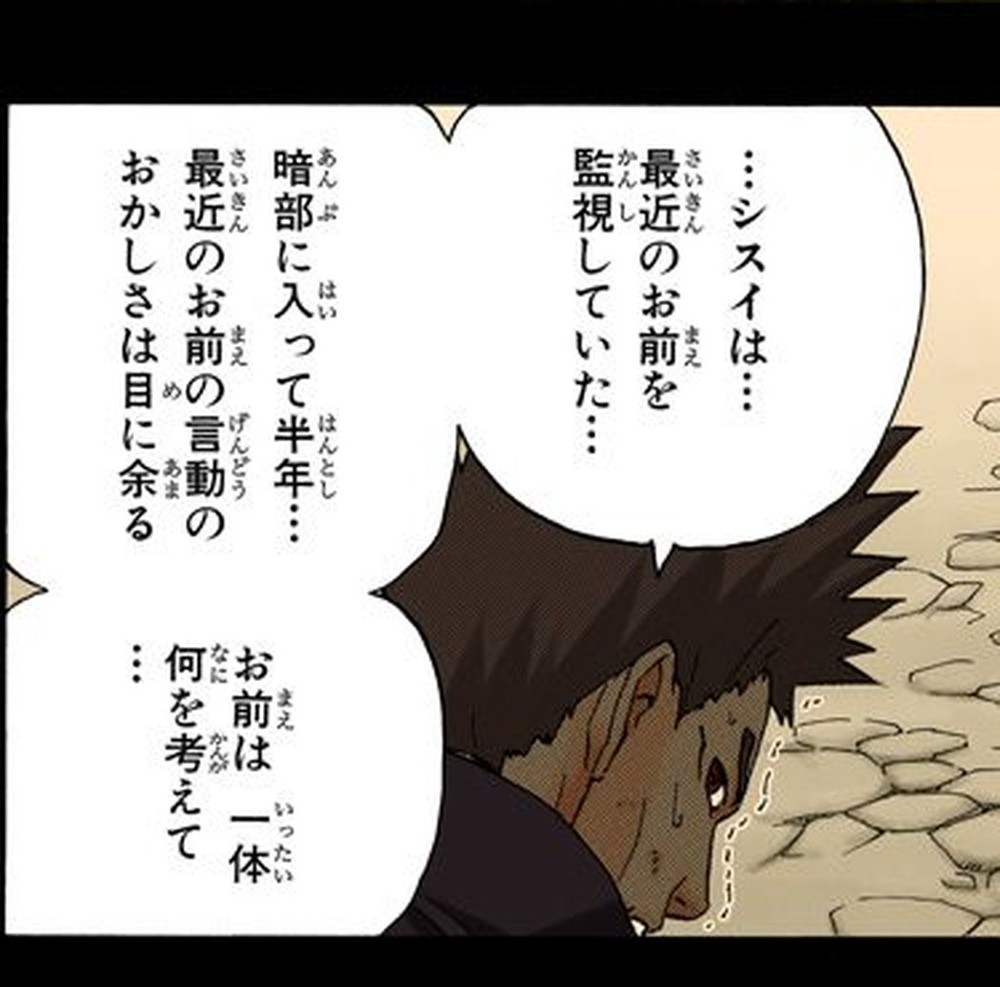
The scene doesn't announce itself. A boy — Sasuke, years before anything in this hub's other Naruto entries — has followed a sound to a doorframe he isn't supposed to be standing at, and he peers around it, sweating, wide-eyed, at a brother he has never seen "like this." Outside, on a stone path along the clan compound's wall, someone is on the ground, leaning back on his hands, muttering the same two words on a loop:
「一族...一族...」
Ichizoku… ichizoku…
VIZ: "THE CLAN... THE CLAN..."
That's Itachi. An unseen figure standing over him keeps talking — about how "you people" (あんたら) misjudge the size of your own "vessel" (器), about how Itachi has no idea of the depth of his — 「オレの”器”の深さを知らぬから今そこにはいつくばってる」, "...AND YOU HAVE NO IDEA OF THE DEPTH OF MINE, WHICH IS WHY YOU'RE CRAWLING RIGHT NOW." — and then the lecture turns from taunt to file report:
「暗部に入って半年...最近のお前の言動のおかしさは目に余る」
Anbu ni haitte hantoshi… saikin no omae no gendō no okashisa wa me ni amaru.
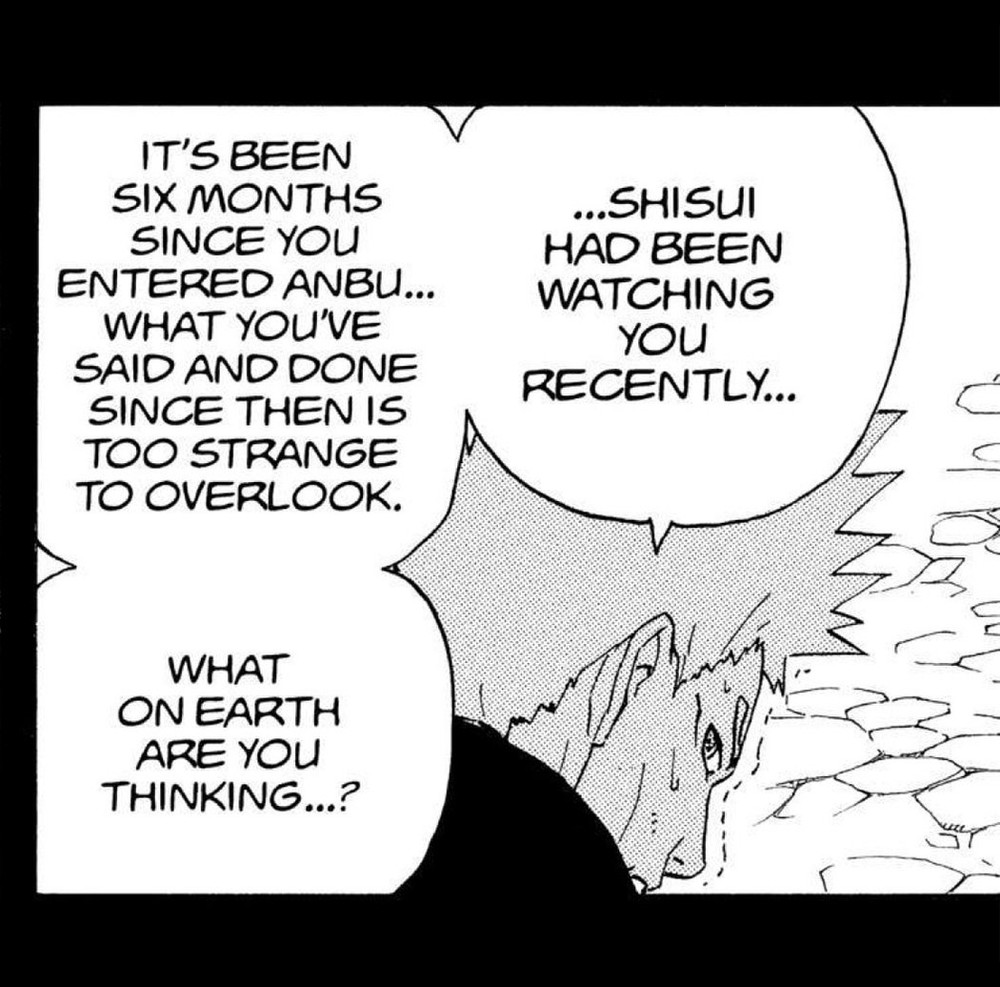
VIZ's English edition prints: "IT'S BEEN SIX MONTHS SINCE YOU ENTERED ANBU... WHAT YOU'VE SAID AND DONE SINCE THEN IS TOO STRANGE TO OVERLOOK." (Vol. 25, p.98.)
Grant the rendering its due: it's a clean, natural piece of English dialogue, and it lands the verdict the Japanese is building toward — this cannot be quietly set aside any longer. A moment later someone bursts in shouting 「止めろ!イタチ!!」 — "ITACHI, STOP IT!!" — and the memory cuts away. We don't get the reprimanding figure's face in this panel, only the accusation and the six-months-in-ANBU timestamp that identifies the person on the receiving end beyond doubt: this is young Itachi, already being watched, already being measured and found wanting, years before the massacre that will define everything Sasuke thinks he knows about his brother.
The Original
目に余る is three ordinary pieces doing one uncommon thing together. 目 (me) is "eye" — no surprise there. に (ni) is the particle that marks where an action lands. And 余る (amaru) is the plain intransitive verb Japanese uses for anything left over or in excess: it's the verb in お釣りが余る ("there's change left over"), in 時間が余る ("there's time to spare"), in food piled higher than a plate can hold.
Put them together and 目に余る doesn't literally mean "I can't ignore this." It means: this has become too much for the eye — the eye recast as a vessel with a rim, and misconduct recast as a liquid poured into it past capacity. Once something 目に余る, it isn't a judgment call anymore; it's an overflow, visible and undeniable, the way water on a table is undeniable once a cup stops holding it.
The idiom is JLPT N1, and its home turf is formal: news copy about a corrupt official (目に余る不正, "corruption too flagrant to overlook"), a teacher's report on a student's conduct, a superior's assessment of a subordinate — exactly the register of the scene it appears in here. It almost always describes an accumulation rather than a single act, which is why the line doesn't arrive alone: it's preceded by a specific duration, 暗部に入って半年 ("six months since you entered ANBU"), the half-year of small excesses that the sentence is now totaling up.
And 余る isn't a one-off metaphor; it's a small family. 手に余る (te ni amaru) puts the same overflow in the hands — a job too heavy to keep carrying. 身に余る (mi ni amaru) puts it on the whole body, most often for excess in the good direction: 身に余る光栄, "an honor beyond what I deserve." 目に余る is the family's eye-branch, reserved for watching someone else's conduct spill past what a bystander can quietly absorb.
VIZ's Choice
Across the volumes we have on file, 目に余る surfaces exactly once — this line, this page, this reprimand. With a single occurrence there's no scatter to chart, no table of five divergent English words the way a recurring term like 因縁 demands; there's just one translator, one sentence, one decision to examine closely.
And the decision holds up better than most single-shot idiom translations do. "TOO STRANGE TO OVERLOOK" keeps the sentence's real payload — おかしさ ("the strangeness/wrongness") as the grammatical subject, 目に余る as what happens to it — and maps おかしさ onto "strange" doing the overflowing and "overlook" catching the verdict. Structurally, that's a tight, idiomatic one-to-one swap, not a paraphrase. The catch is that "overlook" is doing something different under the hood than 目に余る is: English's word is built from a look that travels over and past its target, missing it; Japanese's idiom is built from a container that has run out of room. VIZ found the one English idiom that lives in roughly the same neighborhood — eyes, missing things, failing to notice — without importing the actual furniture of the Japanese image. It's a coincidence of domain, not of mechanism, and it's a good enough coincidence that most readers will never notice the swap happened at all.
The Gap
The vessel disappears. 目に余る's entire argument is that the eye is a container and this misconduct has exceeded it. "Overlook" has no container in it anywhere — it has a gaze that wanders past its target. The reader who only has the English will never learn that Japanese pictures bad behavior as something that physically spills, the same verb family used for change overflowing a hand or rice piled past a bowl's rim.
おかしさ loses its moral edge. おかしい can mean funny, odd, or improper — and in a lecture accusing Itachi of clinging to his organization, his clan, and his name (the very next lines on the page: 組織に執着し一族に執着し名に執着する), おかしさ is doing the "improper, out of line" job, not the "eccentric" job. "Too strange" reads like a diagnosis of weirdness. The Japanese reads like a charge sheet.
The accumulation flattens into a verdict. 余る names a process — small excesses stacking, one after another, until there's no room left — and the line supplies the exact stretch of time that process took: six months. "Too strange to overlook" states the conclusion without carrying the sense that it was built, incident by incident, across that half-year. The six months sits next to the verdict in English; in Japanese, it's the thing that filled the eye.
What If
- "The wrongness of your recent words and deeds has become more than I can overlook." — restores おかしさ's moral-impropriety sense and keeps "overlook." Cost: longer, and still trades Japanese's overflow for English's missed gaze.
- "...what you've said and done since then has gone too far to ignore." — "gone too far" is at least a threshold crossed, closer kin to 余る's excess than "overlook" is. Cost: a distance metaphor, not a container metaphor — a different image, just a nearer neighbor.
- "I can no longer turn a blind eye to your conduct these past six months." — reaches for English's own eye-idiom for willful overlooking, which sets up a clean antonym pairing with 大目に見る ("to see with a big eye"). Cost: "turn a blind eye" makes overlooking the observer's choice; 目に余る makes the overflow the misconduct's own doing. The agency runs backwards.
- "Your conduct these past six months has overflowed anything I can let pass." — keeps the overflow image intact, almost literally. Cost: reads translated rather than spoken; no English speaker reaches for this sentence unprompted.
Take-away
目に余る doesn't describe bad behavior — it describes bad behavior that has stopped being containable, using the same overflow verb Japanese reaches for whenever a hand, a bowl, or a body has taken on more than it can hold. English's "too strange to overlook" gets the verdict right and the machinery wrong: it swaps a vessel that's run out of room for a gaze that's slid past its target, borrowing the eye without borrowing the overflow.
Three rules of thumb to carry off this page:
- When you meet 余る attached to a body part, look for what's overflowing, not what's missing. 目に余る, 手に余る, 身に余る all picture excess spilling past a limit — the opposite move from an English idiom like "overlook," which pictures a failure to catch something in the first place.
- 大目に見る is the idiom's built-in answer key. If 目に余る is an eye too small to hold the offense, 大目に見る is a deliberate choice to make the eye bigger — the same container logic, run in the generous direction.
- Duration often sits right next to this idiom for a reason. 目に余る tends to follow a stated stretch of time (here, 半年) because the idiom names an accumulation, not a single incident — read the timestamp as part of the verb, not just as scene-setting.
This scene hides a second capacity-metaphor in plain sight: the same lecture that ends in 目に余る opens by mocking the size of Itachi's own "器" (vessel) — two overflow-images, one page, both flattened by English into abstract nouns like "abilities" and "strange." For two more moments where this hub tracked what a character's own eyes were doing, see Naruto sizing up his own guesswork in 目星 and a teammate reading an unnamed color off a friend's face in 顔色; for a cousin idiom that keeps its body-part image intact where this one loses it, see 肝に銘じる. For more of what Naruto's translators quietly relocate, browse the Naruto translation notes index.
Every Japanese and English line quoted above is a byte-exact capture from the cited editions — NARUTO―ナルト― Vol. 25 (Japanese, colorized digital edition) and Naruto (VIZ Media) at the corresponding panels — via our bilingual page database; see Sources below.