The Moment
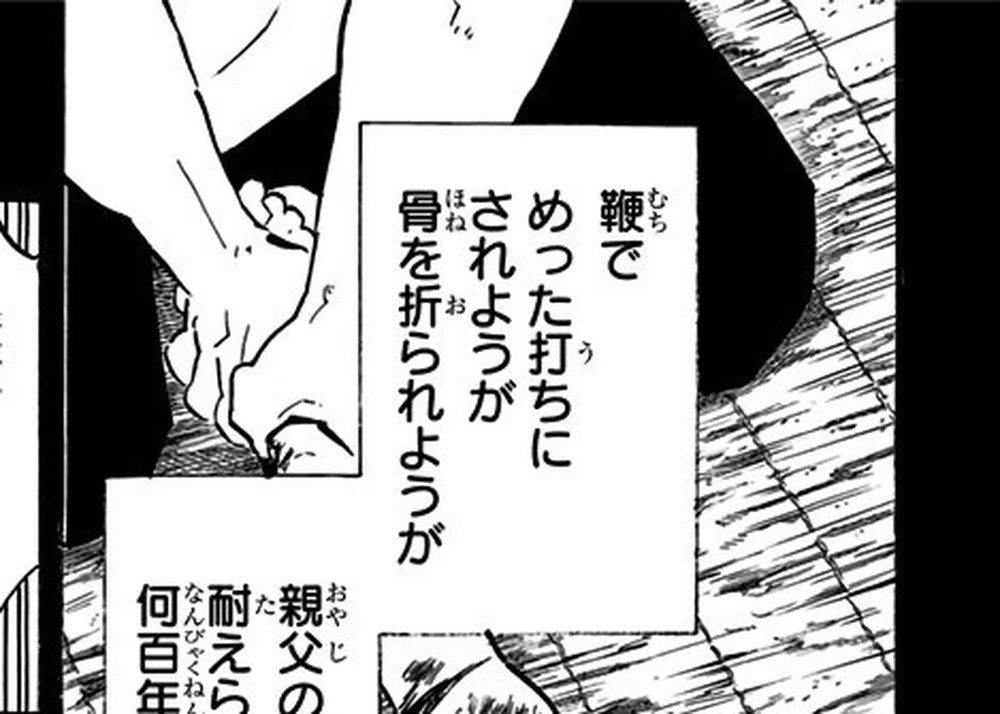
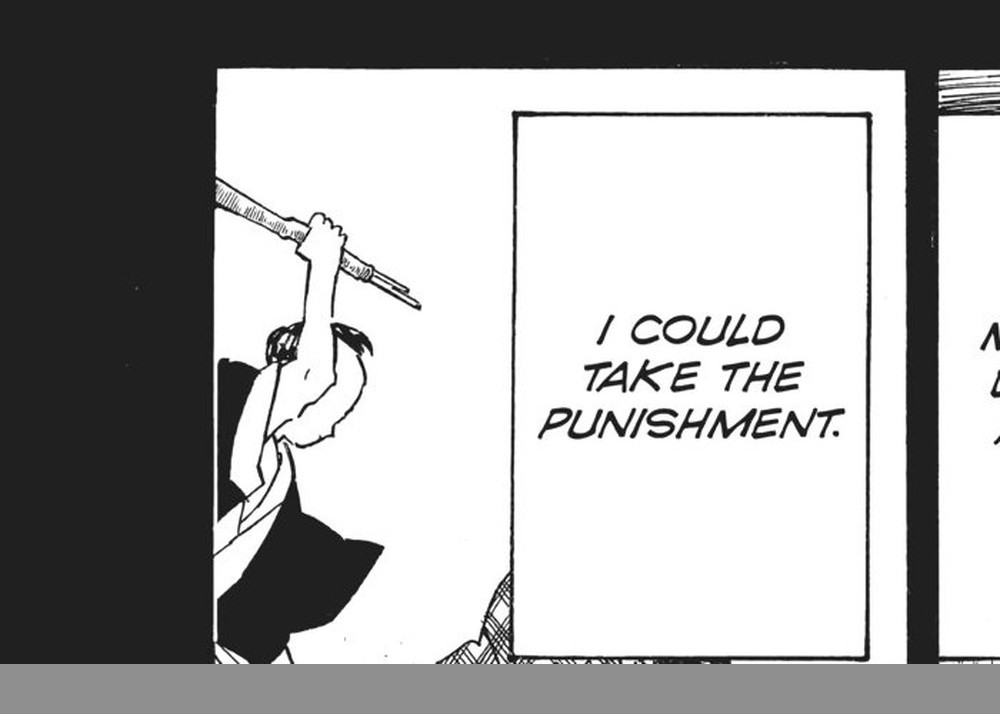
Chapter 155, 「役立たずの狛犬」 ("The Useless Guardian Dog") — one of Demon Slayer's most quietly devastating flashback chapters, the one that explains how the terrifying Upper Rank Three demon Akaza used to be a starving, big-hearted boy named Hakuji. His father is sick and sinking, and Hakuji has been stealing money for medicine — badly, and repeatedly, and he's just been caught again. Page 60 opens mid-punishment: a fist clenched white-knuckled against a tatami mat, a whip raised overhead, and a thought running underneath it like narration:
「鞭でめった打ちにされようが骨を折られようが」
Muchi de mettauchi ni sareyou ga hone o orareyou ga
VIZ's English edition prints: "I COULD TAKE THE PUNISHMENT." (Vol. 18, p.60.)
Grant the rendering its due: four words, present tense collapsed into a flat, hard modal, is exactly the kind of clipped, stoic understatement a flashback wants right before it breaks your heart over the next few pages — a father who insists he did nothing wrong, a boy fighting a whole mob barehanded, a hanging body one chapter later. It reads clean. It reads tough. What it doesn't tell you is what "the punishment" specifically was, or that the sentence Hakuji is quietly reciting to himself has a very particular grammatical shape — the one shape that keeps this line from ever being mistaken for Japanese's favorite idiom about hard work.
The Original
骨 (hone) is ordinary, early-learned vocabulary: "bone." 折る (oru) is transitive — "to break, snap, or fold [something]" — and together they build one of Japanese's sturdiest idioms: 骨を折る, [PERSON が/は] 骨を折る, "[person] breaks a bone," idiomatically "[person] takes great pains, goes to a lot of trouble [for someone]." The image is exertion so total it might snap your own bone doing it — and the load-bearing detail is that the one who breaks and the one who pays the cost are the same person. It's effort turned inward, spent willingly.
Our line doesn't use that verb. It uses 折られる, the direct passive of 折る — "to have [something] broken [by someone]" — folded into the volitional 折られよう and closed off with the concessive が: "even if [I'm made to have my bone] broken." Passivizing a verb in Japanese isn't just decoration; it opens a second grammatical slot for an agent distinct from the person the action happens to. That's precisely the slot the idiom has no room for. 骨を折る's whole meaning depends on breaker and bearer being one person; the moment you passivize it, Japanese grammar insists on a second party doing the breaking — which can only describe an actual assault, never someone quietly going to trouble on your behalf. (When Japanese does want to say "someone went to great trouble for me," it reaches for the benefactive — 骨を折ってもらう, 骨を折っていただく — never the bare direct passive.) So 骨を折られる isn't a scarier synonym of 骨を折る. It's the one conjugation of this phrase that the idiom is grammatically forbidden from occupying.
The clause running just before it does the same trick a second time: 鞭でめった打ちにされよう — めった打ち (mettauchi) is 滅多 ("indiscriminate, reckless") plus 打ち ("striking"), a fixed compound for "beaten senseless," and されよう is the passive volitional of する. Two clauses, same shape, both passive, both literal, chained by 〜ようが〜ようが: whipped, or bone-broken — either way. As vocabulary, 骨 and 折る sit at N5–N4; the idiom 骨を折る is usually shelved around N2–N3 alongside its intransitive sibling 骨が折れる (the "what a hassle" idiom, spontaneous rather than self-inflicted, covered on this network's Naruto hub); the stacked passive-volitional-concessive grammar here is closer to N2 on its own.
VIZ's Choice
Here is everything the needle 骨を折 turns up across all 23 Demon Slayer volumes we have paired and searchable — one occurrence, appearing twice in the raw page data only because the OCR pass logged the same speech bubble twice (the pipeline's own notes flag pairs[1] as a duplicate of pairs[0], differing by one stray small-kana typo: 折られよぅが for 折られようが). One quote, not two:
| Context | Japanese | VIZ English |
|---|---|---|
| Manga corpus — Vol. 18, p.60 (passive, literal) | 鞭でめった打ちにされようが骨を折られようが | I COULD TAKE THE PUNISHMENT. |
| Reference form — active, idiomatic (not attested in this corpus) | 骨を折る | to take pains / to go to great trouble (for someone) |
The second row isn't a citation from the manga — it's the idiom's dictionary entry, printed here for contrast, because it never once shows up on the page, active or figurative, anywhere in the volumes on file. That absence is its own small finding: 骨を折る is common enough in ordinary Japanese that its total silence across 23 volumes of dialogue feels almost deliberate, as if the one appearance of this bone-breaking image in the whole series was reserved for the literal, passive, worst-case reading — a boy's actual body, not a metaphor for someone's actual effort.
Given that, VIZ's "I COULD TAKE THE PUNISHMENT" is a defensible compression: it's accurate, it's terse, it fits the panel, and "punishment" correctly covers both the whip and the threatened bone. What it can't do is show its work. There's no trace left, in four English words, of the fact that the Japanese sentence took the trouble to specify how, twice, in parallel grammar — and no trace that a totally different, much gentler four-word sentence (骨を折ってくれてありがとう, roughly "thank you for going to the trouble") sits one conjugation away, unreachable from this one, in a language the English can't show is doing that math at all.
The Gap
The idiom's whole physical vocabulary collapses into an abstract noun. "Punishment" is accurate as a summary and forgettable as an image — it trades the whip and the bone, kept deliberately distinct by the Japanese's parallel clauses, for a single word that could describe almost anything unpleasant.
The voice distinction that forecloses a whole reading disappears without a trace. "I could take the punishment" would read identically whether the Japanese behind it were active or passive, idiomatic or literal. English gives its reader no structural signal that the original had already ruled out any figurative interpretation before the sentence finished — the ambiguity English can't help introducing was never available to a Japanese reader in the first place.
A learner's dictionary entry for 骨を折る sets a trap it never warns about. Every textbook that teaches 骨を折る as "to take pains" hands over the idiom without mentioning that its passive form isn't a variant — it's a different sentence, describing a different kind of pain, that the idiom simply cannot survive being conjugated into.
What If
- "Whip me raw, break my bones — I'll bear it, for him, however many years it takes." — keeps both concessive clauses and their doubling. Cost: longer than VIZ's clipped four words, loses the punch of a vow delivered in silence.
- "Beat me. Break me. I can take it." — compact, mirrors VIZ's brevity while keeping two separate physical verbs distinct. Cost: drops the specific noun "bone," and the open-ended "even for hundreds of years" that follows it in the next bubble.
- "I could stand the whip. I could stand a broken bone." — preserves both literal images as separate clauses. Cost: "stand" repeats where the Japanese varies its grammar (されよう / 折られよう), flattening the rehearsed, oath-like rhythm of the original.
- Keep VIZ's brevity, restore the anatomy: "I could take having my bones broken." — Cost: an awkward nominalization, drops the whip entirely, and still can't reproduce the doubled ようが construction in four words.
Every option pays because the sentence is doing two jobs Japanese can hold apart and English keeps welding back together: naming the specific harm, and marking, grammatically, that the harm is being done to someone rather than taken on by them.
Take-away
骨を折る's entire idiomatic life lives in the active voice. The instant you meet 折られる, you are reading about an actual break, not a metaphorical one — the passive doesn't intensify the idiom, it exits it, because the idiom needs the breaker and the sufferer to be the same person and the passive grammatically guarantees they aren't.
Three rules of thumb to carry off this page:
- Active 骨を折る, passive 骨を折られる — different sentences, not different intensities. One is effort spent on purpose; the other is an injury received. Watch the voice before you trust the gloss.
- 〜ようが〜ようが doubles a vow into "no matter which of these happens." It shows up in oaths and grim resolutions more than in casual hypotheticals — learn to hear the concession as defiance, not uncertainty.
- Learn 折る / 折れる / 折られる as a trio. One root — transitive, intransitive, passive — three grammatically distinct outcomes, and in this corpus, three different emotional registers depending on which one a character reaches for.
Demon Slayer's own body-idiom shelf runs the same question through other anatomy: courage and cowardice sitting or bolting in 肝が据わる・腰を抜かす, an arm's eagerness in 腕が鳴る, a two-faced tongue in 二枚舌, and a keen nose in 鼻が利く. And on the Naruto side of this network, the intransitive twin of this very idiom — 骨が折れる (hone ga oreru), the "what a hassle" idiom that also turns out to mean exactly what it says the one time it appears — makes the mirror-image case: where Naruto's corpus never lets the idiom be figurative, Demon Slayer's corpus never lets it be active at all. For more of what the Infinity Castle arc's grammar hides from English, browse the full Demon Slayer translation notes index.
Every Japanese and English line quoted above is a byte-exact capture from the cited editions — 鬼滅の刃 Vol. 18 (Japanese) and Demon Slayer: Kimetsu no Yaiba (VIZ Media) at the corresponding panel — via our bilingual page database; see Sources below.