The Moment
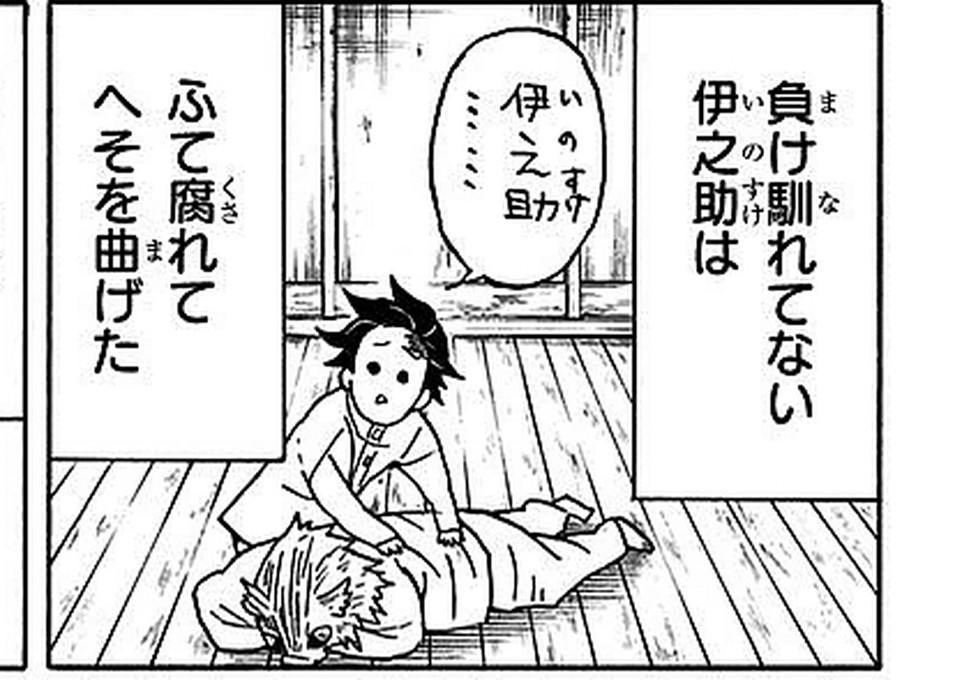
Volume 6, and the story has stepped back from combat to catch its breath. Tanjiro, Zenitsu, and Inosuke are recovering at the Butterfly Mansion — Shinobu Kocho's estate, half infirmary, half training ground — where a fellow trainee named Kanao Tsuyuri keeps beating them at a training contest neither boy can seem to win. The narration opens the page flatly: 「それから五日間カナヲに負け続ける日々が続く」 — "WE LOST TO KANAO FOR FIVE DAYS STRAIGHT." Zenitsu, true to form, accepts the loss without much fuss and asks to go play. Inosuke does not. The narration turns to him specifically:
「負け馴れてない伊之助はふて腐れてへそを曲げた」
Make-narete inai Inosuke wa futekusarete heso o mageta.
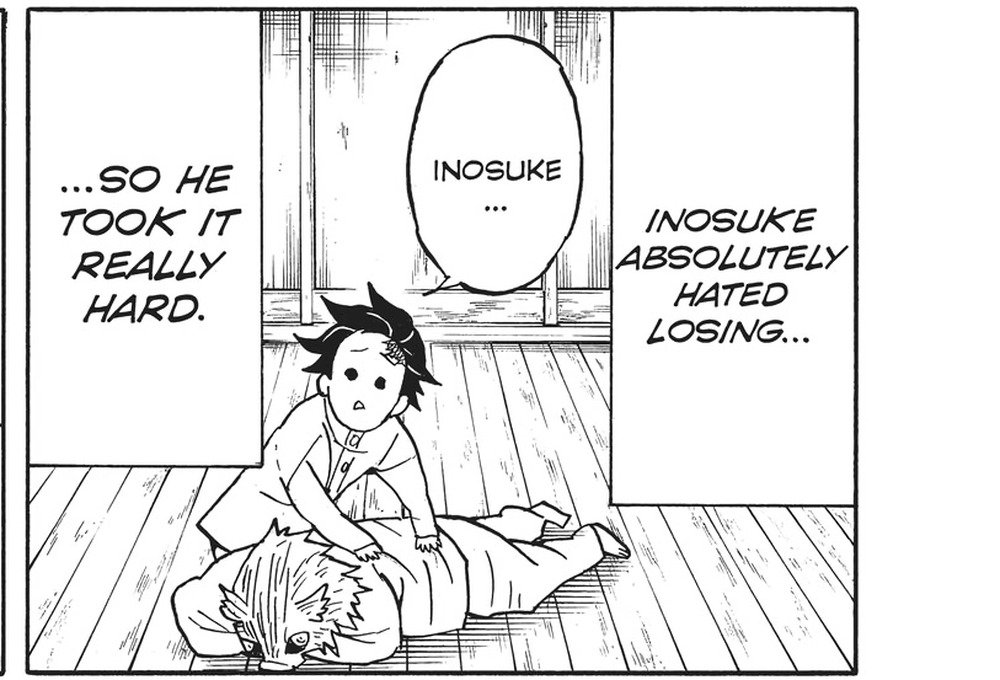
VIZ's English edition splits the sentence across two narration boxes, with a small worried bubble wedged between them: "INOSUKE ABSOLUTELY HATED LOSING..." / 「伊之助...」— "INOSUKE..." / "...SO HE TOOK IT REALLY HARD." (Vol. 6, p.129). Underneath the caption, the panel does its own quiet work: Inosuke face-down on the floor, and Tanjiro crouched beside him, offering only his name.
Grant VIZ its due before going further. "Took it really hard" lands at exactly the right emotional temperature — not devastated, not furious, just stubbornly, childishly upset — and splitting one long Japanese sentence into three short English beats matches the manga's comic pacing panel for panel. Nothing about the plot is wrong here. What's missing is the specific, slightly absurd body part the Japanese sentence reaches for to make its point.
The Original
Take the idiom apart at its seam: へそ (heso, "navel, belly-button") + を (direct-object marker) + 曲げる (mageru, "to bend, warp, twist out of true") — the same verb that puts a bend in a road (曲がり角) or a stoop in someone's back (腰を曲げる, "to bend at the waist"). Put together, the idiom announces, perfectly straight-faced: to bend one's navel. へそ does have a kanji form, 臍, but it's rare enough that most manga and newspapers write it in kana, exactly as this page does.
Dictionaries that catalogue set phrases generally offer more than one account of how a body part ended up meaning "to turn stubborn," and none of them claims to be the last word:
- The honest-center theory. Older Japanese folk-thought treated the navel — roughly the body's physical midpoint — as the seat of a person's true, unguarded temperament, in the same family of thinking that gives the belly (腹, hara) authority over resolve and courage elsewhere in the language. Bend that center out of alignment, and an honest disposition warps into stubborn sulkiness.
- The spinning-bobbin theory. A rival explanation argues the original word wasn't the anatomical 臍 at all, but 綜麻 — also read heso — the wound spool of thread a weaver keeps beside the loom. A crooked 綜麻 throws off the whole weave; over time, the phrase for "the bobbin's gone crooked" is said to have reattached itself to the anatomical homophone, and the belly-button inherited a metaphor that started on a loom.
- The turned-away-body theory. The plainest account skips etymology and just describes the sulker's posture: someone who won't listen turns their whole body sideways, shoulder to the room — and from an angle, that twist drags the navel along with it, pointing crooked at nothing in particular.
Whichever theory a given dictionary prefers, they agree on the destination: a warped navel is a warped mood. As idioms go, へそを曲げる is common rather than obscure — it shows up in intermediate idiom-list textbooks, roughly N3 — but common doesn't mean plain; a learner who has only met へそ as "belly-button, ha-ha" won't expect it to be doing this much grammatical and emotional work.
The line doubles down for comic effect. ふてくされる (futekusareru) — "to sulk, pout, turn openly petulant" — sits right next to へそを曲げる in the same sentence: two sulk-words stacked onto one tantrum. That's the narrator's own joke, not an accident of phrasing.
VIZ's Choice
Only one clean occurrence of へそを曲げる survives in the volumes on file, so there's no scatter-table to build here — but the single occurrence is worth reading slowly, because VIZ actually solves two separate problems on this page, not one.
The first is the idiom itself, discussed above: "TOOK IT REALLY HARD" reports the outcome (Inosuke is upset) without the mechanism (a bent navel) or the specific flavor of the upset — stubborn, childish, refusing to be jollied out of it, closer to 拗ねる ("to sulk") than to plain sadness.
The second is structural. The Japanese is one unbroken sentence — 負け馴れてない伊之助はふて腐れてへそを曲げた, subject clause plus idiom, no stop in between, the topic marker は doing the work of holding "Inosuke" as the single grammatical anchor for everything that follows. VIZ breaks that one sentence into two narration boxes stacked around a small dialogue bubble. The split works beautifully as comic-panel timing: "INOSUKE ABSOLUTELY HATED LOSING..." sets up a beat, Tanjiro's helpless "INOSUKE..." lands in the gap, and "...SO HE TOOK IT REALLY HARD." closes the joke. But it re-anchors "Inosuke" three separate times where Japanese anchors him once and lets one long breath of a sentence carry the whole idea — hating to lose, sulking, bending his navel — to its end.
The Gap
No default body part is on duty for mood in English. Japanese keeps a working vocabulary of emotion-as-anatomy — a bent navel for sulking, a standing belly for anger, a seated liver for nerve — and a fluent reader recognizes each one as a member of the same family the instant it appears. English sulking vocabulary ("pouted," "sulked," "was in a huff," "took it hard") is entirely psychological; no organ is on duty, so there is no family left to recognize.
The near-miss goes unused. English is not actually anatomy-poor here — it owns "bent out of shape," an idiom built on the identical warping-as-displeasure logic as へそを曲げる, down to the verb. VIZ doesn't reach for it on this page, and the near-perfect cousin sits unused a few idiom-dictionary entries away from the phrase actually chosen.
The comedy loses its object. A bent navel is a slightly ridiculous image, well suited to a boy in an animal mask sulking face-down on a training-room floor. "Took it really hard" is accurate about the emotional weight but supplies none of the built-in comic absurdity the Japanese idiom offers for free — the joke has to be rebuilt entirely by the artwork, with the words contributing only the bare fact of the sulk.
What If
- "...SO HE GOT BENT OUT OF SHAPE ABOUT IT." — recruits English's own closest cousin, matching the warping-as-mood logic almost exactly. Cost: "bent out of shape" is casual, near-cliché American idiom that risks reading like a translator's private joke rather than plain narration, and it moves the warp from one specific organ to the whole body.
- "...SO HE GOT HIS NOSE OUT OF JOINT." — a genuine English cousin (wounded pride at being outdone by a rival, which fits losing to Kanao well) that keeps a body part in the sentence. Cost: swaps organs, nose for navel, and "nose out of joint" leans toward jealousy where へそを曲げる describes a stubborn, refuses-to-be-consoled sulk.
- "...SO HE POUTED, EVERY LAST INCH OF HIM." — keeps the plain "pouted" and gestures at total-body sulking without inventing new English anatomy. Cost: vague; a reader gets "he pouted a lot" and none of the specific bent-navel picture.
- Keep VIZ's "TOOK IT REALLY HARD" and let a footnote carry the idiom — the choice most translators actually make, since manga lettering leaves no room for etymology. Cost: a straightforward concession, not a fix; the reader gets the plot and loses the joke printed on the page itself.
Take-away
へそを曲げる is a small idiom doing a large amount of quiet cultural work: it assumes a reader who already accepts that mood lives in the body, low and central, and that a person's temperament can be described the way a technician describes a bent part — off true, needs realigning.
Three rules of thumb to carry off this page:
- When a Japanese sulking-or-anger word names a body part, resist translating straight to a feeling-word first — ask which organ is doing the work, and whether English happens to have a matching one on hand before reaching for a generic adjective.
- Keep 臍 (heso) separate from its lookalike cousins: 臍を固める hardens it into resolve, 臍で茶を沸かす boils tea in it for something absurdly funny, and へそを曲げる bends it for a sulk — one small organ, three unrelated emotional jobs.
- Watch for English idioms that already do the same metaphorical work under different vocabulary — "bent out of shape" was sitting right there — before assuming a translation problem is unsolvable.
For two more places where Demon Slayer keeps its emotions in the body rather than the dictionary, see the liver that sits and the hips that give out, in 肝が据わる・腰を抜かす and the acid throat of disgust in 虫唾が走る — the belly-bug at the center of that second piece, 腹の虫, has a growling cousin worming through Kakashi's own patience in the Naruto volumes as well. Or browse the Demon Slayer translation notes index.
Every Japanese and English line quoted above is a byte-exact capture from the cited editions — 鬼滅の刃 Vol. 6 (Japanese) and Demon Slayer: Kimetsu no Yaiba Vol. 6 (VIZ Media) at the corresponding panel — via our bilingual page database; see Sources below.