The Moment
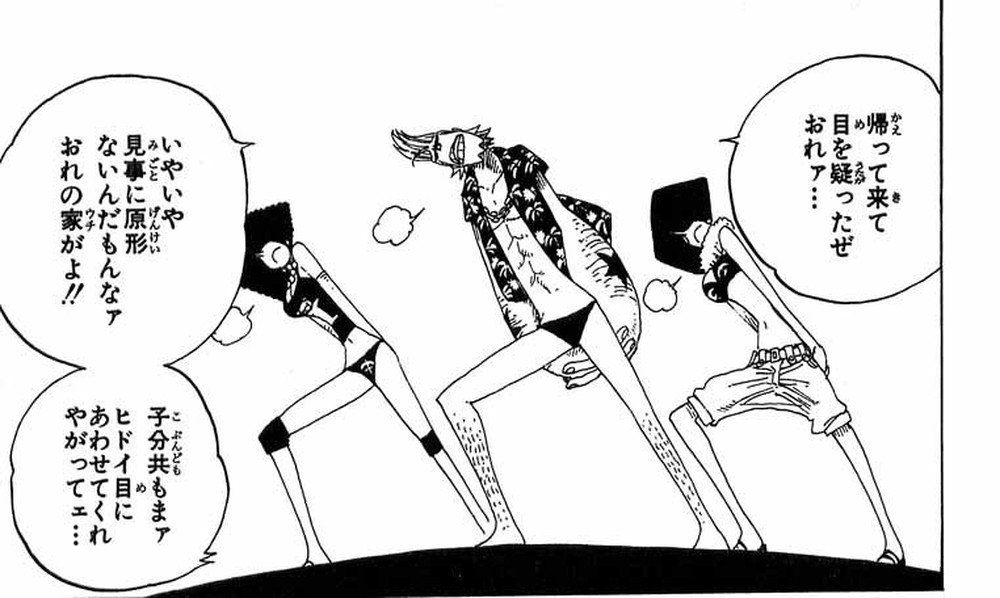
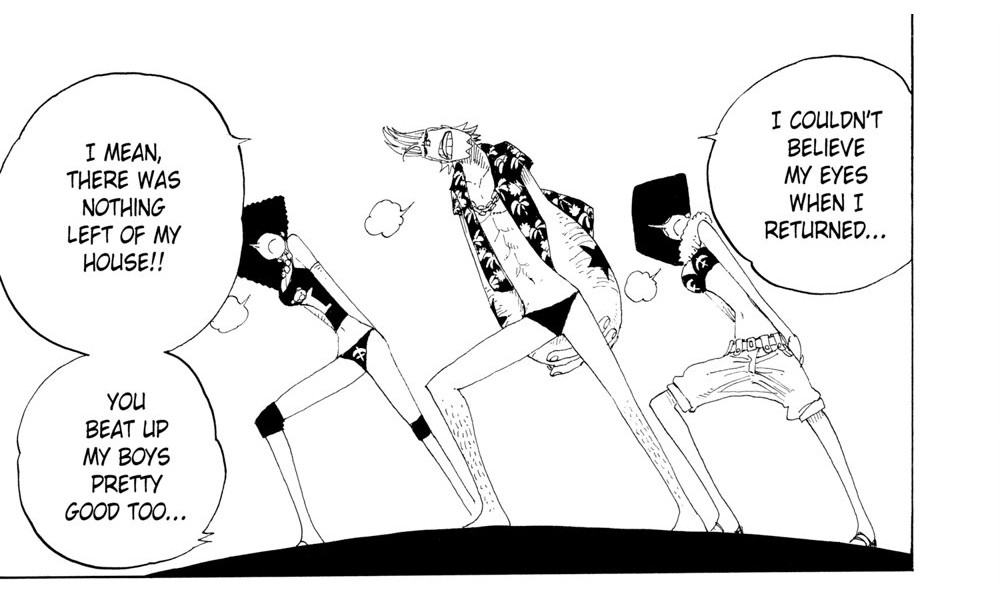
Water Seven, after the fight nobody asked for. Luffy tore through Franky's junkyard turf looking for a shipwright, flattened Franky's own house in the process, and roughed up half the Franky Family along the way. Now Franky is closing in on him, shown three times over in the same low, bracing crouch — a manga shorthand for speed, not a crowd scene; it's one man, mid-stride, drawn in overlapping phases. Piece by piece, across two panels, he tallies what he came home to:
「いやいや見事に原形ないんだもんなァおれの家がよ!!」
"I MEAN, THERE WAS NOTHING LEFT OF MY HOUSE!!"
Then the crew:
「子分共もまァヒドイ目にあわせてくれちゃってやがってェ...」
"YOU BEAT UP MY BOYS PRETTY GOOD TOO..."
And then, last in the sequence, the verdict on his own reaction walking back into the wreckage:
「帰って来て目を疑ったぜおれァ...」
Kaette kite me o utagatta ze oreā…
VIZ's English edition prints: "I COULDN'T BELIEVE MY EYES WHEN I RETURNED..." (Vol. 35, p.169).
Give this rendering its due, because it's a rare pleasure in this column: it's just right. "Couldn't believe my eyes" is exactly the phrase an English speaker reaches for in this exact situation — natural, unforced, immediately legible — and it happens to line up closely with the Japanese underneath it. No improvising required, no compromise, no scattering across five different guesses. For once, the two languages already agree on how to say this.
Except they don't agree completely. Sit with the two verbs for a second. 疑った is "doubted." VIZ's is "couldn't believe." Doubted and couldn't-believe are close cousins, not twins — and the rest of this article is about the small gap between them, and about the one place in our corpus where that small gap opens into a much bigger one.
The Original
目を疑う takes apart into pieces a first-year student already owns:
- 目 (me) — "eye."
- を (o) — the direct-object particle.
- 疑う (utagau) — "to doubt, to suspect" — the same verb living inside 疑問 (gimon, "a question, a doubt") and 容疑者 (yōgisha, "a suspect," literally "a person under doubt").
Put together: to doubt [one's] eyes — to treat the thing you are looking at as testimony you are not yet willing to accept. 疑う is a fully transitive verb, and here its direct object is 目 itself: not a fact, not a rumor, not a story — the organ. You are cross-examining your own eyesight, the way you'd cross-examine a witness whose account doesn't add up.
Two of our three occurrences sharpen the point further with 自分の (jibun no), "one's own": 自分の目を疑う, "to doubt my OWN eyes" — a small emphatic flourish insisting the doubt is personal, first-hand, not hearsay. Franky's headline line skips it (目を疑った, no 自分の), which is mostly manga economy — the sentence-final ぜ already carries plenty of first-person swagger on its own — but it's worth noticing which occurrences reach for the extra emphasis and which don't.
Grammatically there is nothing exotic here: [SUBJECT が/は] 目を 疑う is a plain transitive clause, the kind any beginner textbook could serve up as a model sentence. And that plainness is the whole reason this article exists. As vocabulary, 疑う sits at a workmanlike JLPT N3 — most of the words this column digs into are N1 kanji compounds smuggling in centuries of Buddhist doctrine; this one hides inside grammar an intermediate learner already owns, which is exactly why a small mistranslation here is so easy to walk past. One set phrase worth banking alongside it: 耳を疑う (mimi o utagau), "to doubt one's ears" — same construction, same skepticism, aimed at hearing instead of sight, for the moment something you hear seems too strange to be real.
VIZ's Choice
All three clean, verifiable occurrences of 目を疑う in the volumes we have on file, side by side:
| Vol. / p. | Speaker | Japanese | VIZ English |
|---|---|---|---|
| 3 / 105 | an unnamed pirate, recounting how he found Gaimon stuck in a chest | おれは自分の目を疑った...! | I COULDN'T BELIEVE MY EYES! |
| 27 / 95 | Nami, at Upper Yard | 私だってまだ自分の目を疑ってるのよ!! | EVEN I'M NOT SURE OF WHAT I SAW!!! |
| 35 / 164 | Franky, at Water Seven | 帰って来て目を疑ったぜおれァ... | I COULDN'T BELIEVE MY EYES WHEN I RETURNED... |
Look at rows one and three. Two different volumes, two different arcs, two different speakers — a nameless mob pirate telling a campfire story, and Franky mid-rant at Luffy — and VIZ lands on essentially the same English sentence both times: "I couldn't believe my eyes." For a column that usually documents scatter — 因縁 splitting five ways, 往生 and 成仏 both flattening to "rest in peace" — two independent translators (or the same translator on two different days) reaching for the identical fixed phrase, unprompted, is the exception that proves how strong "couldn't believe my eyes" is as English's default slot for this feeling. It is simply what a fluent English speaker says here, the way 目を疑う is simply what a fluent Japanese speaker says here. Rare alignment, honestly earned.
Then there's Nami. Her line carries the same 自分の目を疑ってる that the mob pirate's line does, plus an extra layer: 私だって — "even I," a contrastive だって that marks her as joining a group of people already startled, admitting she's no less baffled than anyone else. VIZ's "EVEN I'M NOT SURE OF WHAT I SAW!!!" actually keeps that だって beautifully — the "even I" survives intact. What doesn't survive is the idiom itself: no "eyes," no "believe," no "doubt." "Not sure of what I saw" is a perfectly serviceable paraphrase of the same underlying feeling, but it arrives at that feeling by a different road, one that happens to bypass the fixed phrase sitting one panel-transition away in the very same corpus.
The Gap
Doubt is a verb of action; disbelief is a verb of failure. 疑う is something the speaker actively does — an act of skepticism, aimed at the eyes as an untrustworthy source under cross-examination. "Couldn't believe" describes an incapacity instead: a report arrives, and the receiver's believing-mechanism simply fails to process it. Japanese puts the eyes in the witness box and interrogates them; English just reports that the witness stand collapsed. The difference rarely changes what a scene means, but it quietly changes who's in control of the moment — the doubter, or the doubt.
目 sits as a direct object, not a source. In 目を疑う the eyes are the grammatical object of doubt — you doubt THEM, exactly the way you'd doubt a suspect (容疑者) or an unreliable rumor. "I couldn't believe my eyes" treats the eyes almost as a witness delivering testimony you decline to accept — a small shift from interrogating the organ itself to receiving, and rejecting, a message it sent you. English's eyes report; Japanese's eyes are suspected.
The idiom can evaporate even when English hands it over for free. This is the real finding of the table above. Two of three occurrences prove the fixed English phrase was sitting right there, costing nothing, fitting the bubble, matching the register. And still, a third of the time, the translator reached past it for a paraphrase. That's not a translation failure in Nami's case — "not sure of what I saw" is accurate and natural — but it is a reminder that even in idiom translation's easiest possible conditions, convergence is a habit a translator chooses, not a law the sentence enforces.
What If
For Franky's line, the menu and its prices:
- "I doubted my own eyes when I got back..." — the maximally literal calque; keeps 疑う as an act of doubt rather than a failure of belief. Cost: reads a shade stiffer than natural English, which almost never phrases it as "doubt my eyes."
- "I couldn't trust my own eyes when I got back..." — "trust" keeps more of doubt's active, judging sense than "believe" does, while staying idiomatic. Cost: a touch more formal than Franky's rough, panting swagger.
- Keep VIZ's "I COULDN'T BELIEVE MY EYES WHEN I RETURNED..." — Cost: trades active doubt for passive disbelief and loses 自分の's reflexive emphasis where it appears elsewhere, but it's the version every English speaker already owns, and idiomatic naturalness is a real virtue too.
- For Nami's line: "Even I still doubt my own eyes...!!" — restores the idiom VIZ paraphrased away and ties her admission to the same body-part image as the other two occurrences. Cost: "EVEN I'M NOT SURE OF WHAT I SAW!!!" reads more natural for a rushed, anxious outburst, and keeps her だって's "me too" contrast intact just as well.
Notice that unlike most entries in this column, none of these options costs very much. That's the point of choosing an idiom this close to a 1:1 match: for once, the translator's job is easy, and the interesting question isn't "what did English lose" but "what did English almost not have to lose at all."
Take-away
目を疑う is the rare entry in this column where English already owns the idiom — "couldn't believe my eyes" is sitting right there, ready-made, and twice out of three times VIZ reaches for it and lands almost exactly on the Japanese. But even a near-perfect match hides two small slips: Japanese doubts (an act aimed at the eyes as witness), English disbelieves (a failure aimed at a report received); and even the easiest idiom in the corpus can still get paraphrased away, as it does once, for no better reason than that a different English sentence fit the moment just as well.
Three rules of thumb to carry off this page:
- When "the translation already matches," check the verb anyway. 目を疑う and "couldn't believe my eyes" agree on the image (eyes, disbelief) but disagree on the mechanics (doubting vs. failing to believe) — convergence in image is not convergence in grammar.
- Collect 目を疑う's aural twin, 耳を疑う (mimi o utagau, "to doubt one's ears") — the same active-skepticism construction, redeployed for the ears instead of the eyes.
- Don't assume a fixed idiom always survives contact with English just because it can. Nami's line proves that even a free, natural, no-cost translation can still lose to a paraphrase that simply felt right in the moment.
For another idiom where the eyes do idiomatic work — this time as a threat instead of a shock — see 目にもの見せる, the payback idiom VIZ flattens to "I'll show you". For a different body part that won't translate cleanly, see 手も足も出ない, the body-idiom English keeps rewording. Or browse the One Piece translation notes index.
Every Japanese and English line quoted above is a byte-exact capture from the cited editions — ONE PIECE Vol. 3, 27 & 35 (Japanese) and One Piece (VIZ Media) at the corresponding panels — via our bilingual page database; see Sources below.