The Moment
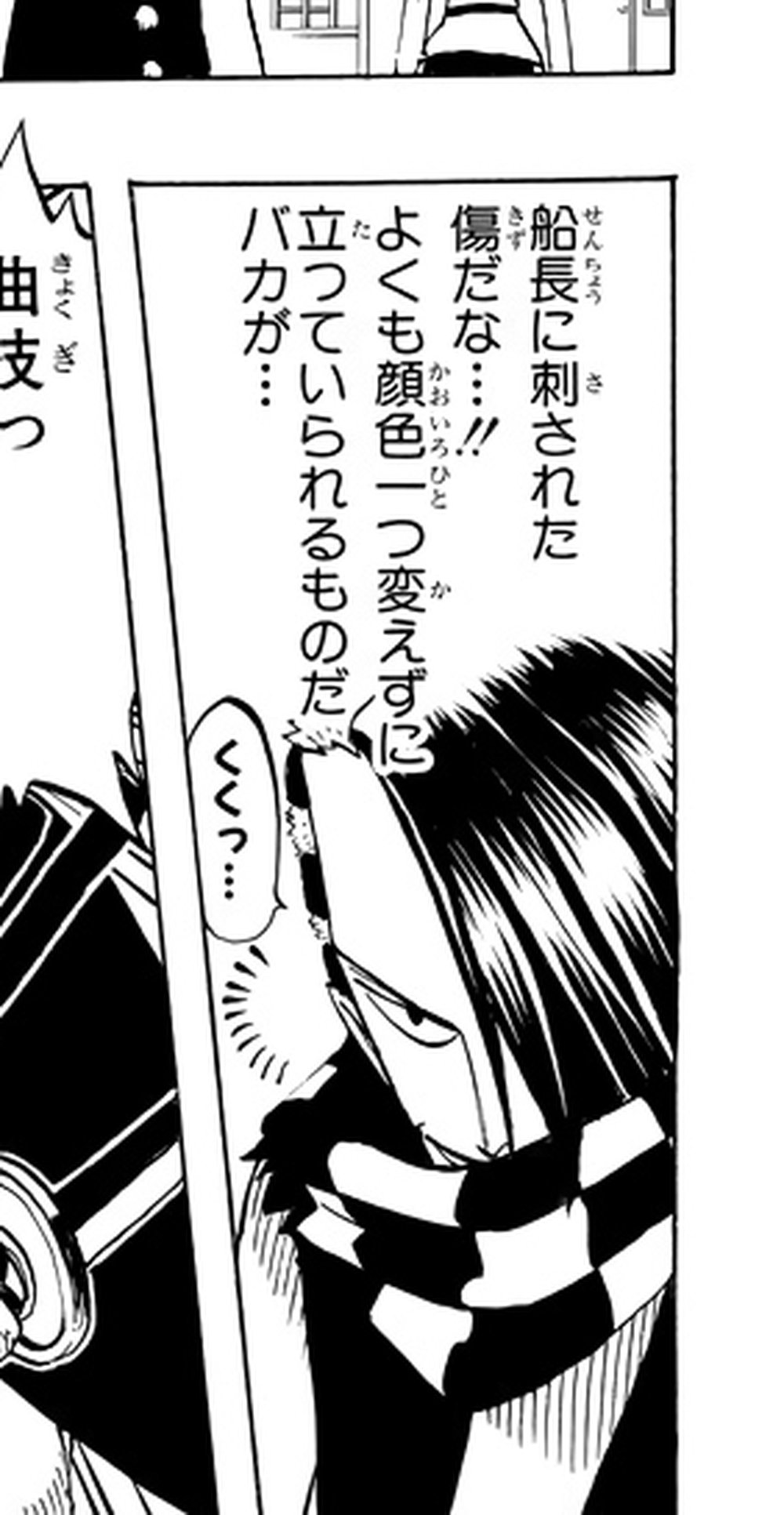
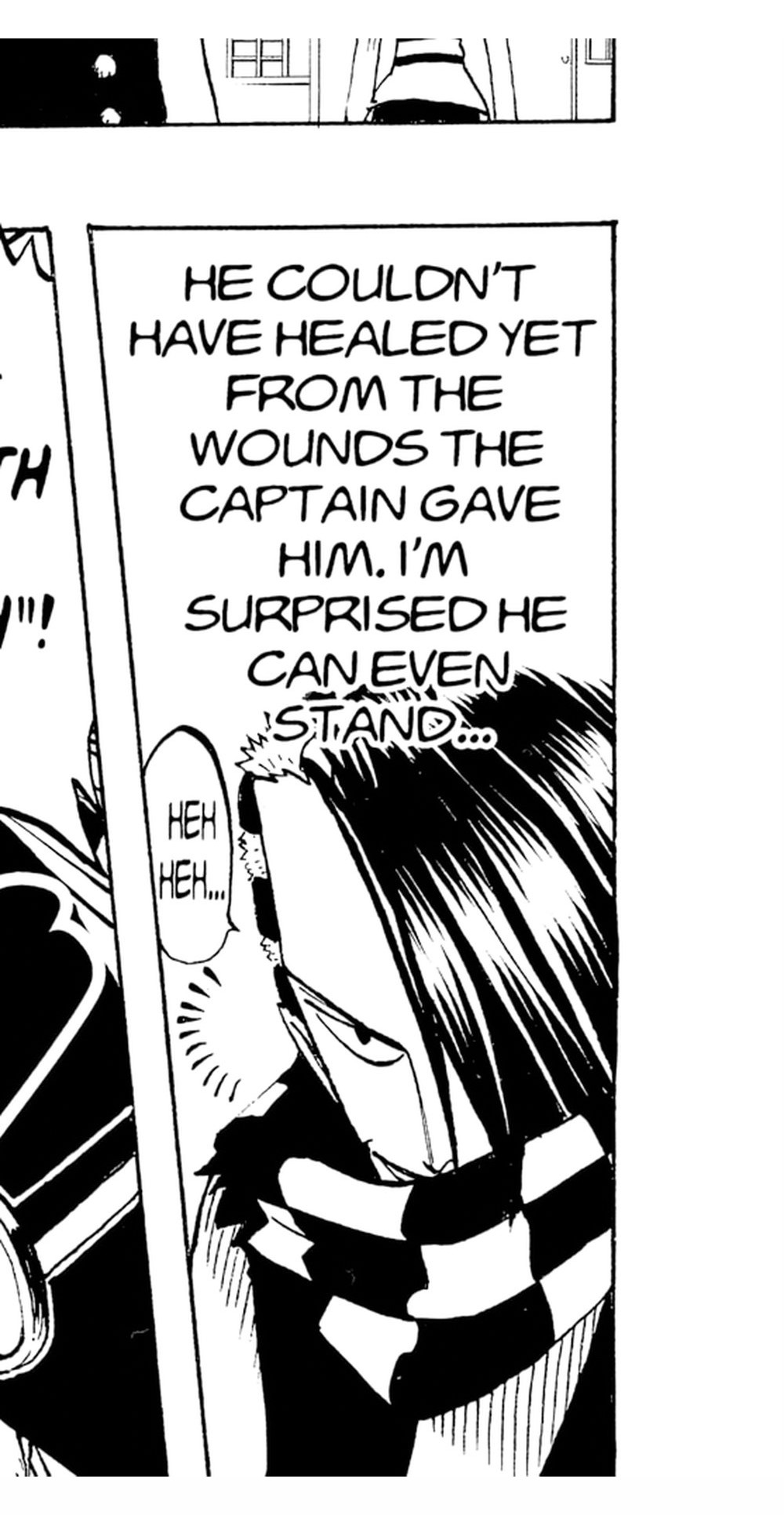
Volume 2. The Buggy Pirates arc is closing in on its last duel. Zoro is already carrying a wound from earlier in the fight — stabbed, the text tells us, by "the captain" himself — and a worried crewmate has just told him to sit this one out: 「おいゾロやっぱり休んでろよ」 ("HEY, ZOLO! MAYBE YOU SHOULD REST."). Zoro doesn't rest. He meets Buggy's second-in-command, the acrobat swordsman Cabaji, blade for blade, answering a taunt about honor with 「剣の相手ならおれがする!」 ("IF IT'S A SWORD DUEL YOU WANT, I'M YOUR MAN!"). Mid-exchange, Cabaji — watching Zoro shrug off a fresh stab wound and keep his feet — mutters something that reads, in Japanese, like backhanded respect curdling into contempt:
「船長に刺された傷だな…!!よくも顔色一つ変えずに立っていられるものだバカが…」
Senchō ni sasareta kizu da na…!! Yoku mo kaoiro hitotsu kaezu ni tatte irareru mono da baka ga…
The line VIZ actually prints in this exact panel — confirmed on the English page itself, not assumed from the aligned database pair alone — reads: "HE COULDN'T HAVE HEALED YET FROM THE WOUNDS THE CAPTAIN GAVE HIM. I'M SURPRISED HE CAN EVEN STAND..." (Vol. 2, p.163).
Grant the rendering its due: it's a perfectly serviceable line of villain monologue, doing real narrative work — establishing that Zoro is hurt, that the wound is recent, that his continued fighting is remarkable. What it does not do is translate 顔色一つ変えずに at all. The clause simply isn't there. Where the Japanese specifically marvels that the wound produced no change in Zoro's face-color — the involuntary tell that, in Cabaji's expectation, should have given him away — the English marvels at something else entirely: that a wounded man is still vertical. Composure became stamina. And バカが, the contemptuous "you fool" that closes the taunt, went with it.
The Original
Take 顔色 (kaoiro) apart and there's nothing exotic in the pieces: 顔 (kao) is "face," among the first fifty kanji any learner meets; 色 (iro) is "color," just as basic. Together, the compound does something bigger than either half alone: it turns the face into an instrument panel, a place where an internal state — fear, illness, shock, guilt — shows up as a literal, involuntary shift in hue, legible to anyone standing nearby.
Three fixed constructions carry that idea through the language, and this corpus catches all three.
The headline construction is 顔色一つ変えない (kaoiro hitotsu kaenai) — "not even one change in face-color." 一つ (hitotsu, "one") isn't counting anything real here; it's doing the same intensifying work as English "not so much as," turning a negative into an absolute. Compare 微動だにしない, "not even a twitch of motion" — same architecture, same rhetorical move: not "mostly composed," but zero, certified, no exceptions. And the certifying witness is the skin itself — color, unlike a held expression, isn't something you can consciously arrange. That's precisely why "not changing color" reads as stronger praise (or, from Cabaji's mouth, needling insult) than merely "keeping a straight face."
The symptom construction, 顔色が悪い (kaoiro ga warui) — "face-color is bad" — appears twice in this corpus (Vol. 9 and Vol. 26), always as concern or observation: something is visibly, chromatically off. Note what it doesn't do: it doesn't name a color. "Bad" leaves the specific hue — presumably pale, presumably drained — as an inference the listener supplies.
The surveillance construction, 顔色を見る/伺う (kaoiro o miru/ukagau) — "to watch/gauge someone's face-color" — turns the same noun into an object of scrutiny: reading a person's mood by monitoring their face like a gauge, the way Robin describes her own upbringing in Vol. 34.
Grammatically none of this is difficult — 顔 and 色 are both N5 kanji, and 顔色が悪い is everyday, conversational Japanese a beginner meets early. What pushes the set phrases toward N3 territory is idiomaticity, not grammar: knowing that 顔色一つ変えない is a fixed unit about composure, not a literal report on skin tone, is cultural fluency wearing a vocabulary costume.
VIZ's Choice
Every appearance of 顔色 in the volumes on file, side by side with VIZ's English:
| Vol. / p. | Japanese | VIZ English |
|---|---|---|
| 2 / 163 | 船長に刺された傷だな…!!よくも顔色一つ変えずに立っていられるものだバカが… | HE COULDN'T HAVE HEALED YET FROM THE WOUNDS THE CAPTAIN GAVE HIM. I'M SURPRISED HE CAN EVEN STAND... |
| 9 / 49 | どうしたナミ顔色が悪い様だが…? | WHAT'S THE MATTER, NAMI? YOU'VE GONE PALE. |
| 26 / 143 | お前よく見りゃ顔色悪ィぞ… | HEY, YOU'RE ALL PALE. |
| 34 / 177 | 子供の頃から人の顔色を見て聞き耳を立てて生きてきたから… | EVER SINCE I WAS LITTLE, I'VE OBSERVED PEOPLE'S MOODS AND LISTENED TO THEM TALK. |
Four appearances across thirty-two volumes, and 顔色 never gets translated the same way twice — in fact, in its strongest, most idiomatically loaded form (Vol. 2), it doesn't get translated at all. Read down the right-hand column: a dropped clause, two named colors, one abstracted mood-word.
In Vol. 9 and Vol. 26, VIZ's solutions — "YOU'VE GONE PALE" and "YOU'RE ALL PALE," spoken respectively by one of Arlong's fishmen crew sizing up Nami, and by Luffy noticing the sky-island guide Conis go white with fear — are close cousins of each other and genuinely serviceable. English's own stock phrase for looking unwell reaches for a name Japanese never gives. In Vol. 34, Nico Robin's aside about her upbringing — 子供の頃から人の顔色を見て聞き耳を立てて生きてきたから, "because ever since I was little I've lived by watching people's face-color and straining my ears" — loses the specific verb of watching a face and lands on the vaguer "observed people's moods": accurate to the outcome, silent on the mechanism. And in Vol. 2, the headline case, the concept doesn't survive at all — the sentence keeps its overall meaning (Zoro's resilience is impressive) by routing around the color entirely.
The Gap
The color drops out, and the insult goes with it. Cabaji's line isn't neutral description; よくも…バカが frames Zoro's blank face-color as maddening, an insult wrapped in awe. VIZ's actual rendering keeps the awe ("I'm surprised he can even stand") but relocates its object from an involuntary physiological tell to a straightforward physical feat — a wounded man standing up. The reader loses the specific claim that Zoro's body refused to confess anything, not just that his legs held.
Japanese states the change abstractly; English must commit to a hue. In both 顔色が悪い occurrences, VIZ reaches for "pale" — the one color English keeps on hand for exactly this symptom, and a fair trade in context. But notice the asymmetry: Japanese's "bad" (悪い) works for a fainting spell, a fright, a hangover, or a lie about to be caught, without ever picking a shade; English's "pale" pins the symptom to one specific, named appearance every time, closing off whatever the Japanese reader was left free to imagine.
When 顔色 means "read a face," English generalizes the organ away. Robin's 顔色を見て isn't vague in Japanese — it specifically credits her habit to watching people's faces, strangers on the street, gauging mood from a visible surface before she needs to hear a single word. "Observed people's moods" keeps the outcome and drops the specifically ocular method: the difference between someone who reads faces and someone who just "understands people well."
English's own color idioms are pre-sorted by emotion; 顔色 isn't. English already owns a small taxonomy for this territory — "white as a sheet" (fear), "red in the face" (anger or embarrassment), "green" (envy), "ashen" (shock) — each color pre-assigned to one feeling. 顔色 is the un-sorted parent category: a single noun covering all of them, disambiguated only by an adjective (悪い) or a verb (変わる), never by naming a shade. Every English rendering has to reach into that pre-sorted cabinet and pick one, even when the Japanese line is deliberately leaving the shade — and therefore the precise feeling — unspecified.
What If
For the headline line, the menu and its prices:
- "NOT EVEN A CHANGE IN HIS COLOR, AND HE'S STILL ON HIS FEET, THE FOOL." — keeps 顔色's color-reading intact and preserves バカが. Cost: wordier, loses the tight punch of VIZ's actual line.
- "HE HASN'T EVEN GONE PALE!! STANDING THERE LIKE NOTHING HAPPENED, THE FOOL." — reuses this corpus's own "pale" solution for consistency across the volumes. Cost: "pale" describes a state at rest, reversing the idiom's dynamic claim (composure = no CHANGE) into a static description.
- "HE WON'T EVEN FLINCH, DAMN HIM…" — natural, idiomatic English for the composure meaning. Cost: relocates the tell from color/skin to muscle/motion — the right effect, the wrong organ.
- "NOT A DROP OF COLOR LOST, AND HE'S STILL STANDING… FOOL." — keeps "color" as a literal noun, closest to the image. Cost: "not a drop of color lost" is invented, slightly unnatural English.
Every option pays because English simply doesn't have a single, all-purpose "face changed color" idiom that covers composure, fear, and illness the way 顔色 does. The translator's job, every time, is deciding which corner of that meaning to keep and which to let go.
Take-away
顔色 is one noun doing a job English splits into a whole color-coded taxonomy. When a translation gives you "pale" here, silence there, and "moods" somewhere else, the word hasn't gotten inconsistent — it's just been cut to fit three very different sentences.
Three rules of thumb to carry off this page:
- 顔色 is one word for a job English pre-sorts by emotion. Resist reaching immediately for "pale" or "flushed" — ask first whether the Japanese is naming a shade at all, or deliberately leaving it as an unspecified "something changed."
- 一つ + negative is Japanese's zero-tolerance intensifier. 顔色一つ変えない, 微動だにしない, 微塵も感じない — the pattern always means "not even the smallest instance," almost always praising, or mocking, total composure.
- When 顔色 pairs with 見る/伺う, the face is doing the talking. Collapsing it to "read the room" loses the specifically visual, face-watching mechanics the word insists on — the difference between someone who reads faces and someone who's just good with people.
For another idiom that puts a body part in charge of truth — this time the gut deciding whether an explanation lands — see 腑に落ちない and the organ English only sometimes finds. For the eyes' turn at the same job, doubting what they plainly saw, see 目を疑う and the quiet slide from doubting your eyes to not believing them. Or browse the full One Piece translation notes index.
Every Japanese and English line quoted above is a byte-exact capture from the cited editions — ONE PIECE Vol. 2–34 (Japanese) and One Piece (VIZ Media) at the corresponding panels — via our bilingual page database; see Sources below.