The Moment
Volume 39. An Akatsuki gathering in a dim stone chamber — the news of the day is that Hidan and Kakuzu, the organization's unkillable "zombie pair," are dead, and that a Konoha cell did it. Tobi — the masked newcomer whose organizational role appears to be irritating S-rank criminals at close range — hears which cell was responsible (「マタカカシト”九尾”ノ人柱カノ小隊ダヨ」 — "KAKASHI AND THAT NINE TAILS' JINCHŪRIKI'S CELL AGAIN.") and does the arithmetic out loud: 「デイダラさんもボコボコにされるわけだ」 — "NO WONDER DEIDARA GOT PUMMELED BY THEM." (p.75). A furious 「トビ!!」 later, Deidara is roaring:
「てめぇそれ以上言ってみろ! オイラのカンニン袋が爆発するぜ!!うん!」
Temee sore ijō itte miro! Oira no kannin-bukuro ga bakuhatsu suru ze!! Un!
— "Say one more word and my kannin-bukuro — my forbearance bag — is going to explode!! Hm!" VIZ prints: "JUST KEEP RUNNING YOUR MOUTH... ...YOU'LL PUSH ME TO MY LIMIT."
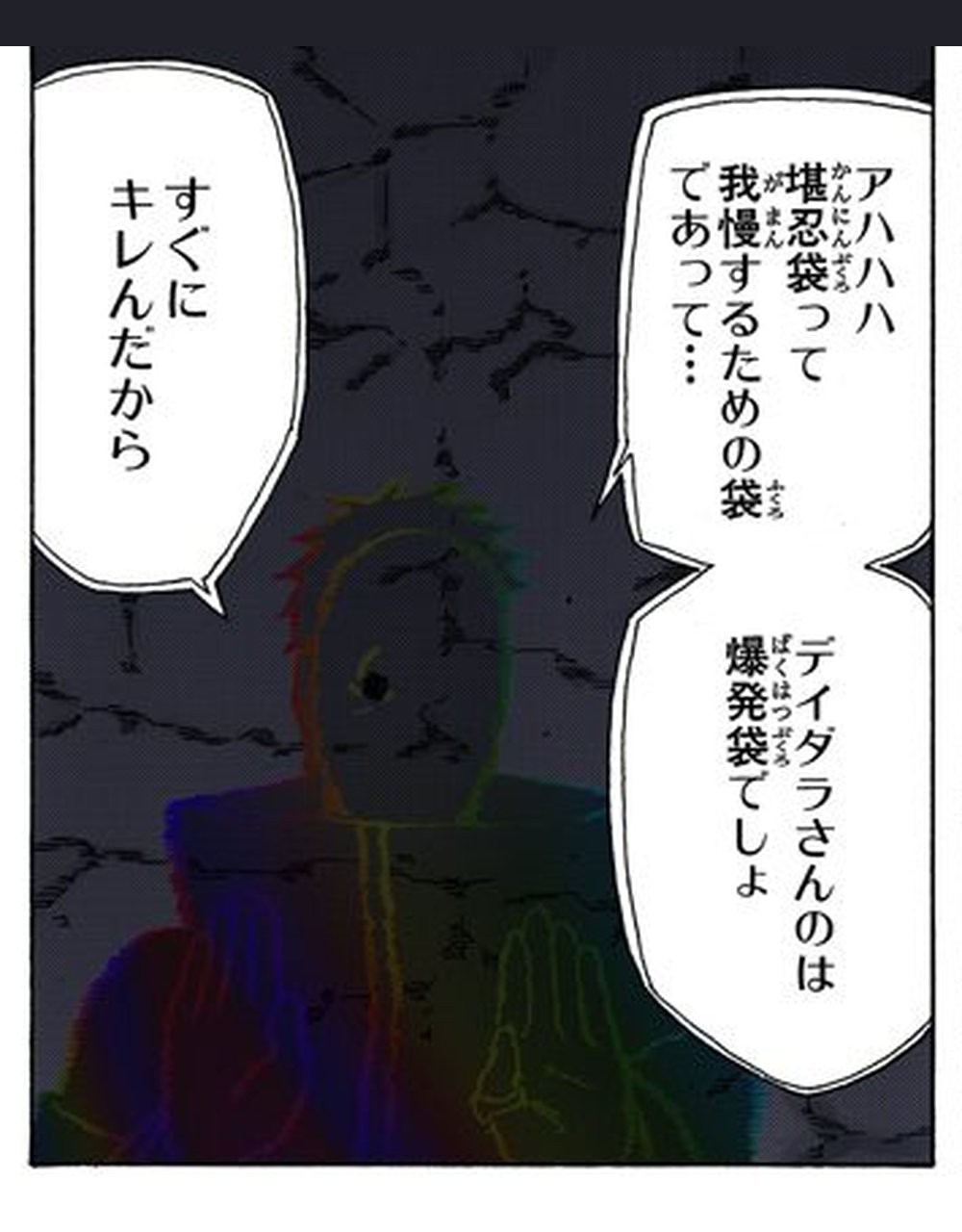
And Tobi, palms raised in the least sincere gesture of appeasement in the ninja world, answers with the line this article exists for — an etymology lesson, delivered mid-quarrel:
「アハハハ堪忍袋って我慢するための袋であって…デイダラさんのは爆発袋でしょ」「すぐにキレんだから」
Ahahaha, kannin-bukuro tte gaman suru tame no fukuro de atte… Deidara-san no wa bakuhatsu-bukuro desho. Sugu ni kiren da kara.
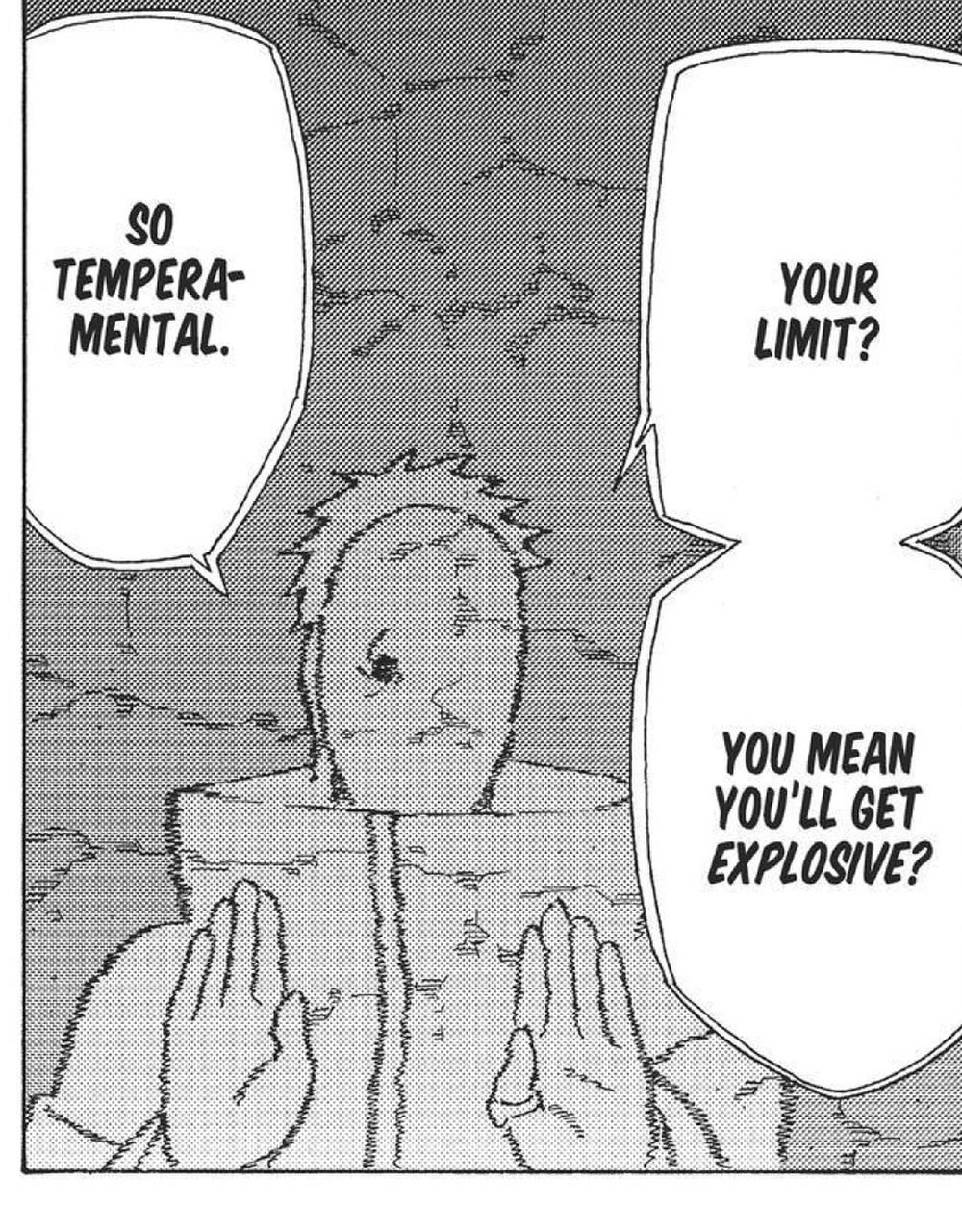
— "Ahaha — see, a kannin-bukuro is a bag for holding your patience in… what you've got, Deidara-san, is an explosion bag. You do snap right away." VIZ prints: "YOUR LIMIT? YOU MEAN YOU'LL GET EXPLOSIVE? SO TEMPERAMENTAL." (Vol. 39, p.76.)
Give the translation its due: "YOUR LIMIT? YOU MEAN YOU'LL GET EXPLOSIVE?" is a real tease with real timing. It bounces Deidara's own word back at him, lands the explosion joke squarely on the explosives artist, and keeps Tobi exactly as slappable as drawn. Deidara certainly buys it — the next panel is a page-wide 「てめェトビコラァアア!!」 ("WHY, YOU UNCULTURED LITTLE... JUST YOU KEEP YAPPING...!") — and it takes Pain himself to end the episode: 「それからトビお前はいつも一言多い」「先輩は立てろ」 — "AND YOU, TOBI... YOU ALWAYS SAY TOO MUCH." "RESPECT YOUR SENIORS."
If you never knew a bag was involved, you'd never miss it. That's the pitfall: in Japanese this exchange isn't banter that happens to mention patience. It's a comedy routine about a specific household idiom — and one of its lines is, word for word, the idiom's dictionary entry.
The Original
Take 堪忍袋 (kannin-bukuro) apart:
- 堪 (kan) — "to bear, to withstand"; the kanji of 堪える (koraeru), "to endure."
- 忍 (nin) — "to endure, to hold hidden" — the 忍 of 忍耐 (nintai, "endurance") and, in this of all manga, of 忍者 and 忍術: in Naruto, the kanji for suppressing your feelings is the profession's own.
- 袋 (fukuro → -bukuro) — a bag.
堪忍 (kannin) by itself means forbearance — holding your temper — and survives in Kansai speech as an apology: かんにんな, "forgive me." So a 堪忍袋 is a forbearance bag: the imaginary sack where you stow each irritation instead of venting it. And the word barely travels alone; it lives inside one set phrase:
堪忍袋の緒が切れる (kannin-bukuro no o ga kireru) — "the cord of the forbearance bag snaps."
緒 (o) is the drawstring. This is Japanese's canonical image for running out of patience, and note what kind of model it is: a capacity model. The bag fills, grievance by grievance, until one last small thing snaps the cord and everything comes out at once. Edo moralists loved the image — the household proverb ならぬ堪忍するが堪忍 ("true forbearance is forbearing the unforbearable") is its virtuous twin — and it still runs modern slang: キレる, today's everyday verb for "to snap, to lose it," turns on the same 切れる that severs the bag's cord.
Now watch what each speaker does with the equipment.
Deidara misquotes the idiom on purpose. The canonical failure mode is a snapped cord; Deidara's bag 爆発する — explodes. Of course it does. This is the man whose creed, screamed at Sasuke one volume later, is 「芸術は爆発なのだ!!」 — "ART IS AN EXPLOSION!!" (Vol. 40, p.12). His temper fails the way his sculptures do. Everything else in the line is bomber texture: てめぇ (the rudest everyday "you"), his rustic-boyish first-person オイラ, the rough assertive ぜ, his sentence-final tic うん! — and カンニン袋 is spelled in katakana, manga's italics, a word being brandished rather than used.
Tobi answers with the dictionary. 堪忍袋って我慢するための袋であって… — that って is the particle Japanese uses to define a term ("a kannin-bukuro, you see, is…"), and であって is a bookish, essayish copula with no business in a villains' lair. The register whiplash is the joke's engine: the organization's clown suddenly talks like a lexicographer, graciously explaining to a colleague that the bag in the idiom is rated for storage, not detonation — デイダラさんのは爆発袋でしょ, "yours, Deidara-san, is an explosion bag," 爆発袋 being a nonce word Tobi mints on the spot, with a mock-polite さん attached purely as provocation. Then the parting shot, すぐにキレんだから — "well, you do snap right away" — quietly lands キレる, the very verb the idiom's drawstring conjugates. Bag, contents, cord, snap: Tobi runs the whole idiom through its parts like a teardown video.
For learners: 我慢 (gaman) is JLPT N4 bread and butter; the full idiom 堪忍袋の緒が切れる is N1-grade; キレる is street register no test will certify. Tobi's line is a free vocabulary lesson — not metaphorically: it is literally a definition, embedded in a gag.
VIZ's Choice
This scene is the only appearance of 堪忍袋 in our 72-volume Naruto corpus, so instead of tracking one word across years of publication, watch it move — and vanish — across a single exchange. Bubble by bubble, as printed (mapping verified against the page images; the machine pairing in our database crosses a few of these):
| Speaker | Japanese (Vol. 39, p.76) | VIZ (Vol. 39, p.76) |
|---|---|---|
| Deidara | てめぇそれ以上言ってみろ! | JUST KEEP RUNNING YOUR MOUTH... |
| Deidara | オイラのカンニン袋が爆発するぜ!!うん! | ...YOU'LL PUSH ME TO MY LIMIT. |
| Tobi | アハハハ堪忍袋って我慢するための袋であって… | YOUR LIMIT? |
| Tobi | デイダラさんのは爆発袋でしょ | YOU MEAN YOU'LL GET EXPLOSIVE? |
| Tobi | すぐにキレんだから | SO TEMPERAMENTAL. |
The rewrite is elegant plumbing. Once "MY LIMIT" replaces the bag in Deidara's bubble, Tobi's etymology has nothing left to define — so VIZ hands him an echo ("YOUR LIMIT?") and fast-forwards to the punchline ("YOU MEAN YOU'LL GET EXPLOSIVE?"). Setup, pedantic digression, punchline becomes setup–punchline. Nothing here is mistranslated, exactly; a whole beat is amputated.
The page even keeps the scar. Kishimoto drew Tobi's first balloon big enough for a twenty-character lecture; VIZ's letterer had to fill that same acreage with the two words "YOUR LIMIT?" in supersized type. The artwork remembers a longer line. (Smaller casualties pile up at the edges: Deidara's うん! tic doesn't make the English page, and the katakana italics of カンニン袋 can't.)
The Gap
A line that teaches becomes a line that only teases. Japanese comedy loves the pedant beat — one character bends an expression, another corrects him with a straight face — and here the corrected item is a real idiom, so the Japanese reader walks away taught: bag, patience, cord, snap. The dialogue doubles as an etymology. In English no idiom appears, so nothing can be explained; Tobi's lecture becomes generic sass, and the reader is entertained but not one word richer.
The deliberate misquote — the characterization — evaporates. 堪忍袋の緒が切れる has one canonical wording, which is exactly what makes Deidara's 爆発するぜ funny: mid-threat, unprompted, he bends a national idiom around his own art form. "YOU'LL PUSH ME TO MY LIMIT" has no fixed form to violate, so his line reads as ordinary anger — and Tobi's correction loses its pretext, because you can't fact-check a man for misquoting "limit."
The props are orphaned. 爆発袋, "explosion bag," is a coined counter-noun with a referent standing right there in the panel: Deidara famously carries actual bags — hip pouches of the clay he sculpts into bombs. Tobi's taxonomy (patience bag: for storing; your bag: for exploding) is also a sight gag. VIZ's "EXPLOSIVE" is an adjective; there is no bag, no object, nothing for the artwork to point at.
キレる loses its cord. Tobi's tag すぐにキレんだから is the idiom's own machinery gone colloquial — the snapping (切れる) of the drawstring is where the modern slang for losing your temper comes from, so the insult re-triggers the idiom one last time on the way out. "SO TEMPERAMENTAL." is a fine sneer and a correct gloss, but it is a synonym where the Japanese had a callback.
What If
What could English have done? The menu and its prices:
- "ONE MORE WORD AND MY PATIENCE BAG'LL EXPLODE!! HM!" / "UM, A PATIENCE BAG IS FOR HOLDING PATIENCE IN… YOURS IS JUST A BOMB BAG." — calque the idiom and let Tobi's gloss stay a real definition; the scene teaches the word exactly as the Japanese does. Cost: "patience bag" isn't English furniture, and the reader must trust the joke to explain it — though this is the rare scene that literally does.
- "KEEP TALKING AND I'LL BLOW A FUSE!! HM!" / "A FUSE IS SUPPOSED TO KEEP THE SPARK FROM GETTING THROUGH… YOURS COMES PRE-LIT." — transpose to an English combustion idiom Tobi can still dissect; the explosive register stays native to Deidara. Cost: the Edo bag becomes electrician's kit, and Tobi's "etymology" is now invented.
- "YOU'RE DOWN TO THE LAST THREAD OF MY PATIENCE!!" / "A THREAD'S MEANT TO HOLD THINGS TOGETHER… YOURS IS DET CORD, RIGHT?" — keep a snappable cord, the idiom's actual moving part, and hand Tobi a real object lesson. Cost: no bag, and "det cord" overexplains the punchline.
- Keep VIZ's limit but restore the definitional beat: "YOUR LIMIT? A LIMIT'S SOMETHING YOU'RE MEANT TO STAY UNDER… YOURS JUST GOES BOOM." — Cost: still bagless, but the lecture-then-punchline shape — the actual joke — survives.
The real difficulty isn't the bag. It's that the scene depends on the audience already owning the idiom: a translator must either teach it on the spot (the calque route) or substitute an English expression concrete enough to lecture about — a fuse, a thread, a last straw. "Limit" is neither. It may be the one word in English's anger vocabulary with no picture inside it at all, which is precisely why nothing in the English scene can be taken apart for laughs.
Take-away
Three rules of thumb to carry off this page:
- When one character explains a word to another, the author is teaching you the word. In-dialogue definitions are load-bearing: a rendering that deletes the definition deletes the scene's reason to exist. Treat them the way you'd treat a plot point.
- Store 堪忍袋の緒が切れる as a picture, not a gloss. A bag; a drawstring; the snap. Once you own the image, its whole family files itself — 我慢の限界 ("the limit of endurance"), キレる and its amplified ブチギレる (the cord doesn't just part, it bursts), and every exasperated もう堪忍袋の緒が切れた you will ever hear.
- When a set phrase arrives with one wrong word, the wrong word is the punchline. Remixing canonical idioms is a standard Japanese gag engine; if a line sounds like a proverb misfiring, find the canonical form — the distance between the two is usually a character sheet in miniature.
Naruto keeps its anger in containers: a bag with a fraying drawstring here, and — one folk organ over — the bug that lives in your belly, 腹の虫, publishing alongside this piece. For a word English flattened in the opposite direction — a Buddhist battlefield turned soap-opera set — see 修羅場 (shuraba), or browse the Naruto translation notes index.
Every Japanese and English line quoted above is a byte-exact capture from the cited editions — NARUTO―ナルト― Vol. 39–40 (Japanese) and Naruto Vol. 39–40 (VIZ Media) at the corresponding panels — via our bilingual page database; see Sources below. Where the database's OCR differs from the printed page (てあって for the printed であって, キレんたから for キレんだから, ボコホコ for ボコボコ), quotations above follow the printed page; the raw captures in Sources preserve the database bytes.