The Moment
Volume 14, the Swordsmith Village arc. Muichirō Tokitō — the boy prodigy of the Hashira, famous for remembering nothing of his own childhood — has just gotten his memory back; the chapter opens with him telling Tanjiro he has finally figured it out: his father had the same red eyes. What returns is this: both parents dead when he was ten, and from eleven, a house shared with exactly one other person — his twin brother, 有一郎, Yuichirō.
And here the Japanese reader gets a gift the English reader never receives. The twins' names are a two-character philosophy: 有 (yū) means "to be, to have"; 無 (mu) means "nothing, without." Being and Nothing, splitting the chores.
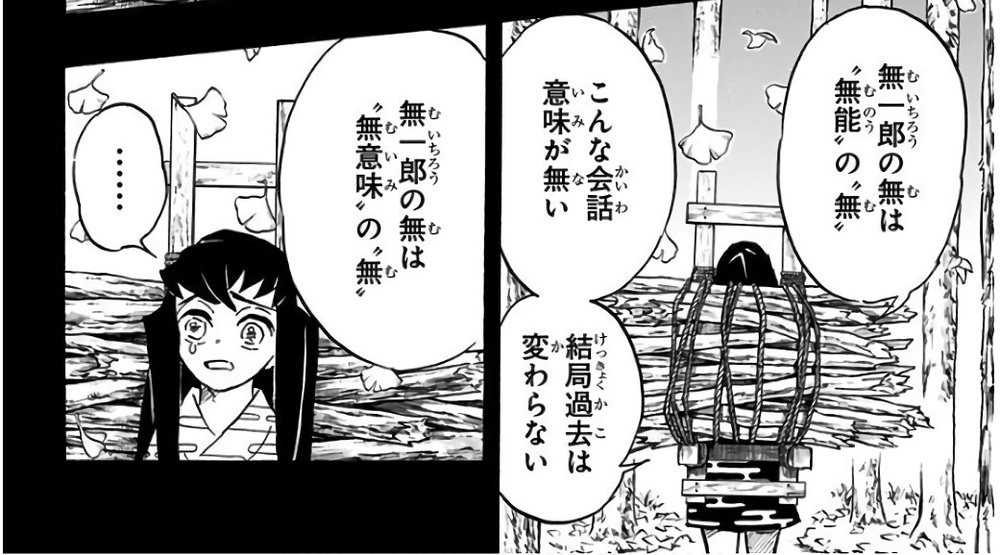
The memory: the brothers trudge home from the woods, Yuichirō up front under a bundle of firewood, back turned; Muichirō behind him, in tears, shouting 「そんな言い方するなよ!!」 — "DON'T TALK LIKE THAT!" Yuichirō doesn't even turn around:
「俺は事実しか言ってない 無一郎の無は〝無能〟の〝無〟」
Ore wa jijitsu shika ittenai. Muichirō no mu wa "munō" no "mu."
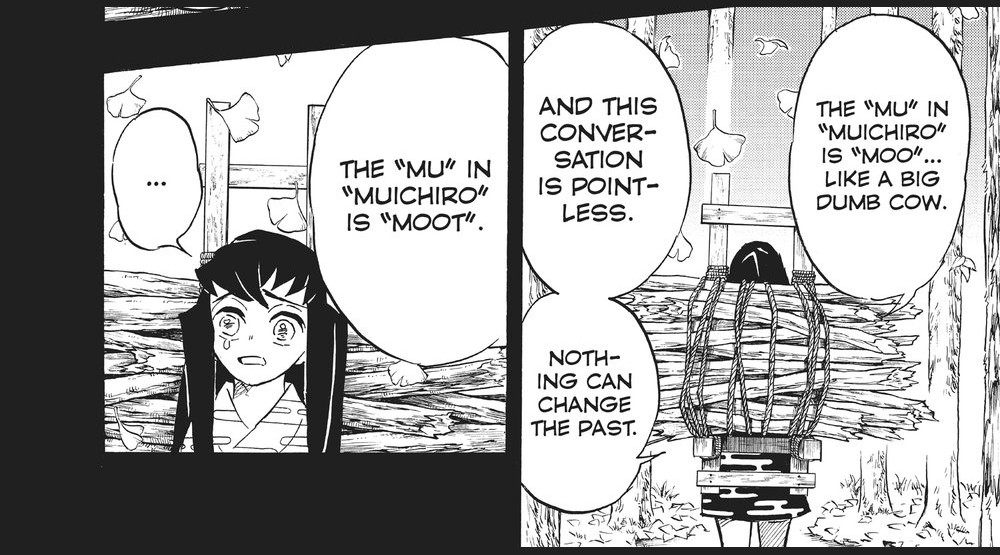
"I'm only stating facts. The mu in Muichirō is the mu of 無能 — 'useless.'" VIZ's English edition prints: "I'M JUST TELLING THE TRUTH." / "THE "MU" IN "MUICHIRO" IS "MOO"... LIKE A BIG DUMB COW." (Vol. 14, p.54).
A few bubbles later he does it again. First the setup on himself — 「こんな会話意味が無い」, this conversation has no meaning (意味が無い, imi ga nai) — then the cap, stamping that very phrase onto his brother's name:
「無一郎の無は〝無意味〟の〝無〟」
Muichirō no mu wa "muimi" no "mu."
VIZ: "THE "MU" IN "MUICHIRO" IS "MOOT"."
Grant the translator its due, because this is close to the worst case in the trade: a written kanji pun on a character's name, in a weekly-serialized story where nobody knows which words will matter later. VIZ refused the footnote and kept the line a pun — something a wounded ten-year-old could actually sneer. "MOO" is even a fair imitation of the Japanese syllable, and "MOOT" lands close enough to "pointless" for the American ear. On this page, it plays.
The problem is ten pages ahead.
The Original
無 (mu) is the heaviest of Japanese's negation prefixes — the family also includes 不, 非, and 未, a JLPT N3 staple. Stamp 無 onto a noun and the noun's referent is absent: 能 "ability" → 無能 (munō), useless; 意味 "meaning" → 無意味 (muimi), meaningless; 料 "fee" → 無料, free of charge; 理 "reason" → 無理, impossible.
Now the name anatomy. 一郎 (ichirō) is the archetypal "first son" name — the Japanese equivalent of naming a boy Junior. 無一郎 therefore parses, on its face, as Nothing-Firstborn; and his elder twin 有一郎 as Being-Firstborn. Read as one word, the pair spells 有無 (umu), "existence and nonexistence" — also the everyday word for "yes or no," as in 有無を言わさず, "without allowing a yes or no." A Japanese reader sees the metaphysics in the family register before either boy says a line.
So when Yuichirō says the mu in his brother's name is the mu of 無能 and 無意味, he isn't punning on a sound. He is pointing at a written character — the same brushstroke-for-brushstroke 無 — sitting in the name and in the insults, and declaring it means what it says. 俺は事実しか言ってない: I'm just reading the facts off the page.
The pivot word arrives at his deathbed: 無限 (mugen) = 無 + 限 "limit" → "without limit" — infinite. Notice what Japanese is doing: it builds infinity as a negation. English does too — "in-finite" — but English hides its negation inside Latin, where modern readers no longer see it. Japanese writes it with the same big character a schoolchild learns, the one in this boy's name. That is why the reversal costs the original nothing: 無能 → 無限 swaps one character after the 無 and the whole verdict flips.
And 無 has a prestige career waiting to receive that flip. Buddhism runs on it — 無常 (impermanence), 無我 (non-self), and the single character 無 that answers Zen's most famous kōan. Everyday Japanese happily builds power out of absence: 無心 (mushin), the swordsman's prized "no-mind"; 無敵 (muteki), "invincible," literally "no enemies." A dying brother turning nothing into no limit is not inventing a trick; he is joining a tradition several centuries deep.
VIZ's Choice
Every appearance of the pun in Volume 14, chapter title included, side by side with the official English:
| Vol. / p. | Japanese | VIZ English |
|---|---|---|
| 14 / 47 (chapter title) | 第118話 無一郎の無 | CHAPTER 118: THE MU OF MUICHIRO |
| 14 / 54 | 無一郎の無は〝無能〟の〝無〟 | THE "MU" IN "MUICHIRO" IS "MOO"... LIKE A BIG DUMB COW. |
| 14 / 54 | 無一郎の無は〝無意味〟の〝無〟 | THE "MU" IN "MUICHIRO" IS "MOOT". |
| 14 / 64 | 無一郎の…無は……本当は……〝無限〟の〝無〟なんだ | THE "MU" IN MUICHIRO... / THE TRUTH IS... / ...IS THE "MU" IN "MUGEN." / INFINITY... |
Three different strategies inside one chapter. The chapter title romanizes the morpheme and trusts you: THE MU OF MUICHIRO. The insults abandon the morpheme for English sound-play: MOO, MOOT. The payoff swings back — romanized MUGEN — and then has to spend an entire bubble, italics and all, being a dictionary: "INFINITY..."
Each choice is locally defensible. The title can afford mystery; the insults need to be sayable by a child; the deathbed needs the real meaning. But read in sequence, the English pun changes species twice, and the cost lands exactly at the emotional climax. In Japanese, the dying line's last word is 〝無〟なんだ — the name itself, re-lit from the inside. In English, the last word of the arc is a gloss.
There is even a small accidental cruelty on p.54: between the two cow puns, VIZ renders 結局過去は変わらない as "NOTHING CAN CHANGE THE PAST." English nothing was available all along — and it got spent on the one line that didn't need it.
The Gap
The pun changed media: written to spoken. The Japanese joke is that one visible character — 無 — sits in the name and in the insults; Yuichirō even springboards off his own 意味が無い ("has no meaning") into 無意味 one bubble later. A Japanese reader doesn't decode the pun; they see it, four identical stamps of ink. "MOO" and "MOOT" chain by sound instead, and teach the English reader a false lesson: that mu is a funny noise. VIZ's "POINTLESS" for 意味が無い is accurate and kills the springboard.
The setup and the payoff use different currencies. MOO and MOOT cannot turn infinite — there is no cow word for the boundless — so at the deathbed the English must quietly re-teach mu as a Japanese morpheme ("MUGEN") that the cow joke had written off as noise. The reader has to un-learn the pun to feel the reversal; the Japanese reader just watches the same character turn over.
Being and Nothing became Yuichiro and Muichiro. 有一郎 and 無一郎 rhyme philosophically on every page the twins share — and the dying scene is Being telling Nothing that his nothing has no end. Romanized, the names differ by one mute letter, and the cosmic joke of the naming never crosses at all.
The retraction no longer quotes the cruelty. Yuichirō's deathbed speech reverses his own doctrine word for word: on p.59 he had shouted 「人を助けるなんてことはな 選ばれた人間にしかできないんだ」 — helping people is something only chosen people (選ばれた人間) can do; on p.65 he hands the phrase back: 「お前は自分ではない誰かのために無限の力を出せる 選ばれた人間なんだ」 — you are one of the chosen, able to draw infinite strength for someone not yourself. VIZ gives "SOMETHING ONLY CERTAIN PEOPLE CAN DO!" the first time and "YOU ARE ONE OF THE CHOSEN!" the second — two fine lines that no longer echo, so the English reader can't hear a boy handing his brother the exact words he once used as a wall.
What If
The menu, and what each option costs:
- "THE 'MU' IN MUICHIRO MEANS 'LESS' — AS IN 'USELESS.'" / "...AS IN 'MEANINGLESS.'" → "THE 'MU' IN MUICHIRO... IS THE 'LESS' IN 'LIMITLESS.'" — English owns a privative morpheme too, and limitless flips it positive exactly the way 無限 does; the payoff finally spends the setup's coin. Cost: the word "means" — one explanatory beat the Japanese never takes, because the name itself contains no "-less."
- Romanize consistently — VIZ's own chapter-title strategy: "THE 'MU' IN MUICHIRO IS THE 'MU' IN MUNO — USELESS." / "...MUIMI — MEANINGLESS." / "...MUGEN — INFINITE." One currency from insult to epitaph. Cost: three vocabulary lessons inside speech bubbles, and the sting slows to a lecture.
- Rebuild on "nothing": "THEY PUT 'NOTHING' IN YOUR NAME, AND NOTHING'S WHAT YOU ARE — GOOD FOR NOTHING. MEANING NOTHING." → "THE NOTHING IN YOUR NAME... IS THE NOTHING WITHOUT END." Keeps the written-pun feeling on an English word that, like 無, can turn transcendent. Cost: abandons the syllable mu entirely and drifts free of the bubble pacing.
- Keep the cows, make the payoff un-say them: "THE 'MU' IN MUICHIRO... WAS NEVER 'MOO.'... IT'S THE 'MU' IN 'MUGEN' — NO LIMIT." Turns the mid-arc currency switch into an explicit beat of retraction. Cost: lets a joke's shadow fall inside a dying whisper.
What every option shares: someone must pay for the fact that English hides its negations inside Latin while Japanese writes them in headline type. The translator's only real choice is where the reader feels the seam — at the insult, at the deathbed, or in a footnote.
Take-away
The mu in Muichirō was never a cow. It was the negation prefix — and the chapter's whole argument is that a negation is not a verdict until you choose the word it negates.
Three rules of thumb to carry off this page:
- Learn to see 無 (and 不, 非, 未) as detachable units. 無能, 無意味, 無限, 無理, 無料 are not five vocabulary items; they are one prefix and five stems. All the 無-words in this chapter are, to a Japanese eye, a single word wearing different endings.
- When manga puns on a name, ask: sound pun or written pun? A sound pun (dajare) can often be rebuilt in English sound. A written pun lives in the kanji, and a translation usually gets to save only one of the two — check which one the later chapters will need.
- Never assume 無 is an insult. 無限, 無敵, 無心 — Japanese has been flipping absence into power since the kōans. If a character's name contains "nothing," the story may be planning to fill it.
For more Demon Slayer lines where one Japanese unit refuses to fit an English seat, see the four-character sword verdict in 一刀両断 and the idiom VIZ explained instead of translated in 腕が鳴る, or browse the Demon Slayer translation notes index. And for another time VIZ reached for an English pun to rescue an untranslatable line — a tombstone joke that quietly swapped religions — see the One Piece piece on 往生しろ and "REST IN PIECES".
Every Japanese and English line quoted above is a byte-exact capture from the cited editions — 鬼滅の刃 Vol. 14 (Japanese) and Demon Slayer: Kimetsu no Yaiba Vol. 14 (VIZ Media) at the corresponding panels — via our bilingual page database; see Sources below.