The Watch
Welcome to the first issue of VIZ Translation Watch — a recurring, data-driven look at how the official English edition of One Piece handles the lines Japanese and English can't say the same way.
Here's the method, in full, because the method is the point. We hold a bilingual page database of every VIZ-published One Piece volume on file — roughly 133,000 aligned JP–EN panel pairs — each one scored for translation risk on a 0–1 scale across axes like semantic shift, register loss, and wordplay. For this issue we pulled every pair scoring 0.7 or higher that no earlier article on this site had already covered, and shortlisted the fifteen most promising.
Then we did the part a scoring model can't do: we opened the actual printed pages — JP and EN both — for every single shortlisted candidate, and checked whether the two lines really are the same panel, the same speaker, the same moment. This step matters more than it sounds like it should. The alignment between a Japanese line and its English counterpart in a bulk-processed corpus is a machine guess, built from page geometry and sequence order — and a "translation gap" scoring 0.95 or even 1.00 is, more often than not, just two unrelated bubbles that got glued together by the aligner. A monologue on one page, a sound effect on the next. An Oda Q&A column mistaken for dialogue. A volume's closing splash page paired with the next volume's opening recap.
Of our fifteen shortlisted candidates, ten were exactly that — alignment noise, not translation choices. That's the honest headline of this series: most of what looks like a dramatic VIZ liberty, at scale, is a bookkeeping error in a database, not a decision a translator made. We're not printing those ten. Printing a false "VIZ butchered this line" claim would be worse than printing nothing.
Five held up. Here they are.
Find One — オカマ拳法 becomes a pun built from nothing
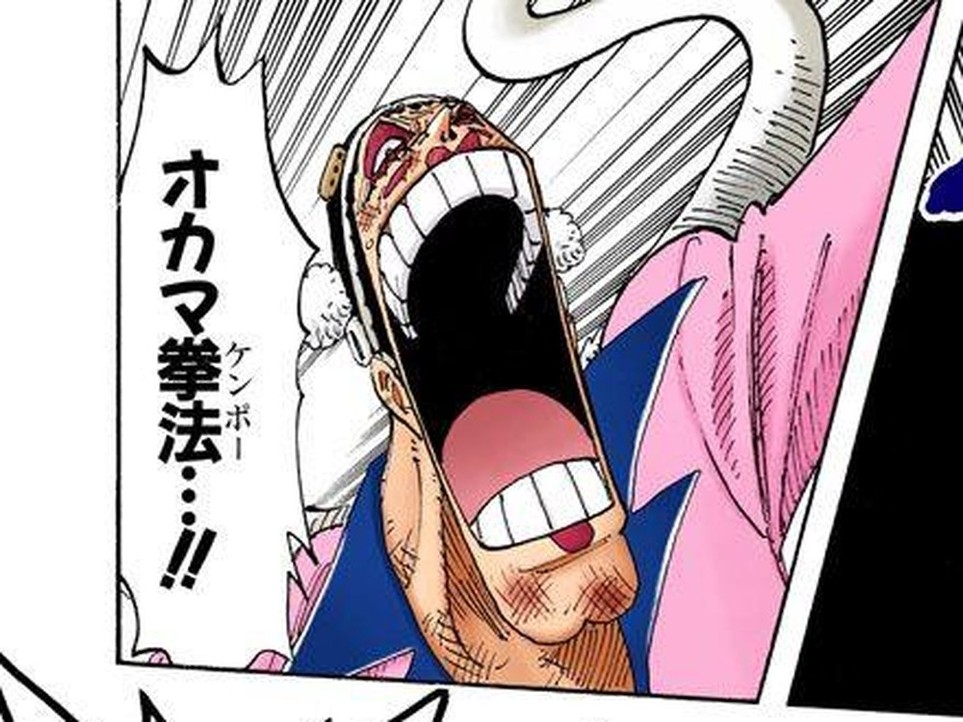
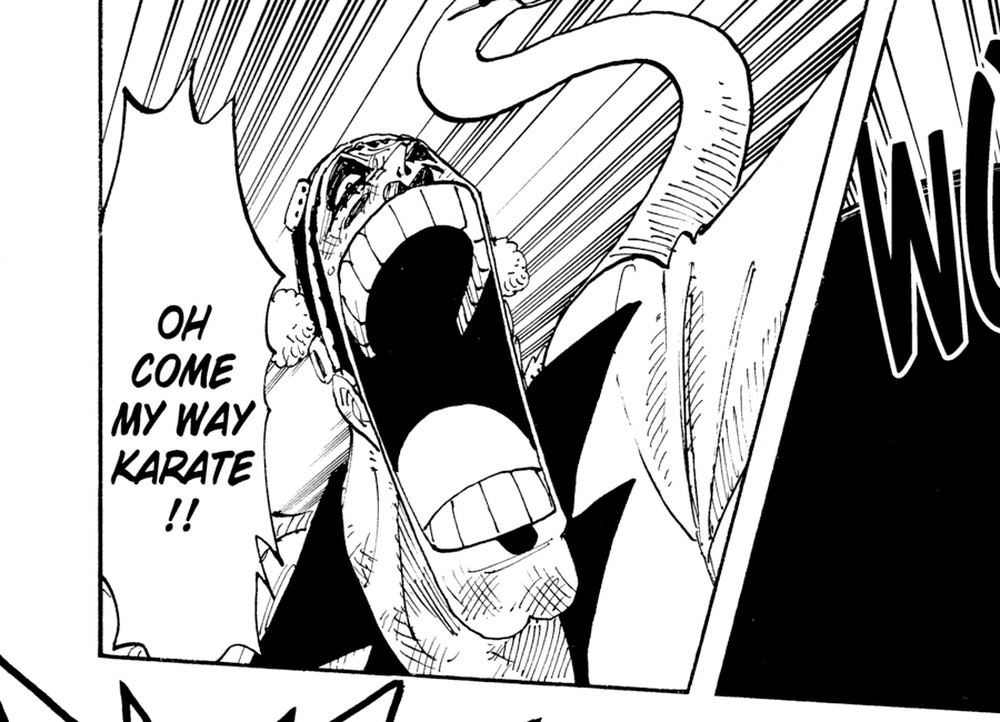
Alabasta arc, Rainbase. Bon Kurei — introduced as the villain Mr. 2 — is mid-fight, and he announces the name of his own fighting style the way every One Piece combatant announces a signature technique:
「オカマ拳法…!!」 Okama kenpō...!!
VIZ (Vol. 21, p.17): "OH COME MY WAY KARATE!!"
Grant this one its due immediately: "oh come my way" is a genuinely clever phonetic match for "okama," and it survives being shouted at full volume mid-punch, which is the actual job description of a wazamei. But listen to what happened to the meaning. オカマ拳法 fuses オカマ (okama — a loaded, slangy Japanese word for an effeminate or cross-dressing man) directly onto 拳法 (kenpō, the formal word for a martial art). Bon Kurei is naming his fighting style after himself, in public, with total confidence. "OH COME MY WAY KARATE" means nothing at all — it's a sound-alike phrase invented from scratch, chosen because it rhymes with the joke rather than makes it.
And this isn't a one-off save. We pulled every appearance of オカマ拳法 in the corpus: it shows up at least eleven times across this arc, and VIZ renders it "OH COME MY WAY KARATE" every single time, including the boast a few pages earlier — 「磨き上げたオカマ拳法おめェゴトキに破れるモンじゃないのよーう!!」, "THAT'S HOW I PERFECTED MY OH COME MY WAY KARATE, AND IT WILL NEVER BE SURPASSED BY THE LIKES OF YOU!!" (Vol. 21, p.9) — right down to a follow-up attack VIZ christens "OH COME MY WAY KNUCKLE" for a move whose Japanese name is a pun on どうぞ ("please, go ahead"). That consistency is the real finding here: this isn't damage control on one bad line, it's a full replacement joke, engineered once and then maintained for an entire arc like a piece of continuity. What's gone is the specific referent — a reader with no Japanese has no way to know that Bon Kurei is proudly naming his style after a real, contested word for who he is. What survives is everything else: the swagger, the volume, the fact that it's funny. For another case in this corpus where VIZ built an entirely new bilingual joke rather than translate the old one, see 108 Desires, 108 Pounds: 煩悩鳳.
Find Two — a name that disappears into "DEAD MAN"
Arlong Park arc. Zoro, pinned and bleeding, faces down one of Arlong's crew before a finishing blow:
「瀕死のロロノア・ソロよ...」 Hinshi no Roronoa Soro yo…
VIZ (Vol. 10, p.146): "DEAD MAN."
(Note the Japanese itself: the fishman calls him "ロロノア・ソロ," not the correct "ゾロ" — likely his own mouth full of teeth mangling the name, a small, ugly character touch VIZ's two words have no room to carry either.)
Two words for a line that, in Japanese, is doing two jobs at once. 瀕死 (hinshi) means "near death, critically wounded" — alive, but barely; it describes a state, not an outcome. And the line names him: Roronoa Zoro, spoken like a title, with the address particle よ giving it the weight of a verdict being read aloud. "DEAD MAN" collapses both. The tense slides from dying to already dead — a small grammatical escalation that turns an observation into a false claim, since Zoro obviously survives the scene. And the name is simply gone: the one thing the Japanese insists on — that this fishman knows exactly who he's about to kill, and says so — vanishes into a generic tough-guy label that could be aimed at anyone. "Dead man" reads fine in isolation. It just isn't the same sentence. For more on how VIZ handles this character's name specifically, see Zolo vs. Zoro: The Complete History of VIZ's Most Contested Name.
Find Three — a decade turns into "since we last met"
Early East Blue, Luffy's first solo chapter as a pirate. He returns to the sea monster that swallowed his arm when he was a child — the same one his crewless, seven-year-old self couldn't fight back then — and grins:
「10年鍛えたおれの技をみろ!!」 Jūnen kitaeta ore no waza o miro!!
VIZ (Vol. 1, p.53): "BUT HERE'S AN ATTACK I'VE BEEN PERFECTING SINCE THE LAST TIME WE MET!!"
This one is subtler than a loss — it's a reframe, and a smart one. Both lines are true to the same story beat: ten years have passed since young Luffy was seven and this monster nearly killed him; he's seventeen now. The Japanese counts the years — 10年鍛えた, "trained for 10 years" — putting the emphasis on effort, on the long unglamorous grind of training, a very standard shōnen boast. VIZ's English drops the number entirely and reframes the same beat as a callback to their specific earlier encounter: not how long I've trained, but this is for you, specifically, since last time. It's a legitimate translator's choice — it plays up the rematch drama for readers who might not immediately clock that this is the same "local sea monster" from the prologue — but it's a different sentence doing a different piece of narrative work, and the neat numerical echo (seven-year-old Luffy, ten years, seventeen-year-old Luffy) simply isn't recoverable from the English at all.
Find Four — a vague "thing" turns into a specific, cool pair of shoes
Long Ring Long Land, the Donut Race. Watching the Straw Hats pull off a trick on their roller shoes, one of the Foxy Pirates calls out:
「面白ェモン持ってんなァお前ら!!」 Omoshirē mon motten naa omaera!!
VIZ (Vol. 26, p.111): "THOSE SHOES OF YOURS ARE COOL!"
Here the shift runs the other direction from the first three finds: English adds precision the Japanese deliberately withholds. 面白いモン (omoshiroi mon) is maximally vague — "an interesting thing," not naming what the thing is or what's interesting about it, letting the artwork do that work instead. VIZ's "those shoes" names the object outright, and "cool" swaps a word about curiosity (面白い can mean funny, strange, or fascinating) for a word about aesthetic approval. It's a defensible, reader-friendly localization — English narration often wants the noun a panel implies rather than a vague pointer to it — but it closes a door the Japanese leaves open: 面白いモン could describe a gadget, a trick, or a whole strategy, and "cool shoes" can only ever describe shoes.
Find Five — a swordsman's technique renamed by its sound
Alabasta arc, Zoro's duel with an opponent whose whole body is blades. Mid-strike, Zoro names his attack the way Bon Kurei named his:
「螺旋抜斬!!」
VIZ (Vol. 21, p.171): "BUZZ SAWS."
螺旋抜斬 (rasen nukizan) is a compound technique name in the classic wazamei pattern: 螺旋, "spiral," plus 抜斬, "draw-and-cut" — a term straight out of iaidō, the art of the fast draw. It names what the move is: a spiraling, sword-drawing cut. "BUZZ SAWS" names what it looks and sounds like instead — trading the swordsmanship vocabulary for a visual/onomatopoeic description of the effect. Worth noting: even Oda's own Japanese leans partway toward this move already, glossing 螺旋 with the katakana reading スパイラル ("spiral," the English loanword) right there on the page — so VIZ isn't inventing an imported-sound flavor from nothing, they're just cutting the kanji layer (抜斬, the actual sword terminology) and keeping only the part that was already halfway to English. It's the smallest gap of the five — a rename, not an erasure — but it's a real one: an English reader never learns this is specifically a draw-cut, an iaidō term, rather than just a fast, spinny sword move.
VIZ's Choice
Five verified shifts, five different shapes of gap:
| Find | Japanese | VIZ English | What Shifted |
|---|---|---|---|
| オカマ拳法 (Vol. 21, p.12) | オカマ拳法…!! | OH COME MY WAY KARATE!! | Meaning traded for sound — a new pun built from scratch, held for 11+ panels |
| ロロノア・ソロ (Vol. 10, p.146) | 瀕死のロロノア・ソロよ... | DEAD MAN. | The character's name deleted; "near death" escalated to "dead" |
| 10年鍛えた (Vol. 1, p.53) | 10年鍛えたおれの技をみろ!! | BUT HERE'S AN ATTACK I'VE BEEN PERFECTING SINCE THE LAST TIME WE MET!! | Training-duration boast reframed as a rematch callback |
| 面白ェモン (Vol. 26, p.111) | 面白ェモン持ってんなァお前ら!! | THOSE SHOES OF YOURS ARE COOL! | Deliberate vagueness resolved into a specific, named object |
| 螺旋抜斬 (Vol. 21, p.166) | 〝螺旋抜斬!! | BUZZ SAWS. | Swordsmanship terminology (draw-cut) replaced by a visual/sound description |
No single pattern unites them — which is itself the finding. "VIZ takes liberties" isn't one phenomenon; it's at least five: pun invention, deletion, reframing, explicitation, and renaming. A translation-risk score can tell you where to look. It can't tell you which of these five things you're looking at, or whether you're looking at anything real at all — that still takes opening the actual page.
Take-away
Three rules of thumb, one for reading VIZ's One Piece and one for reading any "here's what got lost in translation" claim, including ours:
- A high translation-risk score is a place to look, not a verdict — treat it as a lead, and open the real pages before repeating the claim.
- Watch for the shape of the gap, not just its size: VIZ invents (オカマ拳法), deletes (ロロノア・ソロ), reframes (10年鍛えた), specifies (面白ェモン), and renames (螺旋抜斬) — five different translator instincts, not one "loss."
- Consistency is evidence of craft. A pun VIZ holds for eleven straight panels isn't a slip; it's a decision somebody made once and then protected for the length of an arc.
Browse the One Piece translation notes index for the individual deep-dives behind two of this issue's finds. Next issue: we run the same scan against the next unclaimed slice of the corpus — Water Seven and beyond — and find out how many of the next fifteen high scorers turn out to be real.
Every Japanese and English line quoted above is a byte-exact capture from the cited editions — ONE PIECE Vol. 1, 10, 21, 26 (Japanese) and One Piece (VIZ Media) at the corresponding panels — via our bilingual page database; see Sources below.