The Moment
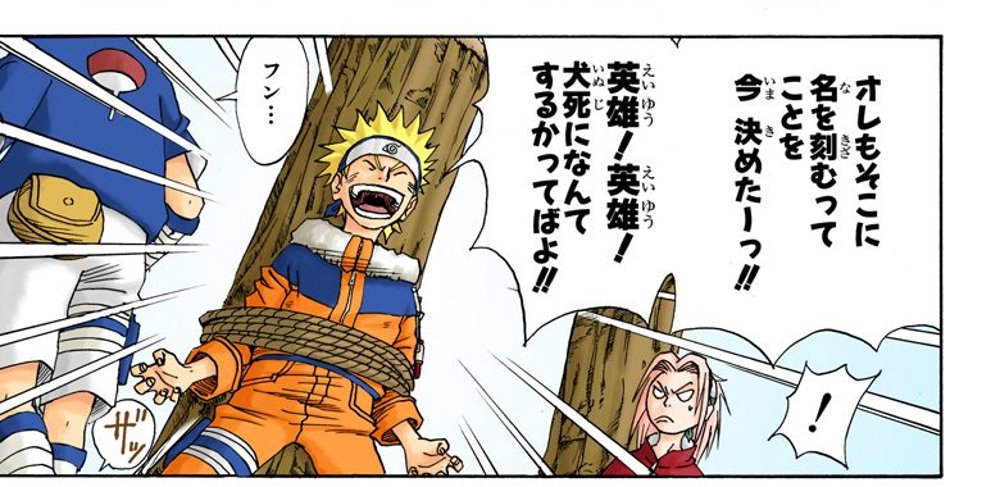
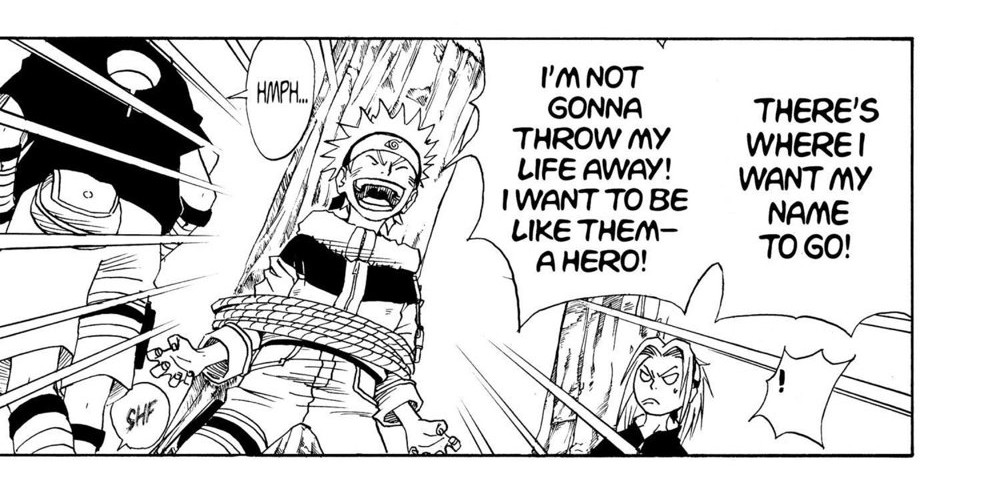
Land of Waves arc, Volume 2. A masked, silver-haired ninja walks toward a weathered stone slab set into the hillside, a speech bubble trailing behind him: 「これを見ろ...この石に刻んである無数の名前...これは全て里で英雄と呼ばれている忍者達だ」 — "LOOK AT THE MARKER... ALL THE NAMES CARVED IN THE STONE... HEROES OF OUR VILLAGE. NINJA." Cut to who's listening: a young Naruto, rope wound tight around his chest, pinned to a tree stump — and not remotely subdued by it. "THAT'S IT! I JUST MADE UP MY MIND!" he shouts, then, "THERE'S WHERE I WANT MY NAME TO GO!" Sakura, a few feet away, flinches at the outburst. Naruto isn't finished:
「英雄!英雄!犬死になんてするかってばよ!!」
Eiyū! Eiyū! Inujini nante suru ka ttebayo!!
VIZ's English edition prints: "I'M NOT GONNA THROW MY LIFE AWAY! I WANT TO BE LIKE THEM- A HERO!" (Vol. 2, p.15.)
Grant the rendering its due first. "Throw my life away" is a real English idiom in its own right, it lands at exactly Naruto's volume, and it keeps だってばよ's manic energy intact even without a direct equivalent for the tic itself. Read on its own, the line does everything a shonen pep-talk needs to do. The trouble only shows up when you go looking for what got left on the cutting-room floor: 犬死に, "a dog's death," has an animal buried inside it that "throw my life away" simply has no room for — and, as we'll see, neither does anything else VIZ tries across this word's next three appearances.
The Original
Take 犬死に apart and it barely needs unpacking: 犬 (inu) is simply "dog," the animal, no euphemism attached, and 死に is the noun form of 死ぬ (shinu), "to die" — voiced from し to じ by rendaku, the same shift that turns 立ち+読み into 立ち読み (tachiyomi, "browsing a book without buying it"). Put the two together and the compound says exactly what it looks like it says: to die the way a dog dies.
Japanese keeps a small working vocabulary of these blunt compound death-nouns, and each one specifies not just that someone died but how much the death counted. 野垂れ死に (notarejini) is to collapse and die by the roadside, forgotten — the image of an abandoned traveler, or animal, nobody stops for. 無駄死に (mudajini) is a wasted death, closer to a flat English "died for nothing" — and, as we'll see below, 犬死に's frequent partner-in-crime. Standing at the opposite end of the same scale is 本望 (hongan): a death that fulfilled one's dearest wish, the death of someone who got to finish what they set out to do — genuinely something close to a good death, in context. 犬死に sits at the very bottom of that ladder, below even 無駄死に. A samurai's death in service to a lord was recorded, named, folded into a domain's history; a stray dog's death in the street was none of those things — nobody wrote it down, nobody counted it. That asymmetry is the whole idiom: to die 犬死に isn't just to die pointlessly, it's to die in a way that doesn't register as a death that mattered at all.
The grammar carrying our headline occurrence rewards a second look. 犬死になんてするか packs a full rhetorical move into five words: 〜なんて marks contemptuous incredulity ("the very idea of..."), and the following か isn't a question, it's a challenge — "[you think I'd] die a dog's death? [Not a chance.]" Naruto caps it with ってばよ (ttebayo), his own sentence-final verbal tic — no dictionary meaning, pure personality, the linguistic equivalent of stamping a foot. As vocabulary, the individual kanji are beginner-level (犬 is JLPT N5, 死ぬ is N4), but the compound idiom lives well above that — closer to N1 by how rarely a learner meets it outside war fiction, historical drama, and exactly this kind of shonen vow.
VIZ's Choice
Every appearance of 犬死に in the volumes on file, speaker included:
| Vol. / p. | Speaker | Japanese | VIZ English |
|---|---|---|---|
| 2 / 15 | Naruto (tied to a stump, Land of Waves mission) | 英雄!英雄!犬死になんてするかってばよ!! | I'M NOT GONNA THROW MY LIFE AWAY! I WANT TO BE LIKE THEM- A HERO! |
| 18 / 93 | Tsunade, to Jiraiya | 結局は夢半ばに里の為に犬死にしただけだしね | AND YET IN THE END, THEY DIED IN VAIN FOR THE VILLAGE, WHILE STILL IN THE MIDST OF PURSUING THEIR DREAMS. |
| 23 / 76 | Kiba, to Akamaru | オレたちゃここで犬死にだ... | WE'LL DIE HERE... |
| 37 / 28 | Tsunade, to Team 10 (Shikamaru, Ino, Chōji) | 犬死にしたいのか! | ...DO YOU REALLY WANT TO DIE IN VAIN?! |
Four appearances, three different solutions, and not one of them keeps the animal. "Throw my life away" externalizes the loss into a possession being discarded. "Died in vain" — used twice, nineteen volumes apart, for two different Tsunade lines about two different subjects — is the closest thing VIZ has to a house style for this word, and it's the most defensible of the three: compact, idiomatic, dignified enough for a Hokage's grief. And in Volume 23, the idiom disappears outright. "WE'LL DIE HERE..." is accurate to the plot beat (Kiba and Akamaru might die, here, in this cave) but not to the sentence Kiba actually says, which specifies how — 犬死に, a dog's death — while he says it looking his own ninja dog in the eye. That's not a subtle loss. It's the single funniest, saddest reading in the whole set, and English never gets the chance to notice it.
The Volume 37 row needed extra legwork to confirm. The bilingual corpus pairs that line with no English text at all — a genuine alignment gap, not a translation choice, caused by a scene where the Japanese tankobon splits its panels across a page boundary the VIZ release doesn't share the same way. Reading the actual printed English page (Vol. 37, p.28) resolves it: Tsunade's rebuke to Shikamaru, Ino, and Chōji after Asuma's death runs across three bubbles in one panel — "DO YOU PLAN THIS TO BE SOME AVENGING BATTLE?!", "IT'S NOT LIKE YOU...", "...DO YOU REALLY WANT TO DIE IN VAIN?!" — the third of which is our line. It's included above because the printed page confirms it beyond doubt, even though the aligned corpus pairing itself came up empty; see Sources for how the two differ.
One more data point, from outside this manga entirely. 犬死に doesn't always travel alone. In Demon Slayer Volume 14, a young Genya Shinazugawa snaps at his sister that all two orphaned, untrained siblings can do is 「犬死にと無駄死にだよ」 — "a dog's death and a wasted death." VIZ's English there is "...IS DIE POINTLESSLY... LIKE DOGS!" — and for once, the dog survives the trip. It survives, notably, only because the Japanese forced the issue: paired directly against its own near-synonym 無駄死に, a translator has to find some way to make the two words say different things, and "like dogs" is the one piece of 犬死に's meaning that 無駄死に doesn't already cover. Standing alone, four times, in Naruto, 犬死に never gets that kind of pressure — and the dog never survives.
The Gap
English isn't missing the image — it's declining to use it. "To die like a dog" is a genuine, centuries-old English idiom for dying in a wretched, undignified, unmourned way; it's the note Kafka's The Trial famously ends on — "'Like a dog!' he said; it was as if the shame of it must outlive him" — and cruder versions of the same sentiment run through English drama for centuries before that. 犬死に and "die like a dog" are close to structural twins. Across every occurrence on file, VIZ reaches for that twin exactly zero times.
The ranking system flattens into one mood. Japanese's death-vocabulary is a ladder, not a synonym cloud — 犬死に at the bottom, 無駄死に one rung up, 本望 at the top — and a fluent reader tracks, scene by scene, exactly where a given death lands on it. "In vain" and "pointless" cover the bottom rungs well enough in isolation, but English has no ladder underneath them, so the specific, sub-human ignominy 犬死に reserves for its very worst deaths collapses into the same general regret that covers everything above it.
The dog is sometimes standing right there. Kiba's オレたちゃここで犬死にだ... is spoken directly to Akamaru — his ninja partner, an actual dog, mid-conversation about whether the two of them are about to die. "WE'LL DIE HERE..." is not wrong about the danger. It is wrong about the joke: a boy warning his dog that they might die like dogs is exactly the kind of gallows humor Kishimoto's dialogue reaches for constantly, and it requires the reader to catch the word to catch the joke at all.
Scatter erases the recurring word. A Japanese reader meets 犬死に in a child's boast, a Hokage's grief (twice), and a warning to a literal dog, and clocks it every time as the same word doing the same specific work. An English reader meets "throw my life away," "died in vain" twice, and a silence, and has no way to notice the manga keeps reaching for one idea across thirty-five volumes and two different narrators' worth of grief.
What If
- "I'M NOT GONNA DIE LIKE SOME DOG!" — keeps the animal by reaching for English's own attested cognate idiom. Cost: "some dog" reads half a register more casual than a kid's declared life ambition wants.
- "NO WAY I'M DYING SOME NOBODY'S DEATH, BELIEVE IT!" — keeps the anonymity/ignominy half of the meaning and Naruto's tic. Cost: "nobody's death" is an invented coinage, not an idiom either language already owns — it explains the image rather than landing it.
- "I WON'T DIE FOR NOTHING!" — short, punchy, close to VIZ's own instinct. Cost: identical failure mode to VIZ's actual line — no animal, no ladder, just generic waste.
- Keep VIZ's "throw my life away," but let the dog back in: "I'M NOT GONNA THROW MY LIFE AWAY LIKE SOME DOG!" — Cost: stacks two images (discarding + dog) that the single Japanese compound keeps fused into one, and runs slightly baggier than the original's four beats.
Take-away
犬死に looks, on the surface, like one more word for "pointless death" — and every VIZ rendering on file treats it that way. It isn't one. It's the bottom rung of a ranking system, and the rung is marked with an animal on purpose, in a language that has plenty of other ways to say "wasted" without reaching for a dog. English isn't even short the matching idiom; it simply never gets used here.
Three rules of thumb to carry off this page:
- When a Japanese death-word names an animal, ask what it's ranking, not just what it means. 犬死に isn't a synonym for "died in vain" — it's a specific rung below it, and the rung is doing the work.
- "To die like a dog" is sitting on English's own shelf. It's rare, but it exists, attested for centuries — worth reaching for exactly when the Japanese reaches for 犬死に, and conspicuously absent from every VIZ line that does.
- Watch what a word does when it's paired against its own synonym. 犬死にと無駄死に, forced to differ from its neighbor in Demon Slayer, kept its dog. Standing alone, under no such pressure, in Naruto, it never does — scatter and omission are what a word defaults to when nothing forces a translator to notice it's recurring.
Tsunade's two lines here both trace back to the same fatalism that drives her most personal possession in the series — see the cursed necklace behind her fear of a meaningless death — and this headline scene shares its arc and its stone marker with the eight-tiered underworld Zabuza gets sent to a few volumes later. For more of what VIZ's Naruto quietly declines to carry across, browse the full Naruto translation notes index.
Every Japanese and English line quoted above is a byte-exact capture from the cited editions — NARUTO―ナルト― Vol. 2, 18, 23 & 37 (Japanese, colored digital edition) and Naruto Vol. 2, 18, 23 & 37 (VIZ Media) at the corresponding panels, plus one companion citation from Kimetsu no Yaiba Vol. 14 — via our bilingual page database; see Sources below. The Volume 37 English line is a direct transcription from the printed page rather than the aligned corpus pairing, which returned no match for that panel; see VIZ's Choice above.