The Moment
Volume 19, deep in the endgame of the Search for Tsunade arc. Naruto has been knocked down again and again by Kabuto Yakushi — Orochimaru's silver-haired, bespectacled aide, composed enough to deflect a full-swing Rasengan and murmur 「そんな大きなモーションでボクに当てることなど出来ないよ」, "you'll never tag me with a windup that telegraphed." Tsunade watches from the sidelines, already hurt, unable to step in. And then Naruto — bloodied, staggering — gets back up one more time. Kabuto's composure finally cracks: 「...まだ立つか...」, "HE'S STILL GETTING UP...?" Naruto's answer isn't really aimed at Kabuto. It's aimed across the field, at Tsunade:
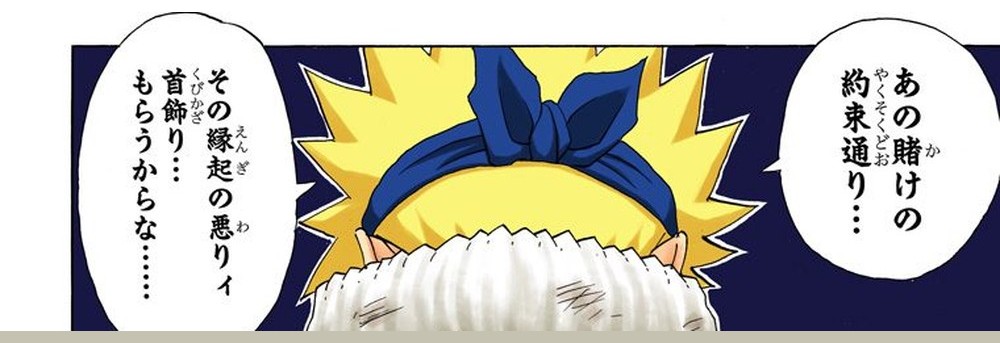
「...綱手のバアちゃん...あの賭けの約束通り...その縁起の悪りィ首飾り...もらうからな...」
…Tsunade no bā-chan… ano kake no yakusoku-dōri… sono engi no warurii kubikazari… morau kara na…
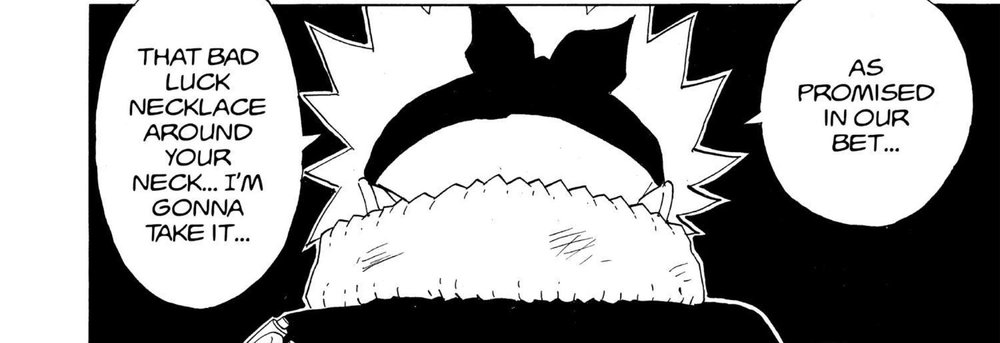
VIZ's English edition prints: "...GRANNY TSUNADE... AS PROMISED IN OUR BET... THAT BAD LUCK NECKLACE AROUND YOUR NECK... I'M GONNA TAKE IT..." (Vol. 19, p.98).
Grant the rendering its due first. "BAD LUCK NECKLACE" is punchy, it fits a shōnen bubble mid-fight, and it isn't wrong that the necklace has a reputation. The line lands, the panel lands — Naruto laces his fingers into a seal, and the next beat is "KAGE-BUNSHIN NO JUTSU!", a wall of clones summoned to finish what one Rasengan couldn't. But sit with the word doing the heavy lifting. 縁起 (engi) is not a coin-flip word, and this necklace isn't unlucky the way a black cat is unlucky. It has a track record.
The Original
Take 縁起 apart the way its sibling article on this site already does, because the anatomy doesn't change from series to series — only the sentence wrapped around it does. 縁 (en) is "connecting condition" — the same 縁 inside 因縁 (innen, a karmic tie) and the everyday ご縁 (go-en, a fateful connection). 起 (ki) is "to arise" — the 起 of 起きる (okiru, "to occur") and 起こる (okoru, "to happen"). Together, 縁起 is the standard Japanese Buddhist calque for pratītyasamutpāda, dependent origination: nothing in the universe arises from a cause alone, only from cause meeting condition. The doctrine survives whole in compounds like 十二縁起 (jūni engi, the twelve links of dependent origination); the everyday adjective 縁起がいい/悪い is what's left once the doctrine wears down into a simple predicate.
Naruto's line puts the negative face of that predicate to work as a relative clause: 縁起の悪い首飾り, literally "the necklace whose arising-sign is bad" — [NOUN] + の + 悪い + [NOUN], a compact grammatical trick that folds an entire causal verdict into a two-word modifier stapled onto "necklace," the same move English performs with "a jinxed heirloom." The adjective itself is doing character work on the page: 悪い (warui) is stretched into 悪りィ (warurii) — a rough, spat-out manga respelling, not a dictionary form, the kind of vowel-stretch this series reserves for its bluntest, least polished speakers. Grammatically the rest of the line is plain — もらうからな is just "I'm taking it, so there," a blunt future with the assertive からな shoved on the end — but 縁起 itself sits at roughly JLPT N2, textbook vocabulary from a "superstitions" unit, one rung below the doctrinal machinery it's quietly built on.
VIZ's Choice
Here is every appearance of 縁起 we can verify in the volumes on file, VIZ's English beside each:
| Vol. / p. | Speaker & scene | Japanese | VIZ English |
|---|---|---|---|
| 19 / 98 | Naruto, mid-fight against Kabuto | その縁起の悪りィ首飾り...もらうからな... | THAT BAD LUCK NECKLACE AROUND YOUR NECK... I'M GONNA TAKE IT... |
| 28 / 173 | Tsunade, staring at a winning lottery ticket | これは相当縁起が悪いな | ...DIRE OMENS, INDEED... |
| 32 / 72 | Naruto, replayed inside Tsunade's memory | その縁起の悪りィ首飾り...もらうからな... | ...THAT BAD LUCK NECKLACE AROUND YOUR NECK... I'M GONNA TAKE IT... |
Two of the three rows are the same panel twice. Thirteen volumes after the Kabuto fight, with Konoha's elders demanding to know what happens once the Akatsuki extract the Nine Tails from Naruto, Tsunade — cornered, remembering her own fiancé's dying words that if you lose the person you love, "dreams and everything else is gone" — replays this exact frame in her head. Kishimoto reuses the art; VIZ, sensibly, reuses the translation. That's not scatter, it's a callback working as intended.
The third row is the interesting one. Vol. 28 opens a short comic aside — a title card literally reads "(Tsunade won the Lottery)" — built entirely on Tsunade's legendary bad luck at gambling. She checks her coat pocket, finds a jumbo lottery ticket, and the winning numbers match. Her reaction isn't joy; it's dread: 「これは相当縁起が悪いな」, and VIZ reaches for "DIRE OMENS, INDEED..." — genuinely better than "luck," because it keeps the omen-reading logic front and center: winning, for a woman whose entire reputation is built on losing, is itself the sign something worse is coming. VIZ had this word available the whole time. It simply judged that a punch-panel needs "BAD LUCK" and a sight gag can afford "DIRE OMENS."
The Gap
"Luck" names an absence of cause; the necklace's 縁起 is a documented chain. A coin flip is lucky because nothing determined it. The necklace is 縁起が悪い because something did — a pattern of loss running back through the people who wore it before Naruto ever asked Tsunade for it. "BAD LUCK NECKLACE" tells the English reader to expect randomness where the Japanese is naming a track record.
VIZ's own corpus disproves the excuse that English has no word for it. The same shelf that gives us "BAD LUCK" twice gives us "DIRE OMENS, INDEED" once, for the identical predicate. The vocabulary was sitting right there. English chose the flatter word for the fight scene because it reads faster mid-punch — a register decision, not a translation ceiling — and the cost is that the necklace and the lottery ticket, which share one Japanese word and one worldview, no longer sound like they're talking about the same thing.
The cross-work rhyme goes completely silent. The same two kanji, in this same batch of translation notes, are the word a swordsmith uses to call Tanjiro's hair "WHAT LUCK!" in Demon Slayer, and the word Naruto uses to call a cursed heirloom "BAD LUCK" here — one doctrine, positive and negative face, running quietly through two unrelated Shonen Jump franchises. A reader who has met 縁起 in one series has, without knowing it, already met it in the other.
What If
For the headline line, the menu and its prices:
- "THAT NECKLACE WITH THE BODY COUNT... I'M GONNA TAKE IT..." — trades "luck" for a phrase that names an actual track record, closer to what 縁起 is reading off the object. Cost: "body count" is grislier and more contemporary-slang than 悪りィ's folksy growl.
- "THAT DOOMED NECKLACE OF YOURS... I'M GONNA TAKE IT..." — "doomed" keeps a forward-pointing causal thread rather than random misfortune. Cost: overstates certainty; 縁起が悪い flags a bad sign, not a guaranteed outcome.
- "THAT NECKLACE WITH THE CURSE ON IT... I'M GONNA TAKE IT..." — keeps the supernatural weight and fits the fight-scene register. Cost: "curse" implies an agent did this on purpose; 縁起 is impersonal, cause without a curser.
- Keep "BAD LUCK NECKLACE," but let an earlier caption carry the necklace's real history, as the manga's own art already does two arcs before this fight. Cost: still asks the English reader to supply the doctrine from memory, since the word itself no longer signals it.
Take-away
縁起 is deceptively small — two kanji, an N2 word, straight out of a "superstitions" unit — but underneath it sits the same claim Buddhist doctrine makes everywhere else it surfaces on this site: nothing happens without a cause meeting a condition, and an omen is just a pattern a person has learned to read. A cursed necklace and a rigged lottery ticket are, in Japanese, the same idea running in opposite directions. In English they don't even rhyme.
Three rules of thumb to carry off this page:
- When you meet 縁起がいい/悪い, ask whether the speaker is reporting a coincidence or reading a pattern. In Naruto, as in the sibling article on this word, it's almost always the latter — the omen has a paper trail.
- Collect 縁 (en) wherever it turns up in this hub's Buddhist cluster — 縁起, 娑婆 (the world outside prison walls), 修羅場 (the asura's battlefield worn into a schoolboy's boast), 正念場 (the scene an actor can't fake), 精進 (effort that purifies) — one root, doing very different jobs.
- Don't assume English lacks the word just because a translator didn't reach for it. The same page of dialogue can give you "luck" in one panel and "omens" in the next; the choice is about pace and register, not vocabulary.
縁起 is also the subject of a companion piece on this batch's Demon Slayer hub, where the same doctrine surfaces as a swordsmith's "WHAT LUCK!" over Tanjiro's hair — Naruto and Kimetsu no Yaiba drifting the identical Buddhist word toward the identical secular shrug, from opposite ends of the luck spectrum. For more of this hub's Buddhist vocabulary, see our piece on 娑婆, the convict's word for the free world, 修羅場 and the veteran's boast VIZ turned into panic, 正念場 and the grave warning VIZ turned into fun, and 精進 and the discipline VIZ reduces to "practice hard" — or browse the full Naruto translation notes index.
Every Japanese and English line quoted above is a byte-exact capture from the cited editions — NARUTO―ナルト― Vol. 19, 28 & 32 (Japanese) and Naruto (VIZ Media) at the corresponding panels — via our bilingual page database; see Sources below.