The Moment
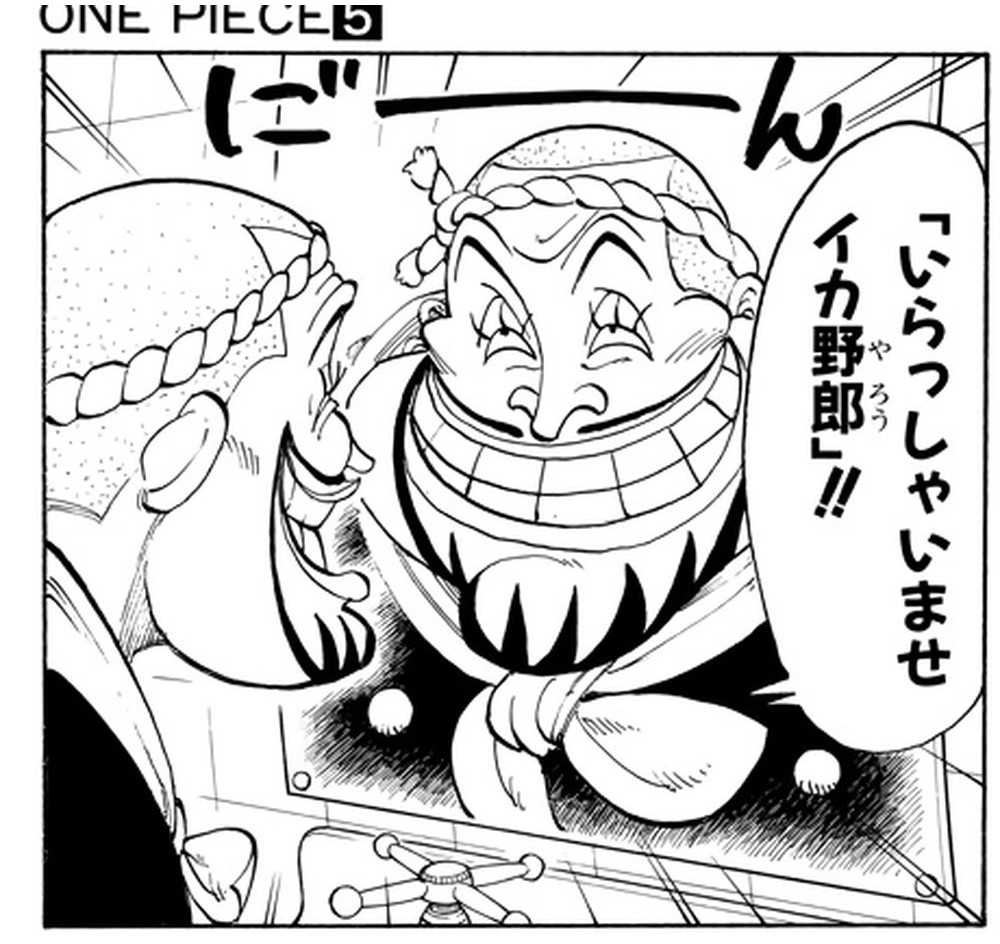
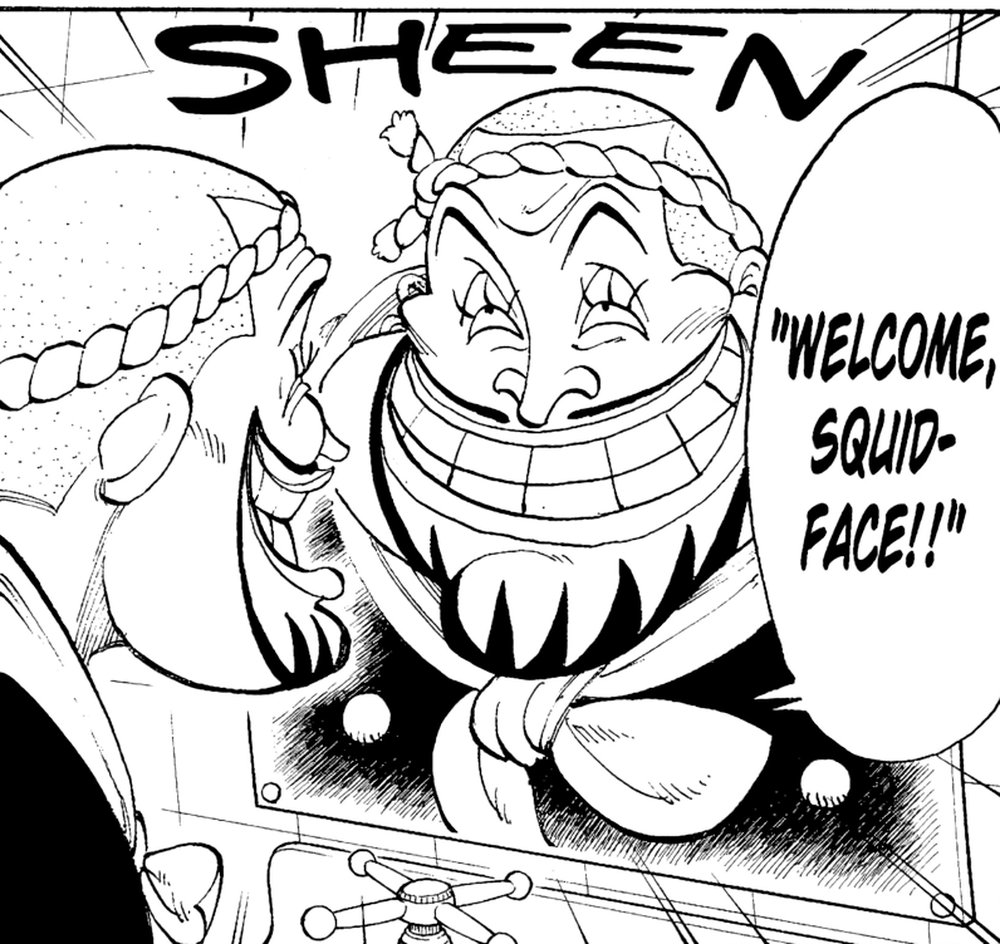
Page 175 of Volume 5 is staged like a parody training manual. Bold caption blocks walk the reader through "the basics of service," step by step — 「サービスの基本は ここちょいあいさつ!!」("The basics of service — right here, a friendly greeting!!") — over a mirror-shined close-up of Patty, one of the Baratie's sous-chefs, mid-demonstration. He announces:
「いらっしゃいませイカ野郎」!!
"Irasshaimase, ika yarō"!!
VIZ's English edition prints: "WELCOME, SQUID-FACE!!" (Vol. 5, p.175).
Grant the rendering its due first: it is the correct shape, in the correct order, at the correct volume. VIZ keeps the sequence an English reader needs to feel the joke — polite noun-of-address first, insult second — and "squid-face" lands as genuinely funny, dumb, and immediate. The page continues the "training" bit for two more tiers — payment, 「一万ベリー入りまーすサマありません」/"DAT'LL BE 10,000 BERRIES, SUCKER!"; farewell, 「おろろいきて下さい」/"COME AGAIN YESTER-DAY." — before landing on the house motto printed at the bottom of the page: 「お客様は神様だ!」— "THE CUSTOMER IS KING!" That caption matters, because it is the actual cultural doctrine behind いらっしゃいませ: in Japan the customer is folk-mythologized as a god (お客様は神様です), and this is precisely the sentence every retail worker's opening greeting exists to perform. Patty executes it letter-perfectly and violates it completely in the same breath — and not just once. Ten pages later, at p.185, a stranger with no money to pay wanders in demanding food, and Patty greets him with the identical line, verbatim: 「いらっしゃいませイカ野郎」 — "WELCOME, SQUID-FACE." — delivered for real this time, not as a training exhibit. The gag isn't a one-off pun. It's Patty's actual greeting.
The Original
いらっしゃいませ is built from いらっしゃる, one of a small closed set of Japanese sonkeigo (尊敬語, "respect language") verbs — irregular honorific verbs that don't merely decorate the plain verb, they replace it outright whenever the person doing the action outranks the speaker. いらっしゃる is the honorific stand-in for not one but three separate plain verbs at once: 居る (iru, "to be/exist"), 来る (kuru, "to come"), and 行く (iku, "to go"). Whether a respected person is somewhere, is coming somewhere, or is going somewhere, Japanese reaches for the same verb — いらっしゃる — and lets context sort out which of the three is meant.
The etymology runs through classical Japanese: 入らせらる (irase-raru), an honorific-causative built on 入る ("to enter") — roughly "to cause [a superior] to deign to enter" — contracted over centuries into いらっしゃる. Onto its polite pre-masu stem, いらっしゃい, retail and hospitality Japanese bolts ませ, a fossil of the old polite-imperative auxiliary (a cousin of ます that now survives almost nowhere else in the language outside a handful of set greetings, like ごめんあそばせ). いらっしゃいませ therefore literally commands something like "please deign to be [here]" — an imperative wearing full formal dress — worn completely smooth by ritual into the single reflexive word every convenience-store clerk, izakaya server, and department-store greeter in Japan is drilled to shout the instant a door chimes.
The insult stapled onto it, イカ野郎, could not sit further away on the register scale: イカ ("squid," plain katakana, zero honorific content whatsoever) plus 野郎 (yarō), a coarse masculine "guy/bastard" suffix that shows up constantly in fight scenes and gangster dialogue — the linguistic equivalent of a bouncer's growl. いらっしゃいませ is usually a learner's first honorific phrase, met around N5 as a fixed chunk memorized by rote before anyone explains the grammar underneath it; the sonkeigo system it belongs to — verb substitution keyed to who outranks whom — is tested explicitly through N3–N2, the same system covered in our companion piece on 召し上がる (meshiagaru), the honorific verb for "to eat/drink." いらっしゃる and 召し上がる are taught side by side in nearly every textbook's keigo chapter, and Oda puts them to structurally identical comic use: a maximally formal verb, executed with total technical accuracy, aimed at someone the speaker plainly does not respect.
VIZ's Choice
Six recoverable forms of いらっしゃいませ/いらっしゃい/いらっしゃる across the volumes on file, side by side with the official English:
| Vol. / p. | Japanese | VIZ English |
|---|---|---|
| 5 / 175 | 「いらっしゃいませイカ野郎」!! | "WELCOME, SQUID-FACE!!" |
| 5 / 185 | 「いらっしゃいませイカ野郎」 | WELCOME, SQUID-FACE. |
| 11 / 129 | はいはいいらっしゃいましね | YES, YES. WELCOME! |
| 12 / 150 | いらっしゃい私の名はイガラッポイ | WELCOME. MY NAME IS IGARAPPOI. |
| 26 / 61 | 家にいらっしゃいませんか"空の幸〟をごちそうしましょう | WON'T YOU COME TO OUR HOME AND ENJOY THE BOUNTY OF THE SKY WITH US? |
| 26 / 133 | “神・エネル”がいらっしゃる | ...KAMI ENERU AWAITS. |
VIZ never once tries to carry the word いらっしゃる across intact; every occurrence is solved locally, verb by verb, situation by situation — "welcome" for the retail imperative (twice), "won't you come" for the invitation-question at p.61, and, notably, "awaits" for the plain declarative marking a god's mere presence in a room at p.133. That last one is worth pausing on. 神・エネルがいらっしゃる is structurally the simplest sentence in the set — subject, honorific copula, done: "Kami Eneru is [here]." VIZ reaches past the flat "is" to the more ceremonial "awaits," manufacturing a small dose of dread and formality in English prose to replace what Japanese was doing in English grammar. It's a genuinely well-judged compensation. It also proves the rule on display across this whole table: every fix here is bespoke, and none of them is transferable to the next いらっしゃる down the page. Note also p.129's はいはいいらっしゃいましね — a weapons-shop owner's rapid-fire, dialect-flavored contraction of いらっしゃいませ (dropping the final せ, adding a colloquial ね) — rendered as the equally breezy "YES, YES. WELCOME!": VIZ matches the energy of the contraction even though nothing in English marks that a shortcut was taken.
The Gap
"Welcome" carries no proof of elevation. いらっしゃいませ doesn't mean "hello, glad you're here" the way an English shopkeeper's "welcome" does — it structurally performs raising the customer above the speaker, the same gesture that, on this exact page, VIZ has to spell out separately, in a caption, as "THE CUSTOMER IS KING!" The Japanese sentence and the doctrine behind it are the same six syllables; the English needs the doctrine printed twice — once as dialogue, once as commentary.
The ritual survives collision with real insincerity; English politeness has no equivalent slot to gut. Because the deference is baked into いらっしゃる's own conjugation rather than assembled from separate polite words chosen moment to moment, Patty can perform it as pure muscle-memory reflex — technically flawless, emotionally absent — while actively insulting the person he's "honoring," and the sentence doesn't grammatically break. English "welcome" has nothing built in to gut; it's just a friendly word sitting next to a mean one. The joke reads the same on the surface; underneath, Japanese is demonstrating that its politeness machinery runs on autopilot, and English simply doesn't own that particular machine.
Honorific stacking disappears rather than scatters. Ten volumes earlier, a court retainer scolds Luffy for attacking the reigning monarch of Drum Kingdom in language so deferential it strains readability: 支配されておいで遊ばされていらっしゃる一国の王 — roughly "the king of a nation who deigns to reign over and rule [its people]" — stacks three honorific layers onto the king's mere act of ruling (支配される, passive; おいで, honorific for being; 遊ばされて, an archaic honorific auxiliary reserved for royalty; いらっしゃる, the honorific copula binding it all together). VIZ's English collapses the entire ornate clause into a blunt "YOU'LL PAY FOR YOUR INSOLENCE!!!" — not a mistranslation of meaning (the scene's outrage survives intact) but a total erasure of the specific grammar of reverence the line was built to display. When honorific density gets too high to carry across, English doesn't approximate it. It deletes it and substitutes generic intensity.
What If
- "Welcome in, esteemed squid-face!!" — forces English to fake elevation onto the noun phrase with "esteemed," at least visibly performing the deference いらっしゃいませ carries silently. Cost: reads as parody-Victorian, a different comic register from Oda's deadpan collision.
- "Right this way, sir — squid-face." — splits the line into two beats, mimicking the whipsaw from maximal politeness to a hard-cut insult. Cost: loses the compactness; the Japanese lands the whole joke in one breath, in one verb, and this needs a full clause.
- VIZ's actual line, kept as printed: "WELCOME, SQUID-FACE!!" — the joke's shape survives intact, and "welcome" alone does correctly gesture at hospitality-industry ritual for an English ear. Cost: none of the reason いらっしゃいませ is funny here — that it is the single most drilled honorific phrase in the language, performed with zero sincerity — makes it into the English; the joke that lands is a simpler joke than the one Oda wrote.
- "HONORED GUEST. ...You look like a squid." — leans hardest into spelling out the elevation before the insult lands. Cost: badly overlong for a manga speech bubble, and "honored guest" reads stiff and deliberate rather than reflexive and ritualized — exactly the texture いらっしゃいませ has in Japanese.
Take-away
いらっしゃいませ isn't politeness added on top of a sentence — it is the sentence, a verb-level bow that Japanese can fire off with total sincerity, total insincerity, or, as here, as a comedy prop, and grammatically nothing about the sentence changes. English "welcome" is a much smaller word doing a much smaller job.
Three rules of thumb to carry off this page:
- いらっしゃる covers 居る/来る/行く all at once — for someone else, never for yourself. If a sentence reaches for いらっしゃる, the person being talked about outranks, or is being deliberately honored by, the speaker; watch for who that is.
- ませ is a fossil, not live modern grammar. いらっしゃいませ's final syllable is a leftover polite-imperative particle that survives almost nowhere else in the language — once you notice it here, you'll start spotting its rare cousins (ごめんあそばせ) elsewhere.
- A ritual phrase can be performed with zero sincerity, and the grammar won't flag it. Politeness encoded in verb morphology, unlike politeness assembled word by word, survives contexts — insults, threats, indifference — where an English speaker's "friendly" tone would simply break character.
This piece continues the keigo cluster opened by 召し上がる and the deference English can't conjugate, Sanji's sonkeigo verb for "to eat," taught in the very same textbook chapter as いらっしゃる. For two other ways Japanese hierarchy collapses into plain English "you," see 貴様 and the pronoun system English flattens and おぬし and the archaic "you" that dissolves into plain "you". More translation notes at the One Piece translation notes index.
Every Japanese and English line quoted above is a byte-exact capture from the cited editions — ONE PIECE Vol. 5–26 (Japanese) and One Piece (VIZ Media) at the corresponding panels — via our bilingual page database; see Sources below.