The Moment
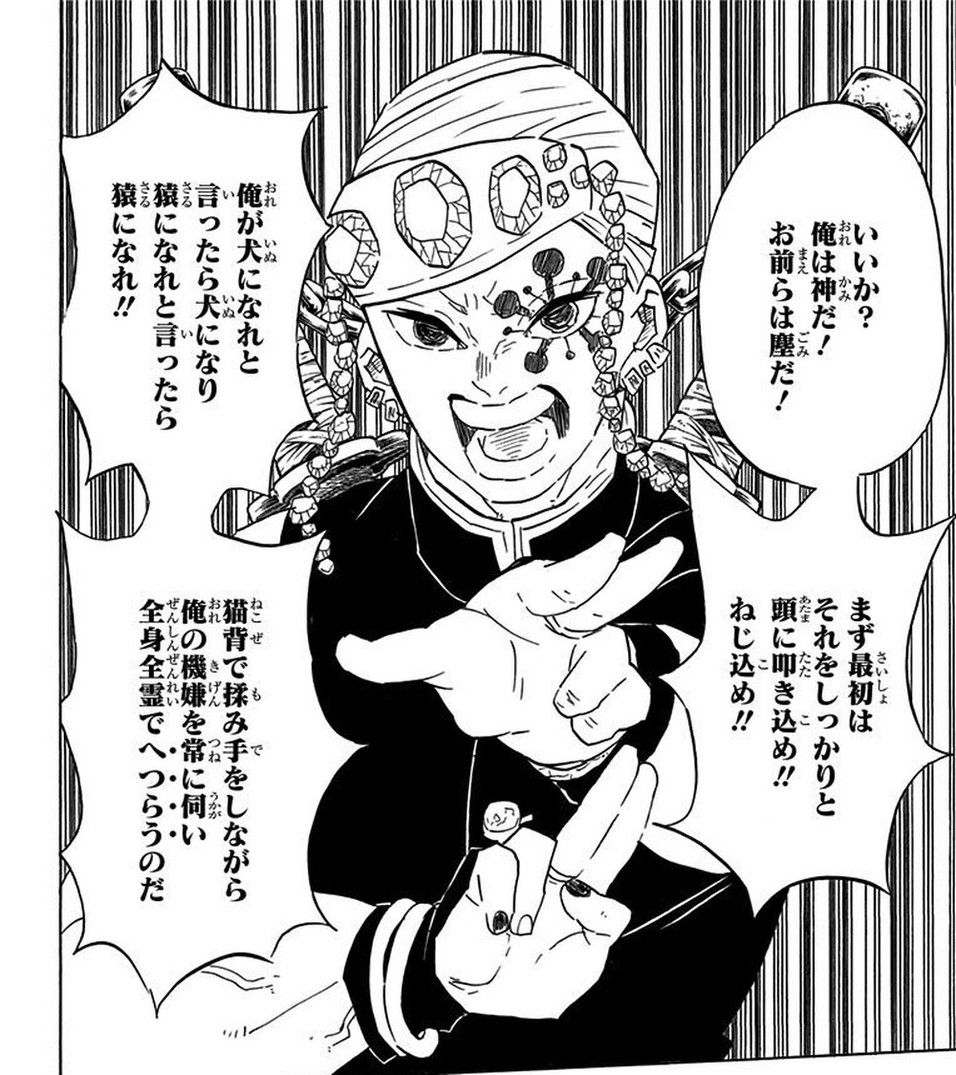
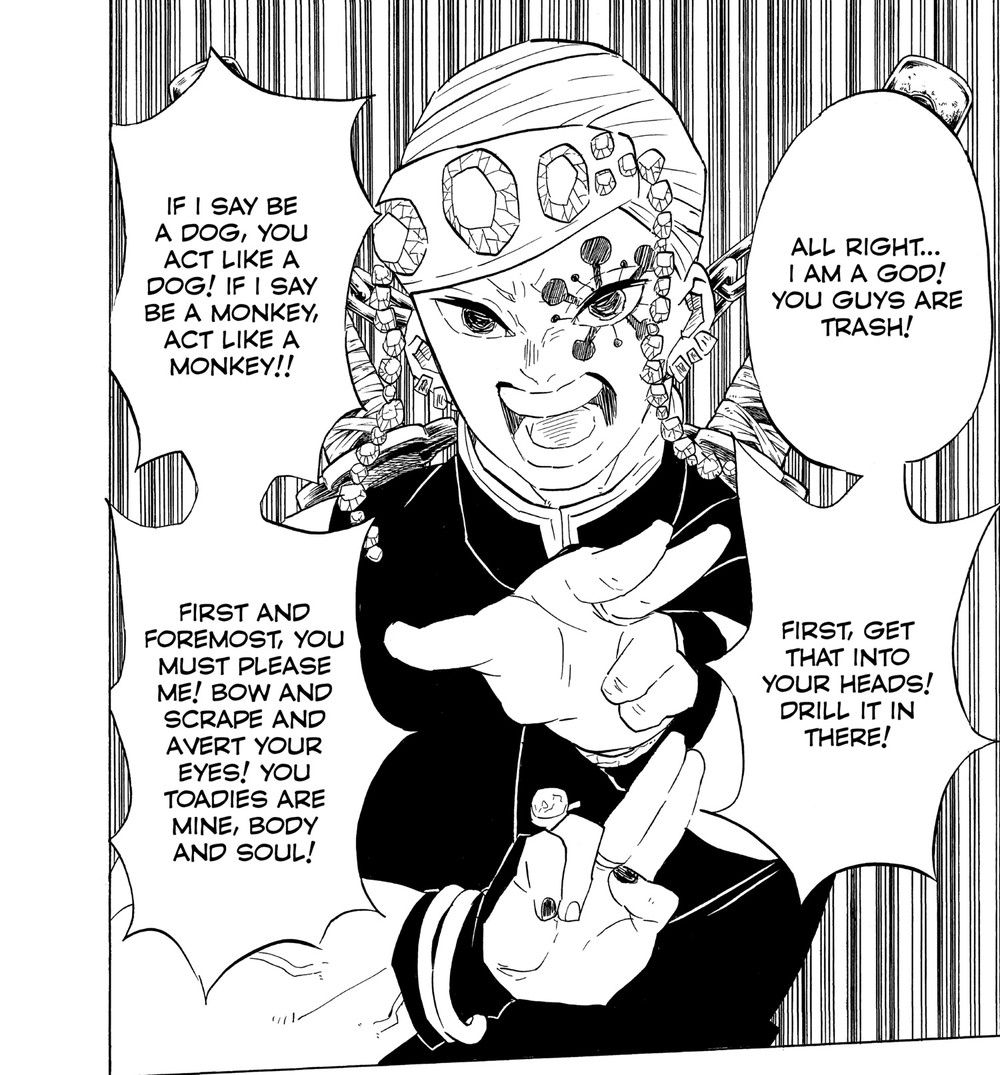
Volume 9 opens the Entertainment District arc with Tengen Uzui's entrance, and the entrance is pure theater. Before the reader learns anything else about him — Sound Hashira, former shinobi, husband to three wives — they watch him vault onto a garden wall in full bejeweled regalia and announce himself a god to three strangers who never asked. 「俺は神だ!お前らは塵だ!!」 ("I AM A GOD! YOU GUYS ARE TRASH!") Two more bursts of decree follow — obey like a dog, obey like a monkey, drill it into your heads — and then he spells out, in detail, what worshipping him actually requires:
「猫背で揉み手をしながら俺の機嫌を常に伺い…全身全霊でへつらうのだ。」
Nekoze de momite o shinagara ore no kigen o tsune ni ukagai… zenshin-zenrei de hetsurau no da.
VIZ's English edition prints: "FIRST AND FOREMOST, YOU MUST PLEASE ME! BOW AND SCRAPE AND AVERT YOUR EYES! YOU TOADIES ARE MINE, BODY AND SOUL!" (Vol. 9, p.8).
This hub has already spent a full article on the back half of this line — 全身全霊, the "body and soul" idiom VIZ matches almost perfectly (see A Rare Perfect Match). This piece is about the clause hiding just before it: 俺の機嫌を常に伺い, "constantly read my mood." Grant the translation its due first — "BOW AND SCRAPE" is a genuinely inspired match for 猫背で揉み手をしながら (hunched back, hand-rubbing, the stock body language of an obsequious shopkeeper in period fiction), and the whole line keeps Tengen's manic comic energy fully intact. But watch what happens to the verb doing the actual work in the missing clause: 伺い (ukagai), from 伺う (ukagau) — and VIZ's answer for it is "AND AVERT YOUR EYES!" Whatever that phrase is doing, it is not what 伺う does. 伺う doesn't look away. It watches.
The Original
伺う (ukagau) is written with a single kanji: 亻(the person radical, from 人) beside 司 (shi, "to administer, to take charge of" — the same 司 in 司会, shikai, "emcee," and 司令, shirei, "command"). The oldest attested job for this pairing is the noun 伺候 (shikō), "to wait upon, to be in attendance" — a retainer stationed near a lord, alert for the moment he might be needed. That image, a subordinate posted within a superior's notice, watching for cues, is the root every modern sense of 伺う grows from.
Modern textbooks teach 伺う as kenjougo — humble language — standing in for three unrelated plain verbs, chosen by context:
- 聞く/尋ねる ("to ask, to inquire") — お伺いしてもよろしいですか, "might I ask you something?"
- 訪問する/行く/来る ("to visit, to go, to come") — 明日伺います, "I will call on you tomorrow."
- and, in the fixed phrase 機嫌を伺う, something closer to 探る/様子を見る ("to probe, to gauge, to check the state of") — literally, "to peer into [someone's] mood."
That third sense is where 伺う brushes against a kanji twin: 窺う, read identically (ukagau), meaning "to peep, to peer, to watch for an opening" — 隙を窺う, "to watch for an opening [to strike]"; 顔色を窺う, "to read someone's face." For centuries these were the same native Japanese verb written two ways; modern usage now steers 伺う toward the polite, self-lowering senses (ask/hear/visit) and 窺う toward the furtive, unmarked sense (spy/peer/watch), but the boundary was never fully sealed, and 機嫌を伺う sits directly on the seam. Is the underling humbly asking after the boss's mood, the way a clerk checks a customer's preference? Or furtively peering at it, the way a scout checks an enemy's guard? The set phrase carries both readings at once — a doubleness a one-word English gloss like "please" throws away entirely.
VIZ's Choice
伺う appears exactly once in the volumes on file, so there is no scatter-table to build here — but the single data point rewards close reading, because the choice VIZ makes for it runs in an unexpected direction. Line up the two halves of the sentence:
猫背で揉み手をしながら → "BOW AND SCRAPE" 俺の機嫌を常に伺い → "AND AVERT YOUR EYES!"
The first swap is a genuine idiom-for-idiom trade: "bow and scrape" is an English fixed phrase for precisely the obsequious body language 猫背で揉み手をしながら pictures, and it earns its place with room to spare. The second swap is stranger. "Avert your eyes" is not a random miss — averted gaze is its own recognizable mark of Japanese deference, the learned habit of not meeting a superior's eyes directly. But it is not what 伺う means. 伺う is a verb of watching: probing, checking, staying alert to a mood so it can be read and served before it needs to be stated. VIZ's three-beat command — please me, bow and scrape, avert your eyes — reads as an escalating catalogue of submissive postures, and on that read it isn't unreasonable: hunch, grovel, look down. But it quietly deletes the one clause in the Japanese that isn't about posture at all. 伺い doesn't ask Tengen's followers to look away from him. It orders them to watch him more closely than anyone should ever need to watch another person's face.
The Gap
The watching verb becomes a not-looking instruction. 機嫌を伺う requires attention — gauging someone's mood means tracking their expression, tone, and body language, exactly what its close cousin 顔色を窺う ("to read someone's face") makes explicit. "AND AVERT YOUR EYES!" asks for the opposite physical action. The clause's real content — an underling functioning as a permanent mood-sensor, primed to react before being told anything — never reaches the English page; what survives instead is a generic image of a cowed servant, eyes on the floor.
The keigo machinery disappears without a trace. 伺う is doing two jobs simultaneously in Japanese: naming an action (checking a mood) and marking that action as deferential — the same self-lowering grammar a hotel clerk or a new employee uses toward a customer or a boss. "Please me" states only the goal. Nothing in the English signals that Tengen is quoting the vocabulary of Japanese customer service and corporate deference back at three strangers as a joke, the same specific move this hub's companion piece on 申す traces in an entirely different scene.
常に ("constantly") loses its shape as a standing duty. In Japanese, 常に伺い frames mood-monitoring as a permanent condition of servitude — not "check once" but "never stop checking." VIZ's imperative burst reads as one instruction among several, delivered in the moment, rather than a decree of ongoing obligation.
A second cliché goes unmarked. 機嫌を伺う is a genuinely institutionalized complaint in modern Japanese workplace vocabulary — 上司の機嫌を伺ってばかりいる, "always tiptoeing around the boss's mood," describes a sycophant, not a virtue. Tengen's line stacks this specific cliché of institutional fawning directly against 全身全霊's job-interview cliché in the very next clause — two distinct, recognizable scripts of Japanese workplace servility weaponized in one breath. An English reader gets the shape of the joke (a tyrant demanding worship) without either piece of the specific cultural furniture being mocked.
What If
- "WATCH MY MOOD LIKE YOUR LIFE DEPENDS ON IT!" — recovers the watching core of 伺う and gives 常に its urgency through threat instead of grammar. Cost: loses "bow and scrape"'s physical comedy, and the specifically Japanese office-servility parody disappears into generic tyranny.
- "ALWAYS BE READING WHICH WAY THE WIND BLOWS WITH ME!" — keeps the probing, gauging sense idiomatically. Cost: wordy for a bubble, and the wind idiom pictures weather, not the face-watching image 機嫌を伺う actually pictures.
- "READ MY MOOD BEFORE I HAVE TO SPELL IT OUT!" — keeps a watching verb and adds the implicit menace of a boss who shouldn't have to state his wants. Cost: still doesn't mark the deferential register; reads as generic bossiness rather than a parody of a specific ritual.
- Keep VIZ's "BOW AND SCRAPE," but swap the eye direction: "BOW, SCRAPE, AND NEVER STOP WATCHING ME!" — restores the watching while keeping the idiom that already works. Cost: "never stop watching me" risks sounding paranoid rather than servile — 伺う's watching is furtive and deferential, not a stare.
Take-away
伺う is easy to gloss and hard to render, because the gloss — "please," "ask," "attend to" — always drops the one thing every sense of the word shares: it names an act of watching, performed from a position of lower status. Reading a mood is not the same as looking away from one, and a translation that swaps the two keeps the shape of the servility without the specific mechanism of it.
Three rules of thumb to carry off this page:
- When you meet 伺う, ask which of its three jobs is active — ask, visit, or (as here) probe/gauge — before reaching for "ask" as a reflex gloss.
- Keep 伺う's watching twin, 窺う, in view: same reading, same root, but pointed at furtive observation (隙を窺う, 顔色を窺う) rather than polite deference. The line between them is a matter of register, not meaning.
- 機嫌を伺う names a specific, recognizable Japanese social reflex — reading a superior's mood before it's stated — not a generic synonym for "please." When a character performs it, or demands it, the joke or the pathos usually depends on the reader recognizing the ritual, not just the outcome.
伺う was already flagged as unfinished business on this hub's 申す・申し上げる entry, which named it directly as "the humble 'to visit / ask / hear'" waiting for its own article — and it shares this exact panel with 全身全霊, the body-and-soul idiom in the very next clause. The same keigo family runs through 参る (humble "go/come"), 致す (humble "do"), 頂戴 (humble "receive"), and 差し上げる (humble "give") — five different verbs, one grammar of lowered selves, running under nearly every formal relationship in this manga. Browse the full Demon Slayer translation notes index for more.
Every Japanese and English line quoted above is a byte-exact capture from the cited edition — 鬼滅の刃 Vol. 9 (Japanese) and Demon Slayer: Kimetsu no Yaiba Vol. 9 (VIZ Media) at the corresponding panel — via our bilingual page database; see Sources below.