The Moment
Two pages before this one, Muzan Kibutsuji reaches into Daki's mind through the blood inside her — the same blood-borne link he uses to command every demon he's created — and speaks:
「堕姫 私の支配から逃れた鬼がいる 珠世のように 見つけて始末してくれ お前にしか頼めない 麻の葉文様の着物に市松柄の帯の娘だ」
VIZ's English: "DAKI, MY DEAR... THERE IS ONE DEMON WHO ESCAPED MY GRIP— LIKE TAMAYO DID. FIND HER. FINISH HER. YOU'RE MY ONLY HOPE. YOU'LL KNOW HER BY HER KIMONO. IT HAS A HEMP PATTERN... AND A CHECKERBOARD OBI." (Vol. 10, p.67). Any reader of the series recognizes that outfit before Muzan finishes describing it: it belongs to Nezuko, Tanjirō's sister, the one demon in the story who has partly slipped Muzan's control. Muzan isn't ordering Daki to hunt a stranger. He's ordering her to hunt the protagonist's sister.
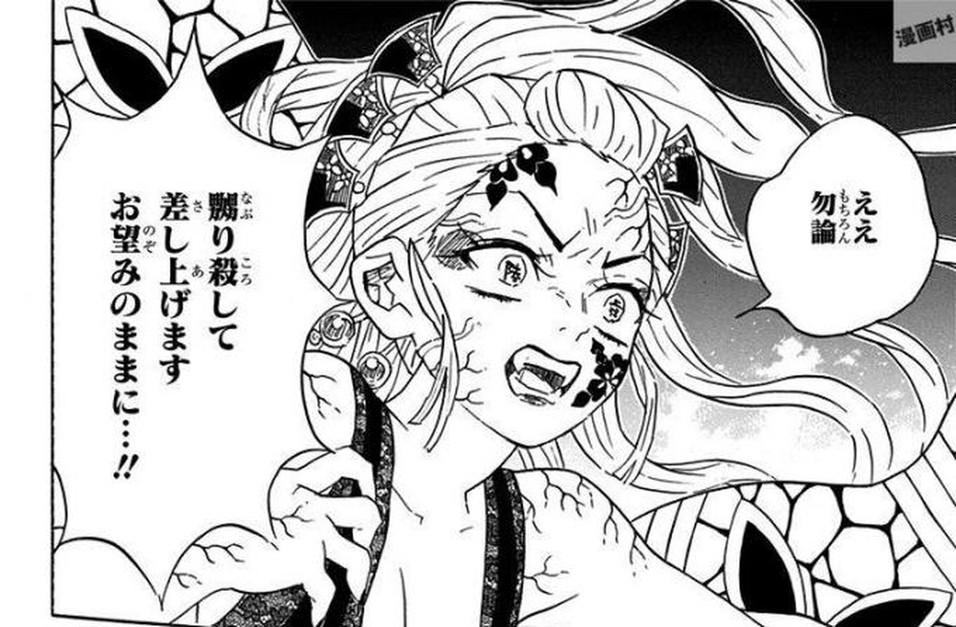
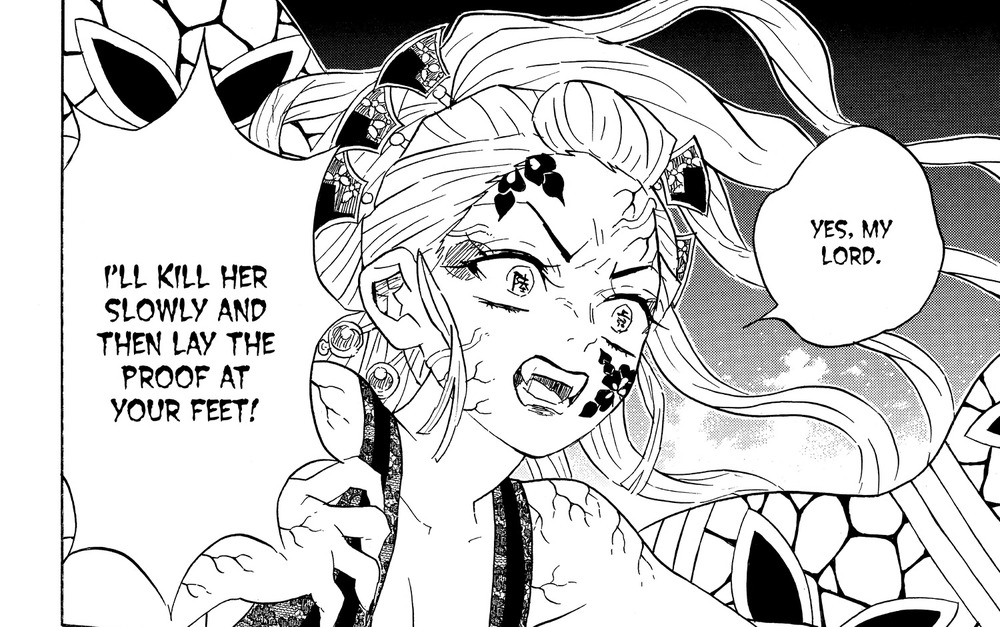
Daki answers on the very next page. A small bubble first: 「ええ勿論」 — "YES, MY LORD." Then, filling most of the panel around her face — already cracking, already mid-transformation, jewelled hairpins and a demon's slit pupils visible under her courtesan's hairstyle — the real promise:
「嬲り殺して差し上げますお望みのままに...!!」
Naburi koroshite sashiagemasu, onozomi no mama ni...!!
VIZ's English edition prints: "I'LL KILL HER SLOWLY AND THEN LAY THE PROOF AT YOUR FEET!" (Vol. 10, p.68).
Grant the rendering its due: "I'll kill her slowly" is genuinely vicious, punchy English, and it keeps the sadism of 嬲り殺して intact — this isn't a quick kill, it's torture, and VIZ's line makes sure an English reader feels that. What it can't hold onto is the one grammatical fact every Japanese reader absorbs instantly and without translation: the verb doing the promising, 差し上げます, is not a plain "I will." It is kenjōgo — Daki is grammatically offering the torture-killing itself UP to Muzan, the way a servant presents a tray with both hands. The most powerful being on the page, one of Muzan's own Upper Ranks, is speaking to her master in the register of a servant bringing tea.
The Original
Start with 嬲り殺す (naburi korosu), because it's doing real work before 差し上げる ever attaches to it. 嬲 (kun'yomi なぶ-る) is an old kanji built from 女 (a woman) flanked by two 男 (men) — a picture of someone toyed with and mocked from both sides at once. Its meaning drifted over centuries from "to tease, to flirt cruelly" toward "to torment, to toy with someone's suffering for pleasure." Add 殺す, "to kill," and 嬲り殺す is the compound verb for "to torture to death" — Daki isn't promising a fast kill with an apology for the delay. The torture is the content of the promise.
Now the verb this article is named for. 差し上げる splits into 差す (sasu), "to extend, to hold out, to insert, to point toward" — you already know this 差す from 差し出す (sashidasu, "to hold out, to submit," what you do with a business card or an outstretched hand) and 差し入れ (sashiire, a supportive gift of food or supplies handed in to someone working hard, or to a prisoner) — plus 上げる (ageru), "to raise, to lift up," the same 上げる inside 打ち上げる (uchiageru, "to launch upward," a firework going off) and 持ち上げる (mochiageru, "to hoist."). Put the two together and 差し上げる stages a small, specific physical gesture: extending something in both hands and lifting it upward, toward someone standing above you. That is the literal picture underneath kenjōgo 差し上げる every time it replaces plain あげる, "to give" — and it is the exact mirror image of 頂戴, this hub's earlier subject, which lifts a RECEIVED gift up to one's OWN head. Both verbs move upward. Only the direction of the gift — outward to someone else, or inward to yourself — changes which one you use.
The grammar of the full line: [verb-te] + 差し上げる is the humble version of [verb-te] + あげる, "I will do X for you [as a favor]." 嬲り殺して差し上げます therefore reads, almost mechanically: "[I will] torture-kill [her], and humbly perform that act as a gift for you." The sentence doesn't end there. お望みのままに closes it out — お望み (o-nozomi, the honorific noun form of 望む, "to wish, to desire") plus のままに ("in the state of, exactly according to") — "exactly as you wish." It's a second, independent submission clause, stacked on top of the kenjōgo verb: not only is Daki lowering herself grammatically by offering the act upward, she's also declaring the METHOD entirely Muzan's to specify. Two bows in one exclamation.
差し上げる belongs to the six-verb 授受 (juju, "giving and receiving") system most Japanese courses introduce around N4–N3, and it rewards being learned as a full system rather than six separate flashcards, because the six verbs aren't six unrelated words — they're three actions (give / receive / "give to me"), each with a plain form and a keigo form, and the keigo form doesn't always work the same way:
| Action | Plain | Keigo | What the keigo form does |
|---|---|---|---|
| I give (up the ladder) | あげる (やる, rough) | 差し上げる | Lowers the SPEAKER (kenjōgo) |
| I receive | もらう | いただく (colloquial: 頂戴) | Lowers the SPEAKER (kenjōgo) |
| Someone gives to me | くれる | くださる | Raises the OTHER PERSON (sonkeigo) |
Notice the asymmetry hiding in that third row. 差し上げる and いただく both work by lowering the speaker — the same strategy, aimed at two different actions (giving and receiving). くださる does something structurally different: instead of lowering the speaker for receiving a gift, it raises the GIVER for the act of giving it. Japanese politeness isn't one dial that turns in one direction; it's two separate strategies — lower yourself, or raise the other person — and the giving/receiving system is where a learner meets both strategies applied to the same physical event from opposite ends. Daki, offering something up to a superior, reaches for the self-lowering half of that system. A demon thanking Muzan for a gift going the other direction would reach for くださる instead — the subject of this hub's sister piece on Naruto, built around Chōza Akimichi's tearful 戻って下さって to Tsunade.
VIZ's Choice
差し上げ appears exactly once across the Demon Slayer volumes in our corpus — one translator, one bubble, one decision, and no scatter table needed to read it.
VIZ chose "I'LL KILL HER SLOWLY AND THEN LAY THE PROOF AT YOUR FEET!" Credit where it's due: "kill her slowly" is a genuinely strong rendering of 嬲り殺す — it keeps the sadism, the drawn-out cruelty, the sense that this is torture and not just murder. That half of the line earns its place.
The second half is where the translation drifts. お望みのままに — "exactly as you wish," an open-ended, unspecified submission to whatever Muzan prefers — is not a promise to deliver evidence. VIZ's "and then lay the proof at your feet" invents a specific new action: bringing physical proof of the kill and presenting it, low, at Muzan's feet. It's a vivid image, and it isn't a bad instinct — a devoted underling promising to prove her loyalty with evidence is a coherent, dramatic beat. But it's invented content, not a translation of お望みのままに, and the kenjōgo verb doing the real grammatical work in the Japanese — 差し上げます — disappears into the flat, unmarked "I'll." Nothing in the English signals that the single most powerful, most monstrous character on the page just spoke to her master in the grammar of a maid offering a tray.
The Gap
The bow disappears into a bare first-person promise. 差し上げます frames Daki's own act of violence as a service rendered UPWARD to Muzan — not just an announcement of what she'll do, but an offering of the act itself, gift-wrapped in humble grammar. "I'LL KILL HER SLOWLY" is flat, declarative, first-person; it could be spoken to an equal, a stranger, or no one at all. Nothing marks that Daki just curtseyed mid-threat.
English invents a physical image the Japanese never gives it — and points it the wrong direction. "Lay the proof at your feet" does gesture at servility, in its own way — a hunting dog dropping prey before its master. But 差し上げる's own built-in image is the opposite motion: something extended and RAISED UP toward a superior, not laid DOWN at their feet. The Japanese gift rises. VIZ's invented gift falls. Both read as submissive to an English ear, but they submit through opposite gestures, and neither sentence actually contains the other's picture.
Open-ended submission collapses into a specific boast. お望みのままに leaves the method entirely in Muzan's hands — it's a second, independent bow, layered on top of 差し上げます, saying nothing more specific than "however you prefer." "And then lay the proof at your feet" replaces that total, unspecified deference with one concrete, invented promise. The Japanese shows total submission of WILL; the English shows a specific plan of ACTION. They aren't the same kind of humility.
What If
- "I will humbly torture her to death for you, exactly as you wish...!!" — the most literal option, keeping お望みのままに intact. Cost: "humbly" stated outright over-explains what 差し上げます performs silently, through grammar alone.
- "It would be my honor to torture her to death, however you prefer...!!" — reaches for English's own courtly-service register. Cost: "honor" imports a note of pride that sits oddly against kenjōgo's self-lowering posture — Daki isn't claiming honor, she's performing submission.
- "Allow me to torture-kill her, just as you desire...!!" — "allow me" is English's closest living fossil of self-lowering grammar, and "just as you desire" keeps お望みのままに. Cost: "allow me" is politer than it is sadistic; it softens 嬲り殺して more than VIZ's blunt "I'll kill her slowly" ever does.
- Keep VIZ's punch, fix the content drift: "I'll torture-kill her, however you like...!!" — minimal surgery, same directness, no invented plot point standing in for お望みのままに. Cost: loses VIZ's vivid "lay the proof at your feet" image — a genuinely good image, just not one the Japanese actually contains.
Every option pays a price, because English has no ordinary-register verb whose entire job is to make an act of giving sound like the speaker just knelt while doing it. The closest living cousins — "allow me," "it would be my honor," "humbly" — are all either imported formality or an adverb doing, out loud, what Japanese grammar does silently and automatically, every time.
Take-away
差し上げる isn't hard to gloss — "I'll give," "I'll do this for you" gets the plot across immediately. What's hard to keep is the fact that the verb is quietly performing a physical gesture — extending a gift and lifting it up toward someone above you — at the exact moment its content is the opposite of a gift.
Three rules of thumb to carry off this page:
- Map the 授受 system as three actions, not six flashcards: あげる→差し上げる (I give, I lower myself), もらう→いただく (I receive, I lower myself), くれる→くださる (someone gives to me, I raise THEM). Two different politeness strategies — lower yourself, or raise the other person — mapped onto three related actions.
- Remember 差し上げる's physical root: 差す (extend) + 上げる (raise) — a gift lifted UP toward a superior. Its mirror, 頂戴, lifts a received gift up to one's own head. Same upward gesture, opposite roles.
- Watch for keigo in the mouths of the powerful, not just the humble. The same self-lowering grammar an attendant uses to bring tea is available, unmodified, to an Upper Rank demon offering a torture-killing to her god. Keigo tracks power, not virtue — and this manga knows it.
差し上げる completes a triangle this hub has been drawing one verb at a time: the humble "receive," 頂戴; the humble "go/come," 参る; the humble "do," 致す; the humble "say," 申す・申し上げる; and honorific vocabulary turned into a weapon, 御身分. For the giving-side mirror image — sonkeigo raising the GIVER instead of lowering the speaker — see くださる on Naruto's hub. Or browse the Demon Slayer translation notes index.
Every Japanese and English line quoted above is a byte-exact capture from the cited editions — Demon Slayer: Kimetsu no Yaiba Vol. 10 (Japanese) and Demon Slayer: Kimetsu no Yaiba (VIZ Media) at the corresponding panel — via our bilingual page database; see Sources below.