The Moment
Volume 11, the month before the Chūnin Exam finals. Jiraiya's idea of training has just gone over a cliff — with Naruto attached. Hurled into a ravine and out of options, Naruto finally reaches the Nine-Tails' chakra inside him and makes the Summoning Jutsu stick — and the next thing he knows, he is standing on top of something the size of a hillside. The something is Gamabunta, the Chief Toad: pipe clamped in his jaw, a boss's growl in his throat, and no idea why he's here. His opening line sets the register — 「ワシの頭の上で何騒いどんじゃボケ!!」, "WHY ARE YOU RUNNING AROUND SCREAMING ON TOP OF MY HEAD, IDIOT?!" — and his first actual complaint is the line this article is about:
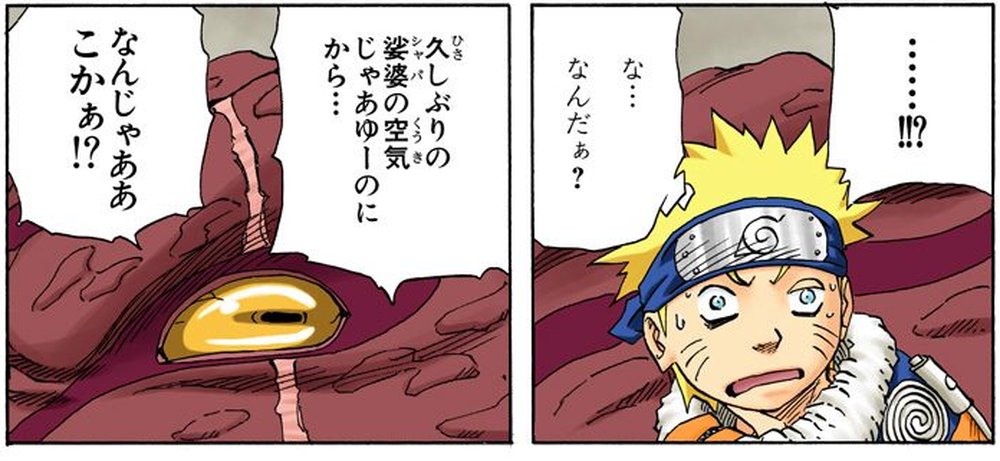
「久しぶりの娑婆の空気じゃあゆーのにから…」
Hisashiburi no shaba no kūki jā yū no ni kara…
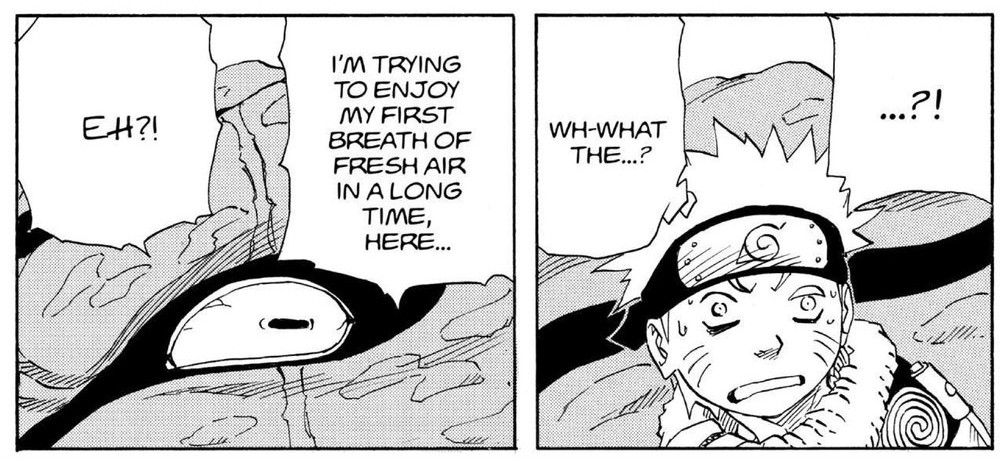
VIZ's English edition prints: "I'M TRYING TO ENJOY MY FIRST BREATH OF FRESH AIR IN A LONG TIME, HERE..." (Vol. 11, p.110).
Grant the rendering its due. The grievance lands; the trailing "HERE..." catches the growl of that dialect-thick じゃあゆーのにから; "IN A LONG TIME" keeps 久しぶり intact. As a line of dialogue, it plays. Bunta then scans the ravine for the only human he believes could have called him — 「自来也はどこなんならぁ…!?」, "WHERE'S JIRAIYA?!" — and mutters 「あのエロオヤジがえらいところへ呼び出しくさりやがって…変なガキまで頭の上に乗せやがってからに!」: "THAT LECHEROUS LOUT, SUMMONING ME TO SUCH AN AWFUL PLACE... ...AND PUTTING A WEIRD BRAT ON TOP OF MY HEAD, TOO!"
Everything in the scene — the pipe, the growl, the aggrieved-don delivery — is one costume, and 娑婆 (shaba) is its most important piece. "Fresh air" is the one spot where the costume didn't make it across.
The Original
For once, don't bother mining the kanji — there is no anatomy here. 娑婆 is pure phonetics: 娑 (sha) is a character that barely exists in Japanese outside this word, and 婆 (ba) is the "old woman" of お婆さん (o-bā-san), drafted purely for its sound. Together they spell Sanskrit sahā — "endurance, forbearance." When the Chinese translators of the sutras wanted the meaning instead of the sound, they wrote 忍土 (nindo), "the land of endurance."
In doctrine, the 娑婆世界 (shaba sekai) — the sahā world — is this world: the realm where Śākyamuni teaches and where beings must endure suffering. Heavy machinery. And then, as Buddhist vocabulary tends to do in Japanese, the word walked out of the temple and kept walking — three steps downhill, each one shrinking the world it names:
- Temple → town. For those who renounced the world, the shaba was the lay world left behind — everything outside the monastery gate.
- Edo's walled worlds. Seen from inside any sealed enclosure — the licensed pleasure quarter, the jailhouse — everything beyond the wall was the shaba. The word stopped meaning "the world" and started meaning "the outside."
- The modern rap sheet. Today the word survives almost exclusively in the mouths of the confined: prisoners, soldiers in barracks, crews at sea. シャバの空気はうまい — "the outside air tastes sweet" — is the released convict's stock line in every prison film and yakuza picture ever made. Gamabunta's 娑婆の空気 is that cliché, verbatim.
Note what the typography is doing on the page: 娑婆 carries katakana furigana シャバ. Ruby in the "wrong" script is Japanese typography's italics-for-slang — a wink telling the reader to hear the jailyard reading, not the sutra one. Modern prose usually just writes シャバ outright; Kishimoto gives you the sutra spelling and the street pronunciation in one glyph stack.
The rest of the sentence is costume too: ワシ (the gruff old-boss "I"), the western copula じゃ, ゆー for 言う, the trailing regional のにから — the growling western-Japan idiom of postwar gangster cinema, issuing from a toad with a pipe. And the payoff of the word choice: for a summoned beast, the human world is the outside he only visits when called. 久しぶり tells us nobody has called in years. Being summoned is day release — that is the joke, and 娑婆 is the entire joke.
JLPT-wise, 娑婆 sits on no list at all — post-N1 street vocabulary, learned from crime dramas rather than textbooks.
VIZ's Choice
The word appears once in Naruto — and, usefully for comparison, exactly once more across the Shonen Jump titles we track, in One Piece. Side by side:
| Work / Vol. / p. | Japanese | VIZ English |
|---|---|---|
| Naruto 11 / 110 | 久しぶりの娑婆の空気じゃあゆーのにから… | I'M TRYING TO ENJOY MY FIRST BREATH OF FRESH AIR IN A LONG TIME, HERE... |
| One Piece 5 / 173 | いやだいやだで…渡っていけるシャバだと思うな 若僧 | ARGH! WHAT YOU WANT... ...DOESN'T MATTER, BOY!! |
The One Piece line is Zeff at the Baratie, saw in hand, demanding a leg from Luffy as payment for wrecked property; when Luffy answers "I DON'T WANT TO," the old pirate leaps: don't think this is a shaba you can get through on "I don't wanna," kid. His シャバ is the middle of the word's biography — the harsh secular world you have to make your way across, the closest modern Japanese gets to sahā's original "endurance." VIZ compresses the clause to "WHAT YOU WANT... DOESN'T MATTER, BOY!!" — the argument's logic survives, the word does not.
So: two appearances, two vanishings. Where 因縁 scattered into five different English words, 娑婆 scatters to zero — the English reader of either series never meets the word at any point on its arc. And grant the bind: English's "outside" only works once an inside has been established, and neither bubble had room to build a prison. VIZ's Naruto line even keeps the sentence's shape and the grumble's rhythm. The failure is structural, not careless — which is exactly what makes it worth an article.
The Gap
The rap sheet vanishes. シャバ means the world outside the walls; "fresh air" has no walls. In Japanese, Gamabunta introduces himself as a boss who's been inside — the pipe, the dialect, and the parole cliché all land in the same two seconds. In English he's a large toad who enjoys weather. The single word doing the character's yakuza-film characterization is the single word that didn't cross.
The theology inverts, and nobody sees it happen. In doctrine, the shaba is the world of suffering — the place you endure. In slang, its air tastes sweet. The word carries its own before-and-after: a sutra term for the world's misery, repurposed by convicts to praise the world's freedom. That inversion — suffering re-graded as sweetness by anyone who's been locked away from it — is a whole sermon folded into two kanji. "Fresh air" has no history to invert.
Two works, one word, zero arrivals. Zeff wields the word's middle sense (the hard world you get through); Gamabunta wields its endpoint (the sweet outside). A Japanese reader crossing from One Piece to Naruto hears the same word twice and watches its biography advance. The VIZ reader gets "...DOESN'T MATTER" in one book and "FRESH AIR" in the other — not five seats like 因縁, but none at all.
What If
The menu and its prices:
- "MY FIRST TASTE OF THE OUTSIDE IN AGES, AND THIS IS WHAT I GET..." — "the outside" is English prison-slang's exact seat for シャバ, and the grievance survives. Cost: with no walls in view, some readers hear geography, not parole.
- "BARELY BACK IN THE FREE WORLD FIVE MINUTES, AND THERE'S A BRAT SCREAMING ON MY HEAD..." — "the free world" is the American convict's own term; the rap sheet survives intact. Cost: strongly US-flavored, and looser than the line.
- "FIRST BREATH OF OUTSIDE AIR I'VE HAD IN YEARS, AND..." — minimal surgery on VIZ: the one word "outside" quietly reopens the inside. Cost: subtle enough to miss; the Buddhist layer stays lost either way.
- "AAAH, SWEET SHABA AIR... FIRST IN A LONG TIME..." — keep the word, as translations of yakuza fiction occasionally do. Cost: a footnote word in a speech bubble, and manga has no margin for the gloss.
Every option pays somewhere, because the Japanese word is doing three jobs at once — location (outside), biography (temple → street), and characterization (a boss who talks like a parolee) — and English has no single word holding all three.
Take-away
娑婆 is what happens when a word serves fifteen centuries and keeps the tattoos: born in the sutras as the world of suffering, demoted to the everyday world, and finally adopted by the people locked away from it, who decided its air tastes sweet. When VIZ files it under "fresh air," the sentence still breathes — but the word's entire past is released without a record.
Three rules of thumb to carry off this page:
- シャバ = the world outside the walls. If a character has been anywhere confined — a cell, a barracks, a summoning realm — and praises the 空気, you are looking at the parole cliché, not the weather report.
- Katakana furigana over kanji is a register flag. When the ruby and the base disagree in script (娑婆 read シャバ), the page is telling you the slang reading is the point. Watch for the same trick on other temple-born words.
- Temple-to-street is a standard Japanese pipeline. 娑婆, 修羅場, 因縁, お陀仏 — when Buddhist vocabulary turns up in a gangster's mouth, look for the missing middle of its biography; that middle is usually where the translation fell.
For the sibling word that walked the same road — the Buddhist war-realm 修羅場 that ended up meaning a veteran's tight spot — see our piece on Naruto's shuraba boast, or browse the Naruto translation notes index. And for the karmic tie English split five ways, see our One Piece piece on innen.
Every Japanese and English line quoted above is a byte-exact capture from the cited editions — NARUTO―ナルト― Vol. 11 and ONE PIECE Vol. 5 (Japanese) and Naruto / One Piece (VIZ Media) at the corresponding panels — via our bilingual page database; see Sources below.