The Moment
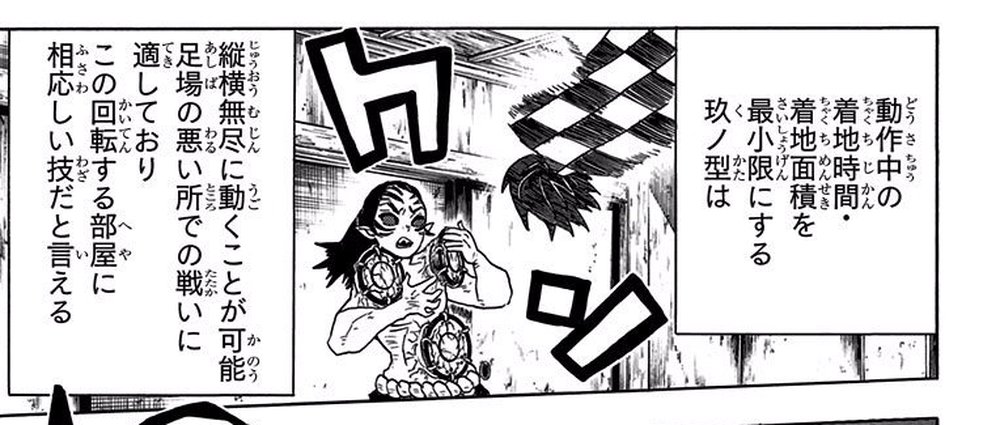
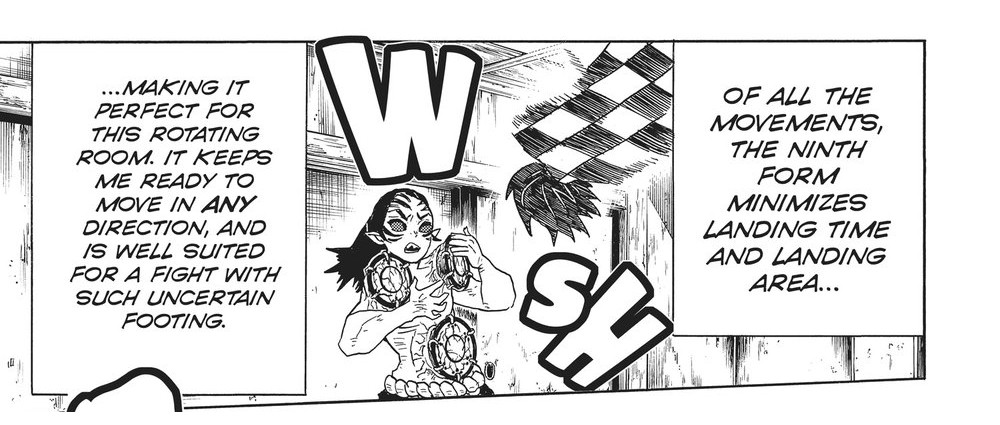
Volume 3, the climax of the Final Selection. Somewhere on Mt. Fujikasane, inside a mansion built to disorient anyone who enters it — floors and walls that rotate without warning — Tanjiro is mid-fight with the demon guarding the trial. His teacher gave him nine forms of Water Breathing to draw on, and here he reaches for the ninth, announced two pages earlier in bold block lettering under the header "NINTH FORM": 水流飛沫・乱, VIZ's "SPLASHING WATER FLOW: TURBULENT!" An ally shouts him forward — 「懐に入り込め!!」, "GET IN TOWARD HIS TORSO!" — and as Tanjiro executes the technique, a narration box drops in with the tactical reasoning behind the choice, split across two boxes on the page:
「動作中の着地時間・着地面積を最小限にする玖ノ型は縦横無尽に動くことが可能足場の悪い所での戦いに適しておりこの回転する部屋に相応しい技だと言える」
Dōsachū no chakuchi jikan/chakuchi menseki o saishōgen ni suru ku no kata wa jūō-mujin ni ugoku koto ga kanō, ashiba no warui tokoro de no tatakai ni tekishite ori, kono kaiten suru heya ni fusawashii waza da to ieru.
VIZ's English edition prints: "OF ALL THE MOVEMENTS, THE NINTH FORM MINIMIZES LANDING TIME AND LANDING AREA... ...MAKING IT PERFECT FOR THIS ROTATING ROOM. IT KEEPS ME READY TO MOVE IN ANY DIRECTION, AND IS WELL SUITED FOR A FIGHT WITH SUCH UNCERTAIN FOOTING." (Vol. 3, p.177.)
Grant the rendering its due first: "any direction" reads clean, it moves at manga speed, and "well suited for a fight with such uncertain footing" is an honest, athletic sentence that earns its keep. One panel later, Tanjiro finds his opening — 「見えた!!隙の糸!!」, "THERE IT IS—THE OPENING THREAD!" — and the technique delivers exactly what the narration promised. But the promise itself is smaller in English than in Japanese. Where the caption reaches for 縦横無尽 — four characters that name two specific axes and then deny them any limit — English reaches for "any direction," a phrase that names no axis at all.
The Original
縦横無尽 (jūō-mujin) fuses two compact two-character words, and both are worth taking apart.
縦 (jū) "vertical, lengthwise" + 横 (ō) "horizontal, sideways" give 縦横 (jūō), literally "length and width" — the two perpendicular axes of anything with an extent. You've likely met 横 already in 横断歩道 (ōdan hodō, "crosswalk," literally "sideways-cut walkway") or 横柄 (ōhei, "arrogant" — someone who takes up space sideways, off the straight line of propriety). 縦横 by itself is already the everyday word for "every which way": 縦横に走る is "to run in every direction."
無 (mu) "without, none" + 尽 (jin) "to exhaust, use up, run out" give 無尽 (mujin), "inexhaustible, without limit." The same 尽 sits inside 尽きる (tsukiru, "to run out, be used up") and inside 無尽蔵 (mujinzō), "an inexhaustible reserve" — literally "a storehouse (蔵) that never runs empty."
Fuse the two halves and the idiom claims something more specific than a vague "everywhere." It claims total coverage of two named axes — up-and-down, side-to-side — and then insists that coverage never depletes. Not "I can go anywhere" so much as "I can go anywhere, indefinitely, without using myself up." Grammatically the idiom works as a manner adverb: 縦横無尽に + verb, "to move/act jūō-mujin-ly," bolted directly onto verbs of movement (動く) or performance (活躍する). As vocabulary, 縦横無尽 sits outside the JLPT's official lists, as most yojijukugo do — but its parts are ordinary: 縦 and 横 are N3/N4 staples, 無 is N4, and only 尽 pushes toward N1. The whole idiom reads as upper-intermediate to advanced: common enough that a battle narrator reaches for it without breaking stride, formal enough that it would sound faintly showy dropped into casual chat.
VIZ's Choice
Two occurrences turn up across the Demon Slayer volumes on file, and both land on the same English solution:
| Vol. / p. | Japanese | VIZ English |
|---|---|---|
| 3 / 177 | 縦横無尽に動くことが可能足場の悪い所での戦いに適しておりこの回転する部屋に相応しい技だと言える | ...MAKING IT PERFECT FOR THIS ROTATING ROOM. IT KEEPS ME READY TO MOVE IN ANY DIRECTION, AND IS WELL SUITED FOR A FIGHT WITH SUCH UNCERTAIN FOOTING. |
| 14 / 105 | 縦横無尽自由自在よ | ...I CAN BEND IN ANY DIRECTION I LIKE! |
Two occurrences, two very different speakers and moods. The second belongs to Volume 14's Swordsmith Village arc: the fish-armed Upper Rank Five demon Gyokko, freshly revealed in his true form, taunts two hidden Demon Slayer Corps members — the dialogue's flat, deadpan sarcasm ("OH... OKAY." "THAT'S QUITE A LOT.") points to Genya Shinazugawa, watching from a tree alongside a silent Nezuko — with a rundown of his own powers: 「どうだね私のこの神の手の威力」 ("WHAT DO YOU THINK OF MY GODLIKE HANDS?"), 「拳で触れたものは全て愛くるしい鮮魚となる」 ("ANYONE MY FISTS TOUCH TURNS INTO AN ADORABLE FISH!"), and then a boast about his own body: 「さらには鱗の波打ちにより」 ("AND THANKS TO MY FLEXIBLE SCALES...") leading into:
「縦横無尽自由自在よ」
Jūō-mujin jiyū-jizai yo.
VIZ: "...I CAN BEND IN ANY DIRECTION I LIKE!" — followed immediately by 「震えているな怖ろしいか?」, "YOU'RE TREMBLING. ARE YOU SCARED?"
VIZ reaches for the identical phrase, "any direction," in both scenes — Tanjiro's tactical narration and Gyokko's taunt — and that's not laziness so much as "any direction" genuinely being the closest single English handle for what 縦横無尽 claims. What's lost is what makes the second occurrence distinctive: Gyokko doesn't say 縦横無尽 alone. He says 縦横無尽自由自在よ — stacking a second freedom-idiom, 自由自在 ("freely, exactly as one pleases"), directly onto the first, for redundant emphasis. It's a boast built from near-synonyms piled on top of each other, the demon repeating himself in slightly different vocabulary because one four-character claim of freedom wasn't flashy enough. VIZ's "I CAN BEND IN ANY DIRECTION I LIKE" is a genuinely clever compression — "any direction" absorbs 縦横無尽, "I like" absorbs 自由自在 — but the doubling itself, the sound of a villain unable to resist a second idiom where one would do, doesn't survive into a single clean clause.
The Gap
The two axes collapse into a shrug. 縦 and 横 are specific: up-and-down, side-to-side, the two perpendicular directions that together cover a plane. "Any direction" is a hedge that names nothing — it asserts total coverage without saying what, exactly, was covered. This costs more than usual in the Vol. 3 panel, because the scene is about axes: a room that spins, floors that stop staying floors, footing that keeps changing which way is down. 縦横無尽 answers that specific geometric threat with a specific geometric claim. "Any direction" answers it with a shrug that happens to be true.
無尽's "never runs dry" has no seat in either sentence. VIZ's Vol. 3 line gets close — "IT KEEPS ME READY" gestures at ongoing readiness — but nothing in either English rendering asserts that the coverage is inexhaustible, which is arguably the more interesting half of the idiom's claim. 縦横無尽 isn't only "I can go anywhere"; it's "I can go anywhere, indefinitely, without using myself up" — a claim about stamina and reserve as much as geometry. That claim disappears quietly, twice.
The doubled boast becomes a single clause. This one belongs to Gyokko alone. 縦横無尽自由自在よ is two idioms of freedom stacked for redundant emphasis, and the redundancy is the characterization — a demon so pleased with his own flexibility that a single four-character idiom can't hold the boast. "I CAN BEND IN ANY DIRECTION I LIKE" is accurate to the sum of both idioms and loses the doubling that made the line swagger rather than simply state a fact.
What If
The menu, with prices:
- "IT LETS ME COVER EVERY AXIS AT ONCE, WITH NOTHING LEFT UNREACHED — PERFECT FOR THIS ROTATING ROOM." — restores both the named axes (縦/横 as "every axis") and 無尽's "nothing left over." Cost: reads like a spec sheet dropped into the middle of a fight scene, not narration.
- "IT KEEPS ME COVERING THE WHOLE GRID, UP AND ACROSS, WITHOUT A GAP — SUITED FOR SUCH UNCERTAIN FOOTING." — "up and across" does explicitly what 縦/横 do. Cost: "grid" imports a metaphor the Japanese never literally reaches for, and the sentence runs long for a caption box.
- "VERTICAL, HORIZONTAL, ENDLESS — I'M READY FOR ANY DIRECTION THIS ROOM THROWS AT ME." — front-loads both axes and the inexhaustible half as a staccato list before folding into VIZ's own solution. Cost: makes the reader assemble the idea piece by piece where the Japanese compresses all of it into a single adverb.
- (For 縦横無尽自由自在よ) "I CAN BEND ANY WHICH WAY, AND NEVER RUN OUT OF WAYS TO DO IT!" — keeps the doubled structure: one clause for direction, one for the inexhaustible flourish. Cost: "any which way" is slangy where the Japanese idiom pair leans showy and literary — a register mismatch traded for keeping the repetition.
The shared price across all four: 縦横無尽 packs a compass and a stamina claim into one adverb, and English idioms of unrestricted movement ("all over the place," "every which way," "without limit") never learned to hold both at once. You can buy back the axes or the inexhaustibility — rarely both, and never for free.
Take-away
VIZ's "any direction" is the right shape wearing the wrong precision: it keeps the totality of 縦横無尽's claim and drops the geometry and the stamina that make the claim specific rather than generic.
Three rules of thumb to carry off this page:
- When a yojijukugo names two things — 縦/横, 一/両, and the like — check whether English is about to average them into one vague word. 縦横無尽 spends two characters on two named axes before it ever reaches "unlimited"; losing either half loses real information, not just flavor.
- Watch 尽 wherever it turns up — 無尽, 無尽蔵, 尽きる, 使い尽くす — it is Japanese's dedicated vocabulary for "running out," and its negation is a strong, specific claim of inexhaustibility, stronger than a loosely used "endless" or "a lot."
- When a character doubles up idioms — 縦横無尽自由自在, or a villain stacking "any and every"/"whatever, however" — the doubling is the point. A clean, accurate single-clause translation can nail the meaning and still miss the joke of a character who couldn't resist repeating his own boast.
This sits alongside the Demon Slayer translation notes' other four-character idiom — Kokushibo's recited law of the blade in 一刀両断 and the count English drops — another yojijukugo where VIZ kept the meaning and spent the arithmetic. Between the two, a pattern starts to show: Japanese battle manga reaches for four-character idioms exactly where it wants compression and cultural weight in the same breath, and translation, however skilled, tends to keep the weight and spend the compression. The same trade shows up outside Demon Slayer: Naruto's characters bark 問答無用 (mondō-muyō, "no more debate — enough talk") to end an argument with a fist instead of a word, and One Piece runs its own four-character idiom, 自業自得 ("your own actions, your own consequences" — self-inflicted karma), through a similar dilemma. Four kanji, one word, in Japanese; a phrase, a clause, sometimes a whole sentence, in English.
For more entries in this series, browse the Demon Slayer translation notes index.
Every Japanese and English line quoted above is a byte-exact capture from the cited editions — 鬼滅の刃 Vol. 3 & Vol. 14 (Japanese) and Demon Slayer: Kimetsu no Yaiba Vol. 3 & Vol. 14 (VIZ Media) at the corresponding panels — via our bilingual page database; see Sources below.