The Moment
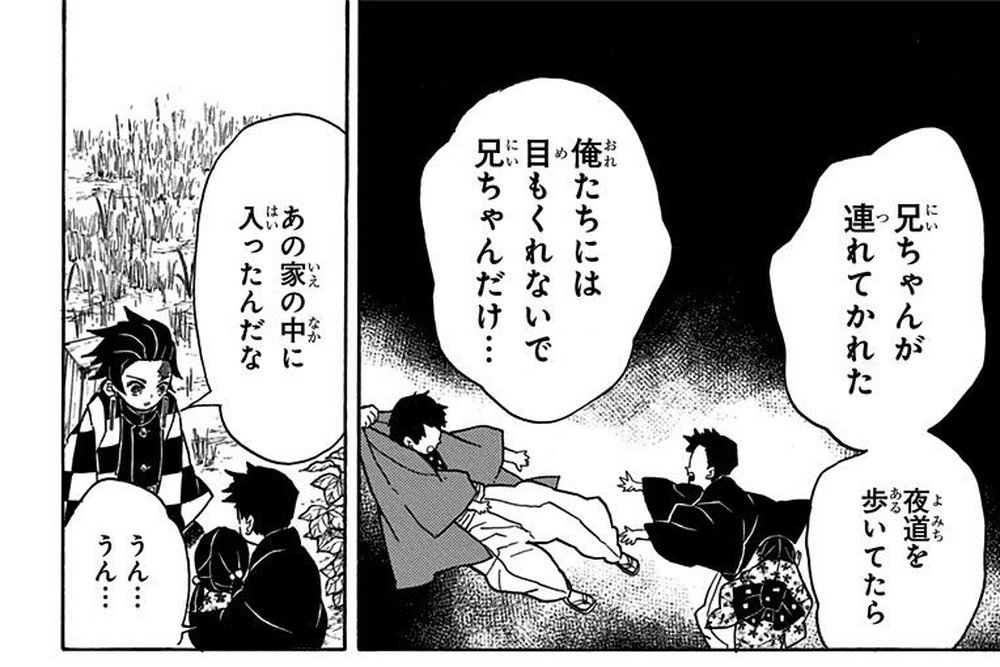
Volume 3, the Tsuzumi Mansion arc: a house strung with drums that shift its own hallways whenever one is struck, home to Kyogai, a demon who has been quietly making people disappear. Tanjiro — traveling with Nezuko boxed on his back — finds two village boys collapsed in the woods just outside it, one cradling the other. 「ばっ…化け物の…家だ…」, one manages — "A M-MONSTER'S... HOUSE..." — and Tanjiro, crouching to their level, asks what happened. The answer arrives out of order, the way panic tells a story: shock first, detail after.
「兄ちゃんが連れてかれた」
Nii-chan ga tsurete kareta
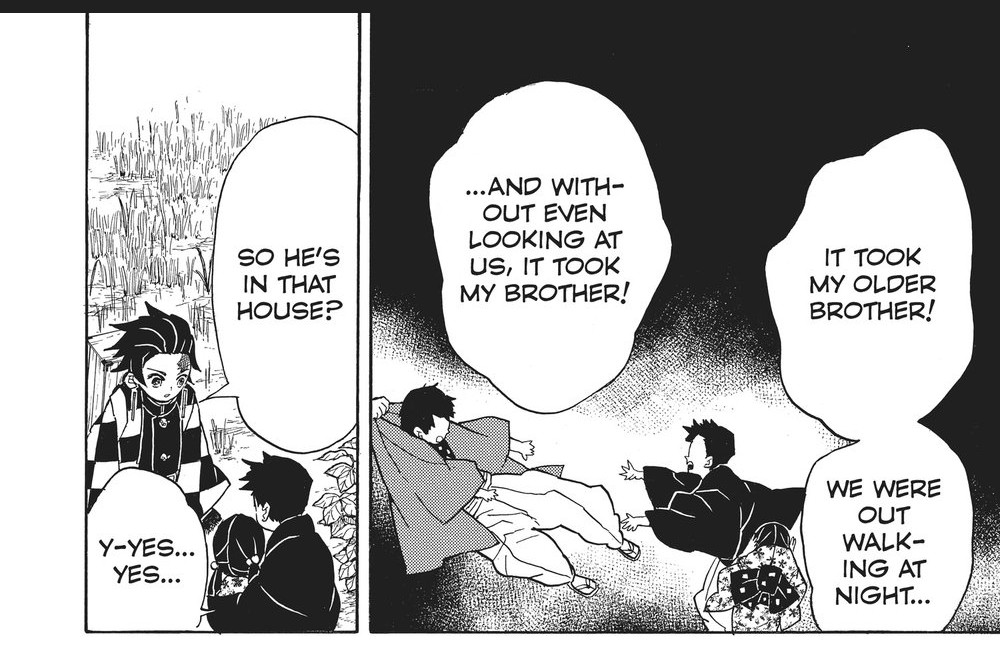
"IT TOOK MY OLDER BROTHER!" the boy blurts — and then, as if the first telling wasn't enough, he says it again, this time with the detail that is clearly the part that won't leave him:
「俺たちには目もくれないで兄ちゃんだけ…」
Oretachi ni wa me mo kurenaide nii-chan dake…
VIZ's English edition prints: "...AND WITHOUT EVEN LOOKING AT US, IT TOOK MY BROTHER!" (Vol. 3, p.80).
Grant the rendering its due first. It reads exactly like a frightened child talking — the run-on "and," the present cruelty of "IT TOOK MY BROTHER" repeated almost verbatim, the "even" doing real emphatic work. Nothing about the English sounds like a translation; it sounds like a boy who watched something take his brother and can't stop replaying the detail that hurts most. That detail — that the demon didn't so much as look at them — is preserved. What isn't preserved is what kind of thing a look would have been if it had been given: not mere noticing, but a small mercy. 「あの家の中に入ったんだな」 — "SO HE'S IN THAT HOUSE?" — Tanjiro confirms, and a few panels later, having heard how the boys tracked their brother's blood through the dark, he promises: 「大丈夫だ 俺たちが悪い奴を倒して兄ちゃんを助ける」 — "DON'T WORRY. WE'LL BEAT THE BAD GUY... AND SAVE YOUR BROTHER." Tanjiro's whole response is built on the opposite of what the demon did: he looks straight at these two children, takes them seriously, gives them his attention as a matter of course. The panel is quietly organized around a contrast the English text states but doesn't fully explain — one figure withholding the cheapest possible kindness, another handing it over freely.
The Original
目もくれない earns its difficulty from a piece of grammar most learners meet early and never quite finish learning: Japanese's three-way giving-verb system. あげる sends something away from the speaker, out toward another person. もらう receives something coming in. And くれる — the verb buried inside our idiom — brings something toward the speaker's own side: a gift arriving, not departing. This is not decoration; it is obligatory. You cannot describe an act of giving in ordinary Japanese without also encoding, in the verb itself, which direction across the social map the gift traveled.
くれる shows up constantly bolted onto other verbs, where it stops meaning literal "give" and starts marking an action as done as a favor: 見てくれる, "to do me the favor of looking [at this]"; 手伝ってくれる, "to do me the favor of helping." 目をくれる is built the same way, except the thing being handed over is a glance itself. 目 (me) — "eye," standing in for "a look," the way English lets "eye" mean "look" in "catch someone's eye." を marks it as the direct object: an eye, a look, treated grammatically as a thing that can change hands. くれる: given, toward you. 目をくれる is, at the letter, "to give a look" — to treat the mere act of glancing at someone as an extension of favor toward them.
Now negate it, and add も. も is the particle that turns any single case into the extreme end of a scale: not X, not even X. 目もくれない: [the subject] wouldn't even give [us] that much. Not "didn't notice us" — didn't extend, even once, the smallest transaction of attention a passing glance would have cost. The grammar itself keeps score of what should have been offered and wasn't.
(One trap worth flagging, because the sound alone won't save you from it: this くれる is 呉れる, "to give." A completely different verb, 暮れる — "for the day to draw to a close, for light to fade," as in 日が暮れる, "the day grows dark" — shares the identical reading. Only context, never the sound, tells a listener which one they're hearing.)
Grammatically, none of this is advanced — 目, くれる, and も are all early vocabulary. What takes longer to absorb is the underlying claim: that attention itself is a giveable, spendable thing, subject to the same directional bookkeeping as a physical present. English readers meet the idiom's meaning easily enough ("didn't even look") without ever being handed the part that makes a native speaker wince a little extra — that the sentence is quietly accusing someone of failing to give a gift.
VIZ's Choice
Only one occurrence of 目もくれない turns up in the volumes we have on file for Demon Slayer, which means there's no scatter to chart here, no table of five different English guesses at the same Japanese phrase. There is exactly one translator's decision, made once, and it's worth sitting with on its own terms rather than measuring it against sibling renderings that don't exist.
"...AND WITHOUT EVEN LOOKING AT US, IT TOOK MY BROTHER!" does several things well. It keeps the "even," preserving real scalar force — this is not a neutral "it didn't look at us," it's an escalated "it didn't so much as look at us," which tracks も's job in the Japanese closely. It keeps the direction ("at us"), so the boys remain the ones being denied something, not incidental bystanders. And it lands in a natural, breathless spoken register that matches a sobbing child's voice far better than a more literal, clunkier alternative would.
What it changes, silently, is the verb doing the work. VIZ's sentence pivots on looking — a perceptual, spatial verb, describing where a demon's eyes did or didn't point. The Japanese sentence pivots on giving — a transactional, benefactive verb, describing what a demon did or didn't hand over. Both sentences describe the identical physical fact (no eye contact was made), but they file that fact under different categories of meaning: one under vision, one under generosity withheld. That's not a mistranslation. It's the quieter, harder kind of loss — the kind where every word is defensible and the sentence still ends up meaning something structurally different from what it started as.
The Gap
The verb changes species. Japanese's operative verb is a giving-verb, negated: didn't give. English's operative verb is a seeing-verb: didn't look. "Give" implicates will and generosity, or their deliberate absence; "look" reports a direction, indifferent to motive. The sentence's emotional center of gravity shifts from an act of withheld kindness to an act of un-happened perception.
The claim of being owed goes quiet. くれる always answers "toward whom," which means 目もくれない always implies a baseline expectation — a glance our way would have been the least it could do. "Without even looking at us" keeps its "even" working hard, and deserves credit for that — but the "even" modifies "looking," not "giving," so the entitlement humming underneath the Japanese survives only as something a careful reader might infer, not as a fact built into the sentence's own grammar.
The idiom loses its relatives. 目もくれない is the dark twin of 目をかける (attention as patronage) and お目にかかる (attention as an honor received) — a Japanese reader hears all three as members of one family, gazes that get bestowed, conferred, or refused. "Without even looking at us" reads as a single, self-contained description. Nothing marks it as the negative case of a whole system of eyes given and received, so the sentence's kinship with every other 目 idiom in the language quietly disappears along with the translation.
What If
The menu for this line, and what each option costs:
- "...AND IT DIDN'T EVEN GIVE US A GLANCE — IT TOOK MY BROTHER!" — restores くれる's actual verb, "give," as the sentence's grammatical center. Cost: reads a shade more composed and written than a sobbing child's outburst calls for.
- "...AND IT DIDN'T EVEN SPARE US A LOOK — IT TOOK MY BROTHER!" — "spare" keeps the sense of a look as a finite resource the demon could have extended and chose not to; the closest single-word fix. Cost: "spare" leans toward "had enough left over for," a slightly different flavor of stinginess than "give."
- "...WE WEREN'T EVEN WORTH A GLANCE TO IT — IT TOOK MY BROTHER!" — makes the implied judgment (we didn't deserve that much) explicit. Cost: states an interpretation the Japanese only implies through its grammar; leans from translation toward commentary.
- Keep VIZ's line, minimally repaired: "...AND WITHOUT EVEN SPARING US A LOOK, IT TOOK MY BROTHER!" — one-word swap that keeps VIZ's whole cadence while nudging the verb back toward benefaction. Cost: subtle enough most readers won't consciously clock the change — which may be exactly the problem with a one-verb fix for a whole grammatical worldview.
Every option on this list pays somewhere, because English simply doesn't have a everyday verb that means "to look at someone, understood as a favor extended." The closest it gets — "spare a glance," "give a look" — are fossil idioms, not live grammar the way くれる is in Japanese. Restoring the benefactive costs naturalness; keeping the naturalness costs the benefactive. That trade is the whole article.
Take-away
目もくれない is easy to gloss and hard to fully hear: a demon "not looking" at two children is a fact about eyes; a demon "not giving" them so much as a glance is a fact about what it judged them worth. English can state the first without any trouble. Stating the second takes an extra verb it doesn't quite have on hand.
Three rules of thumb to carry off this page:
- Whenever くれる shows up bolted onto another verb — 見てくれる, 教えてくれる, or negated as here — read it as "done for me/us as a favor," and ask what the sentence implies was owed. That question is often the real payload.
- も + a negative verb is Japanese's standard machine for "not even X" — the same pattern that builds 歯牙にもかけない and a whole family of contempt-and-refusal idioms. Once you spot the shape, new instances stop needing a dictionary.
- Track the 目 idiom family as one vocabulary, not scattered entries: 目をかける gives attention, お目にかかる receives it as an honor, 目もくれない refuses it outright. They're grammatically the same gesture pointed in different directions.
For more Demon Slayer body idioms English couldn't keep intact, see the nose that simply works in 鼻が利く, the seated liver and lost hips of 肝が据わる・腰を抜かす, and the doubled tongue of 二枚舌 — or browse the Demon Slayer translation notes index.
Every Japanese and English line quoted above is a byte-exact capture from the cited editions — 鬼滅の刃 Vol. 3 (Japanese) and Demon Slayer: Kimetsu no Yaiba (VIZ Media) at the corresponding panel — via our bilingual page database; see Sources below.