The Moment
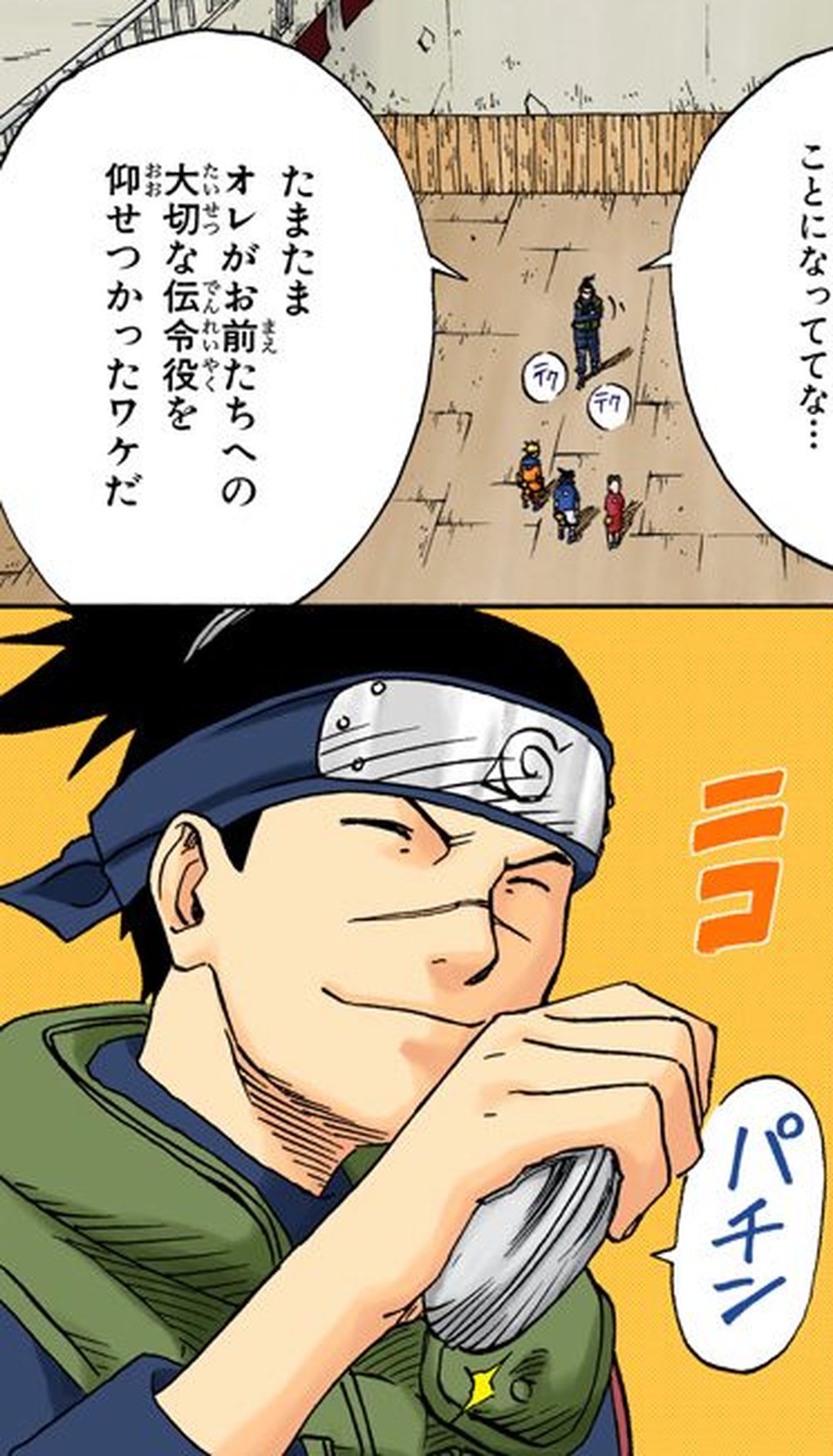
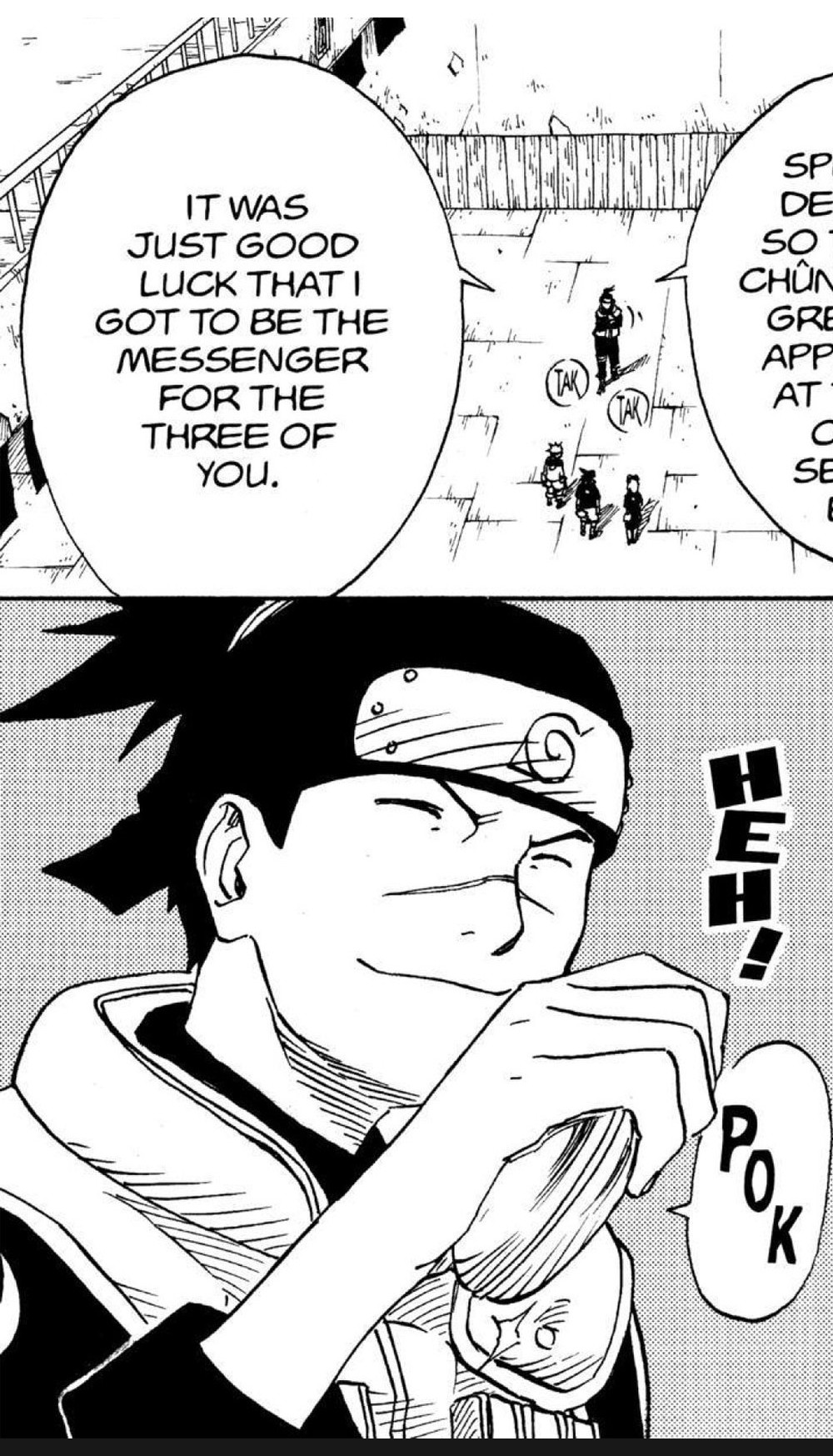
The Forest of Death is over. Naruto, Sasuke, and Sakura have barely survived the Second Chūnin Exam, and they're still catching their breath when a scroll flares in front of them and — of all people — their old Academy teacher steps out of a summoning jutsu. 「何でイルカ先生が口寄せで出てくんだってばよ!?」 one of them yelps — VIZ's "MASTER IRUKA... WHAT ARE YOU DOING, POPPING UP OUT OF A SUMMONING SPELL?!" Iruka explains, dry and a little smug: the spell exists so a chūnin can greet the exam's survivors in person. Then, grinning — the sound effect beside him is ニヨ, a satisfied smirk — he adds:
「たまたまオレがお前たちへの大切な伝令役を仰せつかったワケだ」
Tamatama ore ga omae-tachi e no taisetsu na denreiyaku o ōse-tsukatta wake da.
VIZ's English edition prints: "IT WAS JUST GOOD LUCK THAT I GOT TO BE THE MESSENGER FOR THE THREE OF YOU." (Vol. 8, p.11).
Grant the rendering its due: the line is warm, funny, and completely in character — Iruka teasing his old students with mock modesty, waving off what is obviously a proud moment as a coincidence. VIZ's comic timing survives intact. What's gone is the single word doing the real work underneath the joke: 仰せつかった — not "I happened to get," but "I was entrusted, by someone above me, with a command." Iruka isn't reporting a coin flip. He's reporting a chain of command, and pretending not to notice it is the entire joke.
The Original
仰せ付かる breaks into three working pieces.
仰 (gyō; kun-readings あお-/おお-) is "to look up at; to revere; to request of a superior." It's the same 仰 in 仰ぐ (aogu, "to look up to for guidance") and in 信仰 (shinkō, "religious faith" — literally "looking-up belief"). As the stem of the verb 仰る (ossharu), it is sonkeigo — honorific language that elevates the person being quoted, never the speaker: 何と仰いましたか, "what did you say?", asked of someone the speaker defers to.
仰せ (ōse) is the noun built on that stem — not "a remark" but a word spoken by someone above you: an instruction, a command, something closer to "His Lordship's pronouncement" than "what he said."
付かる (tsukaru) is the passive-flavored form of 付く, "to attach, to be granted" — something sticks to you, whether you asked for it or not.
Fuse the three and 仰せ付かる reads, literally, "to have a superior's word attached to oneself" — to be entrusted, from above, with a duty. Notice the double bow in the grammar: 仰せ elevates whoever gave the order, while using the compound about one's own assignment quietly lowers the speaker's position as the one who received it. It's the same motion as 頂く ("to humbly receive" — honoring the giver while lowering the receiver), just built on "say" instead of "give."
And that's the real news here: Japanese doesn't have one verb for "to say." It has at least three, and which one a speaker reaches for depends entirely on who is talking, relative to who is listening:
- 言う (iu) — plain, neutral: anyone says anything.
- 仰る (ossharu) — sonkeigo: reserved for someone the speaker defers to. Raises the person quoted.
- 申す (mōsu) — kenjōgo: reserved for the speaker's own speech, in front of someone the speaker defers to. Lowers the speaker.
One act — a mouth opening, words coming out — and Japanese asks, every single time, who outranks whom here? before it even picks a verb. Iruka's ワケだ at the end of the line is breezy, spoken-register self-explanation ("that's the reason," delivered with a shrug); 仰せ付かった, one clause earlier, is formal enough to show up in a company memo or a period drama. That mismatch — a chūnin explaining a scheduling assignment with the vocabulary of royal decree — is the texture of the joke, and it sits at JLPT N1: the base verb 仰る is usually taught around N3, but this noun-plus-verb compound belongs to the more specialized register of business and formal Japanese.
VIZ's Choice
Four sightings of 仰せ(付か)る across the volumes we have on file:
| Vol. / p. | Speaker | Japanese | VIZ English |
|---|---|---|---|
| 8 / 11 | Iruka Umino | たまたまオレがお前たちへの大切な伝令役を仰せつかったワケだ | IT WAS JUST GOOD LUCK THAT I GOT TO BE THE MESSENGER FOR THE THREE OF YOU. |
| 8 / 20 | Iruka Umino | オレが仰せつかった伝令のすべてだ! | THAT'S THE ENTIRE MESSAGE!! |
| 8 / 41 | Gekkō Hayate | ここからは〝審判〟を仰せつかったこの…月光ハヤテから… | IF YOU DON'T MIND HANDING THE REST OF THE PROCEEDINGS OVER... ...TO ME, GEKKO HAYATE, PROCTOR OF THE THIRD EXAM. |
| 21 / 64 | A Sound ninja escorting Sasuke | 実は大蛇丸様から仰せ付かった大切な事が一つあります | IT'S JUST THAT LORD OROCHIMARU GAVE US A TASK... SOMETHING... CRITICAL. |
Four appearances, four unrelated English solutions: "got to be," "the entire message," "handing… over," "gave us a task." Not one of them keeps 仰せ visible as a recurring idiom, so a reader who has just watched Iruka's joke has no way to recognize the same grammar of deference when Hayate kneels before the Hokage nine pages later, or when a Sound ninja invokes "Lord Orochimaru" seventeen volumes after that.
The Vol. 8, p.41 case deserves a closer look, because the loss there is not just lexical — it's directional. Gekkō Hayate, interrupting the Third Hokage with 恐れながら ("if I may humbly interrupt"), says ここからは〝審判〟を仰せつかったこの…月光ハヤテから…: from here, [it will proceed] from this Gekkō Hayate, who has been entrusted with the role of judge. Grammatically, this is a completed-action announcement — Hayate already holds the mandate; he's informing the room, not requesting anything. VIZ's "IF YOU DON'T MIND HANDING THE REST OF THE PROCEEDINGS OVER" reshapes that announcement into a request for permission, so when the Hokage answers 任せよう — "GO AHEAD" — the English reads as consent to a question the Japanese never actually asked. The Hokage isn't granting a favor; he's acknowledging an appointment that was already his own doing.
The Gap
Luck erases the ladder. "IT WAS JUST GOOD LUCK" reframes a top-down assignment as a random break — chance, not chain of command. 仰せ付かった says the opposite: someone above Iruka decided, and he's reporting that decision while pretending it's nothing.
One English "say" for three Japanese registers. 言う (plain), 仰る (elevates the person quoted), and 申す (lowers the speaker) are three different verbs in Japanese and a single flattened "say" in English. A reader who only ever meets "say" has no way to notice when a character has just pivoted from casual to reverent to self-effacing mid-scene — and Naruto, with its academy students, jōnin, Hokages, and missing-nin all sharing panels, pivots constantly.
A reversal, not just a softening. Hayate's line doesn't lose a shade of meaning in translation — it flips speech-act type, from an announcement of already-granted authority into a request awaiting permission. That's a small grammatical accident with an odd consequence: the Third Hokage's "GO AHEAD" now looks generous in English, where the Japanese has him simply rubber-stamping his own earlier decision.
The set phrase disappears as a set phrase. The idiom for "entrusted with a duty from above" surfaces four times — a mentor's tease, a proctor's formal handover, a defector's escort reporting Orochimaru's orders — and VIZ finds a fresh, unrelated English phrase almost every time. The pattern that would tell a Japanese reader these scenes rhyme never reaches the English one.
What If
No option is free; here's the menu and its prices.
- "Turns out I'm the one who got the honor of being your messenger." — keeps both Iruka's modesty and a whisper of the top-down mandate. Cost: "honor" tips the line more sincere than his smirking, teasing delivery.
- "Lucky me — I got tapped for messenger duty." — "tapped for duty" at least implies someone else did the choosing. Cost: still loses the specifically honorific shape of 仰せ; "tapped" reads as arbitrary as a coin flip.
- "It just so happens I was the one assigned to deliver your message — from on high." — makes the chain of command explicit. Cost: "from on high" over-explains a hierarchy that Japanese leaves for a single verb to carry silently.
- Keep VIZ's rhythm, patch the mandate: "IT WAS JUST GOOD LUCK THAT I GOT HANDED THE JOB OF MESSENGER FOR THE THREE OF YOU." — "got handed" at least gestures at an outside assigner. Cost: still no honorific coloring, and 仰せ's formality disappears.
Every option trades the same thing away: English has no verb that simultaneously (a) reports being assigned a task and (b) honors the person who assigned it. Japanese does — that's the whole point of 仰せ付かる — and no amount of paraphrase gets both properties into one English clause without sounding like a memo.
Take-away
仰せ付かる looks, at a glance, like a fancy way to say "I got a job to do." It is actually a small grammatical bow: it names the duty, and in the same breath it tells you who outranks whom. When Iruka jokes about it, when Hayate announces it formally, and when a Sound ninja invokes it in Orochimaru's name, the verb performs the identical social gesture in three very different rooms — and English, lacking the gesture, has to reinvent a solution every time it shows up.
Three rules of thumb to carry off this page:
- 仰せ always points up, never down. Whether it's 仰せ ("an honored word"), 仰る ("to say," honorific), or 仰ぐ ("to look up to"), the character never elevates the speaker — only the person being deferred to.
- One act of speaking, three Japanese verbs. 言う is neutral, 仰る raises the person quoted, 申す lowers the speaker — the same three-way keigo split runs through much of the verb system, not just "to say."
- Watch for reversed speech acts, not just softened words. A polite refusal to state a fact outright (仰せつかった as completed appointment) can read, once translated, as a request for one ("if you don't mind handing over") — the tone survives even when the grammar quietly changes what kind of sentence it is.
For the rest of this hub's keigo cluster inside Naruto — the mock-reverent "I shall humbly behold" a genin levels at Sasuke in 拝見 and the mock-reverent "show us", the archaic humble "I" a pack of ninja dogs never drops in 拙者 and Pakkun's samurai "I", the copula Kishimoto once gave an alternate Kakashi in ござる and the Kakashi that might have been, the honorific "you" a priest levels at two Akatsuki members in 貴殿 and the officer's "you", and the elder pronoun spoken by a toad, a man, and a fox alike in わし and the elder "I" — or browse the Naruto translation notes index.
Every Japanese and English line quoted above is a byte-exact capture from the cited editions — NARUTO Vol. 8 & Vol. 21 (Japanese, digital color edition) and Naruto Vol. 8 & Vol. 21 (VIZ Media) at the corresponding panels — via our bilingual page database; see Sources below.