The Moment
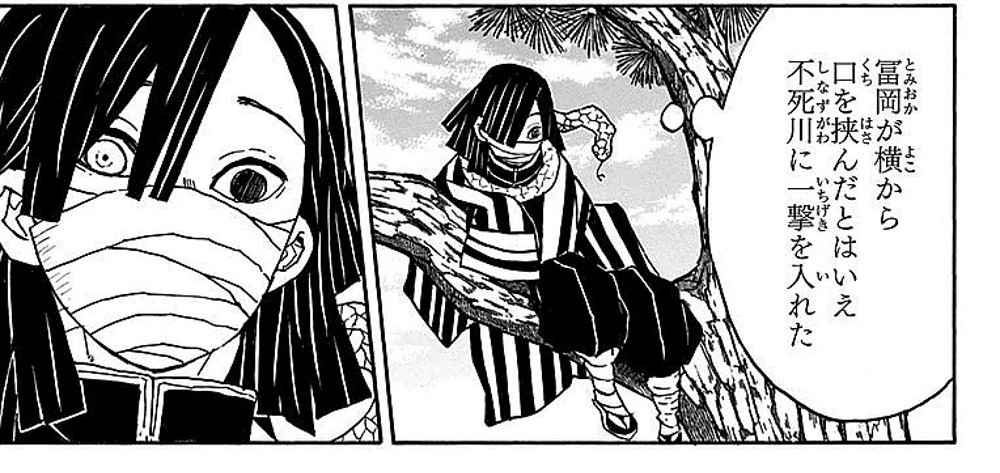
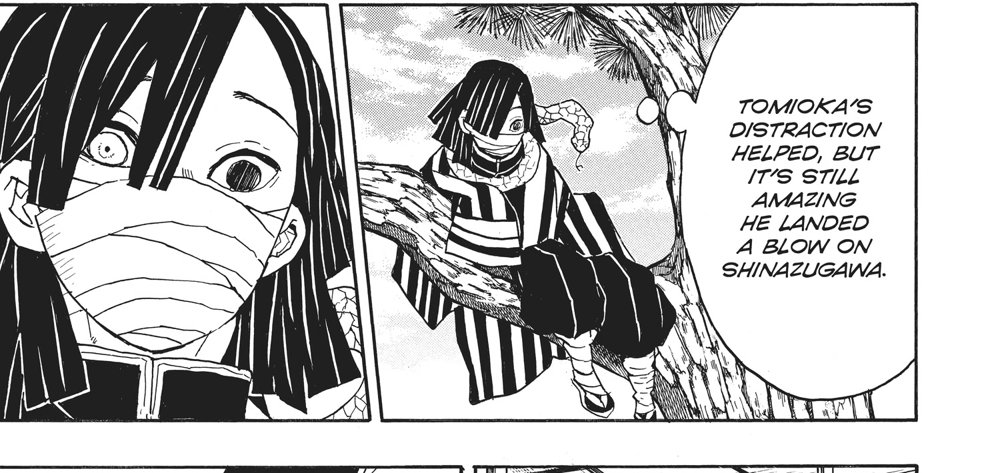
A page earlier, Tanjiro has just said the line fans quote most from this stretch of the story: 「俺の妹を傷つける奴は柱だろうが何だろうが許さない!!」 — "I DON'T CARE IF YOU'RE A HASHIRA OR WHATEVER! I WON'T LET ANYONE HURT MY SISTER!" — shouted at Sanemi Shinazugawa, the Wind Hashira, who has made no secret of wanting Nezuko dead. Swords come out. Somewhere in the scramble, a dark-haired figure shouts 「やめろ!!もうすぐお館様がいらっしゃるぞ」 — "Stop!! Master (Ubuyashiki) will be here soon!" — the kind of line that requires someone willing to override two Hashira mid-fight. Blades clash. And then, on page 51, beside a panel of Obanai Iguro watching coolly from a pine branch, snake coiled at his wrist, a caption sums up what just happened:
「冨岡が横から口を挟んだとはいえ不死川に一撃を入れた」
Tomioka ga yoko kara kuchi o hasanda to wa ie Shinazugawa ni ichigeki o ireta
VIZ's English edition prints: "TOMIOKA'S DISTRACTION HELPED, BUT IT'S STILL AMAZING HE LANDED A BLOW ON SHINAZUGAWA." (Vol. 6, p.51.)
Grant the rendering its due first. It's a clean, readable caption that keeps the beat moving: Tomioka did something, Tanjiro landed a hit anyway, the narrator is impressed. Nothing about it is wrong, exactly. But look at what "distraction" is standing in for. The Japanese verb is 口を挟む — literally, to wedge a mouth in — and the caption is not describing a maneuver. It's describing Giyu Tomioka, of all people, choosing to speak.
The Original
Take the idiom apart at the joint. 口 (kuchi) is "mouth." 挟む (hasamu) is "to sandwich, to pinch, to wedge between two things" — the verb your chopsticks perform on a piece of food, the verb a bookmark performs between two pages, the verb describing a commuter squeezed between two other bodies on a train. It is a thoroughly physical, spatial verb, with nothing inherently verbal about it.
口を挟む grafts the body part onto that spatial action: to jam one's mouth into a gap that wasn't left open for it. The "gap" is implicit — a conversation, an exchange, an argument already underway between other people — and the idiom pictures that exchange as a physical space with an inside and an outside. To 口を挟む is to force your way from outside to inside, uninvited.
Notice what the sentence does next: it adds 横から, "from the side." This isn't new information so much as an echo. 挟む already means "between"; 横から restates the same geometry from a different angle, confirming that whoever is butting in was standing off to one side, not part of the original exchange, until they wedged their way into it. Japanese is willing to say "between" twice in one clause if the image is worth it.
The verb family has a formal register too: 差し挟む (sashihasamu), "to insert, to interpose," which shows up in stiffer prose — 異議を差し挟む余地がない, "there is no room to raise an objection," i.e. beyond doubt. Same mouth, same wedge, dressed for a courtroom instead of a fight.
Grammatically the sentence turns on とはいえ (to wa ie), "even though / that said" — a concessive that grants one fact before pivoting to a second, only loosely related one. It doesn't say the two facts caused each other. It says: this happened, and — even so — that also happened. 挟む itself is unremarkable N3 vocabulary; 口を挟む as a fixed idiom for "to interject" is the kind of phrase N2 idiom lists like to collect, precisely because it recycles a literal, physical verb for something purely verbal.
VIZ's Choice
Only one occurrence of 口を挟む turns up in the Demon Slayer volumes on file, which makes this less a question of scatter across many scenes and more a question of what a single, loaded word choice costs in a single, loaded moment.
The choice VIZ made — "distraction" — is defensible as a battlefield word: something happened that broke the fight's rhythm, and "distraction" names the effect without committing to the mechanism. But that's exactly the trade. 口を挟む commits, hard, to the mechanism: it says mouth. It says speech. And the character it's describing is Giyu Tomioka — a swordsman built almost entirely out of not talking. Across the series, Tomioka is defined by silence: terse to the point that other Hashira read it as arrogance, a man who has to be prompted twice to explain himself and often doesn't bother. A caption that reaches specifically for 口を挟む to describe him isn't neutral vocabulary. It's marking an exception — the quiet one spoke — and "distraction" has no way to mark that, because a distraction doesn't have to involve a mouth at all. It could be a thrown pebble.
The Gap
The mouth disappears. 口を挟む is a body-part idiom in the fullest sense — it doesn't just mean "interrupt," it means "interrupt by inserting your mouth," and the whole flavor of the phrase depends on that physical image. "Distraction" keeps the interruption and drops the body: English readers get the effect (a duel got interrupted) with none of the specific cause (someone spoke). For a character whose defining trait is silence, that's the one detail worth keeping, and it's the first thing cut.
横から's doubled image goes unheard. The Japanese sentence states the sideways-intrusion picture twice — once in 挟む ("between"), once in 横から ("from the side") — a small rhetorical redundancy that Japanese uses for emphasis. English collapses both into a single word, "distraction," that carries neither.
とはいえ's shrug hardens into a claim. "Even though X, Y" concedes two facts side by side without asserting that one produced the other. VIZ's "X helped, but Y" does assert exactly that: it tells the English reader Tomioka's interjection is why the blow landed. The Japanese narrator — plausibly Obanai, watching from a tree, characteristically unconvinced of anything involving Tanjiro — commits to no such thing. The caption's whole tone is faint bemusement: he spoke up; the hit landed anyway; make of that what you will. VIZ resolves an ambiguity the original was content to leave open.
What If
The menu for this caption, and what each choice costs:
- "Even with Tomioka butting in from the side, he still landed a blow on Shinazugawa." — restores the mouth and the shrug. Cost: "butting in" leans slightly comic for a scene this tense.
- "Tomioka spoke up from the sidelines — and somehow, a blow still got through to Shinazugawa." — keeps the verbal specificity and the narrator's mild surprise. Cost: longer, and "somehow" imports a note of astonishment the flatter Japanese doesn't quite state.
- "For all that Tomioka cut in, he still landed one on Shinazugawa." — "cut in" is one of the few English phrases that, like 口を挟む, can specifically mean interrupting speech. Cost: on its own, "cut in" is ambiguous between interrupting a conversation and physically cutting between two combatants — exactly the kind of confusion the Japanese doesn't have.
- Keep "distraction," but name the mouth: "TOMIOKA SPOKE UP AND BROKE THE RHYTHM — EVEN SO, HE LANDED A BLOW ON SHINAZUGAWA." — Cost: needs more words than the terse Japanese original to do the same job.
Every option that keeps the concessive also has to decide, on its own, whether "cut in" or "spoke up" or "butted in" sounds right for a Hashira as reserved as Tomioka — the original leaves that entirely to the reader's memory of the character; English can't.
Take-away
口を挟む asks a translator to keep three things moving at once: a body part (mouth), a spatial verb (wedge between), and a concessive that refuses to assign blame or credit. VIZ's "distraction" keeps the interruption and loses the rest — and for a scene whose whole small joke is that the Corps' quietest swordsman chose, once, to open his mouth, that's the detail the sentence needed most.
Three rules of thumb to carry off this page:
- 挟む is always about betweenness. Whether it's chopsticks, a bookmark, or a mouth, the verb pictures one thing forced into a gap between two others. Once you see that image, 口を挟む, 差し挟む, and even 板挟み ("caught between a rock and a hard place," literally "sandwiched between boards") all click into the same family.
- とはいえ concedes; it doesn't conclude. "Even though X, Y" states two facts and trusts the reader to weigh their relationship. Watch for translations that quietly upgrade that trust into a causal claim the original never made.
- A quiet character's rare words are data. When a famously silent character speaks, the verb Japanese chooses to describe it (口を挟む, not just 言った, "said") is doing characterization work. Losing the verb loses the characterization.
Japanese keeps a whole cluster of idioms built around this same 口, and it's worth knowing the neighbors: 口を出す ("to put one's mouth out," to meddle with unsolicited opinions) is the nosier cousin of 口を挟む, while — on a different work entirely — a mouth that breaks open under pressure, 口を割る, is the idiom VIZ's Naruto translation renders as everything from "confess" to "talk," the subject of a sibling article on that series' hub. Same organ, opposite direction: one mouth forces its way in, the other is forced open.
For other places where a Demon Slayer body-part idiom hides more than its English translation shows, see the nose Tanjiro never claims credit for in 鼻が利く and the arms that ring in 腕が鳴る — or browse the Demon Slayer translation notes index.
Every Japanese and English line quoted above is a byte-exact capture from the cited editions — 鬼滅の刃 Vol. 6 (Japanese) and Demon Slayer: Kimetsu no Yaiba Vol. 6 (VIZ Media) at the corresponding panel — via our bilingual page database; see Sources below.