The Moment
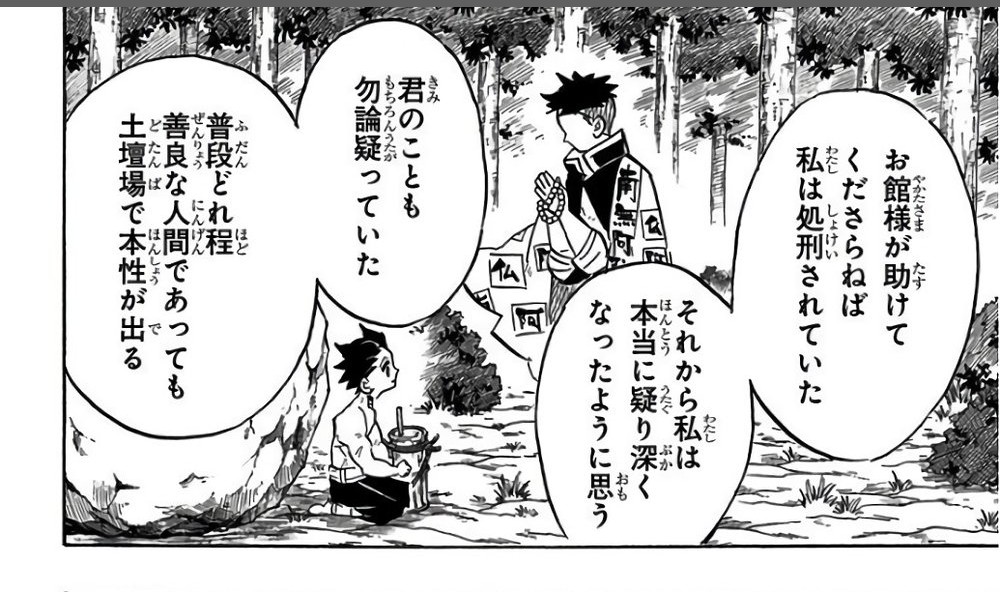
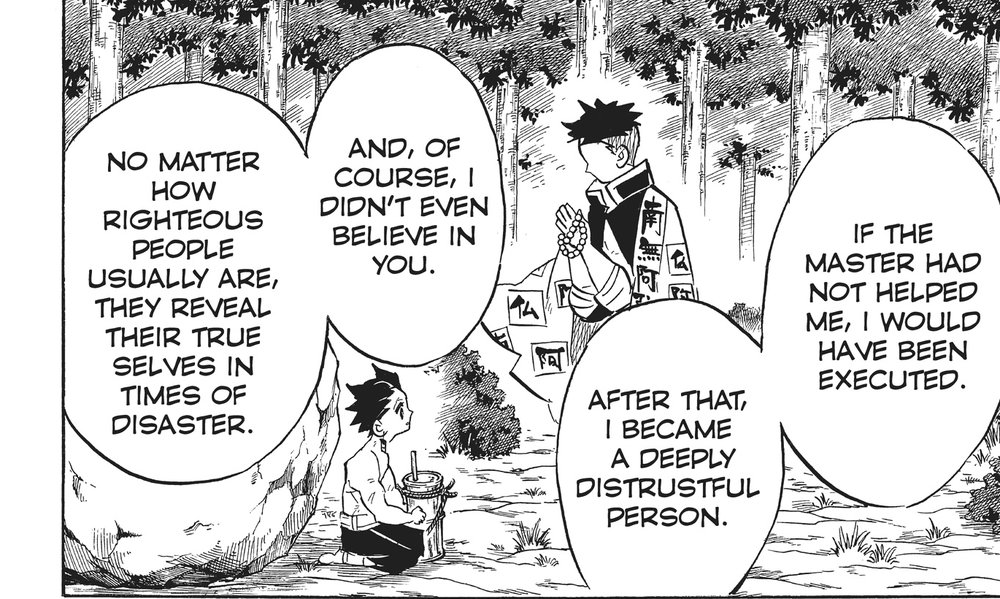
Hashira Training arc, Volume 16. In a forest clearing, Gyomei Himejima — the blind Stone Hashira, prayer beads in hand, his robe printed with the nenbutsu 南無阿弥陀仏 — has finally decided that Tanjiro, seated on the ground and listening, deserves his story. It is not a gentle one. 「お館様が助けてくださらねば私は処刑されていた」 — "IF THE MASTER HAD NOT HELPED ME, I WOULD HAVE BEEN EXECUTED." Falsely accused, saved at the brink, and never trusting again: 「君のことも勿論疑っていた」 ("AND, OF COURSE, I DIDN'T EVEN BELIEVE IN YOU."). And then the principle he distilled from all of it:
「普段どれ程善良な人間であっても土壇場で本性が出る」
Fudan dore hodo zenryō na ningen de atte mo dotanba de honshō ga deru
VIZ's English edition prints: "NO MATTER HOW RIGHTEOUS PEOPLE USUALLY ARE, THEY REVEAL THEIR TRUE SELVES IN TIMES OF DISASTER." (Vol. 16, p.44).
Grant the rendering its due: it is clean, aphorism-shaped, and roughly true to the thought — extreme pressure pulls masks off. If you never saw the Japanese, nothing would snag. But Himejima has just said 処刑 — execution — and then, three bubbles later, he reaches for 土壇場. To a Japanese reader those two words rhyme, because dotanba is not "disaster." It is the execution ground.
The Original
Take the word apart:
土 (do) is "earth." 壇 (dan) is "raised platform, dais" — the same 壇 as 祭壇 (saidan, "altar"), 花壇 (kadan, "flower bed"), and 教壇 (kyōdan, the teacher's podium; to 登壇 is to take the stage). 場 (ba) is "place, scene."
So 土壇場 is "the place of the earthen platform." In the Edo period that meant something specific: the beheading ground. The condemned was made to kneel and lean forward over a low packed-earth mound — the 土壇 — which lifted the neck and gave the executioner's sword a clean path through. By most accounts the same mounds served when new blades were tested on the bodies afterward — a grim footnote that readers of a story about swordsmiths may feel land a little close. Major dictionaries still list "execution ground for beheading" as the word's first sense. The second sense — "the last moment; the cornered place with no way out" — is the only one modern speech remembers.
And modern speech uses it constantly. 土壇場で逆転する — a last-gasp comeback. 土壇場に立たされる — forced to the brink. Sports pages print 土壇場で同点 ("equalized at the death" — English football's own little mortality idiom) every weekend. Above all, every learner already owns this word without knowing it: ドタキャン (dotakyan), the universal slang for cancelling at the last minute, is a clipping of 土壇場でキャンセル. There is an execution mound folded inside every flaked dinner plan in Japan.
English has a perfect mirror for this kind of fossil, and it is the word "deadline" — by the usual account, originally the line around a Civil War prison camp beyond which a prisoner would be shot. Nobody feels the rifle in "deadline"; nobody feels the sword in ドタキャン. A dead metaphor stays dead — until a scene deliberately stands next to it.
Which is what happens here. Vocabulary-wise 土壇場 sits around JLPT N1, and the line's frame — 普段どれ程〜であっても…本性が出る — is textbook concessive grammar wrapped around an executioner's noun. Himejima, an ex-temple guardian who speaks in liturgical cadences, was nearly beheaded in the most literal era for it: Demon Slayer is set in the Taishō years, and Japan had abolished beheading only a generation or so earlier, in early Meiji. In his mouth, the scaffold inside the word is barely cold.
VIZ's Choice
Both appearances of 土壇場 in the volumes we have on file:
| Vol. / p. | Speaker | Japanese | VIZ English |
|---|---|---|---|
| 11 / 81 | Gyutaro | 土壇場で心が折れたか | AT DEATH'S DOOR YOUR SPIRIT IS FINALLY BROKEN! |
| 16 / 44 | Gyomei Himejima | 普段どれ程善良な人間であっても土壇場で本性が出る | NO MATTER HOW RIGHTEOUS PEOPLE USUALLY ARE, THEY REVEAL THEIR TRUE SELVES IN TIMES OF DISASTER. |
Two occurrences, two opposite instincts.
Volume 11, the Entertainment District in ruins: Tanjiro on his knees amid the rubble, head lowered, before Upper Rank Six. Gyutaro looms over the bowed boy and gloats — 「土壇場で心が折れたか」 "AT DEATH'S DOOR YOUR SPIRIT IS FINALLY BROKEN!" — then keeps twisting: 「みっともねえなあ本当にみっともねえ!!」 ("HOW TERRIBLE! YOU TRULY ARE MISERABLE!"), 「俺は惨めでみっともなくて汚いものが好きだからなあ」 ("I LIKE WRETCHED, PITIFUL, FILTHY THINGS! THINGS LIKE...") 「…お前の額のその汚い傷!!」 ("...THAT SAD SCAR ON YOUR FOREHEAD!"). Look at the staging: a kneeling figure, head down, neck bared; an executioner-figure gloating above. The scene has quietly rebuilt the 土壇. And "AT DEATH'S DOOR" lands only a few feet from the truth — but by coincidence of scene, not by reading of the word. English's "at death's door" is its idiom for the dying — the sickbed at the threshold — not for the decisive last moment; it works here only because Tanjiro happens to be both.
Then Volume 16 — the one place where the etymology is doing real work, spoken three bubbles after "EXECUTED" by a man who knelt at his own dotanba once — and VIZ chooses the most scaffold-free rendering available: "IN TIMES OF DISASTER." The one time English accidentally stands near the block, nothing depends on it; the one time the block matters, the translation wanders off to the weather.
The Gap
The scaffold was load-bearing, and it is gone. Himejima's speech runs: I would have been executed → I stopped trusting anyone → but even the righteous show their true nature at the execution ground. The idiom is faded in everyday Japanese, yes — but parked next to 処刑, it wakes up; the man's biography re-literalizes his vocabulary. "EXECUTED… IN TIMES OF DISASTER" keeps the facts and loses the rhyme.
"Disaster" points at the sky; 土壇場 points at the corner. A disaster is external — an earthquake, a fire, a demon attack; it happens to you, and to everyone around you. 土壇場 is positional: it is where you stand when there is no way out. That is exactly why the proverb works in Japanese — the pressure that squeezes out 本性, true nature, is cornered-ness, not misfortune. Plenty of people are lovely in a disaster; the dotanba is where the mask has no room left to sit.
The taunt and the counsel stop rhyming. In Japanese, Gyutaro and Himejima are running the same word through opposite mouths — and the story referees. Mocked as broken at his dotanba, Tanjiro lifts the bowed head two pages later — 「準備してたんだ」 "I PREPARED FOR THIS MOMENT!" — straight into the most famous headbutt in the series. His true nature at the dotanba was the opposite of a broken spirit. Himejima's line in Volume 16 reads like the caption to that panel: the dotanba showed what the boy was, which is precisely why the distrustful Hashira now trusts him. In English, "DEATH'S DOOR" and "TIMES OF DISASTER" share not one word, and the echo is inaudible.
What If
The menu and its prices:
- "No matter how righteous a man is in ordinary times, the moment of truth reveals his true nature." — "moment of truth" keeps the decisive final moment, and even hides its own death etymology: it entered English from bullfighting, la hora de la verdad, the instant of the killing thrust. Cost: an arena where Japanese built a scaffold, and a whiff of the sports page.
- "However good a person may be, you learn what they are when their back is against the wall." — the cornered, no-exit pressure is exactly what 土壇場 asks for, and the wall even carries a faint firing-squad echo. Cost: wordy, and it smuggles in a flavor of defiant struggle the original doesn't have.
- "…their true self comes out at the eleventh hour." — the stock dictionary gloss for 土壇場, fine for deadlines and contract talks. Cost: the eleventh hour is about lateness, not mortality; it turns hard-won counsel into scheduling advice.
- "Put the most virtuous man on the scaffold, and you will see what he really is." — restores the execution ground outright and rhymes perfectly with the speaker's own story. Cost: English hears a live, lurid metaphor where a Japanese ear hears a faded one; it shouts what the original murmurs.
That last cost is the interesting one. The translator's real dilemma with a dead metaphor is that both exits are wrong: render the fossil and you say too much; render the modern sense and you say too little. VIZ took "too little" both times — in opposite directions.
Take-away
土壇場 is what a language looks like a century after it stops beheading people: the place stayed in the word after the practice left the world. Japanese pushed the scaffold all the way down into scheduling slang — and then a story like this one stands a nearly-executed man next to the word, and the ground under it is suddenly visible again.
Three rules of thumb to carry off this page:
- Map the 〜場 family. Japanese names its decisive moments after the stages they were once played on: 土壇場 (the scaffold), 正念場 (kabuki's make-or-break scene), 修羅場 (the carnage-field of the asura, now any domestic blowup). When you meet a new 〜場 idiom, ask what theater it was built in.
- You already own this word. ドタキャン is 土壇場でキャンセル. Dead metaphors are the deepest ones — English's "deadline" hides a prison stockade the same way. Etymology is not trivia; it is where scenes like Himejima's get their voltage.
- Keep 土壇場 apart from ピンチ and 危機. A crisis is danger; the dotanba is the cornered last moment that forces the truth out. If the sentence ends in 本性が出る, you are at a dotanba, whatever the weather.
For the prayer stitched across Himejima's robe — and what VIZ did with it — see the nenbutsu in 南無阿弥陀仏. For more of the series' death vocabulary in translation, try the snarled 往生しやがれ and the gentle 成仏してください — or browse the Demon Slayer translation notes index.
Every Japanese and English line quoted above is a byte-exact capture from the cited editions — 鬼滅の刃 Vol. 11 & 16 (Japanese) and Demon Slayer: Kimetsu no Yaiba (VIZ Media) at the corresponding panels — via our bilingual page database; see Sources below.