The Moment
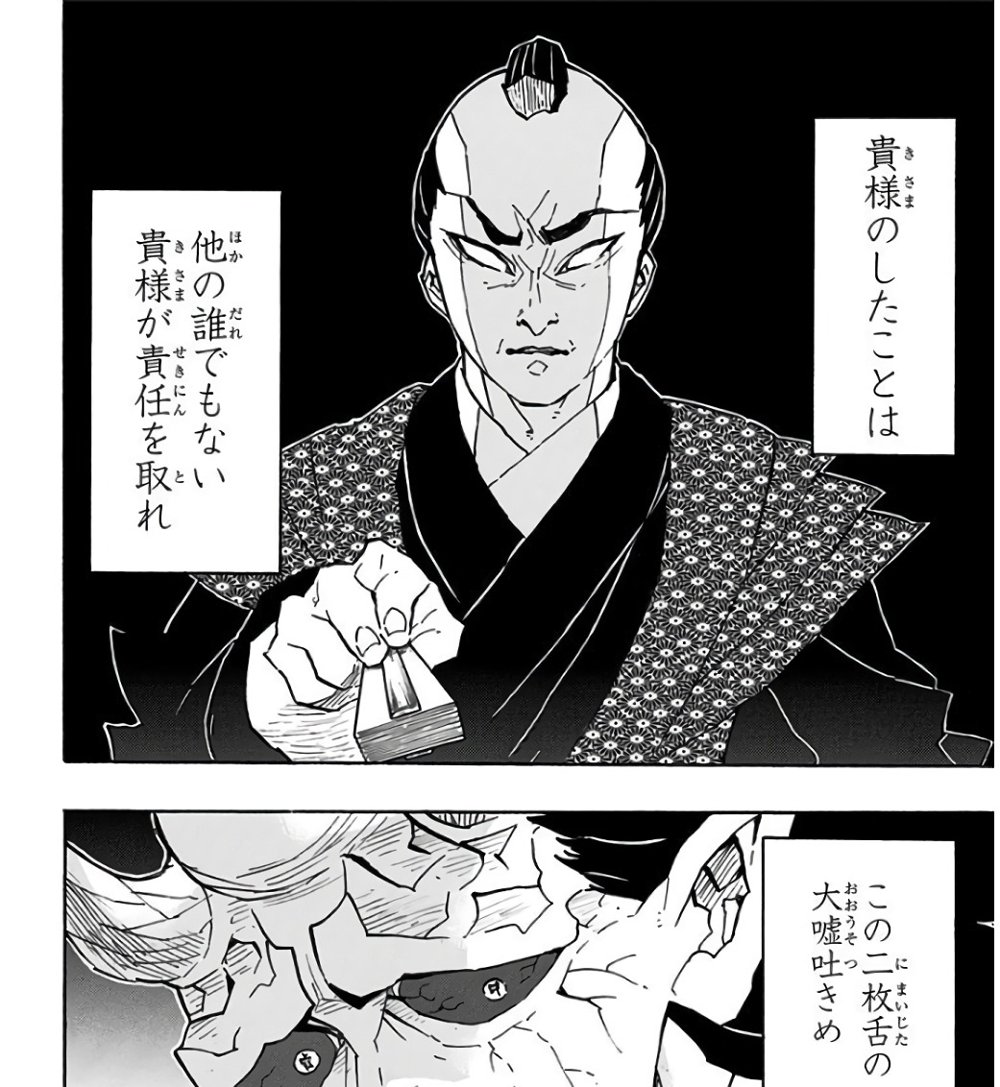
Late in Volume 14 — after Tanjiro, the newly-appointed Mist Hashira Muichiro Tokito, Love Hashira Mitsuri Kanroji, and Genya Shinazugawa (mid-experiment, chewing on the enemy to borrow its regenerative power) have spent several pages chasing down a fleeing, serpentine demon — the manga does what it does at almost every demon's death: it shows you the human being underneath. The fight cuts away entirely. A stern, topknotted figure in a formal, hemp-leaf-patterned kimono looms over someone kneeling out of frame, a bound document gripped in his fist:
「貴様のしたことは他の誰でもない貴様が責任を取れ」
Kisama no shita koto wa hoka no dare demo nai kisama ga sekinin o tore
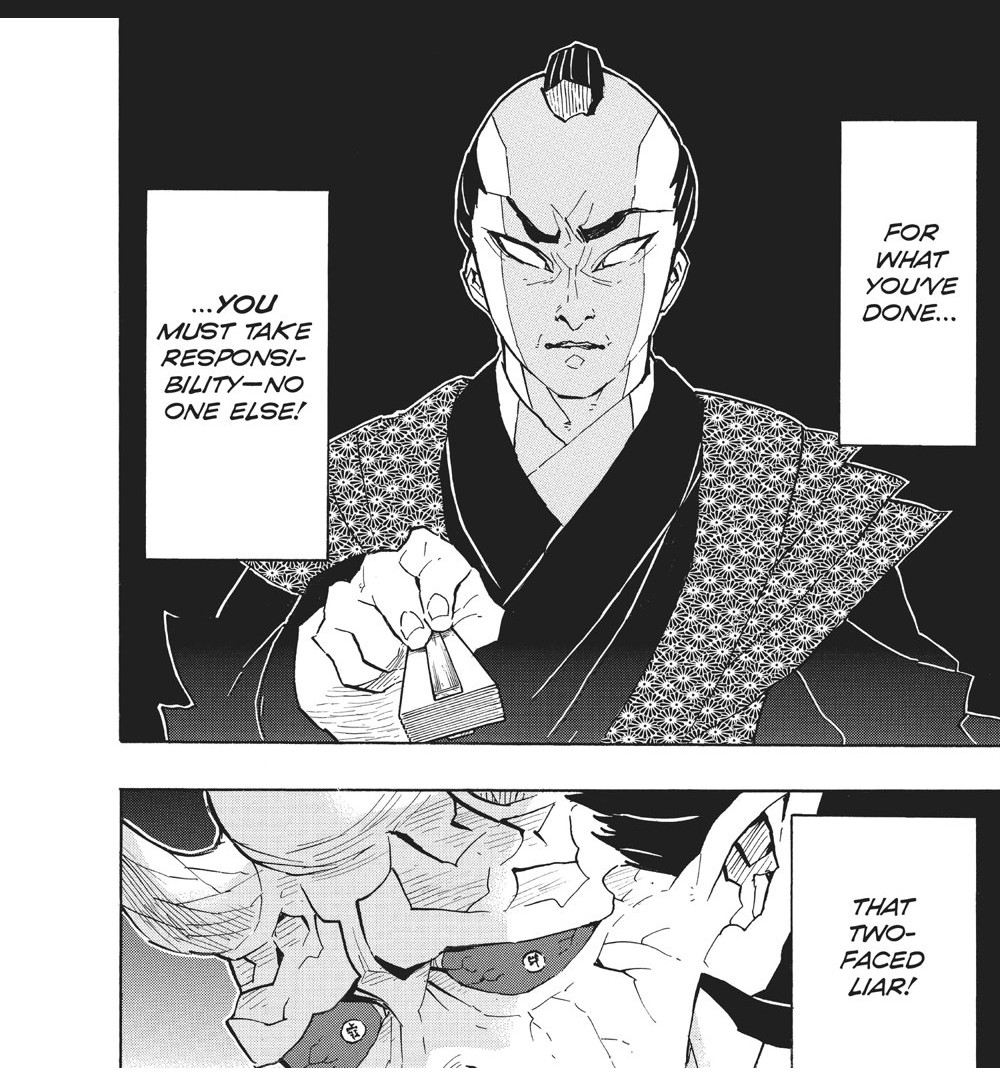
"FOR WHAT YOU'VE DONE..." / "...YOU MUST TAKE RESPONSIBILITY—NO ONE ELSE!"
Then the panel drops to a pair of clawed, cracked hands — hands already turning into something not quite human — and the accuser finishes his sentence:
「この二枚舌の大嘘吐きめ」
Kono nimaijita no ōusotsuki me
VIZ's English edition prints: "THAT TWO-FACED LIAR!" (Vol. 14, p.188).
Grant the rendering its due first: it's a clean, punchy insult, exactly the kind of line an English-speaking reader expects a furious accuser to spit, and "two-faced" is genuinely in the same conceptual neighborhood as the Japanese — both describe someone whose outside doesn't match what's underneath. It scans, it lands, nobody would flag it as wrong reading the page cold.
But hold the two accusations side by side and something odd shows up: they accuse the same man of the same general crime using two entirely different body parts.
His accuser isn't finished, either. Two panels later the accused answers — in the archaic, elderly first person 儂 (washi) — with a wounded, self-pitying denial: 「儂は生まれてから一度たりとも嘘など吐いたことがない」, "SINCE THE DAY I WAS BORN I'VE NEVER LIED... NOT EVEN ONCE!" — followed by 「善良な弱者だ 此程可哀想なのに誰も同情しない」, "I'M A GOOD-NATURED WEAKLING! I DESERVE PITY, BUT NO ONE HAS ANY SYMPATHY!" Two pages later, mid-battle, the demon dies. Whatever happened in that unseen room, he is still lying about it with his last human memory intact — which makes the accuser's word choice, whatever English does with it, exactly right.
The Original
Take 二枚舌 apart stroke by stroke.
二 (ni) is "two." 枚 (mai) is a counter — not just any counter, but specifically the one Japanese reserves for flat, thin, stackable things: sheets of paper (紙二枚), plates (皿二枚), tickets (切符二枚), photographs. And 舌 (shita) is "tongue," voiced to jita after 枚 through rendaku, the same sound-softening at work in 折り紙 (origami, from 折る + 紙).
So 二枚舌, read literally, doesn't say "a forked tongue" or "a two-faced person." It says: two tongues, counted the way you'd count photocopies. The image isn't a snake's biological fork; it's a liar's tongue treated as inventory — mass-produced, interchangeable, one fresh unit per contradiction, restocked the way you'd restock a printer tray.
The standard idiom form is 二枚舌を使う (nimaijita o tsukau), "to use two tongues" — to tell person A one thing and person B the opposite, to say whatever's convenient to whoever's listening. Attach め to the noun — the contemptuous suffix that also shows up in 馬鹿め ("you fool") and 泥棒め ("you thief") — and the accuser isn't describing a trait anymore; he's spitting a label directly at the man: two-tongue.
There's an older, more solemn cousin standing behind this everyday word. Classical Buddhist ethics enumerates ten unwholesome acts (十悪, jūaku) — three physical, three mental, and four of speech: 妄語 (false speech), 綺語 (idle flattery), 悪口 (harsh speech), and 両舌 (ryōzetsu) — literally "both/paired tongue," the sin of telling two parties two different, discord-sowing things. 両舌 uses 両 ("both, a pair") where the everyday word uses 枚 (the sheet-counter); different grammar, same organ, same accusation, a thousand years and change apart. Whether or not the manga intends the specific echo, 二枚舌 carries that lineage the way an English speaker carries "trespasses" from the Lord's Prayer without necessarily tracing the theology — the tongue has been the seat of this particular sin in Japanese ethical vocabulary since long before anyone drew a panel about it.
Grammatically the line is nothing exotic: [この + NOUN + め], a demonstrative-plus-contempt-suffix construction any first-year student could parse. The vocabulary is the toll gate — 二枚舌 is the kind of compound that shows up in JLPT N1 idiom drills, common enough in newspaper Japanese (politicians get accused of it constantly) but specific enough that most learners meet it first on a list, not in conversation.
VIZ's Choice
二枚舌 appears exactly once in the volumes we have on file, so there's no scatter to chart across a table — just one translation decision, made once, worth sitting with on its own.
Compare what each language accuses the man of possessing, in duplicate:
- Japanese doubles the tongue (舌) — the organ that produces speech. The crime is what comes out of his mouth: contradictory statements, one for each listener.
- English's "two-faced" doubles the face — the organ that presents a self to the world. The crime is what he shows people: an outside that doesn't match an inside.
These aren't the same accusation in different words. They're two different theories of where deception physically lives. The Japanese liar has one mouth manufacturing two incompatible outputs; the English liar has one person wearing two incompatible masks. Both describe someone untrustworthy — but ask a Japanese reader and an English reader to sketch the offender, and they'd draw different anatomy: one draws a mouth, one draws a mask.
VIZ had a truer anatomical match sitting on English's own idiom shelf. "To speak with a forked tongue" — English's genuine tongue-based idiom for duplicity, still current enough to surface in writing about diplomats and dealmakers — keeps the exact organ 二枚舌 keeps. "THAT FORKED-TONGUED LIAR!" would have been the organ-for-organ trade.
VIZ didn't take it. "Two-faced" is the more common, punchier, more instantly legible insult in contemporary English — you can shout it in a doorway and everyone knows exactly what you mean, where "forked-tongued" reads faintly literary, better suited to a villain's epithet than a shouted accusation. That's a real and defensible trade: readability and impact over anatomical fidelity. But it's still a trade, made silently, inside a single word an English reader has no way of knowing was ever a body part at all — let alone which one.
The Gap
The accusation points at the wrong organ. "Two-faced" is a real English idiom for duplicity, but it names the wrong body part for this particular crime. The demon's sin, as the scene plays it, is verbal — he told someone what they wanted to hear and someone else something else, and got caught in the gap between the two statements. 二枚舌 names that gap exactly: two tongues, two outputs. "Two-faced" names a different, adjacent failure — presenting a false front, having a hidden true self — a matter of character rather than of specific statements. A two-faced person can stay entirely silent and still be two-faced; a person with 二枚舌 has, by definition, spoken twice and contradicted himself. The English label is close enough to pass, but it diagnoses appearance where the Japanese diagnoses speech.
English already owned the exact organ, and reached past it. "To speak with a forked tongue" keeps the tongue, keeps the doubling, keeps the idea that the crime lives specifically in what the mouth produces. It was sitting there, current and comprehensible. VIZ chose the more colloquial, more universally punchy "two-faced" instead — a reasonable call for a one-panel shout — but it means the one English idiom that could have preserved the organ-for-organ metaphor went unused.
The Buddhist genealogy goes silent. 二枚舌's older cousin 両舌 (ryōzetsu) is one of Buddhism's four sins of speech — a specific, named, centuries-old category of wrongdoing. "Two-faced liar" carries none of that weight; it's a schoolyard insult with no religious register behind it at all. The Japanese line, spoken by a formally dressed accuser passing what reads like a judgment, gets to borrow gravity from a moral taxonomy stretching back past the sutras. The English line borrows nothing older than the insult itself.
What If
The menu for 「この二枚舌の大嘘吐きめ」, and what each option costs:
- "THAT FORKED-TONGUED LIAR!" — the organ-for-organ trade: English's one native tongue-based idiom for duplicity, deployed as an adjective. Cost: reads more literary/archaic than "two-faced," with a faint whiff of snakes and broken treaties rather than an everyday household liar.
- "THAT DOUBLE-TALKING LIAR!" — keeps the accusation aimed at speech rather than appearance, matching 二枚舌's focus on what comes out of the mouth. Cost: "double-talk" usually names deliberately confusing, evasive language, not bald self-contradiction — a shift in the specific flavor of the lie.
- "THAT LYING, TWO-TONGUED CHEAT!" — the most literal transplant: same body part, same doubling. Cost: "two-tongued" isn't standing, familiar English idiom the way 二枚舌 is standing, familiar Japanese — it reads as invented imagery rather than a phrase everyone already owns.
- Keep VIZ's "two-faced," stack the metaphors: "THAT TWO-FACED, FORKED-TONGUE LIAR!" — hedges between both organs. Cost: wordier than a one-breath shout should be, and redundant — accusing someone of two different anatomical betrayals in one line dilutes the punch of either.
Every option on this list pays somewhere. That's the real lesson: English's duplicity vocabulary is organized around the face (two-faced, wearing a mask, a false front) far more than the tongue, so any translation that keeps 二枚舌's actual anatomy has to reach for a less common phrase — and any translation that reaches for the common phrase has already changed which body part is on trial.
Take-away
Japanese and English both keep a body-part vocabulary for dishonesty — they just disagree about which body part does the lying. When a translation swaps the organ, the sentence still accuses the right person of the right general crime; it just draws a different picture of how the crime was committed.
Three rules of thumb to carry off this page:
- When Japanese blames the tongue, check what English blamed instead. 二枚舌 → "two-faced" swaps mouth for face; watch for the same swap wherever 舌 (tongue), 口 (mouth), or 舌先 (tongue-tip) idioms cross into English — the anatomy rarely survives intact.
- 枚 counting a body part is worth noticing every time. Using the flat-object counter for a tongue is Japanese quietly treating the offending organ as inventory, not flesh — a small grammatical joke reinforcing the insult.
- Look for the Buddhist ledger under everyday insults. 二枚舌 sits on top of 両舌, one of Buddhism's four sins of speech; 大嘘 sits near 妄語, the first of them. A shouted insult in a manga panel can be standing on a categorization system a thousand years older than the page.
For more Demon Slayer body idioms English couldn't keep in the same body part, see the nose that simply works in 鼻が利く, the ringing arms of 腕が鳴る, and the seated liver and lost hips of 肝が据わる・腰を抜かす — or browse the Demon Slayer translation notes index.
Every Japanese and English line quoted above is a byte-exact capture from the cited edition — 鬼滅の刃 Vol. 14 (Japanese) and Demon Slayer: Kimetsu no Yaiba Vol. 14 (VIZ Media) at the corresponding panel — via our bilingual page database; see Sources below.