The Moment
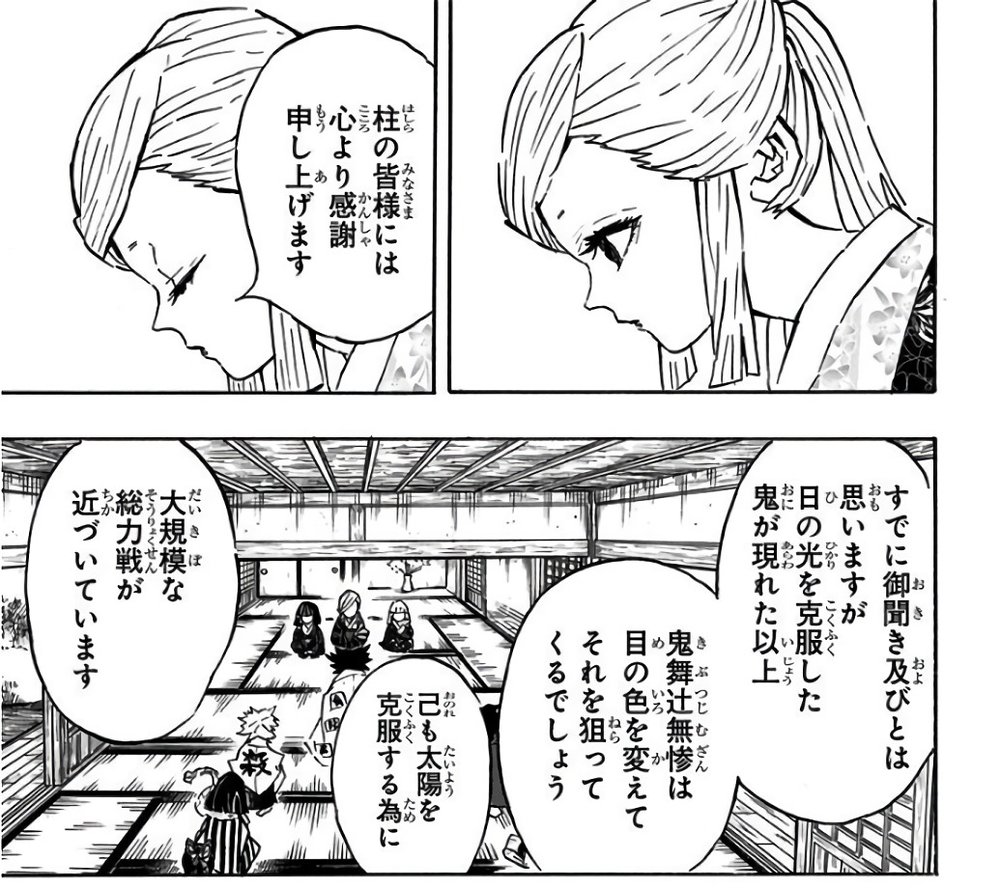
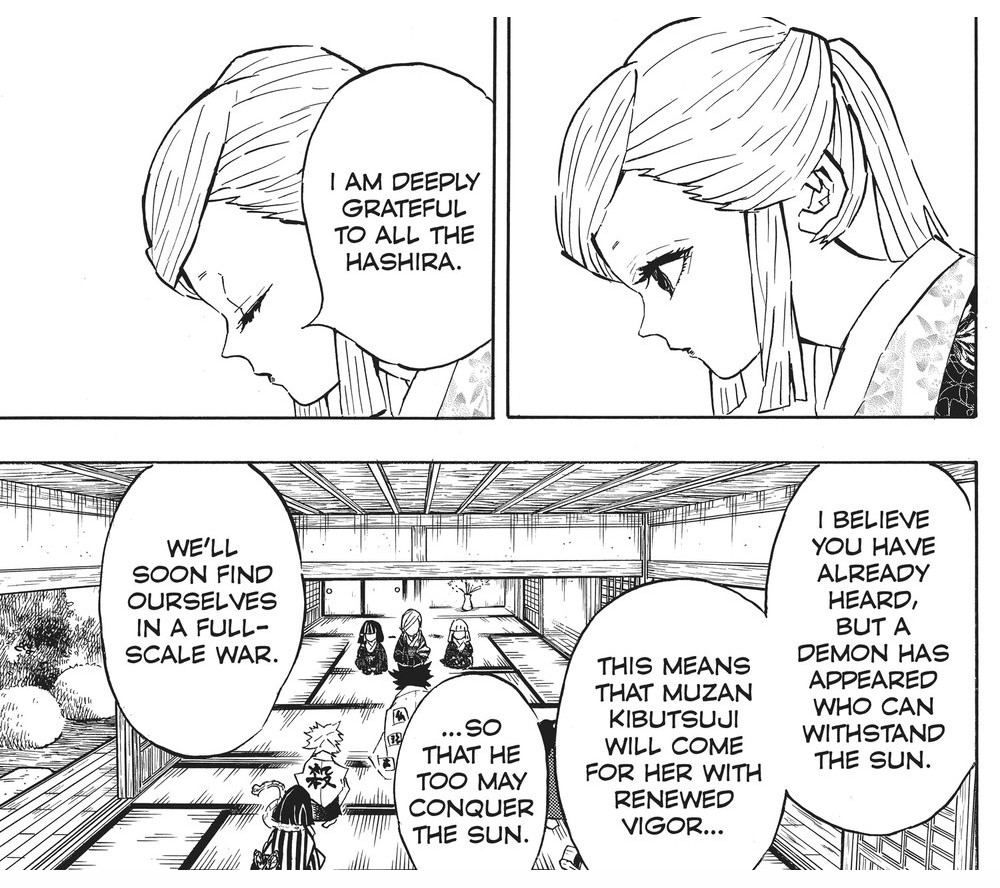
Volume 15. The Hashira have been summoned to a 柱合会議 ("Hashira Meeting") — but this time the summons carries extra weight, because Kagaya Ubuyashiki, the 97th master of the Demon Slayer Corps, is dying, and the meeting is being run in his place by his wife. In profile, downcast, she opens with ceremony: 「柱の皆様には心より感謝申し上げます」 — "I AM DEEPLY GRATEFUL TO ALL THE HASHIRA." Then she gets to the reason for the summons. A demon — Nezuko, though she names no one yet — has done what no demon has ever done and withstood sunlight. The Hashira are seated in a row across the tatami; Sanemi Shinazugawa, unmistakable in his 殺 ("kill")-marked headband, crouches near the front. Into that room, Amane delivers the sentence this article is about:
「鬼舞辻無惨は目の色を変えてそれを狙ってくるでしょう」
Kibutsuji Muzan wa me no iro o kaete sore o neratte kuru deshō.
VIZ's English edition prints, split across two speech bubbles that finish each other: "THIS MEANS THAT MUZAN KIBUTSUJI WILL COME FOR HER WITH RENEWED VIGOR... SO THAT HE TOO MAY CONQUER THE SUN." (Vol. 15, p.81.)
Grant the rendering its due first: the strategic content survives intact. The reader learns exactly what Amane needs them to learn — Muzan will now hunt Nezuko harder than before, because her breakthrough is the missing piece he's spent centuries chasing. The sentence reads cleanly, sets up the volumes of pursuit to come, and never once sounds like a translation. But sit with the Japanese a moment longer. Amane doesn't say Muzan will search harder, or want it more, or feel any particular way at all. She says his eyes will change color. That specific, watchable image — the one detail that makes this a warning about something the Hashira could actually see coming — never makes it onto the English page.
The Original
目の色を変える breaks into four pieces: 目 (me, "eye"), の (a possessive particle), 色 (iro, "color"), and 変える (kaeru, "to change"). Read straight, it says exactly what it looks like it says: "to change the color of one's eyes." And that is precisely the joke buried in the idiom's DNA — it describes something that, biologically, never happens. Japanese eyes do not shift pigment with mood the way, say, a chameleon's skin does. The phrase has always been figurative.
The key is that 色 in Japanese is a wider word than English "color." It doesn't only name hue — it names whatever visible quality a thing gives off, the outward register of an inner state. This site has already tracked one cousin of this usage in 顔色 (kaoiro, "face-color"): not a patient's static complexion but a live readout other people are expected to check, the same logic behind 声色 (kowairo, "voice-color," meaning tone) and 気色ばむ (keshikibamu, "to color with feeling," meaning to visibly bristle). 目の色を変える applies that same family of logic to the eyes specifically: the glint, the widening, the sudden hardness that tells a witness someone has stopped performing composure and tipped into single-minded intent.
Grammatically, the idiom almost never stands alone as a complete sentence. It works adverbially — 目の色を変えて + [verb] — describing how an action is carried out: 目の色を変えて探す ("to search with one's eyes gone intense," i.e. frantically), 目の色を変えて怒る ("to get angry with one's eyes gone hard"), 目の色を変えて金を数える (a stock image for someone newly, visibly greedy). Amane's version follows the pattern exactly: 目の色を変えて狙ってくる, "to come targeting [her], eyes changed." As vocabulary, this lands around JLPT N2 — every individual kanji is beginner-level, but the idiomatic sum has to be learned as a unit, the way "green with envy" can't be derived from "green" and "envy" separately in English either.
VIZ's Choice
目の色を変える appears exactly once across the Demon Slayer volumes in our corpus — a genuine single occurrence, no scatter table to build. That makes the translator's one decision easier to examine in isolation, and it's worth being fair to it before critiquing it.
VIZ's actual printed choice is "WILL COME FOR HER WITH RENEWED VIGOR..." — functionally correct, dramatically legible, and it lands the paragraph's real payload: Muzan is coming, and coming harder than before. "Renewed vigor" isn't a mistranslation in the sense of getting the plot wrong; a reader closes this page understanding precisely what they're supposed to understand. The cost is narrower than an outright error — it's a substitution of kind. Japanese hands the translator a description of a symptom (the eyes will visibly change); English hands the reader a description of an internal resource (vigor, renewed). One is something Amane is telling the Hashira to watch for; the other is something they'd only infer after the fact, once Muzan's attacks resumed. The idiom's whole reason for being — that intent is legible on a face, if you know to look — quietly exits the sentence.
The Gap
The image disappears. 目の色を変える is built entirely around a visible tell — a change an onlooker could, in principle, watch happen on Muzan's actual face, the way Amane herself is presumably picturing it as she speaks. "WITH RENEWED VIGOR" relocates that tell from something seen to something felt or inferred. Vigor is a quality of effort; it isn't a thing a Hashira could spot across a room and think, there — that's the change she warned us about.
"Renewed" invents a history the Japanese doesn't claim. 目の色を変えて describes a switch flipping — a discrete, sudden shift from one state to another — not a return to a prior condition. Nothing in Amane's sentence implies Muzan's vigor had lapsed and is merely being restored to some earlier baseline. VIZ's phrasing quietly writes a before-and-after arc into Muzan's motivation that the source sentence never makes; the Japanese only claims now he will look different, not that he once looked this way and stopped.
The register of intent narrows. 目の色を変える is deliberately promiscuous — it covers greed, fury, and predation with equal ease, because it only ever names the outward glint, never the emotion producing it. The demonic reading here should land closer to a beast's eyes catching a scent than an athlete finding a second wind. "Vigor" carries a faintly wholesome, physical-strength connotation — stamina, energy, drive — that undersells the specifically hungry, almost feral focus the idiom is built to convey when its subject is a monster rather than a student cramming for exams.
What If
No option is free; here is the menu and its prices.
- "...means Muzan Kibutsuji's eyes will change, and he'll come for her." — keeps the literal image and its unsettling suggestion that something is about to visibly shift in Muzan. Cost: ambiguous in English; a reader unfamiliar with the idiom may picture literal color-shifting rather than a glint of focus.
- "...means Muzan Kibutsuji will come for her with murder in his eyes." — swaps in an English idiom that keeps both the eyes and the menace intact. Cost: "murder in his eyes" imports a specifically violent reading the Japanese leaves open — greed and obsession fit the idiom just as well as violence does.
- "...means Muzan Kibutsuji will fix his eyes on her and come." — keeps the eyes as the site of the change and the predatory focus. Cost: loses 色 entirely; "fix his eyes" is about direction and attention, not a visible shift in the eyes themselves.
- Keep VIZ's outcome, restore the image: "...means Muzan Kibutsuji's eyes will go hard, and he'll come for her." — Cost: "go hard" is a workable English idiom for a hardened stare, but it still trades "color" for a texture metaphor — an approximation of the image, not a match for it.
Take-away
目の色を変える describes a change that never physically happens and matters anyway: Japanese treats the eyes as an instrument other people are always reading, so a shift in someone's underlying intent gets reported as a shift in what their eyes look like, whether or not any pigment is involved. When VIZ swaps that glint for "renewed vigor," the plot survives; the specific, watchable warning does not.
Three rules of thumb to carry off this page:
- When 色 turns up outside a paint chart — 顔色, 声色, 目の色 — read it as "visible tell," not "hue." The kanji is doing the work of "the outward sign of an inner state."
- 目の色を変えて almost always modifies a verb, not a sentence on its own — treat it as stage direction ("eyes gone hard/bright, [verb]") rather than a standalone claim about someone's feelings.
- Watch for idioms that get translated by outcome rather than image. "Renewed vigor" correctly predicts what Muzan will do; it just stops describing what he'll visibly look like doing it — a common and easy-to-miss kind of loss, since the sentence still reads perfectly well without the image.
For two more entries in this series' family of face-and-eye idioms, see the complexion English reduces to a symptom in 顔色 and the glance withheld as a favor in 目もくれない — or browse the full Demon Slayer translation notes index.
Every Japanese and English line quoted above is a byte-exact capture from the cited editions — 鬼滅の刃 Vol. 15 (Japanese) and Demon Slayer: Kimetsu no Yaiba Vol. 15 (VIZ Media) at the corresponding panel — via our bilingual page database; see Sources below.