The Moment
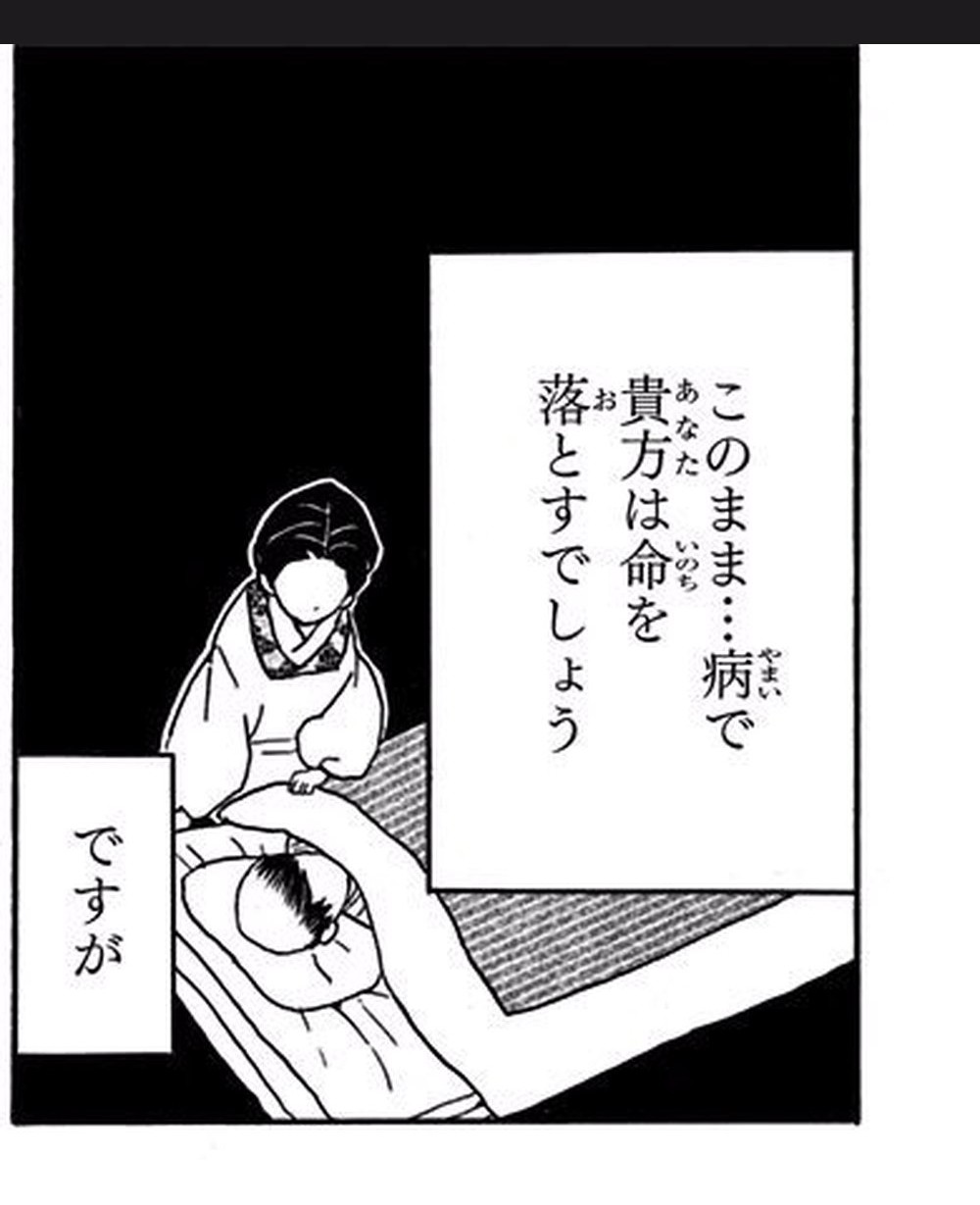
Volume 3. Tanjiro and Nezuko have just met Tamayo and her attendant Yushiro — a demon doctor who broke from Muzan centuries ago and now spends her stolen years hunting a cure for demonhood, funded by an unusual practice: she finds the dying, offers them a controlled version of the same transformation that ruined her own life, and keeps them alive — weak, caged, adjusting — in exchange for their blood. Before Tanjiro can fully process what he's looking at, Tamayo lays out the arrangement to a patient in the same brisk, formal register she'd use with any stranger:
「このまま…病で貴方は命を落とすでしょう」
Kono mama… yamai de anata wa inochi o otosu deshō.
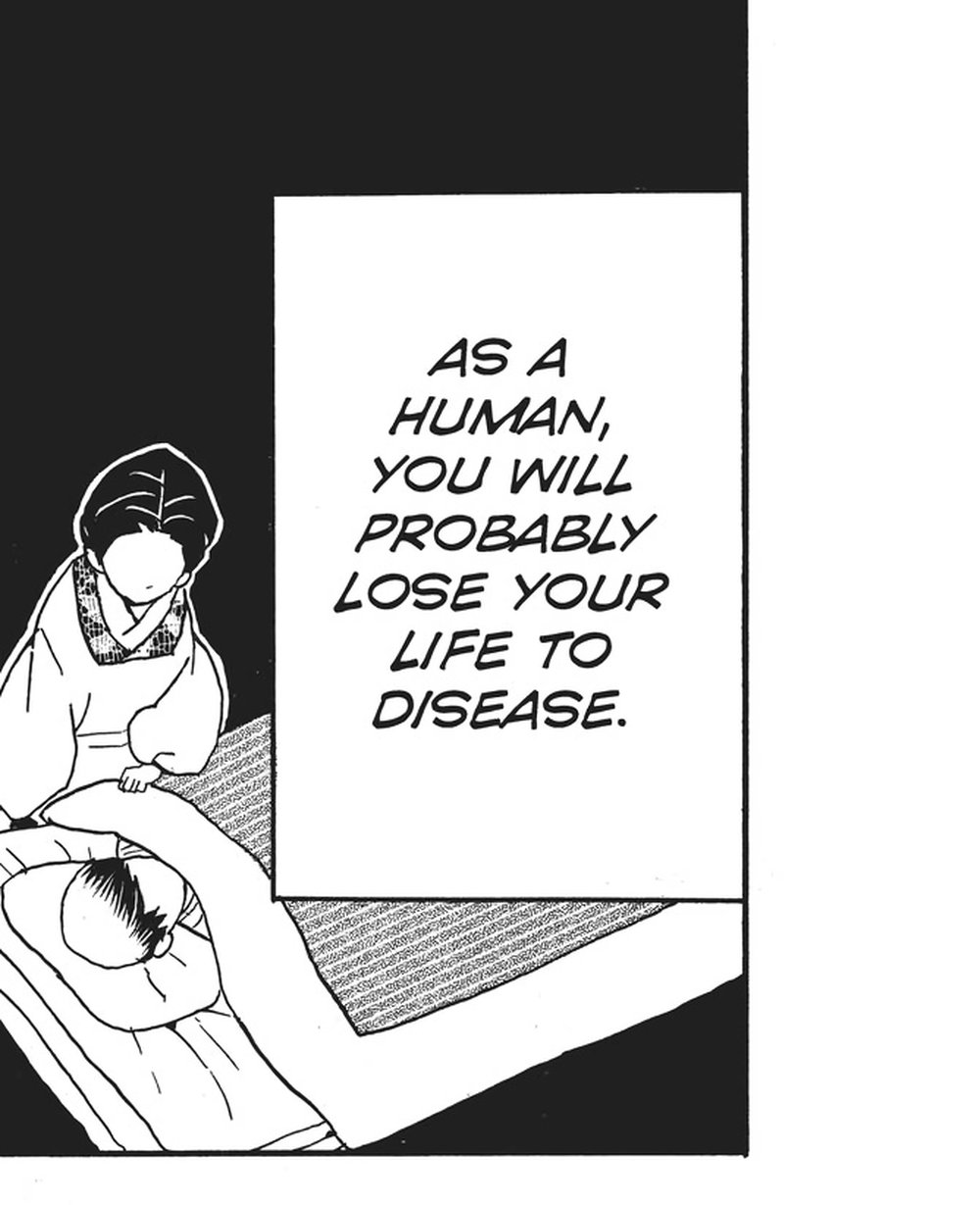
VIZ's English edition prints: "AS A HUMAN, YOU WILL PROBABLY LOSE YOUR LIFE TO DISEASE." (Vol. 3, p.59.)
Grant the rendering its due: it's accurate, clean, and does exactly what a diagnosis should do — delivers bad news without flinching. "Probably" catches でしょう's hedge; "as a human" catches このまま's implicit fork in the road, stay-as-you-are versus become-what-I'm-offering. Nothing here is wrong.
What's invisible is a choice Tamayo made before she opened her mouth. She is not this patient's friend, not their family, and — this being the kind of pitch she has clearly made before, to strangers pulled off the street and out of sickbeds — almost certainly not someone whose name she has any standing to use yet. She doesn't reach for one. She reaches for 貴方 (anata) — polite, correct, and just formal enough to keep doctor-and-patient distance intact even while she is offering to remake this person's entire existence. "You" carries none of that calculation. It is the word any English speaker would default to here regardless of how well they knew their patient, because English never makes them answer the question Japanese just quietly answered.
The Original
Take 貴方 apart, because both halves are doing real work.
貴 (ki) means "noble, precious, valuable" — the same 貴 in 貴族 (kizoku, "aristocracy"), 貴重 (kichō, "precious"), and 貴社 (kisha, the deferential "your esteemed company" that opens a Japanese business letter).
方 (kata / hō) means "direction, way" in its plain sense — but it moonlights as a polite way of referring to a person without naming them: あの方 ("that person," respectful), お二方 (o-futa-kata, "the two of you," respectful). Put the two together and 貴方 reads literally closer to "that noble direction" than to "you": rather than pointing at the person, or using their name, the word gestures at the honored place where they happen to be standing.
That indirection isn't decorative — it's fossil. Historically あなた began life as a plain spatial deictic, "that way, over there," paired with こなた, "this way, near me," and only later narrowed from a direction into a person: the same slide that turned English's "your grace" or "your honor" into forms of address for a specific human being standing in front of you. Japanese simply kept the habit running long enough for it to calcify into the everyday, textbook word for "you."
And it really is the textbook word: 貴方/あなた is JLPT N5, one of the first ten pronouns and nouns any beginner course supplies, right beside わたし for "I." This is a small irony worth sitting with, because fluent native use is far narrower than any beginner course lets on. Japanese doesn't require an explicit subject, and when a speaker does need to address someone directly, adults overwhelmingly reach for a name plus title — 田中さん, 部長, 先生 — rather than any pronoun at all. Using 貴方 on someone whose name you know is a marked choice, not a default: courteous toward a stranger, cool or faintly accusatory between people who ought to know each other better, and — in exactly one famous domestic register, always spelled in hiragana — a wife's fond, old-fashioned way of getting her husband's attention: "dear." Stack the honorific 様 on top, 貴方様, and the word climbs again, out of ordinary courtesy and into the register of someone who is very afraid of the person they're addressing.
VIZ's Choice
We found roughly three dozen uses of 貴方/貴方様 across the volumes on file — far too many to table in full, so here is a deliberately mixed sample, chosen for how differently placed the speakers are along every axis that matters: power, fear, species, and how the scene ends.
| Vol. / p. | Speaker → Addressee | Japanese | VIZ English |
|---|---|---|---|
| 3 / 59 | Tamayo → a dying patient | このまま…病で貴方は命を落とすでしょう | AS A HUMAN, YOU WILL PROBABLY LOSE YOUR LIFE TO DISEASE. |
| 6 / 190 | An unnamed demon → Muzan Kibutsuji | 貴方様直々に手を下して戴けること | ...I WILL DIE BY YOUR OWN HAND. |
| 12 / 9 | Gyokko (Upper Rank 5) → Akaza (Upper Rank 3) | 私はもしや貴方がやられたのではと火が躍った… | I'D BEGUN TO THINK YOU WERE DEFEATED. |
| 15 / 166 | Tanjiro Kamado → Genya Shinazugawa | 俺も貴方を認めてないので! | I DON'T LIKE YOU EITHER! |
| 18 / 122 | Shinobu Kocho → Doma | 貴方の顔色全然変わってない | YOU'RE NOT SAD. NOT EVEN A LITTLE. |
| 22 / 92 (VIZ p.93*) | Tanjiro (channeling an ancestor's memory) → Yoriichi Tsugikuni | 貴方は価値のない人なんかじゃない!! | YOUR LIFE IS NOT WITHOUT VALUE! |
* The Japanese line sits on p.92; the corresponding page of the VIZ tankobon prints one page later, on p.93 — a small pagination drift in this stretch of Vol. 22, confirmed against both editions' page images. The Japanese and the English are still the same panel and the same line.
Six relationships, one pronoun, and almost nothing else in common. The dying demon kneeling before Muzan stacks the honorific 様 onto 貴方 and still isn't safe — two pages earlier she'd begged, 貴方様の血を分けて戴ければ, "if you could give me a little more blood," and been told 甚だ図々しい, "how very impudent, know your place," before he ends her anyway; her last line is gratitude for the privilege. Gyokko's 貴方 to Akaza is professional courtesy between two monsters who outrank everyone but each other — bowing, fretting over his colleague's health, using the same word a doctor uses on a patient because that is simply how junior demons are expected to address their superiors. Tanjiro's 貴方 to Genya is almost playful: Genya has just snarled 俺はテメェを認めてねえ ("I don't like you," with the gutter pronoun てめェ), and Tanjiro's polite 貴方 right back is a small, deliberate refusal to match his hostility — courtesy as a mild power move. Shinobu's 貴方 to Doma is the coldest of the six: she knows his name, she uses it elsewhere in the same scene, and choosing 貴方 instead — over and over, while she tells him exactly what she thinks of him — is a held-at-arm's-length control that never once breaks into a name, an insult-pronoun, or a raised voice. And Tanjiro's 貴方 to a vision of Yoriichi is reverence pointed at a legend two hundred years dead: too vast a figure to address any other way.
The Gap
"You" can't withhold a name. Every one of these six speakers has, or could easily reach for, a rougher, warmer, or more intimate way to refer to their addressee — お前, a name, 君, 貴様 — and every one of them picks 貴方 instead. In Japanese that's a visible decision, repeatable and countable, exactly the kind of thing a corpus search can surface thirty-four times. In English, "you" is the only door in the house; there's no way to show a translation-reader that a character walked past several other options to get here.
The politeness staircase collapses to one step. Name → -san → -sama → 貴方 → 貴方様 is a five-rung ladder of escalating distance and fear that the demons orbiting Muzan climb in real time, sentence by sentence, as the scene gets more dangerous for them. English's "you" doesn't have rungs. "I WILL DIE BY YOUR OWN HAND" is a strong, eerie line on its own, but it can't show that the speaker just reached one honorific higher than she would for an ordinary superior — because there's nowhere higher for "you" to go.
The word tells you who's afraid of whom, and English erases the direction. Every demon in this corpus who addresses Muzan reaches upward for 貴方様. Muzan, addressing them, never once reaches back — elsewhere in the same volume he calls his Twelve Kizuki 貴様, the hostile pronoun this hub has already covered as a One Piece villain's fighting word. Two pronouns, opposite ends of the same scale, sitting on either side of one relationship — and "you" flattens both directions into the same four letters, so the fear stops pointing anywhere.
What If
For the headline line, the menu and its prices:
- "As you are, I'm afraid this illness will take your life." — spells out the courteous hedge でしょう and 貴方 carry silently. Cost: "I'm afraid" is a politeness marker English needs stated outright, where Japanese folds it into word choice alone.
- "You will, in all likelihood, lose your life to this illness as a human being." — matches 貴方's clinical formality with equally formal English diction. Cost: stiffer aloud than the Japanese — more legal brief than bedside manner.
- "Staying human, you'll probably die of the sickness." — natural, economical spoken English. Cost: the courteous distance evaporates; this reads as a friend's blunt warning as easily as a doctor's diagnosis.
- Keep VIZ's line exactly as printed. The words were never wrong. Cost: no phrasing fix exists in English for a loss this structural — "you" simply cannot carry the information 貴方 is carrying, no matter how the sentence around it is rebuilt.
Take-away
貴方 is hard to translate not because it's rare or archaic but because it's ordinary — the first pronoun every learner meets — while carrying a social calculation English never asks its speakers to make. When a translation gives you "you" here and "you" there, the courteous distance is real; it's just been paid for in a currency English's pronoun system doesn't mint.
Three rules of thumb to carry off this page:
- When you meet 貴方, ask what a name would have cost the speaker to say instead — that unpaid cost is the meaning.
- Watch for the honorific ladder: name → -san → -sama → 貴方 → 貴方様. Each rung up is a rung further from safety, in either direction — reverence or terror.
- Remember which way the fear is pointing. In this corpus, 貴方様 climbs toward Muzan; 貴様 comes down from him. English's "you" cannot hold both ends of that rope at once.
For the hostile end of the same spectrum, see this hub's One Piece companion pieces: 貴様, from "your esteemed self" to a fighting word, てめェ, the floor of the register, おのれ, the self turned into a curse, and おぬし, the archaic "you" time wore smooth. Closer to home, Demon Slayer's own first-person half of this same puzzle is worth the detour: 小生, the bookish, self-effacing "I", おいら, the rustic "I" a trainful of country boys reach for, and 手前勝手, the doubled self hiding inside a word for selfishness. Together, I and you sketch the whole grid Japanese grammaticalizes and English collapses into two words. Or browse the full Demon Slayer translation notes index.
Every Japanese and English line quoted above is a byte-exact capture from the cited editions — 鬼滅の刃 Vol. 3–22 (Japanese) and Demon Slayer: Kimetsu no Yaiba (VIZ Media) at the corresponding panels — via our bilingual page database; see Sources below.