The Moment
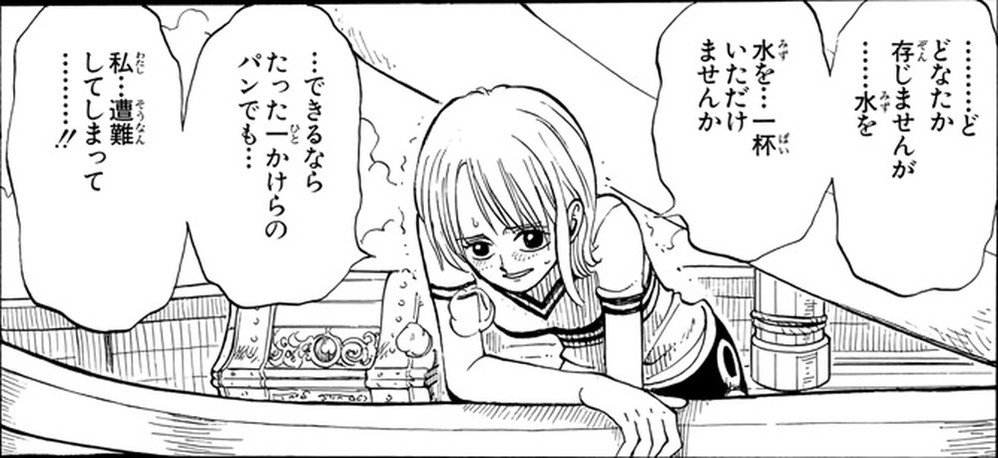
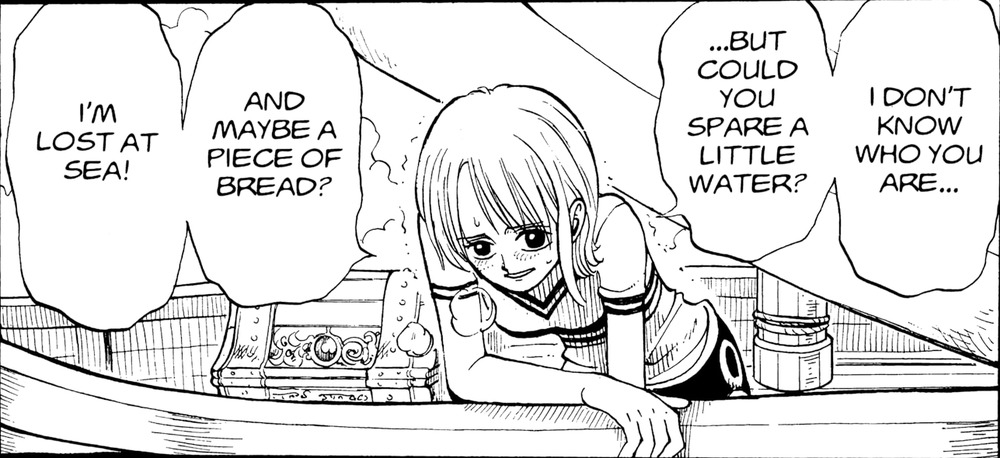
A raft, drifting on an empty sea. A crew of pirates rowing home from a raid spots a girl slumped over the gunwale of a wrecked boat, treasure chest beside her. She stirs, blinks, murmurs to herself that she must be dreaming — and then, before the men who just found her, delivers a line built entirely out of humility:
「......どどなたか存じませんが......水を 水を...一杯いただけませんか」
...Do— donata ka zonjimasen ga...... mizu o... mizu o... ippai itadakemasen ka.
VIZ's English edition prints: "I DON'T KNOW WHO YOU ARE... ...BUT COULD YOU SPARE A LITTLE WATER?" (Vol. 1, p.198).
The girl is Nami, and this is her introduction to the reader — not as a navigator, not as a thief, but as a performance. Buggy the Clown's pirates have no idea they've just been conned by a master, and neither, on a first read, does the audience. "I DON'T KNOW WHO YOU ARE" is a perfectly serviceable English sentence. It is also missing the exact grammatical machinery that makes the scene work: Nami isn't simply stating ignorance. She is performing deference, and Japanese has a verb built to let her do it in a single word.
The Original
That verb is 存じる (zonjiru) — the kenjōgo, humble, form of two separate plain verbs at once: 知る (shiru, "to know") and 思う (omou, "to think"). Where 召し上がる and いらっしゃる (covered elsewhere in this series) raise the person being talked about, 存じる does the opposite: it lowers the speaker's own mental state. 知っています becomes 存じております; 思います becomes 存じます. One humble verb absorbing two plain ones is already unusual — Japanese doesn't normally let a kenjōgo form freely straddle two distinct meanings — but 存じる gets away with it because both "knowing" and "thinking" are, at root, the same modest act: holding something in your mind and not presuming to assert it too loudly in front of someone else.
The kanji 存 does real etymological work here. It shows up in 存在 (sonzai, "existence") and 保存 (hozon, "preservation") — its core sense is "to exist, to be retained, to be held." Classical Japanese built a verb, 存ずる (zonzuru), directly on that sense: "to retain [an idea] in one's mind" — a deliberately understated way of saying "I am aware," softer than a flat claim to knowledge. Modern Japanese reshaped the conjugation into the ichidan-pattern 存じる, but the humility built into the kanji never left. Nami's line uses the negative: 存じません, "[I] do not [presume to] know." Grammatically it is a plain denial. Socially, it is a bow.
存じる belongs to a short, closed list of suppletive kenjōgo verbs — verbs that don't take a humble prefix or suffix but are simply different words standing in for the plain ones: 言う → 申す, する → いたす, いる → おる, 行く/来る → 参る・伺う, and 知る/思う → 存じる. These are the irregular workhorses of business Japanese, memorized as a set, tested explicitly through JLPT N2 — and 存じる is arguably the strangest of the family, because it is the only one that lowers a mental act rather than a physical or verbal one. Japanese keigo doesn't stop at what you do or say in front of a superior; it reaches all the way into what you're willing to claim you know.
That reach has a mirror image. 御存知 (gozonji) — usually written ご存知 — is built from the same 存 root, but it isn't a verb at all: it's a nominalized honorific, ご + 存知 ("cognizance"), used to raise the listener's or a third party's knowledge instead of lowering the speaker's. ご存知ですか — "Do you know?" (deferentially) — and ご存知の通り — "as you [already, of course] know" — are two of the most common honorific set phrases in Japanese customer-service and business speech. 知る therefore has three separate faces depending on who's doing the knowing and who's being addressed: 知っている (plain), 存じております (kenjōgo — I humbly know), ご存知でいらっしゃる (sonkeigo — you graciously know). One cognitive act. Three grammatically mandatory bows, pointed in different directions.
VIZ's Choice
Two clean occurrences of the 存じる family survive in the volumes on file — and between them they demonstrate both directions of the same verb root:
| Vol. / p. | Speaker | Japanese | VIZ English | Register |
|---|---|---|---|---|
| 1 / 198 | Nami, feigning helplessness to Buggy's pirates | ...どなたか存じませんが...水を | I DON'T KNOW WHO YOU ARE... | kenjōgo — lowers the speaker's not-knowing |
| 25 / 150 | Lafitte, to Vice Admiral Tsuru at Marine HQ | おや私の名などご存じで... | YOU KNOW MY NAME. | sonkeigo — raises the listener's knowing |
Both times, VIZ reaches for the same flat English verb, "know," and both times the choice is defensible: neither line is decorative, and forcing an archaic-sounding "I would not presume to know" onto a shipwrecked castaway, or a stilted "you are cognizant of my name" onto a smirking pirate, would read far worse than plain English does. But set the two rows side by side and the erasure becomes visible. In Japanese, these two lines are grammatical opposites — one lowers, one raises — built from the identical root. In English, they are the identical verb, twice. A reader who notices that "know" keeps recurring around moments of social calculation in this manga has no way to see, from the translation alone, that the grammar itself was flagging those moments the entire time.
The Gap
Nami's line is not really about ignorance — it's about status. 「どなたか存じませんが」 doesn't just mean "I don't know who you are." It performs not presuming to know — the humble disclaiming a stranger uses before making a request of someone whose rank she can't yet place. That's why the line doesn't stop there: it flows straight into 水を一杯いただけませんか, "could I humbly receive a cup of water" (いただく, the kenjōgo companion verb for receiving — already covered in this series' piece on 召し上がる's mirror form). Nami stacks two humble verbs back to back, and the effect is a girl radiating harmlessness at men who could easily decide she isn't worth saving. It works. They fall for it completely — and lose their ship, their treasure, and their pride to the same girl one page later. 存じません isn't a fact here; it's a weapon disguised as etiquette, deployed by the character who will spend the entire series doing exactly that.
Lafitte's ご存じ inverts the whole mechanism — and still isn't sincere. Told he's been recognized by name at Marine Headquarters, he doesn't answer with a plain 知ってるんですか ("oh, you know?"). He reaches for ご存じで — grammatically honoring Tsuru's knowledge, raising her cognition rather than lowering his own — while the surrounding おや…で trails off with dry, unbothered amusement. The honorific is technically correct and emotionally almost mocking: he's giving Tsuru the grammar she's owed by rank while making it obvious he isn't impressed. Exactly like 恐れ入る elsewhere in this cluster, the verb form doesn't tell you whether the speaker means it — only the scene does.
English "know" cannot mark direction, so both scenes lose their grammar's built-in commentary. Whose knowledge is being flagged as remarkable — the speaker's ignorance, or the listener's insight — is, in Japanese, a compulsory choice baked into which verb gets used. English "know" needs zero such choice; it works identically no matter who's doing the knowing. That's a real efficiency in English and a real loss in translation: two characters using grammar to manage a power gap collapse, on the page, into the same flat word doing the same flat job.
What If
- "...I couldn't say who you might be... but water — could I trouble you for a little water?" — "couldn't say" gestures at reticence rather than flat ignorance, closer to the humble disclaiming of 存じません. Cost: still reads as English politeness convention, not as grammatically marked deference the way the Japanese verb is.
- "Oh — so you're aware of my name." — swaps "know" for "aware," nudging toward the raised-register feel of ご存じ. Cost: "aware" isn't actually more formal in English; the honorific weight doesn't survive the substitution.
- Leaning on delivery instead of vocabulary: italicizing or otherwise marking the verb ("you know my name") to signal it's doing social work. Cost: typography can flag "this word matters" but can't specify which direction of politeness is in play — readers still can't tell raised from lowered.
- VIZ's actual choice, read as strategy: using plain "know" both times keeps the dialogue natural and unobtrusive — appropriate, since neither scene wants its prose to sound like a keigo textbook. Cost: the reader never learns that Nami's whole introduction, and Lafitte's whole introduction, are staged partly through the choice of verb form, not just the words around it.
Every option pays the same tax: English "know" has no honorific slot to spend from, so a translator can gesture at formality with word choice, but can't reproduce a grammatical fact — that Japanese requires you to specify whose knowing is being talked about, every single time the topic comes up.
Take-away
存じる is the strangest member of Japanese's small, closed family of kenjōgo substitute verbs, because it's the only one that reaches past action into cognition itself — Japanese won't even let you claim to know or think something in front of a superior without grammatically marking your own modesty first. Its honorific mirror, ご存じ, does the identical job in the opposite direction, raising someone else's knowing instead.
Three rules of thumb to carry off this page:
- 知る has three grammatical faces, not one. 知っている (plain), 存じております (I humbly know), ご存知でいらっしゃる (you graciously know) — the same fact about the world, three different social postures, chosen every time someone in Japanese says "know."
- 存じる folds 知る and 思う together on purpose. When a humble verb refuses to distinguish "know" from "think," that vagueness is often doing useful work — softening a claim, avoiding overcommitment — not just economizing vocabulary.
- Kenjōgo can be sincere, or it can be a con. Nami's 存じません is a disguise; Lafitte's ご存じ is a shrug wearing a bow. The verb form marks the social move, not the speaker's true feelings — that's always left to the scene.
This piece closes the keigo cluster opened by 召し上がる and the deference English can't conjugate, continued in いらっしゃいませ and the sonkeigo greeting VIZ turned into "Welcome, squid-face", and carried forward in 恐れ入る and the humble verb English splits four ways — four flagship verbs from the same textbook chapter, four different ways Japanese grammar tracks who bows to whom, none of which English's plain verbs can conjugate for. More translation notes at the One Piece translation notes index.
Every Japanese and English line quoted above is a byte-exact capture from the cited editions — ONE PIECE Vol. 1, 25 (Japanese) and One Piece Vol. 1, 25 (VIZ Media) at the corresponding panels — via our bilingual page database; see Sources below.