The Moment
One Piece Vol. 4, the Syrup Village arc. For three years, the butler Klahadore has served the orphaned heiress Kaya with a devotion the whole household takes for granted. The page just above this one shows the old head butler, Merry, presenting Klahadore with a gift: eyeglasses Kaya had specially designed for him, to mark the exact anniversary of his arrival at the estate. Klahadore takes them — and calmly crushes them in his hand.
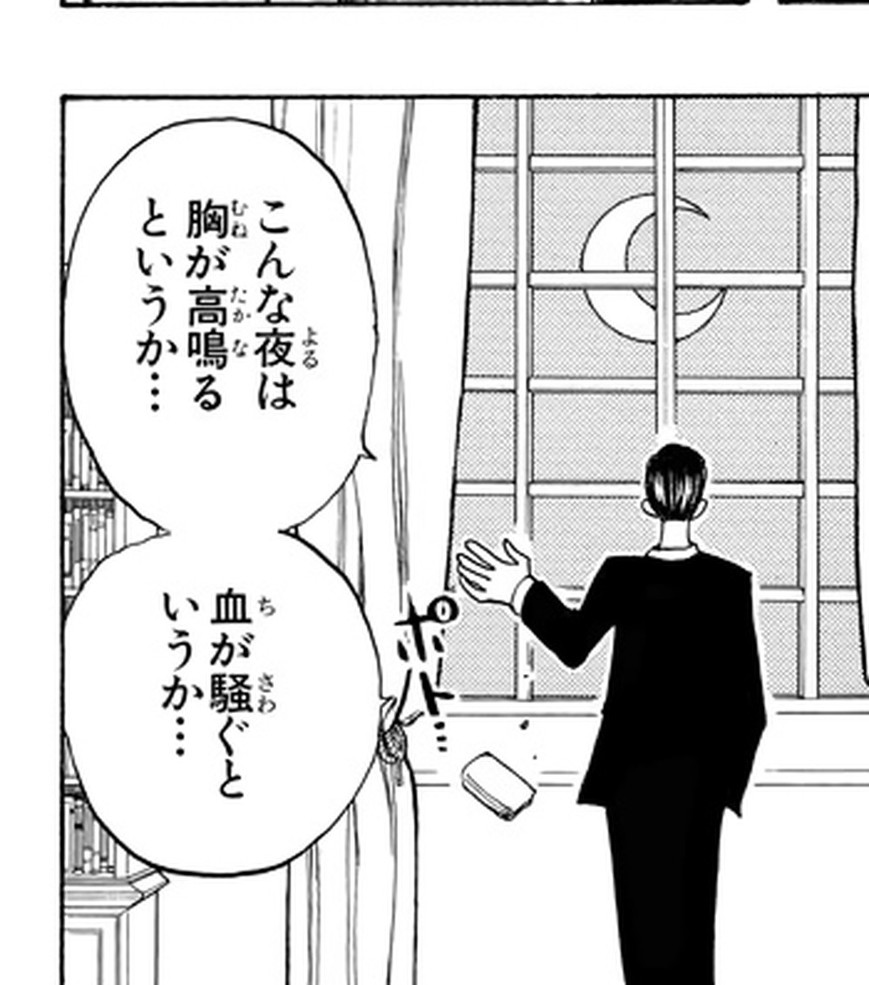
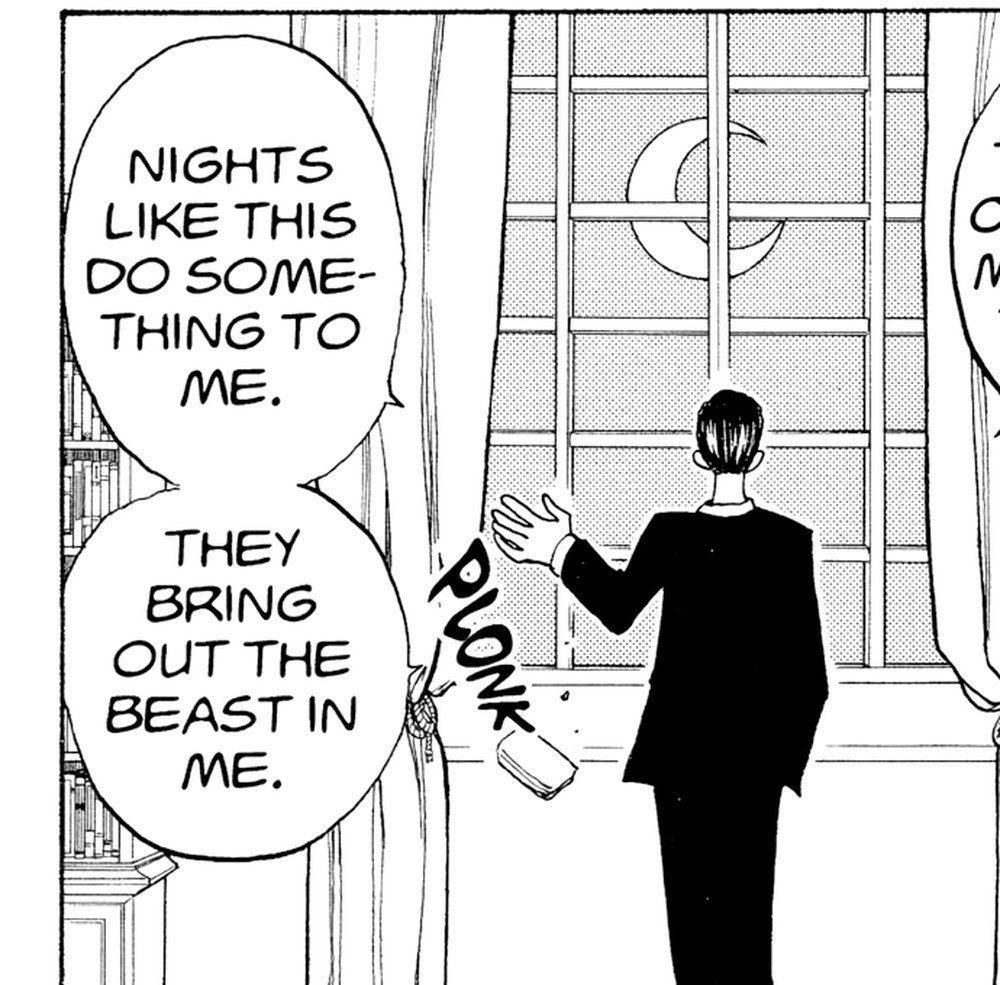
Alone afterward, his back to the reader, he stands at a tall window. A crescent moon hangs outside. The broken glasses fall from his fingers ("PLONK" — パサ/ポト in the sound effects), and for the first time in the story, the mask comes down — not yet by name; "Klahadore" is still the only name on this page. He murmurs, almost to himself:
「こんな夜は胸が高鳴るというか…」
Konna yoru wa mune ga takanaru to iu ka…
and then, a beat later:
「血が騒ぐというか…」
Chi ga sawagu to iu ka…
VIZ's English edition prints: "NIGHTS LIKE THIS DO SOMETHING TO ME. THEY BRING OUT THE BEAST IN ME." (Vol. 4, p.35).
Grant the rendering its due first: it is genuinely creepy, it reads naturally as English dialogue, and it does the scene's real job — this is the reader's first hint that Kaya's devoted butler is someone else entirely, and both English lines land as menace. But listen to what the Japanese is actually built from. Two different body parts, two different verbs, two different physical images — a chest that rings and blood that riots — collapsed into one generic mood: something is happening to me, and it's bringing out a beast. The picture underneath the feeling is gone.
The Original
Take the first idiom apart. 胸が高鳴る is 胸 (mune, "chest") + が (subject marker) + 高鳴る, itself a fusion of 高い (takai, "high; loud") and 鳴る (naru, "to sound, to ring, to cry out") — the verb you'd use for a struck bell, a ringing telephone, a crying bird. 高鳴る literally means "to peal loudly, to throb" — not the drumbeat English reaches for ("heart pounds," "heart races," both motion-metaphors) but a bell-image: the chest as something struck that rings out on its own, announcing an excitement before the speaker has even named what it's for.
A breath later, the second idiom: 血が騒ぐ. 血 (chi, "blood") + が + 騒ぐ (sawagu, "to be noisy, to clamor, to riot") — the verb for a rowdy crowd, a churning sea, a room in an uproar. Where English's "blood boils" or "blood's up" borrows a heat metaphor, 騒ぐ borrows a crowd-noise metaphor: the blood isn't getting hotter, it's getting loud and unruly, like a mob packed too tight.
Both idioms are fixed collocations, not productive grammar — 高鳴る almost always attaches to 胸 or 心 (heart/chest), and this sense of 騒ぐ almost always attaches to 血. You cannot swap in a different loud body part and expect the phrase to still mean "excited"; the vocabulary is frozen in place. As vocabulary, 高鳴る sits around N2 — a word textbooks introduce later than its cousin 躍る (odoru, "to dance," as in 胸が躍る) — while 騒ぐ itself is basic N4 vocabulary, with this idiomatic, body-noun-plus-騒ぐ sense worth flagging on its own.
Grammatically, the line is barely a sentence at all: [NOUN] が [VERB] というか…, "[X] does [Y], I suppose…" 「というか」 (to iu ka) is a hedge — "or you might call it," "I guess you'd say" — the connective tissue of someone testing out language for a feeling rather than confidently naming it. Repeated identically across both lines, it builds a rhythm: statement, softener; statement, softener. That rhythm is doing as much work as the vocabulary.
VIZ's Choice
There is only one occurrence of 胸が高鳴る in the corpus on file, so there's no scatter-table to build — but the single scene rewards close reading precisely because it pairs two idioms, and VIZ makes two different kinds of choice for them.
For 「こんな夜は胸が高鳴るというか…」, VIZ writes "NIGHTS LIKE THIS DO SOMETHING TO ME." This is a subtraction: the bell-image is gone, and "do something to me" is deliberately, almost clinically vague — which actually echoes というか's hedging tone reasonably well. The speaker doesn't fully know what to call this feeling either way.
For 「血が騒ぐというか…」, VIZ writes "THEY BRING OUT THE BEAST IN ME." This is not a subtraction — it's a substitution. "The beast in me" is a real, specific image, just not the Japanese one. 騒ぐ describes noise and disorder (a crowd, a stormy sea); it never suggests a caged animal waiting to get out. VIZ has reached for a stock English idiom of suppressed-monster-within, which is vivid and on-brand for a villain reveal, but it points the reader's imagination somewhere the original text doesn't: toward Klahadore-as-monster, rather than Klahadore's-own-blood-getting-rowdy. It's the rarer move in this hub's case files — not flattening an image away, but trading it for an unrelated one that happens to read well.
The Gap
The bell disappears without a trace. 高鳴る's core image — the chest as a struck gong, ringing out before the speaker can explain why — has no equivalent in "do something to me." The English keeps the mystery but drops the machinery that produces it.
The crowd becomes a monster. 騒ぐ's noisy-mob image is swapped for "the beast in me" — an interior-monster metaphor the Japanese never uses. Klahadore isn't describing an animal hidden inside himself; he's describing his own blood behaving like an unruly crowd. The English image is compelling, but it's a different image telling a slightly different story about what kind of danger he is.
The searching hedge vanishes. というか, repeated twice, marks a man testing out language for a feeling he hasn't catalogued before — not performing a line, but privately, almost curiously, taking his own emotional temperature. Two flat English declaratives read as a confident villain aside instead, losing the sense that this is Kuro's own quiet, dawning self-recognition.
The idiom's normal warmth goes unheard. 胸が高鳴る is, in ordinary Japanese, romantic-comedy and sports-manga vocabulary — the night before a trip, the first minutes of a date, a big match about to start. A reader who knows the idiom's usual home feels a specific chill seeing it repurposed here, for pleasure at planned murder. An English reader meeting only "do something to me" gets ominous atmosphere, but not the particular irony of borrowed, wholesome vocabulary turned to a killer's use.
What If
For the pair, the menu and its prices:
- "Nights like this... my chest rings out, I suppose... My blood starts to riot, I suppose..." — keeps both body-images (bell, crowd) and the doubled hedge. Cost: "my chest rings out" asks English to do unfamiliar metaphor-work that VIZ's smoother prose spares the reader.
- "A night like this gets my heart pounding... gets my blood up..." — trades Japanese's bell/crowd images for English's own native body-idioms, keeping the parallel two-beat structure and a natural dialogue rhythm. Cost: "blood up" reads more like a boxer's pre-fight buzz than a killer's dawning bloodlust.
- "Nights like this... my heart rings a little, doesn't it... and the blood starts to clamor..." — the closest image-for-image match available. Cost: "clamor" is stiff, literary English for a private murmur, and "rings a little" undersells what 高鳴る is doing.
- Keep VIZ's mood, restore the hedge: "Nights like this — they do something to my heart, I suppose... Stir something up in my blood, I suppose..." — Cost: still no bell/crowd image, but at least the searching, not-yet-named quality of the original survives.
Every option trades something. The bell and the crowd are a package deal in Japanese; English has to choose between keeping the pictures and keeping the naturalness.
Take-away
胸が高鳴る isn't hard because it's rare — it's hard because English's heart-excitement vocabulary runs on a completely different metaphor (percussion and motion) from Japanese's (sound and bells), and losing that metaphor loses the specific texture of the feeling, even when the mood survives intact.
Three rules of thumb to carry off this page:
- When you meet 高鳴る, listen for what it's normally attached to — 胸 or 心, almost nothing else — and ask what kind of anticipation the scene is borrowing: is it the idiom's usual warm home, or is someone using warm vocabulary for something cold?
- Don't let 騒ぐ's body-idiom sense (血が騒ぐ) blur into a heat metaphor — it's a noise verb first, the same 騒ぐ you'd use for a crowd or a stormy sea, and that noise-image is worth protecting in translation.
- Track というか as a hedge, not filler — a speaker reaching for it twice in one breath is a speaker who isn't sure of his own feeling yet, which is character information a flat declarative sentence throws away.
This scene sits in the same body-idiom territory this hub has mapped from other organs — the gut that does the understanding in 腑に落ちない, the liver English relocates in 肝っ玉, and the missing blood and tears of 血も涙もない. 血が騒ぐ itself turns up again as a companion idiom on two other hubs in this project — this project's Naruto and Demon Slayer coverage of 武者震い and 腕が鳴る both list it as a sibling expression — though its full, dedicated treatment waits for a future piece. For more of this hub's work on the body as metaphor, browse the One Piece translation notes index.
Every Japanese and English line quoted above is a byte-exact capture from the cited editions — ONE PIECE Vol. 4 (Japanese) and One Piece Vol. 4 (VIZ Media) at the corresponding panel — via our bilingual page database; see Sources below.