The Moment
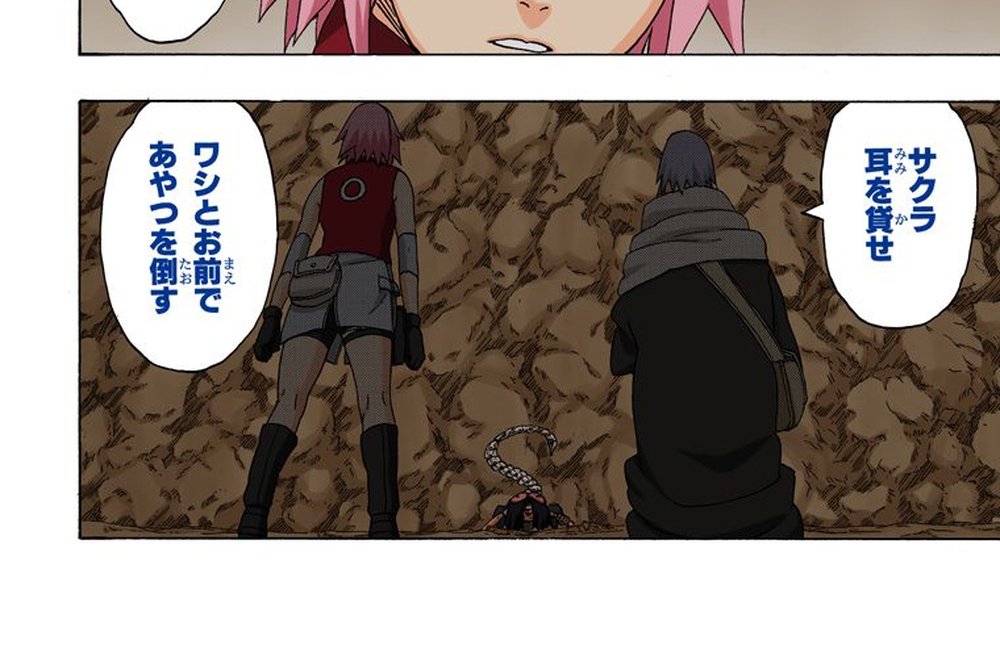
The fight against Sasori is going Chiyo's way. The retired Sunagakure elder has already landed the opening blow — 「先手は打った」, "I've already made my first move" — and a broken puppet-body lies cast off at her and Sakura's feet, one of the many shells the puppeteer fights from. Chiyo has just finished needling her own résumé — 「実戦経験はあやつの比では無い」, "his combat experience doesn't even compare to mine" — when she cuts herself off mid-boast:
「それに...じゃ サクラ耳を貸せ」
Sore ni… ja. Sakura, mimi o kase.
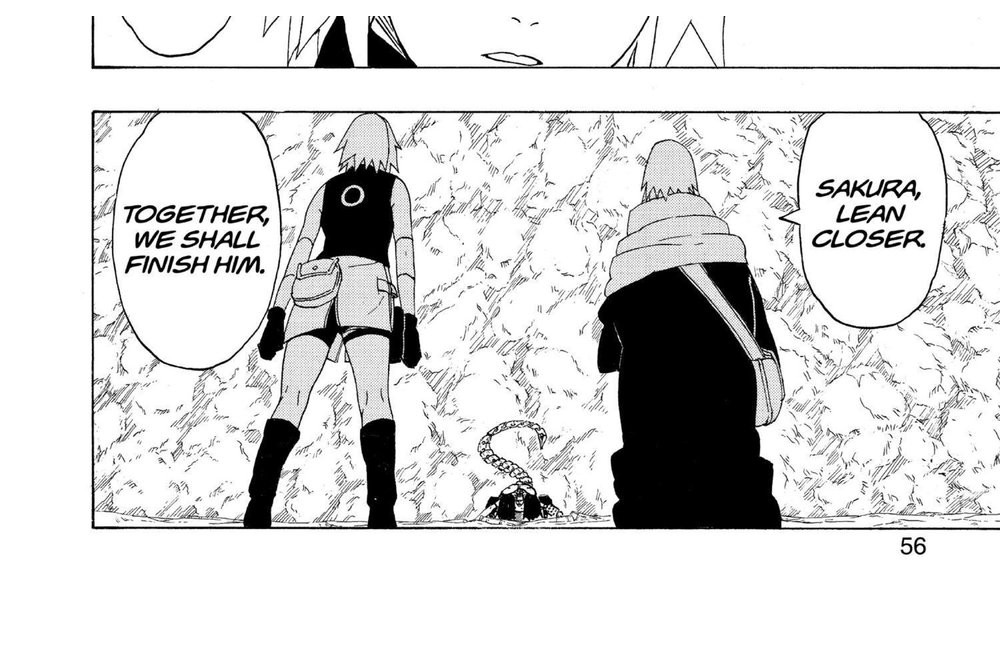
VIZ's English edition prints: "BESIDES… SAKURA, LEAN CLOSER." (Vol. 30, p.56).
Grant the rendering its due first: "lean closer" is clean, immediate, and it matches the art panel for panel — Chiyo and Sakura are drawn standing shoulder to shoulder, backs to the reader, exactly the blocking the English describes. Nothing about "LEAN CLOSER" is wrong. But listen to what the Japanese actually says. 耳を貸せ is not a stage direction about posture. It is the imperative of 耳を貸す, "to lend an ear" — and English owns that idiom too, word for word, going back at least as far as Shakespeare's Mark Antony asking Rome to "lend me your ears." VIZ had the equivalent sitting one drawer over and reached past it for blocking instead.
The Original
耳 (mimi) needs no unpacking — it's just "ear," plain and unglossed. The verb is where the idiom lives: 貸す (kasu), "to lend." Take the kanji apart and it tells on itself: 貸 is built from 代 ("in place of; substitute") stacked over 貝 ("shell") — the old cowrie-shell radical that also anchors 買う ("to buy"), 費 ("expense"), 貯 ("to save/store"), and 財 ("wealth"). Japanese filed "lending" in the same cabinet as buying and spending long before anyone used 貸す for something as intangible as attention. So 耳を貸す, read literally, asks you to hand over your ear the way you'd hand over a book or an umbrella: a possession, temporarily transferred, with the faint social expectation that the loan gets honored — or even repaid.
The grammar is nothing exotic. 貸せ is the bare imperative of a godan す-verb: 話す → 話せ, 貸す → 貸せ, the same shape that produces 黙れ ("shut up") and やめろ ("stop it"). Zero politeness, maximum urgency — the form of someone who does not have time to say ください. As vocabulary, 貸す is elementary, N5, one of the first transitive verbs any learner drills. But 耳を貸す as a fixed idiom — rather than the faintly absurd image of literally detaching an ear — belongs a tier higher, the everyday-idiom bracket most learners meet around N3: it surfaces in casual requests (「ちょっと耳を貸して」, "got a sec?"), in reporting about officials "lending an ear" to grievances, and in complaints about people who won't (「人の話に耳を貸さない」). Grammar-simple, register-common — and, crucially, structurally identical to an idiom English has owned for centuries.
VIZ's Choice
耳を貸せ appears twice in this volume, barked by two different mentors at two different students in structurally identical scenes — a veteran issuing a clipped battlefield command, immediately followed by a plan:
| Vol. / p. | Speaker → Addressee | Japanese | VIZ English |
|---|---|---|---|
| 30 / 56 | Chiyo → Sakura | サクラ耳を貸せ | SAKURA, LEAN CLOSER. |
| 30 / 183 | Kakashi → Naruto | 今までの話が飲み込めたら耳を貸せ | IF YOU'RE WITH ME SO FAR, THEN STAY CLOSE. |
Eleven pages after Chiyo's line, Kakashi — mid-sprint through the trees with Naruto, tracking an Akatsuki operative who slipped alone into Sunagakure and got past Gaara — lays out the situation, then closes with the identical imperative: 「今までの話が飲み込めたら耳を貸せ」, "if you've followed the story so far, lend an ear." VIZ: "IF YOU'RE WITH ME SO FAR, THEN STAY CLOSE."
Same fixed idiom, same sentence-final imperative, same command structure — a mentor telling a junior to draw near before delivering the plan. And VIZ solves it the same way both times: not with the idiom, but with a different physical verb each time. "Lean closer" answers a scene where two people are standing still and someone might overhear. "Stay close" answers a scene where two people are moving fast and might lose each other. Both choices are locally smart — they synchronize the caption with exactly what the art is already showing. But the price of that smartness is consistency: a Japanese reader catches the rhyme between Chiyo's order and Kakashi's order instantly, because it's the same four syllables. An English reader gets two unrelated sentences and never learns the rhyme existed.
The Gap
The idiom was available and went unused — twice. This is not a case of English lacking the concept. "Lend an ear" is arguably the single closest lexical match in this whole series of pitfall articles: same verb (lend/貸す), same body part (ear/耳), same underlying logic (attention as a loan). VIZ had it in reach on page 56 and again on page 183, and chose blocking language both times.
The favor collapses into a direction. "LEAN CLOSER" and "STAY CLOSE" describe where a body should be. 耳を貸す describes what a person is willing to give. The Japanese line asks Sakura for something — her attention, extended as a kindness mid-fight, from a superior who nonetheless has to ask for it with 貸せ rather than simply assuming it. The English line asks nothing; it just repositions her.
The cross-volume echo disappears. Two mentors, two students, one identical idiomatic command, eleven pages apart — a structural fingerprint that only survives if the English translation stays as fixed as the Japanese. "Lean closer" and "stay close" share no vocabulary, so the fingerprint is gone before an English reader could ever notice it.
The transaction goes quiet. 貸す's whole point is that this is a loan, not a gift — 貸し借り, the ledger of favors Japanese social life runs on. "Lend an ear" in English has the same DNA, worn smooth by centuries of use but still technically there if a translator wanted to lean on it. Stage-direction English skips the ledger entirely; nobody in the English edition owes anybody an ear.
What If
The menu, and what each option costs:
- "SAKURA, LEND ME YOUR EAR." — the idiom transplants almost perfectly, keeps the loan structure, and even carries a faint Shakespearean resonance as a bonus. Cost: reads a touch bookish for a battlefield bark — Mark Antony's cadence dropped into a shonen panel.
- "SAKURA, LISTEN UP." — plain, contemporary, keeps the imperative's urgency. Cost: drops both the idiom and any trace that 貸す frames listening as a favor rather than a duty.
- "SAKURA — EAR, NOW." — clipped, keeps the body part front and center, matches Chiyo's brusque register. Cost: unnatural English; nobody talks this way, so it reads as translator flourish rather than a real command.
- Keep VIZ's blocking note but restore the metaphor underneath: "SAKURA, LEAN IN — LEND ME YOUR EAR." — folds the physical staging and the idiom into one line. Cost: too long for a manga speech bubble; doubles the image instead of choosing one.
The deeper point: unlike most words in this series, where English simply has no seat for the Japanese concept, 耳を貸す is a case where the seat exists, upholstered and ready. The translator's choice here wasn't between "possible" and "impossible" — it was between two possible translations, and the idiomatic one lost to the staging-literal one.
Take-away
耳を貸す is a rare bird in this column: an idiom that survives the trip into English almost intact, verb and body part both — and got left behind anyway, twice, in favor of matching the caption to the artwork. That's not a translation failure so much as a translator's bet that "lean closer" reads faster in a speech bubble than "lend me your ear" does, even when the second option was sitting right there, Shakespeare and all.
Three rules of thumb to carry off this page:
- 貸す never simply gives — it lends. Whenever you meet 貸す attached to something intangible (耳を貸す, 力を貸す — "to lend a hand"), Japanese is quietly filing that intangible thing as a possession, extended on trust.
- 貸せ is a command with no cushion. The bare imperative of a す-verb turns any lending, however small, into an order. Watch for that register whenever an elder or superior uses it on a junior.
- When English already has the idiom, check whether the translator used it. Most of the words in this series have no English seat at all. 耳を貸す did — and the choice to skip it anyway is worth noticing precisely because it was a choice, not a necessity.
Elsewhere in Naruto, VIZ reaches for a ready-made English proverb without hesitation — see 出る杭は打たれる and the one proverb VIZ left alone — so borrowing a pre-built English phrase is clearly within the translator's toolkit; here, twice, it simply wasn't the tool chosen. Chiyo herself gets rerouted again a few volumes earlier, when her sensei-elder roar 問答無用 gets cut down to a single word — see the four-character verdict VIZ cut to one word. And for another battlefield command that relocates a body-idiom's organ rather than its metaphor, compare 肝に銘じる and the order VIZ rerouted to the muscles. Or browse the Naruto translation notes index.
Every Japanese and English line quoted above is a byte-exact capture from the cited editions — NARUTO―ナルト― Vol. 30 (Japanese) and Naruto Vol. 30 (VIZ Media) at the corresponding panels — via our bilingual page database; see Sources below.