The Moment
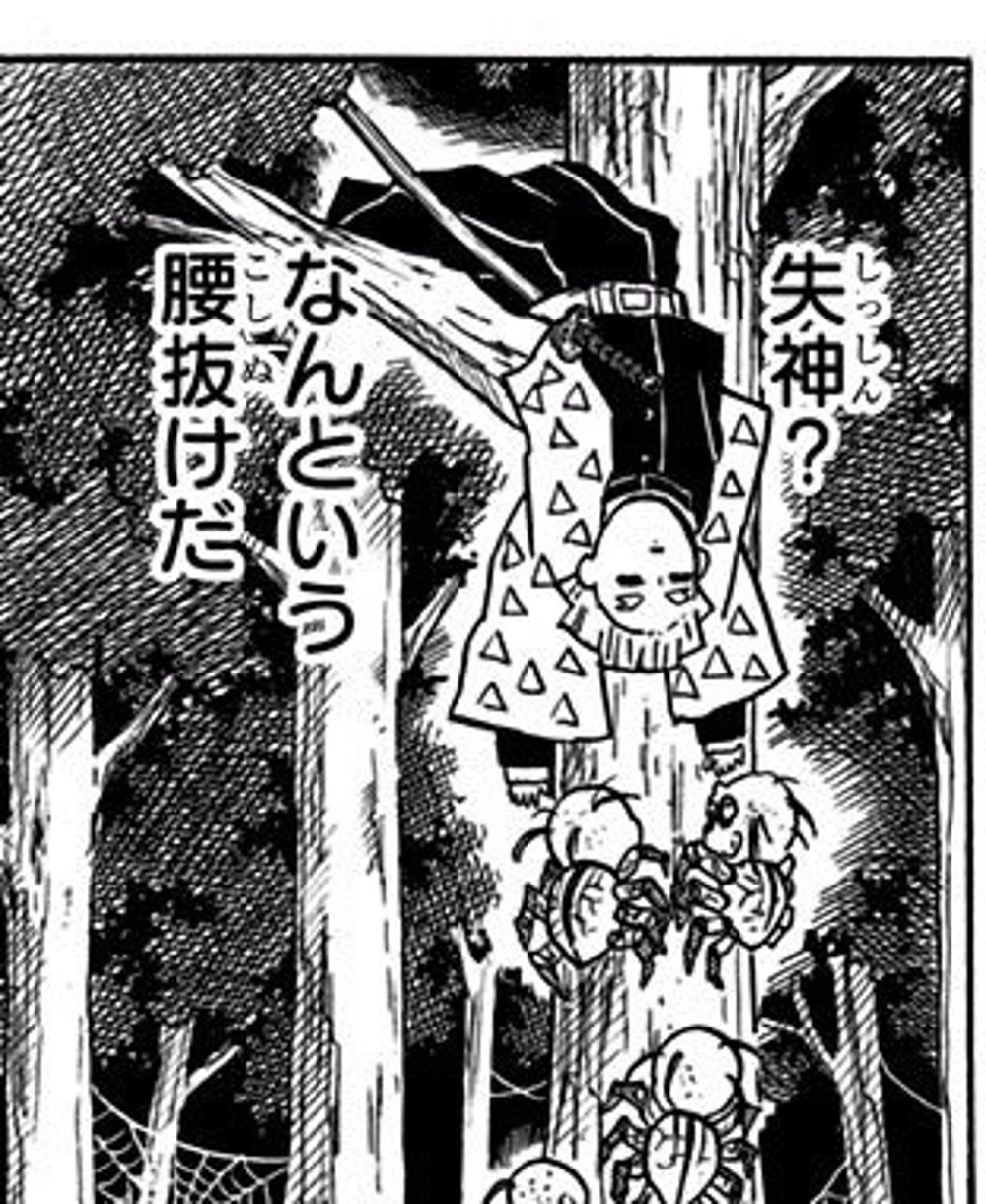
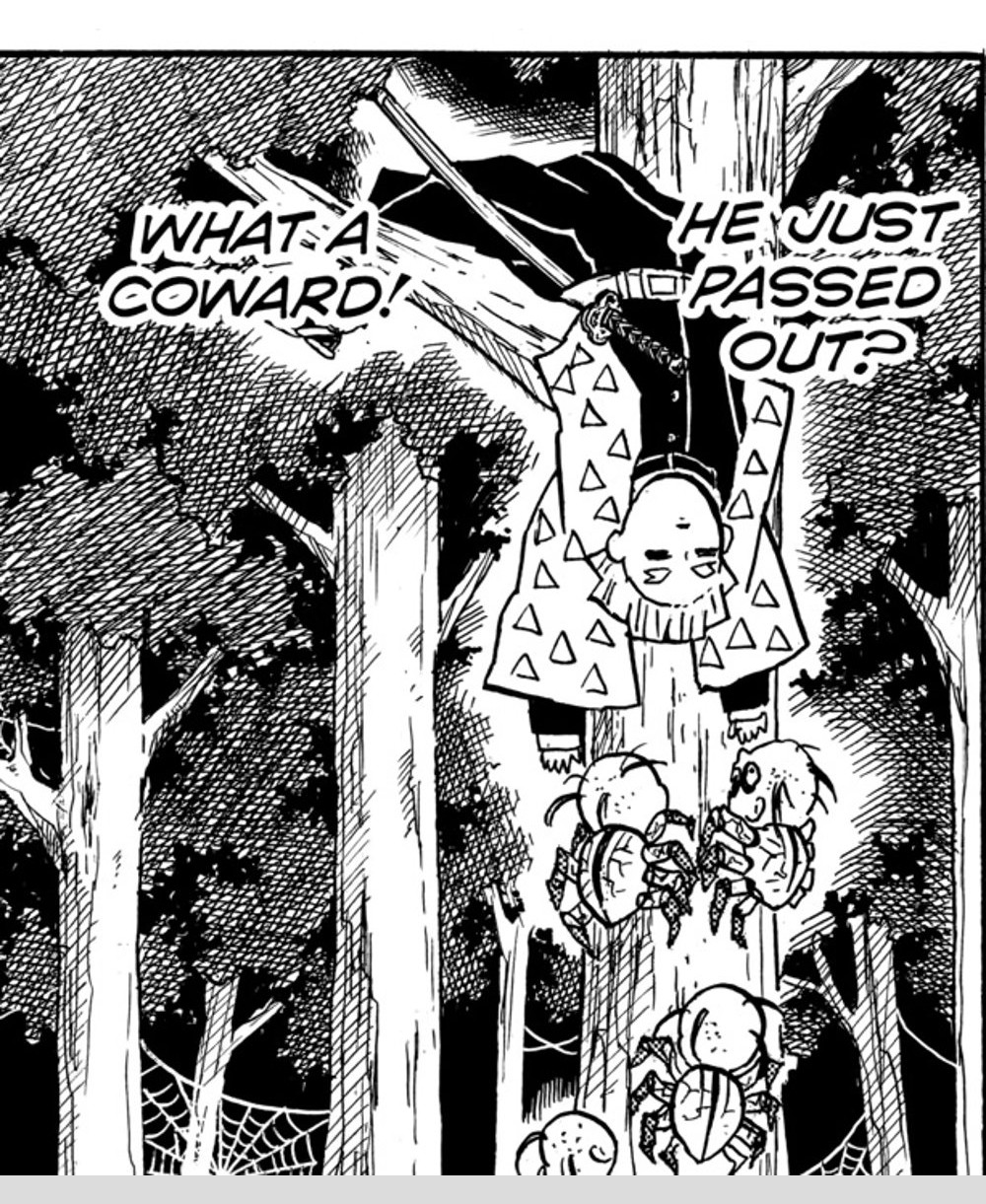
Volume 4, deep in the woods of Natagumo Mountain. Tanjiro's group has been sent to investigate a village terrorized by demon spiders, and the forest is already laced with webbing by the time anyone realizes they're being watched. Zenitsu Agatsuma — introduced a volume earlier as the party's self-declared coward, the one who begs to go home before every fight — has just been caught. The panel shows him strung up by silk thread, hanging upside down from a tree in his signature checked haori, eyes shut, a small speech balloon trailing off beside him: 「ぱうっ...」 ("OHHH..."). Small spider demons cluster below his dangling body and confer. One reads him a diagnosis — 「失神?」, "HE JUST PASSED OUT?" — and another delivers the verdict:
「なんという腰抜けだ」
Nan to iu koshinuke da
VIZ's English edition prints: "WHAT A COWARD!" (Vol. 4, p.157).
Grant the rendering its due first. "WHAT A COWARD!" is punchy, it fits a two-beat exclamation bubble, and "coward" is the first word any dictionary hands you for 腰抜け. Nothing here is inaccurate. What's missing is that 腰抜け is not a judgment about someone's character. It is a diagnosis of a body part — and the demon delivering it is, in effect, reading Zenitsu's hips, not his soul.
The Original
腰抜け takes apart cleanly into two pieces, and each is worth owning on its own.
腰 (koshi) is "hips, lower back" — not a minor body part in Japanese but the pivot of the entire physical-culture vocabulary. Martial arts, dance, even posture correction all run through 腰: 腰を入れる ("put your hips into it," commit your full weight to a stance or a swing), 腰高 ("hips riding high," the unstable stance of a beginner in judo or kendo). If Japanese has one physical seat of readiness, it's here, not the chest or the spine.
抜け is the noun form of 抜ける (nukeru), "to slip out, fall away, come loose, go missing" — the verb behind 気が抜ける ("the tension slips out": to let your guard down or lose focus) and 力が抜ける ("the strength slips out": to go limp, to lose the ability to hold yourself up). It is not a violent verb. Nothing tears or breaks; something that was properly seated simply stops being seated.
Put together, 腰抜け names a very specific failure: the hips have slipped their mount. It is the fossilized noun-form of a verb phrase, 腰を抜かす (koshi o nukasu), "to lose the use of one's hips" — the everyday idiom for the full-body collapse of shock, the instant the legs simply stop holding a person up and they sit down on the ground whether they meant to or not. Three volumes after this scene, the same verb phrase gets drawn out in full elsewhere in this hub: 「肝が据わっていると評判だった母はこの日人生初で腰を抜かした」 — "her mother, famous for steady nerve, lost the use of her hips for the first time in her life" (Vol. 14, p.164; see this hub's 肝が据わる・腰を抜かす article for the full panel, in which Mitsuri Kanroji's mother sits collapsed on the ground while baby Mitsuri toddles past with a fifteen-kilo pickling stone on her head). That is 腰を抜かす as a live event — a single, involuntary collapse. 腰抜け takes exactly that collapse and nails it to a person as a permanent trait: someone whose hips are presumed unreliable on a standing basis. Not "a coward" in the abstract — someone whose hips have already given out once, with everyone assuming they'll do it again. Grammatically the word carries no JLPT weight of its own (腰 is N5, 抜ける is N4), but the compound is common enough in shonen manga and schoolyard Japanese to sit comfortably in N2-territory by frequency, alongside its opposite number 腰が据わる.
VIZ's Choice
Both appearances of 腰抜け in the volumes on file, side by side:
| Vol. / p. | Speaker | Japanese | VIZ English |
|---|---|---|---|
| 4 / 157 | a spider demon, over the fainted Zenitsu | なんという腰抜けだ | WHAT A COWARD! |
| 7 / 14 | Aoi Kanzaki, to Tanjiro, at the Butterfly Mansion | …恐ろしくて戦いに行けなくなった腰抜けなので | ...SINCE THEN, I'VE BEEN AFRAID TO GO FIGHT, SO I'M A COWARD. |
The Naruto branch of this same idiom — covered in this hub's sister publication on 腰抜け across the Chunin Exams — turns up six times across four volumes and scatters into four different English words: "coward" twice, "losers" once, and the archaic "milksop" once, spoken by five different characters who never share a scene. Here, with only two occurrences on file, VIZ does the opposite: it converges. A demon jeering at an unconscious victim in Volume 4 and a young woman quietly confessing her fear to a friend in Volume 7 receive the exact same English word, down to the letter.
That convergence is worth sitting with, because it isn't obviously wrong — "coward" is accurate both times — but it is worth noticing what it costs. In Japanese, なんという腰抜けだ and …腰抜けなので are doing structurally opposite work: one is contempt hurled at a body that can't defend itself, the other is a confession offered by someone hoping to be believed rather than pitied. The identical noun sits at the center of both, but Japanese carries the difference in everything around it — the exclamatory なんという…だ frame versus the hedging …ので clause, the register of a demon's sneer versus a traumatized girl's apology. English's "coward," reached for twice without variation, keeps the verdict and loses the frame each time it was wrapped in.
The Gap
The mechanism disappears twice over. "Coward" names a character trait; 腰抜け names a joint that failed. English had body-based options on the very next shelf — "spineless," "gutless" — and both renderings on file reach past them for the fully abstract word instead. That's not a gap English is forced into; it's a gap the translator chose, twice.
One word erases two registers. A demon's public jeer at an unconscious victim and Aoi's private, apologetic self-diagnosis are opposite speech acts — mockery versus confession — and "coward" renders both without changing shape. An English reader flipping between Volume 4 and Volume 7 has no lexical signal that one line is cruelty and the other is grief.
The family resemblance goes dark. 腰抜け is 腰を抜かす frozen into a noun — the exact idiom this hub's kimo-ga-suwaru article documents through Mitsuri's mother, hips lost for the first time in her life at the sight of her own toddler. A Japanese reader who has met either idiom carries the image of failed hips into every later encounter with the other. "Coward" carries no hips anywhere.
English isn't as bodyless here as it looks — it just forgot. Most dictionaries trace "coward" through Old French coard back to Latin cauda, "tail" — very possibly the heraldic image of a lion drawn with its tail tucked between its legs, medieval shorthand for a beaten animal. English used to keep a body in this word too. The modern ear just can't hear it anymore, which is its own quiet argument for why 腰抜け's still-legible hips are worth preserving rather than flattening into the one word that already buried its own anatomy centuries ago.
What If
For Zenitsu's line, the menu and its prices:
- "SPINELESS!" — swaps hips for spine, English's own default courage-bone, so the insult keeps a body part instead of losing one outright. Cost: "spine" reads as failed posture or resolve, not the specific hips-buckling collapse the word diagnoses.
- "GUTLESS!" — belly-based, closer kin to Japanese's own 腰・肝・腹 courage-vocabulary than the fully abstract "coward." Cost: "guts" implies missing willpower more than a joint physically giving out.
- "HIS HIPS NEVER CAME BACK!" — closest to the literal event behind the word. Cost: far too long for a two-beat taunt; the fossilized-noun punch disappears into a full sentence.
- Keep "COWARD," but let the two occurrences diverge — "PATHETIC COWARD!" for the jeer, a plainer "...so I'm a coward" for Aoi's confession. Cost: doesn't restore the hips, but it would at least restore the emotional contrast the current identical wording erases.
Take-away
腰抜け is easy vocabulary hiding the same structural fault line this hub keeps finding in Demon Slayer's body idioms: Japanese locates failed nerve in a joint — the hips — while English locates the identical failure somewhere else entirely, and "coward" locates it nowhere at all. A translator reaching for the word isn't wrong about the meaning; they're just standing outside the body the Japanese never leaves.
Three rules of thumb to carry off this page:
- When a Japanese insult names a body part, ask which organ English would use for the identical judgment — spine, gut, liver — and notice it's never the hips. Different anatomy, same emotional job.
- 抜ける is a slipping-loose verb, not a breaking one. 気が抜ける, 力が抜ける, 腰が抜ける — nothing tears; something that was seated simply comes unseated.
- When one Japanese noun recurs across very different registers — a jeer, a confession — check whether the translation lets the difference show. Convergence on a single English word can quietly erase the contrast the scene depends on.
This is the noun-insult half of a pair already living on this hub: 肝が据わる・腰を抜かす traces the same collapsing hips through Mitsuri Kanroji's mother, the idiom 腰抜け is frozen from. For more of the series' body-idiom family, see 鼻が利く, the nose Tanjiro never has to brag about and 足を引っ張る, the leg-pull VIZ has to untangle from its English false friend. The hip joint travels further than this hub, too: Naruto carries its own 腰抜け, six occurrences spoken by five different characters, where VIZ's choices scatter into "coward," "losers," and the archaic "milksop" rather than converge the way they do here — and a One Piece 腰抜け entry, documenting the idiom's third appearance across Shonen Jump's biggest translated franchises, is in progress. Or browse the full Demon Slayer translation notes index.
Every Japanese and English line quoted above is a byte-exact capture from the cited editions — 鬼滅の刃 Vol. 4, 7 & 14 (Japanese) and Demon Slayer: Kimetsu no Yaiba (VIZ Media) at the corresponding panels — via our bilingual page database; see Sources below.