The Moment
Konoha is still smoking. A few pages earlier, the Third Hokage finished the Reaper Death Seal that cost him his life to stop Orochimaru; a few panels before that, a summoned snake was loose in the streets and even the shinobi trying to hold it back had to admit 手に負えん — "THIS IS OUT OF CONTROL!!" Then a giant kunai comes down out of nowhere and ends it in one blow. The rescued men look up to find out who just saved them:
「…自来也様…」/「白米也って…!あの三忍の!?」
…Jiraiya-sama…/Jiraiya tte…! Ano san-nin no!?
"...LORD JIRAIYA...!" / "'LORD JIRAIYA'...?! YOU MEAN HE OF THE THREE GREAT SHINOBI!?"
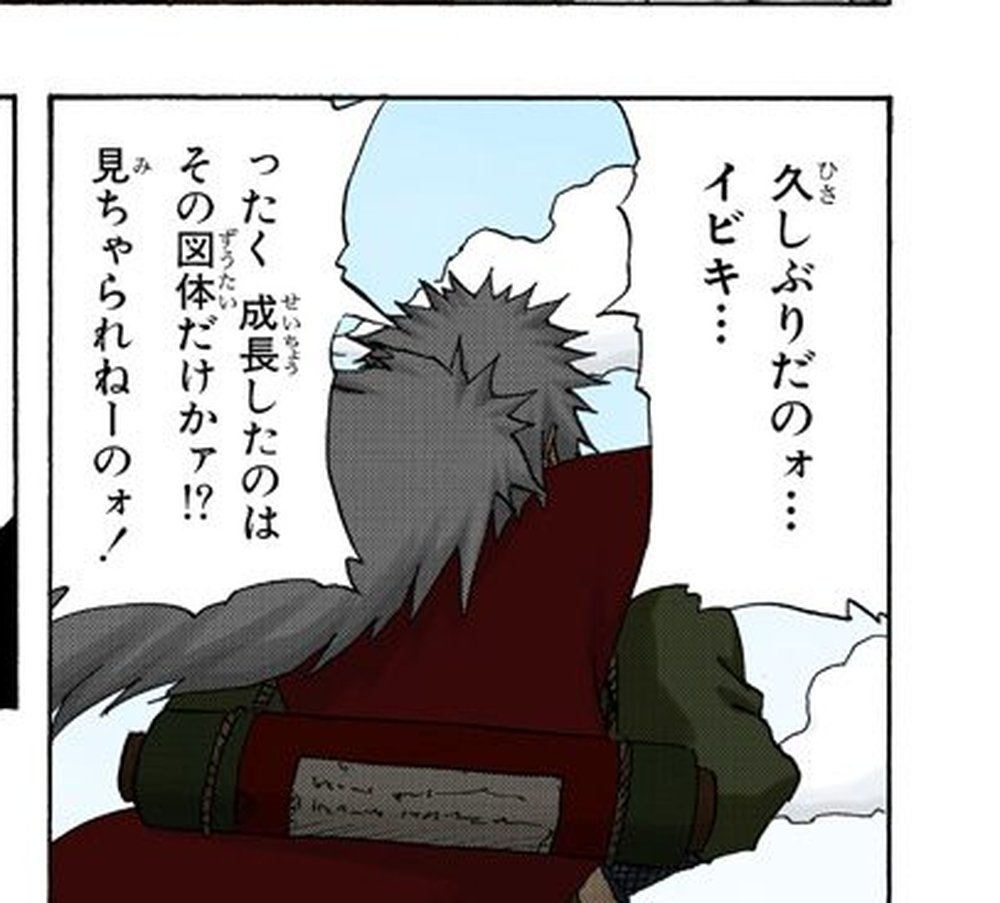
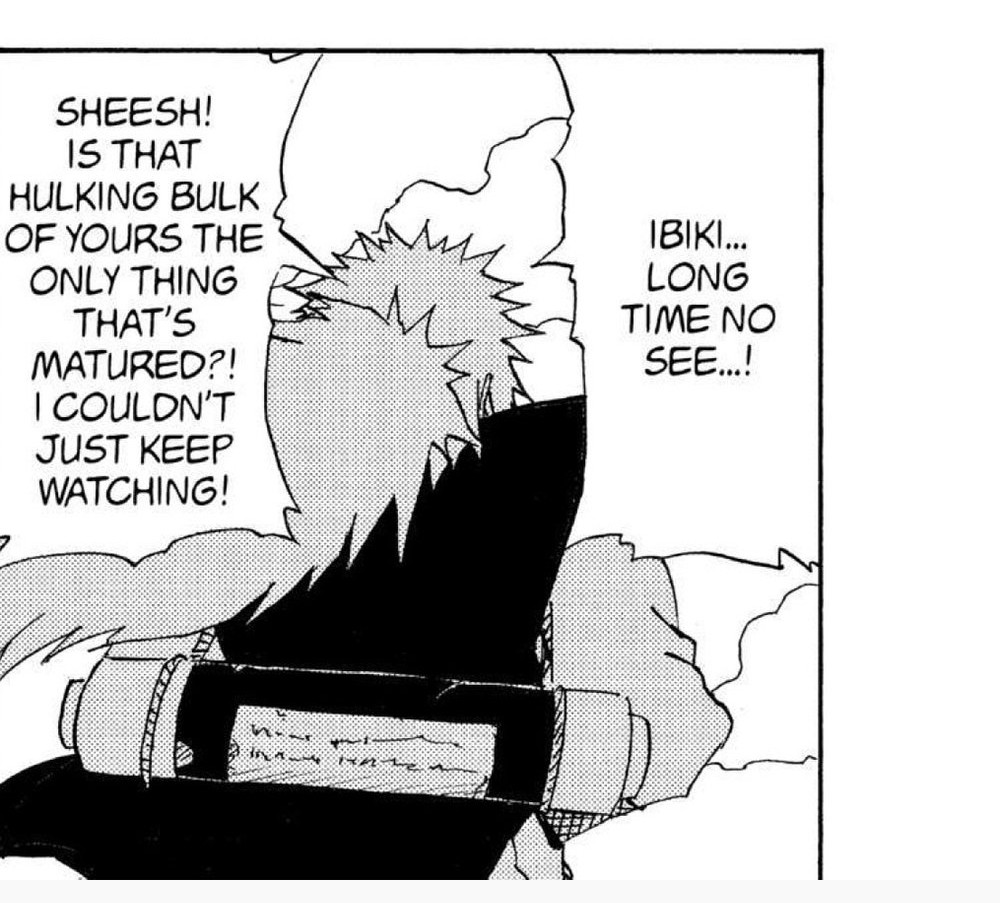
And Jiraiya, without turning around, giant scroll case still strapped to his back, greets the man he just pulled out of trouble:
「久しぶりだのォ…イビキ…」「ったく成長したのはその図体だけかァ!?見ちゃられねーのォ!!」
Hisashiburi da no… Ibiki…. Ttaku, seichō shita no wa sono zūtai dake kā!? Micharare nē no ō!!
VIZ's English edition prints: "IBIKI... LONG TIME NO SEE...!" and "SHEESH! IS THAT HULKING BULK OF YOURS THE ONLY THING THAT'S MATURED?! I COULDN'T JUST KEEP WATCHING!" (Vol. 14, p.129).
Grant the rendering its due, because this is the rare case in this idiom's file where it's earned. "SHEESH!" lands ったく's exasperated, old-timer register without strain. "I COULDN'T JUST KEEP WATCHING" is a clean, natural fit for 見ちゃられねーのォ, right down to its shrugging colloquial edge. And "HULKING BULK" — two words where the Japanese used one — actually does what 図体 does on its own: it doesn't just report Ibiki's size, it judges it. That is worth pausing on, because in this idiom's other appearances across three different manga, it's exactly what English keeps failing to do.
The addressee matters here too. Ibiki Morino heads Konoha's Torture & Interrogation Force — a job that runs on being the most physically unmissable, unshakeable presence in the room. Jiraiya just watched that presence get overwhelmed by a snake. The tease isn't idle; it's aimed at the one part of Ibiki's professional reputation that a rescue directly undercuts.
The Original
図体 (zūtai) looks, kanji by kanji, like 図 (zu, "a drawn figure, diagram" — the same 図 in 地図, "map") plus 体 (tai, "body"): "the shape a body draws." That's a fair surface reading, and a durable folk etymology — but word-origin dictionaries trace the word differently. 図体 is generally explained as ateji layered over a sound-shifted pronunciation of 胴体 (dōtai, "torso, trunk"): dōtai sliding toward zūtai in speech, with 図 attached afterward purely because it can be read zu, no more connected to "diagram" than the spelling of "could" is connected to "coal." Whichever account you credit — and both are worth knowing — usage settled the word into one narrow, well-worn lane: 図体 names a BIG body, and specifically a body whose bigness is the whole complaint. Dictionaries gloss it flatly as a word "most often used to belittle a large body."
The headline sentence builds its taunt by stacking 図体 against two other pieces. 成長 (seichō, "growth, maturation" — 成 "become" + 長 "grow, elder, long") is the ordinary word for a person maturing, physically or otherwise. だけ ("only") does the narrowing. 成長したのはその図体だけかァ — "is it only that zūtai of yours that grew?" — is a complete, self-contained insult: not "you got big," but "the only kind of growing you did was the kind that doesn't count." The second half, 見ちゃられねーのォ (a colloquial contraction of 見ていられない, "I can't just watch/stand by"), is the idiom a Japanese speaker reaches for when someone's plight is too pathetic to ignore — Jiraiya isn't just teasing, he's explaining why he stepped in.
As vocabulary, 図体 sits around JLPT N1 — not because either kanji is exotic (図 and 体 are both taught well before N4) but because the word's specific, derisive collocation is exactly the kind of native intuition a textbook never drills. You don't learn 図体 is an insult from a dictionary entry; you learn it from hearing it aimed at somebody.
VIZ's Choice
図体 shows up once in the Naruto volumes we have on file — but it belongs to a small cluster that spans three unrelated shōnen series, and laying all three next to each other is the real test of what English does with this word:
| Work / Vol.-p. | Japanese | VIZ English |
|---|---|---|
| Demon Slayer Vol. 13 / p.173 | 親父は図体がでかい上にろくでもなかった | MY FATHER WAS BIG BUT GOOD-FOR-NOTHING. |
| One Piece Vol. 25 / p.107 | あァあの時の大猿達にゃ笑ったよ!!あの図体で | THOSE MONKEYS WERE SO FUNNY! WITH THOSE COMICAL BODIES AND... |
| Naruto Vol. 14 / p.129 | ったく成長したのはその図体だけかァ!?見ちゃられねーのォ!! | SHEESH! IS THAT HULKING BULK OF YOURS THE ONLY THING THAT'S MATURED?! I COULDN'T JUST KEEP WATCHING! |
Three different translators (or at least three different editorial passes), three completely different scenes — a son's flat contempt for a dead father, a pirate mocking beaten thugs, a mentor razzing a rescued colleague — and three different solutions. Demon Slayer goes plainest: "BIG" is accurate and nothing more, and the sentence has to lean entirely on "GOOD-FOR-NOTHING" to do the judging that 図体 was already doing by itself. One Piece goes for comedy instead of contempt: "COMICAL BODIES" mocks through absurdity — big, ridiculous, cartoonish — which is a real kind of mockery, just not 図体's specific one, the assumption that a big body promised something it didn't deliver.
Naruto is the outlier. "HULKING BULK" is the only rendering in the set that reaches for an English size-word carrying its own built-in judgment, the way 図体 does natively — "hulking" doesn't just describe Ibiki's frame, it editorializes about it. That's not an accident of vocabulary size; English does have words like this (hulking, brawny, lumbering), they just require a translator to reach past the safe, neutral options. This once, someone reached.
The Gap
English's neutral size-words report a measurement, not a verdict. "Big," "physique," "massive" are facts anyone could check with a tape measure. 図体 never needs a following adjective to do its sneering — the Demon Slayer line has to import "GOOD-FOR-NOTHING" to supply what 図体 was already carrying alone. When a translation reaches for a neutral size-word, as two of these three did, the contempt either has to be rebuilt somewhere else in the sentence or it quietly disappears.
No single English word means "a body whose size is the entire complaint." "Hulking," "bulky," "brawny" each drag in their own separate flavor — menace, clumsiness, muscle — rather than 図体's open-ended, all-purpose derision. A translator has to gamble that the borrowed flavor fits the scene, or play it safe with something neutral and lose the derision outright. Two out of three times in this cluster, safety won.
Even the win is narrower than the original. "Hulking bulk" is a real success — but 図体 pre-loads the idea that this growth is empty before だけ ("only") ever shows up to confirm it; the Japanese noun is doing double duty as body-word and verdict in one syllable-pair. "Hulking bulk," however well-chosen, still needs "the ONLY thing that's matured" to finish the sentence's judgment for it. English's contempt rides on the whole clause; Japanese's rides on the noun alone, before the clause even gets going.
What If
The menu and its prices, for a line that's already close to right:
- "GEEZ, ALL THAT GREW WAS YOUR CARCASS?! COULDN'T JUST STAND BY!" — "carcass" is a body-word that's all judgment, no neutral reading available, arguably closer to 図体's automatic sneer than "hulking bulk." Cost: "carcass" usually means a dead body — a strange, faintly morbid note for what's really an affectionate ribbing between old allies.
- "STILL NOTHING BUT BRAWN, HUH?! I HAD TO STEP IN!" — "brawn" carries its own cliché (muscle without sense) and does 図体's judgment-work in one word. Cost: narrows the target from "frame, size" specifically to "muscle" — a slightly different insult than the one Japanese is making.
- "SHEESH, DID YOU ONLY BULK UP?! COULDN'T JUST WATCH THAT!" — turns 図体 into the verb "bulk up," keeping ったく's colloquial economy. Cost: "bulk up" reads more like a gym compliment than a put-down; the sneer softens toward banter.
- Keep VIZ's own compound, tightened: "SHEESH, YOUR HULKING BULK'S THE ONLY THING THAT GREW?!" — folds the size-noun and "only" into one clause, closer to the Japanese's single-breath taunt. Cost: the possessive reads slightly less natural than VIZ's own two-sentence build — sometimes the "worse" grammar is the better performance.
Take-away
図体 isn't a bigger word for "body" — it's a verdict wearing a body's clothes, and most of the time English translates the body and drops the verdict. What makes this Naruto line worth a whole article isn't that it's flawless; it's that it's the one place in a three-work sample where a translator reached for an English size-word — "hulking" — that carries its own contempt, instead of settling for a word that merely measures.
Three rules of thumb to carry off this page:
- Test any "big"-adjacent translation by asking whether the judgment survives without help. If a sentence needs a second word (like "good-for-nothing") to supply the insult, 図体's real trick — judgment built into the noun itself — has already been lost.
- Watch for English size-words that come pre-loaded with attitude: hulking, brawny, lumbering, hulk. These are the closest native tools English has for 図体's job, and they're used far less often than the neutral alternatives.
- Remember だけ isn't decoration — in this idiom, it's doing structural work. 図体 supplies the contempt; だけ ("only") supplies the comparison that makes the contempt land as a specific accusation: not "you're big," but "that's all you grew."
For the same scene from one panel back — the moment even Konoha's own shinobi call this snake 手に負えん before Jiraiya arrives — see the hands that fail to hold in 手に負えない. For more Naruto body-and-appearance idioms English couldn't carry across whole, see the complexion under constant watch in 顔色, the spine English regrows in 腰抜け, and the limbs VIZ keeps calling "in the way" in 足手まとい. This is also the Naruto branch of a body-idiom cluster that spans three manga: Demon Slayer's own companion piece on Sanemi Shinazugawa's father tracks the same word flattening to "BIG" and "PHYSIQUE," with only this Jiraiya line breaking the pattern — no article for the One Piece occurrence is live yet, but the panel is quoted above. Or browse the Naruto translation notes index.
Every Japanese and English line quoted above is a byte-exact capture from the cited editions — NARUTO―ナルト― Vol. 14 (Japanese) and Naruto (VIZ Media) at the corresponding panels, with single comparison panels from 鬼滅の刃 Vol. 13 and ONE PIECE Vol. 25 — via our bilingual page database; see Sources below.