The Moment
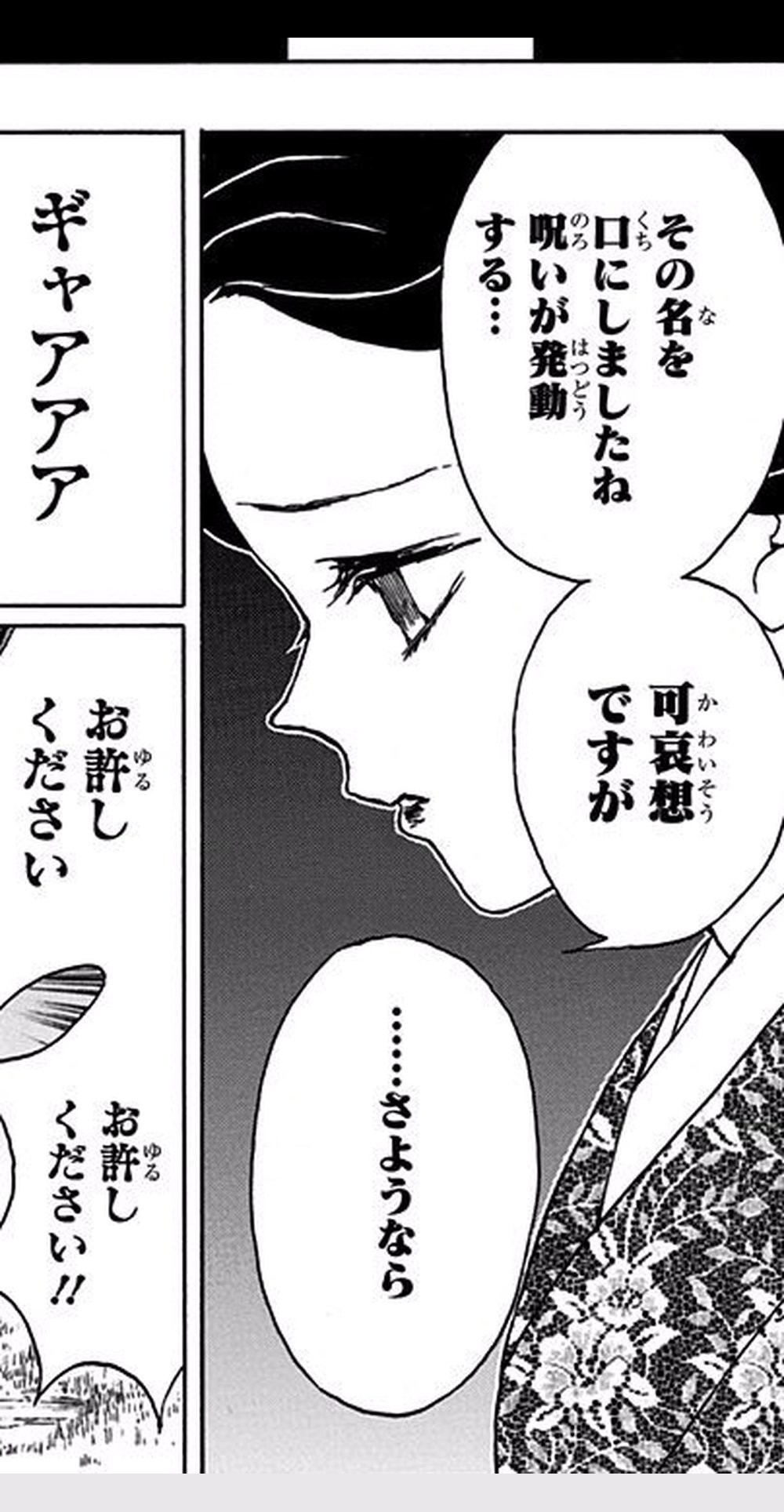
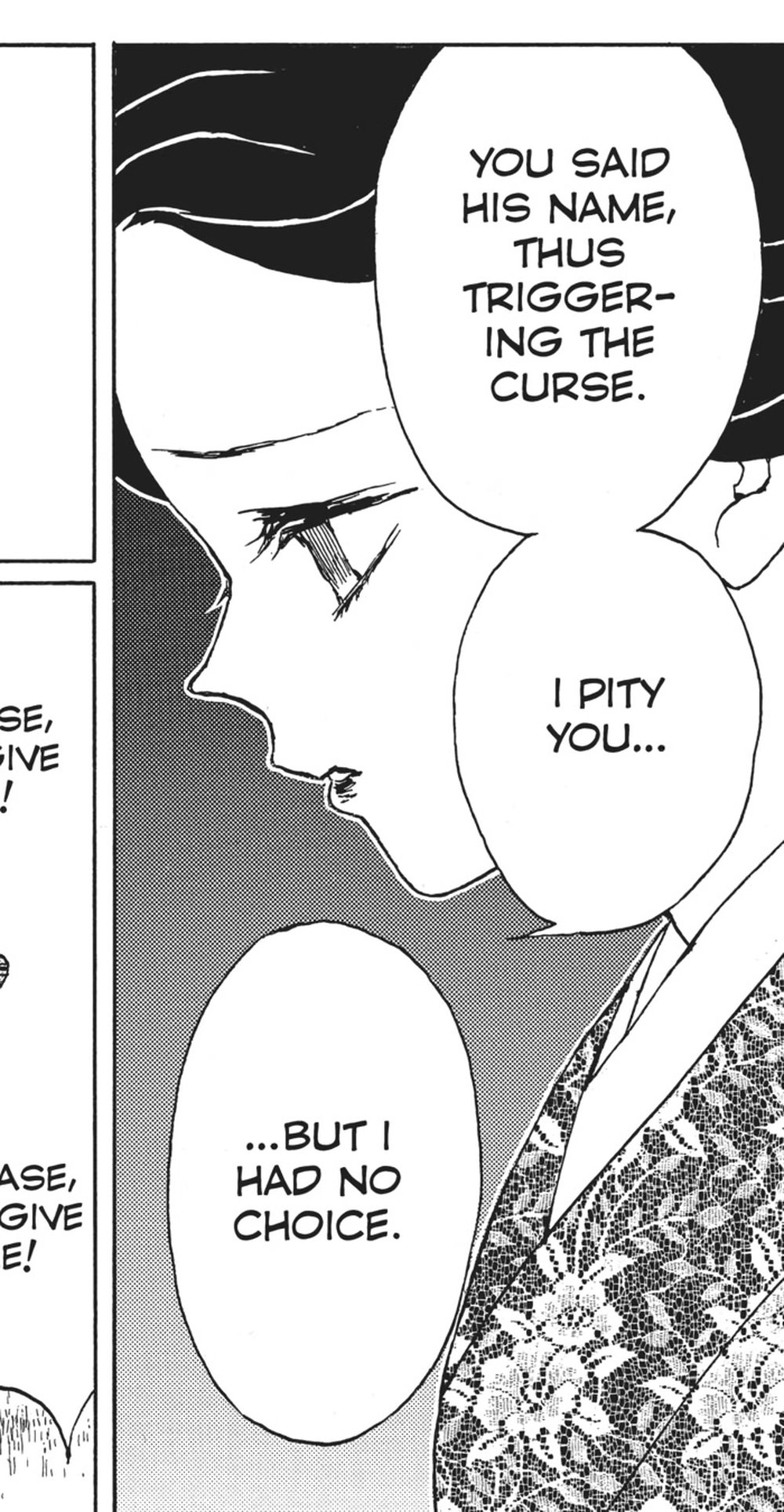
The Asakusa arc, deep in the interrogation. Tamayo and Yushiro have captured two of Kibutsuji Muzan's demon underlings — impostors dressed up as members of the Twelve Kizuki, as Tamayo will confirm a few pages later by checking their unmarked eyes. She has drugged one of them with 白日の魔香, a truth-inducing incense: 「脳の機能を低下させるので虚偽を述べたり秘密を守ることが不可能となる」 — "IT SUBDUES BRAIN FUNCTIONS, SO STATING FALSEHOODS OR KEEPING SECRETS BECOMES IMPOSSIBLE" — 「自白剤のようなものである」, "...IS LIKE A TRUTH SERUM." Under its influence, forced to explain his own master, the demon has just done the one thing every demon in this story is drilled never to do outside Muzan's presence: he has said Kibutsuji's real name aloud. Tamayo watches him convulse and screams begin, and delivers the diagnosis, gently, like a doctor confirming a result:
「その名を口にしましたね呪いが発動する…」
Sono na o kuchi ni shimashita ne, noroi ga hatsudō suru…
VIZ's English edition prints: "YOU SAID HIS NAME, THUS TRIGGERING THE CURSE." (Vol. 3, p.44.)
Grant the rendering its due first: it is accurate, it is legible in a single breath, and "triggering" is a genuinely sharp choice — it keeps the mechanical, switch-flipped quality of the Japanese verb 発動する. The failure isn't in what VIZ added; it's in what "curse" quietly assumes. In English, a curse needs a curser: someone spoke a malediction, someone will lift it, someone is the villain of the sentence. Look again at the Japanese grammar: 呪いが発動する puts 呪い itself in the subject slot, doing the activating. Nobody in this panel is casting anything. A name was spoken; a mechanism fired. Tamayo isn't describing an attack. She's reading an instruction manual for a body that isn't fully its owner's anymore — and the very next words out of her mouth, 可哀想ですが…さようなら ("I PITY YOU... ...BUT I HAD NO CHOICE."), are pity for a machine, not vengeance on an enemy.
The Original
Pull 呪い apart at the root. 呪 (ju/noro-) is built from 口 — mouth, doubled in its oldest form — sitting over a component several dictionaries trace to a kneeling human figure: a mouth performing a rite over someone kneeling before it. Speech, in other words, doing ritual work, not merely describing one. Kanji dictionaries like to point out that 呪's closest relative in the entire writing system is 祝 (shuku), "to celebrate, to bless" — the two characters share that same ritual-mouth core down to the stroke; 祝 swapped the mouth radical for 示, an altar, and drifted toward blessing, while 呪 kept the mouth and drifted toward cursing. The script itself records blessing and cursing as one gesture, pointed in two directions.
From that root, Japanese built an entire working vocabulary, and once you can see 呪, you start seeing it everywhere in the genre:
- 呪う (norou) — the verb, "to curse."
- 呪い (noroi) — the noun, our headline word: "a curse."
- 呪術 (jujutsu) — "sorcery" as a practiced discipline. (The same two kanji, in the same order, behind the title Jujutsu Kaisen.)
- 呪文 (jumon) — "an incantation," the words a sorcerer actually chants.
- 呪縛 (jubaku) — "a binding spell/curse" — and, not incidentally, the title of the very chapter this scene sits inside: 第18話「呪縛」, "CHAPTER 18: THE CURSE."
呪い itself is grammatically unremarkable — it only became official jōyō vocabulary in the 2010 kanji-list revision, decades after most Japanese readers had already met it through ghost stories and shōnen manga rather than a classroom, which puts it at roughly N2–N1 for learners chasing the JLPT ladder but earlier for anyone who reads fiction. What makes this particular sentence hard isn't the word; it's the verb standing next to it. 発動する (hatsudō suru) is the verb Japanese uses for a jutsu activating, an ability switching on, a device engaging — not for a witch waving a wand. 呪いが発動する reads, structurally, closer to "the trap springs" than to "the spell is cast."
VIZ's Choice
Every occurrence of 呪 we can verify across the volumes on file — three different referents, one convergent English word:
| Vol. / p. | Japanese | VIZ English |
|---|---|---|
| 2 / 153 | 私の体を随分弄っていますから鬼舞辻の呪いも外しています | I HAVE ALTERED MY BODY AND REMOVED KIBUTSUJI'S CURSE. |
| 2 / 153 | 呪い? | CURSE? |
| 3 / 27 | 第18話 呪縛 (chapter title) | CHAPTER 18: THE CURSE |
| 3 / 44 | その名を口にしましたね呪いが発動する… | YOU SAID HIS NAME, THUS TRIGGERING THE CURSE. |
| 3 / 50 | これが“呪い”です | IT'S THE CURSE. |
| 3 / 54 | 鬼舞辻の呪いで殺された | ...AND THEN KIBUTSUJI'S CURSE KILLED HER. |
| 16 / 72 | 私の一族は..呪われていた... | ...AND FOR THAT IT WAS CURSED. |
| 23 / 201 | 俺最近人に呪いをかける勉強してんだぜ舐めるなよ | I'VE BEEN STUDYING HOW TO CAST CURSES, SO WATCH OUT! |
Where our companion piece on 因縁 found scatter — one Japanese word, five different English guesses — this is the opposite pattern: total convergence. Eight appearances, spanning twenty-one volumes and at least three unrelated referents (Muzan's demonhood-binding, a samurai clan's hereditary affliction, and a schoolboy's joke about hexing his classmates in a bonus 4-koma strip at the back of Volume 23), and every single one lands on "curse." That consistency is good series-bible discipline — a translator who let "curse" drift into "hex" here and "jinx" there would create false distinctions the Japanese doesn't make. But it comes at a cost the scatter cases don't have: it hides the fact that Japanese itself is doing something delicate here — using one root for three conceptually different phenomena on purpose, trusting the reader to sort constitutive curse (Muzan's demons) from inherited curse (Kokushibō's clan) from folk-magic curse (the schoolboy) by context alone, the same way English trusts "spring" to sort a season from a coil from a leap without a translator's note. "Curse" preserves the coincidence. It can't preserve the reason a Japanese reader never mistakes one sense for another.
The Gap
Demonhood and the curse are the same event, not two. A Western storybook curse is added onto an existing self — Sleeping Beauty pricks her finger and remains a princess, merely an afflicted one. Muzan's 呪い is constitutive: a human doesn't become a demon and then get cursed; accepting Muzan's blood and accepting the 呪い are one act. "Curse" in English usually names a layer painted over a life. Here it names the paint and the canvas at once — and that distinction is the entire tragedy of every demon in this story who never chose the transformation.
No caster in the room. English "curse" grammar wants an agent: someone curses someone. 呪いが発動する has no agent at all — the curse is the grammatical subject, and 発動する is switch-flipping vocabulary, not spellcasting vocabulary. "Triggering the curse" gestures at the mechanism, but the word "curse" alone still smuggles in a caster (implicitly Muzan, brooding somewhere off-page) that the Japanese sentence pointedly does not mention. Tamayo isn't naming Muzan's malice here. She's naming a fact of biology.
Christian furniture under a shrine word. "Curse" descends through Old English curs, reinforced for a thousand years by the churchyard anathema — a formal denunciation, typically liftable by absolution, holy water, true love's kiss. 呪い's family — 呪術, 呪文, 呪縛 — traces to Onmyōdō court sorcery and Buddhist esoteric ritual: a curse achieved through named technique, chant, and sealed name, not moral condemnation from on high. "THE CURSE" sends an English reader's mind to a storybook witch. 呪い sends a Japanese reader's mind to an effigy nailed to a shrine tree at two in the morning.
The kinship survives one page and vanishes the next. Inside this same chapter, Japanese uses 呪い twice and titles the whole thing 呪縛 — the same kanji, visible on sight to any reader of the original. VIZ's "curse," "curse," and "THE CURSE" happen to preserve that resemblance here, almost by luck. It does not survive the trip to other shelves of the same genre: Naruto's 呪印 (juin), naming Orochimaru's brand on Sasuke's neck, becomes the freshly-coined "curse mark" — same root, unrelated-looking English compound — and One Piece's black demon blades carry their own inherited 呪い with no shared vocabulary to Demon Slayer's at all. One native word is doing structural work across three different Shonen Jump franchises, in three different English translations, with three different vocabularies, and nothing on the English page tells a reader the rhyme exists.
What If
No option here is free — the menu and its costs:
- "YOU SPOKE HIS NAME. THE BINDING HAS ACTIVATED." — trades "curse" for "binding," closer to 呪縛's compulsion, and keeps 発動 as mechanism. Cost: unfamiliar as a death sentence, and loses the weight "curse" already carries for an English reader walking in cold.
- "YOU SPOKE HIS NAME… AND THE HEX HAS DONE ITS WORK." — "hex" leans toward English's own folk-magic register, nearer to a nailed straw doll than a churchyard anathema. Cost: can read quaint, even faintly comic, undercutting a death.
- "YOU SAID HIS NAME. THE SPELL IS EXECUTING." — keeps 発動する's automatic, program-like quality. Cost: "spell" sounds too whimsical for Tamayo's clinical register, and "executing" risks a pun the Japanese doesn't intend.
- Keep "curse," fix the grammar: "YOU SAID HIS NAME. THE CURSE IS RUNNING NOW." — Cost: "running" is a shade colloquial for Tamayo's voice, but it keeps 呪い alive and ongoing rather than a one-off hex already completed.
Every option still reaches for a single English noun to cover a Japanese root that keeps branching into a verb, a discipline, an incantation, and a binding. That's not a failure of ear. It's what happens when the target language never had to build the sorcery vocabulary the source language already had on the shelf.
Take-away
呪い looks like a simple word — "curse," one syllable, done — and VIZ's steady rendering is honest, working English. What it quietly erases is that 呪い in Demon Slayer is doing three different jobs with one root: the constitutive binding that makes a demon a demon, the inherited affliction of a mortal clan, and the ordinary folk-magic hex of a schoolyard joke — all visibly related in Japanese, all invisibly identical in English.
Three rules of thumb to carry off this page:
- When 呪い shows up with 発動する rather than a caster's verb, ask what makes it fire, not who cast it. Japanese sometimes builds curses as self-executing mechanisms, not maledictions flung by a villain.
- Collect 呪's whole family — 呪う, 呪術, 呪文, 呪縛, and (in other franchises) 呪印 — once the root is visible, you'll start noticing how often English's "curse," "spell," "hex," "sorcery," and "curse mark" are the same Japanese character in different grammatical clothes.
- Ask whether "curse" names a condition or an event. Is the curse something a character is, or something done to them? Japanese often keeps that ambiguous on purpose — 呪い lives in exactly that uncertainty, and Demon Slayer never lets the reader settle it for Muzan's demons.
For the other half of Muzan's cosmology — the heavenly justice he insists has never touched him — see the impersonal heaven flattened into a personal punisher in 天罰; and for how thoroughly this story runs on Buddhist vocabulary VIZ keeps having to re-translate from scratch, see the eight-tiered underworld packed into 地獄. Or browse the full Demon Slayer translation notes index.
Every Japanese and English line quoted above is a byte-exact capture from the cited editions — 鬼滅の刃 Vol. 2, 3, 16, 23 (Japanese) and Demon Slayer: Kimetsu no Yaiba (VIZ Media) at the corresponding panels — via our bilingual page database; see Sources below.