The Moment
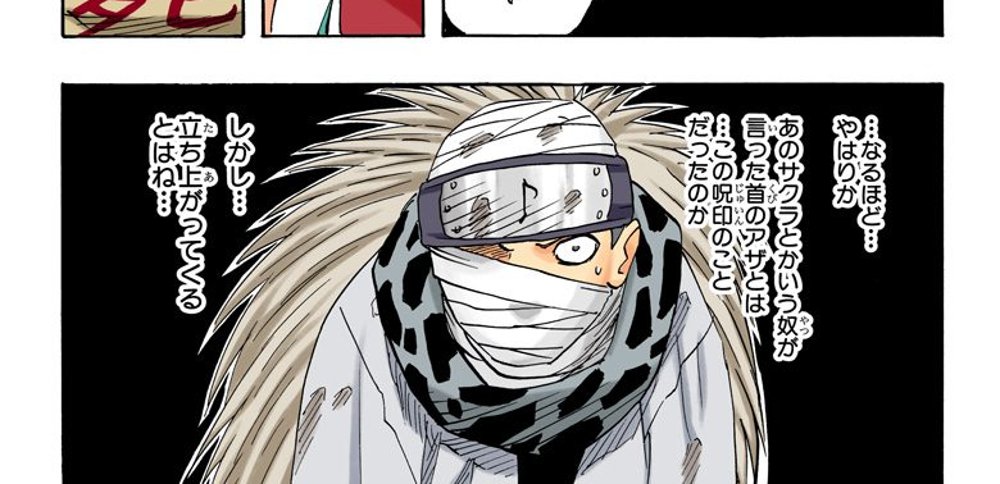
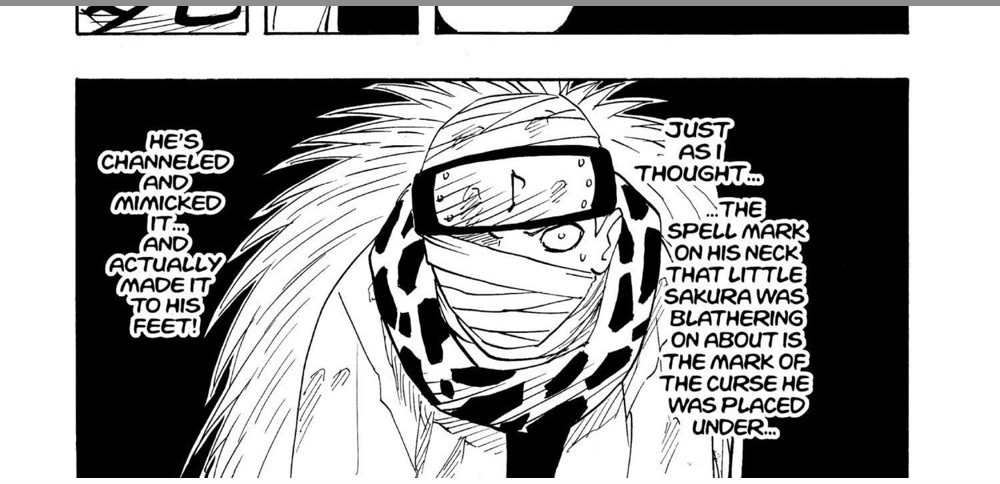
The Forest of Death, mid-Chūnin Exam. Sasuke has just torn through the Sound genin in a black-marked, half-transformed rage after Naruto and Sakura were left beaten in the dirt. He collapses back to himself, dazed, muttering to no one — 「オレは復讐者…たとえ悪魔に身を委ねようとも…力を手に入れなきゃならない道にいる…」 ("I AM AN AVENGER... EVEN IF IT MEANS SELLING MY FLESH TO THE DEVIL! ON THE PATH I WALK, I HAVE TO DO WHATEVER IT TAKES TO GAIN POWER..."). Watching from the trees, bandaged head to collar in a battlefield disguise, is Kabuto Yakushi — Orochimaru's spy, already circling this exam long before anyone suspects him. He watches Sasuke drag himself back to his feet and puts together what he's just confirmed with his own eyes:
「…なるほど…やはりか あのサクラとかいう奴が言った首のアザとは…この呪印のことだったのか」
…Naruhodo… yahari ka, ano Sakura to iu yatsu ga itta kubi no aza to wa… kono juin no koto datta no ka.
VIZ's English edition prints: "JUST AS I THOUGHT... ...THE SPELL MARK ON HIS NECK THAT LITTLE SAKURA WAS BLATHERING ON ABOUT IS THE MARK OF THE CURSE HE WAS PLACED UNDER..." (Vol. 7, p.29).
Grant the rendering its due: it's a genuinely hard sentence to carry into English in one breath, and VIZ keeps every beat — the private deduction, the faint condescension toward Sakura ("blathering on"), the reveal. But look at what the sentence is actually doing in Japanese. Sakura's word for the mark, back on an earlier page, was the ordinary, non-magical アザ — a bruise, a blemish, a birthmark, nothing more sinister than a skin discoloration. Kabuto's word, replacing it, is 呪印 — and that single substitution is the whole point of the line: what looked like an injury is actually a spell. VIZ's English has to invent a second, unrelated noun phrase ("the spell mark on his neck") just to give Sakura's アザ somewhere to live in the sentence at all — smuggling in the word "spell" for a term that, in the original, carries none.
The Original
Take 呪印 apart. 呪 (ju) is "curse, spell, incantation" — trace the character back and you find a mouth (口, for chanting) doing ritual work; whatever the precise etymology, the ideograph has always meant speech performing magic. 印 (in) is the ordinary word for "mark, seal, stamp" — the same 印 in 印鑑 (personal seal) or 印象 (impression). So 呪印 is not "a mark that happens to look cursed"; it is, literally, a seal that is the spell itself, fixed permanently into skin rather than spoken and released.
呪 is not a one-off character. It roots an entire working vocabulary:
- 呪う (norou) — the verb, "to curse."
- 呪い (noroi) — the noun, "a curse, a hex."
- 呪術 (jujutsu) — "sorcery," magic as a practiced discipline. (Yes — the same two kanji behind the title Jujutsu Kaisen.)
- 呪文 (jumon) — "an incantation," the words a sorcerer actually recites.
- 呪縛 (jubaku) — "a binding curse," the spell that paralyzes or compels.
A Japanese reader meeting any one of these sees the family resemblance instantly — same kanji, same root concept, different grammatical role. That resemblance is invisible in English the moment each word gets its own unrelated translation.
And 呪 is not old-fashioned or archaic; it's oddly recent as official vocabulary — the character was only added to the jōyō (general-use) kanji list in the 2010 revision, decades after most of Japan's kids had already learned it from manga and ghost stories rather than a textbook. As grammar, the headline line is unremarkable: なるほど…やはりか is simply "I see… just as I thought," the cadence of a private hypothesis confirmed, and […]とは…このXのことだったのか is a common pattern for a delayed reveal — "turns out that […] was actually X all along." The difficulty here isn't grammar. It's that the sentence's entire dramatic function — replacing an innocent word with an occult one — depends on 呪印 sounding like nothing English has a name for.
VIZ's Choice
Here is every 呪 occurrence we can verify on the page, across two completely different plotlines that happen to share the word:
| Vol. / p. | Japanese | VIZ English |
|---|---|---|
| 7 / 29 | …やはりか…この呪印のことだったのか | ...THE MARK OF THE CURSE HE WAS PLACED UNDER... |
| 8 / 61 | チャクラ練り込んだだけでも呪印が反応して | ...WILL PROVOKE A REACTION FROM THAT SPELL-MARK... |
| 10 / 127 | 彼に与えた呪印…カカシの奴に封印されちゃった | THE CURSE MARK I PUT ON HIM... IT'S BEEN SEALED BY KAKASHI... |
| 12 / 49 | その呪いの印は〝籠の中の鳥〟を意味し | THIS CURSE MARK REPRESENTS A "CAGED BIRD"... |
| 12 / 58 | この呪印はいわば宗家が分家に与える死という絶対的恐怖 | THIS CURSE MARK SIGNIFIES AN ABSOLUTE THREAT OF DEATH... |
| 36 / 77 | すでにてめーはオレに呪われた… | I HAVE ALREADY CURSED YOU... |
| 37 / 165 | 人を呪わば穴二つ… | (printed) THAT THERE IS YOUR GRAVE. |
Read top to bottom and a real pattern shows up. Volume 7 and Volume 8 — both early, both describing Orochimaru's mark on Sasuke within a few chapters of each other — can't agree on a term yet: "mark of the curse" in one, "spell-mark" in the next. By Volume 10, VIZ has settled: "curse mark," full stop, and it never wavers again through Volumes 12, 20, 21, 26, 38, and 39. That settling is good localization discipline — a series term, fixed once and reused.
But fixing the English term doesn't fix the underlying problem, because Volume 12 uses the Japanese word for something else entirely. Neji Hyūga, forehead seal visible, explains to Naruto that his own clan's branch family is marked at birth with a 呪印 that "represents a caged bird" and "fades only after death" — a hereditary caste-brand with nothing to do with Orochimaru, sorcery training, or the Sound Village. VIZ's "curse mark" is accurate for it. It is also, word for word, the same English label already used for Sasuke's brand. Two unrelated magical technologies, one shared Japanese name, one shared English name — the coincidence in Japanese is visible on the page (same two kanji, same furigana); the coincidence in English reads as a limitation of vocabulary rather than a meaningful echo.
The last row is the sharpest gap. Shikamaru, standing over a trap he's just realized was baited for him, quotes a real Japanese proverb: 人を呪わば穴二つ — "curse someone, and you dig two graves" (one for them, one, eventually, for yourself). The line VIZ actually prints on the page is "THAT THERE IS YOUR GRAVE." — sharp, in-character, and completely silent on the word "curse." (Our bilingual database's automatic pairing attaches this Japanese line to a looser gloss, "If you curse someone, you dig your own grave..." — that gloss is not what's printed; the real VIZ bubble, confirmed against the page art, is the shorter "THAT THERE IS YOUR GRAVE." We keep the database's raw text in Sources for the record and flag the discrepancy here, per our sourcing policy.) Either way, printed or glossed, the proverb's grammatical subject — 呪う, cursing — never survives into English.
The Gap
The visible family disappears. 呪う, 呪い, 呪術, 呪文, 呪縛, and 呪印 all wear the same kanji; a Japanese reader spots the kinship between Hidan's curse-ritual, the Hyūga's curse-seal, and a folk proverb about curses at a glance. English's "cursed," "curse mark," and "digs your grave" share no visible root at all — three siblings walk into the translation and come out as strangers.
One label, two stories. "Curse mark" is correct for both Orochimaru's brand and the Hyūga seal individually — and precisely because it's correct for both, nothing in the English signals that these are two different inventions that only rhyme because the story wants them to: an outsider's curse that eats its host, and a family's curse on its own children. The shared kanji is doing quiet thematic work in the original that the shared English phrase does by accident, not by design, and can't be told apart from coincidence.
The proverb loses its own subject. 人を呪わば穴二つ is centuries of Japanese folk wisdom about a curse's boomerang — the entire idiom exists to talk about 呪う. "THAT THERE IS YOUR GRAVE" keeps the punchline (a grave) and cuts the premise (a curse) that makes the line a proverb instead of a threat.
What If
No option is free — here's the menu and what each one costs.
- "SORCERY MARK" (for 呪印) — signals a named branch of magic, not a party trick. Cost: too neutral; loses the harm 呪 always implies.
- "HEX-SEAL" — closer to folk-witchcraft than to churchyard "curse," which is the right neighborhood. Cost: "hex" can read a shade comic in English, and the Hyūga scene needs to stay funereal.
- "BINDING-MARK" (for the Hyūga seal specifically) — leans into 呪縛-style compulsion, ownership rather than injury. Cost: sounds reversible; undersells Neji's flat "absolute threat of death."
- "IF YOU DIG A GRAVE FOR SOMEONE ELSE, DIG TWO" (for 人を呪わば穴二つ) — restores the actual proverb shape and its self-inflicted logic. Cost: too long for the bubble, and it still swaps "curse" for "dig a grave" — a smaller loss, not a solved one.
The throughline: every fix still has to choose one English word for a Japanese root that keeps branching. That's not a failure of any single translator's ear — it's what happens when the target language never built the sorcery vocabulary the source language already had on the shelf.
Take-away
呪印 looks like a simple compound — "curse" plus "mark" — and VIZ's "curse mark" is a genuinely serviceable, consistent English seat for it. What the steady translation quietly erases is that 呪 is not a single word doing a single job in Naruto; it's a root system, branching into a verb, a noun, a discipline, an incantation, a binding, and a folk proverb, all visibly related on the Japanese page and invisibly scattered on the English one.
Three rules of thumb to carry off this page:
- Whenever 呪 shows up, check whether it's the same word doing double duty. 呪印 covers Orochimaru's brand and the Hyūga's caste-seal in the very same volumes — same term, two unrelated stories, one shared English label that hides the coincidence.
- Collect 呪's whole family. 呪う, 呪文, 呪術, 呪縛 — once you can spot one, you can spot them all, and you'll start noticing how often a "spell," a "hex," or a "binding" in translated manga is secretly the same Japanese root in a different grammatical costume.
- A proverb without its keyword is just a threat. 人を呪わば穴二つ needs 呪う on the page to be wisdom rather than a one-off line; watch for compressed idioms that keep the imagery (a grave) and drop the argument (a curse).
For two more Naruto lines where a Buddhist- or folk-religious root gets flattened on the way into English, see the eight-tiered Buddhist underworld packed into 地獄 and the counting proverb behind 仏の顔も三度 — or browse the full Naruto translation notes index.
Every Japanese and English line quoted above is a byte-exact capture from the cited editions — NARUTO―ナルト― Vol. 7, 8, 10, 12, 36–37 (Japanese) and Naruto (VIZ Media) at the corresponding panels — via our bilingual page database; see Sources below.