The Moment
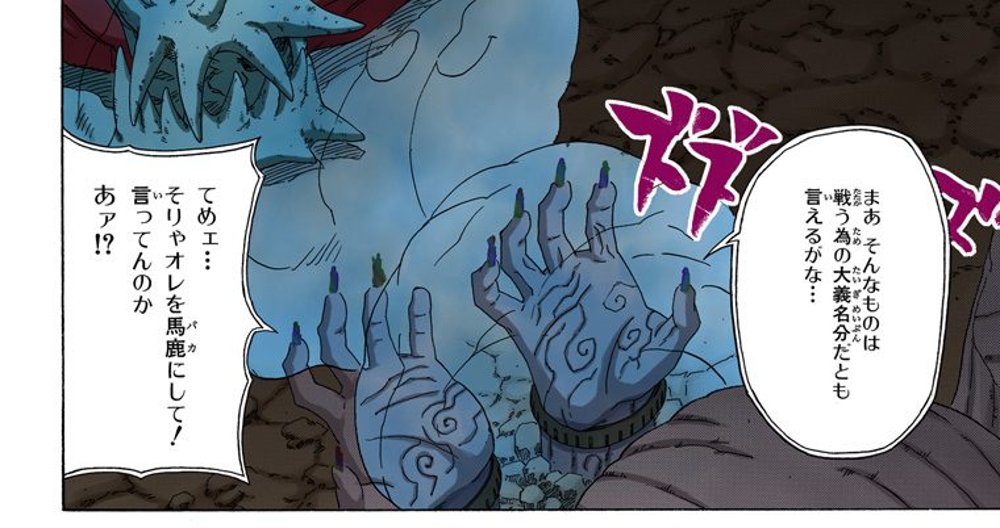
Volume 36. The Akatsuki's tailed-beast sealing campaign is in full swing, and Hidan and Kakuzu — the organization's most combustible partnership, an immortal Jashinist paired with a four-hearted mercenary — have fallen into one of their running arguments. Hidan has just been crowing about a raid on Konoha, boasting that he was almost done wiping the village out and showing its "godless" inhabitants that his god Jashin is real. Kakuzu corrects him without much heat:
「先代を神とし“火の意志”を思想にこうどう行動する」
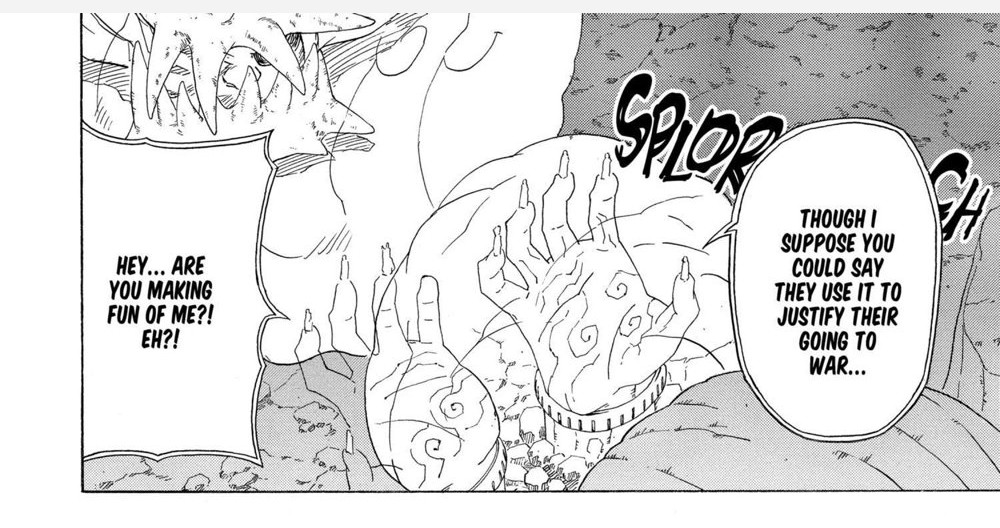
VIZ: "They act with the 'Will of Fire' as their ideology, and the First Hokage as their god." Konoha isn't atheist at all, Kakuzu is saying — it just worships something else.
Then, as one of Kakuzu's four detachable mask-hearts stirs to life in a huge stitched hand beside him, he widens the point into something close to a stump speech: religion, ideology, resources, land, old grudges, love, plain whim — any of it, however petty, becomes a war's stated cause, and wars, he says, never stop. And here is the line at the center of this article:
「まあそんなものは戦う為の大義名分だとも言えるがな…」
Mā sonna mono wa tatakau tame no taigi-meibun da to mo ieru ga na…
VIZ's English edition prints: "THOUGH I SUPPOSE YOU COULD SAY THEY USE IT TO JUSTIFY THEIR GOING TO WAR..." (Vol. 36, p.178).
Grant the line its due: it's clean, idiomatic, unshowy English that sounds exactly the way a jaded mercenary should sound, and "justify" is not a wrong word — 大義名分 really has drifted, in casual modern speech, toward meaning something close to that. The problem is what the drift papers over. 大義名分 isn't Japanese for "reason," or even "excuse" — it's a specific, load-bearing term from Confucian political theory, and Kakuzu reaching for it instead of the plain 理由 ("reason") he uses everywhere else on this same page is not incidental. It's the whole joke.
(A note on the corpus text before moving on: the bilingual database's first-pass OCR mis-scans one word of this line's English as "...YOU COULD SAY THAT USE IT..."; a recovery OCR pass over the same page, and the printed panel itself, both confirm the real word is "THEY" — "...YOU COULD SAY THEY USE IT..." The quote above, and this article's analysis, follow the verified printed line; the corpus's exact bytes are preserved in Sources/References below, per this project's quoting rules.)
The Original
大義名分 splits into two two-character words, and both are already technical terms before they're ever combined.
大義 (taigi) is 大, "great, highest," plus 義, "righteousness, duty, justice" — the same 義 that appears in 正義 (seigi, "justice") and 義理 (giri, the social obligation owed to kin, allies, and hosts). Together, 大義 is "the great duty": classically, the moral cause a person's life is owed to — loyalty to one's lord, one's realm, the order of things.
名分 (meibun) is 名, "name," plus 分, "portion, share, one's due station" — literally, "the portion that comes attached to a name." This is not loose metaphor; it is a specific piece of Neo-Confucian political theory descended from Confucius's own doctrine of 正名 (seimei), "the rectification of names." The locus classicus is Analects 13.3: asked what he would attend to first if put in charge of a state, Confucius answers 必也正名乎 — "it would certainly be to rectify the names" — because when names and realities drift apart, speech stops following reason, undertakings fail, and eventually the people have nowhere to put hand or foot. 名分 is the technical term for the duty a given name obligates: a ruler must rule as a ruler should, a retainer serve as a retainer should — political legitimacy, in this framework, is a question of whether names and conduct line up.
Weld the two halves together and 大義名分 names a specific kind of cause: not just any reason, but one grounded in the duty one's name and rank impose, framed as service to a higher, righteous order. Historically, it is the term a court would use to ask whether a lord had the right to make war, or a shogunate the right to rule — "a just cause," in the sense a tribunal, not a mood, would recognize.
There's no clean single English word for 名分 on its own; translations of Confucian texts tend to reach for cumbersome paraphrase — "the name-derived duty," "nominal obligation" — because ordinary English "justification" drops the name-and-rank half entirely. As vocabulary, 大義名分 sits above the ordinary JLPT tiers; 大義 alone shows up on some advanced/N1 wordlists, but 名分 barely exists outside this compound and a handful of set phrases, so most study guides simply file the whole thing as specialized political-history yojijukugo.
VIZ's Choice
Only one panel on this page carries the four-character compound itself, so there's no scatter table to build — but the surrounding lines hand us an unusually clean point of comparison, because Kakuzu spends the rest of the speech saying almost the same thing twice: once in plain vocabulary, once in elevated vocabulary.
Track the word for "reason" across the speech. Kakuzu opens with the ordinary word and keeps returning to it: どんなくだらない理由でも戦争するだけの理由になってしまう, "no matter how trivial the 理由 (riyū, 'reason'), it becomes reason enough for war" — VIZ: "...NO MATTER HOW TRIVIAL THE MOTIVE, IT BECOMES THE CAUSE FOR CONFLICT." A few lines later: 戦争の理由なんてのは何でもいい, "the 理由 for war can be anything at all" — VIZ: "BUT IN THE END, IT DOESN'T MATTER WHAT ONE'S REASON IS." Three uses of 理由 across one short speech, rendered three plain ways: "motive," "cause," "reason." Then, once, right in the middle of that plain vocabulary track, Kakuzu steps the register up and swaps 理由 for 大義名分 — and VIZ answers with "justify," a verb from the exact same everyday shelf as "motive" and "reason," with no marker that anything has shifted at all.
That flattening is the real loss, more than any single word choice. In Japanese, the passage has a shape: plain reason, plain reason, plain reason — then a spike into formal, faintly bureaucratic Confucian vocabulary, then back down to plain reason again on the next page. The spike is doing character work: it's the moment Kakuzu, a man who fought as a hired blade in the Second Shinobi World War for money and nothing else, names the fancy word governments and armies use for the thing he doesn't believe exists. English's "motive… cause… reason… justify… reason" never rises above a single register anywhere in the speech. The line reads perfectly smoothly — and precisely because it reads so smoothly, a reader who can't see the kanji has no way to notice that one word in the middle of it was supposed to sound different from all the others.
The Gap
No name, no rank, no theory. "Justify" is content-neutral — you can justify a parking ticket or a war with the same verb. 名分 specifically claims the action answers to the duty attached to one's NAME and social station; that's a structural claim about legitimate authority, not a generic appeal to reasonableness. "They use it to justify going to war" could describe a smuggler's cover story; 大義名分 could not — it only ever names the kind of cause dressed in the vocabulary of rightful duty.
正名 vanishes without a trace. 名分 isn't free-floating vocabulary; it's a term of art inside a 2,500-year-old political doctrine arguing that social order depends on names and their attached duties lining up. None of that theoretical scaffolding survives into "justify" — there's no way for an English reader to learn, from this line alone, that the speaker has reached for a term with a named doctrine standing behind it.
The register spike is sanded flat. As shown above, Kakuzu's speech deliberately rises from plain 理由 into elevated 大義名分 and back down — a rhetorical gesture, not just a vocabulary choice. English's uniformly plain "motive/cause/reason/justify/reason" has nowhere to rise from and nowhere to fall back to; the spike simply isn't there to notice.
The word's own irony goes untranslated. In modern colloquial Japanese, 大義名分 has itself drifted toward meaning something close to "a respectable-sounding pretext" — the set phrase 大義名分を掲げる ("to hoist a taigi-meibun") is often used with an eyebrow raised, for cloaking a selfish motive in noble language. A mercenary reaching for this exact word instead of the plain 理由 he's using everywhere else on the same page is already making a dry joke about people who dress their real motives up in official-sounding vocabulary — an irony "justify" is too neutral a verb to carry.
What If
- "...I suppose you could call that their 'righteous cause' for going to war" — keeps 大義's grandeur, and the scare quotes gesture at the irony Kakuzu intends. Cost: still drops 名分's name-and-rank half entirely; a reader gets "noble-sounding excuse," not the structural claim about legitimate duty.
- "...you could say that's the banner they fight under" — borrows the imagery of 錦の御旗 (nishiki no mihata, the historical "brocade banner" once carried to prove an army fought with the Emperor's blessing), keeping 大義名分's political-theater flavor. Cost: "banner" is an imported metaphor not literally present in the line, and leans on an idiom most English readers won't recognize.
- "...you could say that's their official pretext for war" — "official" gestures at 名分's institutional, rank-bound dimension in a way plain "pretext" alone can't. Cost: "official" reads bureaucratic-modern where 大義名分 carries centuries of Confucian weight behind it.
- "...you could say that's the duty they hide behind" — keeps 名分's core sense, an obligation attached to a name or station, rather than collapsing straight to "excuse." Cost: loses 大義's grandiosity; "duty" alone sounds too modest for a nation's declared cause for war.
Every option pays a different tax, because English simply never built a word meaning "an excuse dressed in the specific vocabulary of legitimate, name-bound authority." That gap is exactly what 大義名分 was coined to name, inside a political tradition English never had to translate for itself.
Take-away
大義名分 looks, on the page, like a fancy synonym for "reason" — and in the loosest modern slang, it has drifted close to that. But underneath the four characters sits a real Confucian doctrine: 大義, the highest duty owed to one's lord or state, plus 名分, the specific obligations a NAME and rank impose — a term built directly on Confucius's own doctrine of 正名, the rectification of names. Rendering it as "justify" isn't wrong so much as it is silent about all of that architecture.
Three rules of thumb to carry off this page:
- 名分 means "the duty a name carries," not "a reason." Whenever you meet it — alone, or welded into 大義名分 — ask whose name and whose rank the claim is riding on.
- 義 is the moral-duty kanji to collect. 正義 (justice), 義理 (social obligation), 大義 (the highest cause) — one family, all pointing at duty owed rather than feeling felt.
- Watch for register spikes inside a single speech. When a character swaps their own plain vocabulary (理由) for a sudden formal term (大義名分) mid-sentence, that swap is characterization — and a translation that keeps every word in the same register erases it invisibly.
For two more places where a Naruto four-character phrase carried more than English's replacement kept, see the dark political history packed into 問答無用 and the chapter title that became a borrowed Bible verse in 油断大敵 — or browse the full Naruto translation notes index.
Every Japanese and English line quoted above is a byte-exact capture from the cited editions — NARUTO―ナルト― Vol. 36 (Japanese) and Naruto Vol. 36 (VIZ Media) at the corresponding panels — via our bilingual page database; see Sources below. Note: the corpus's first-pass OCR of the headline line's English misreads one word ("...YOU COULD SAY THAT USE IT..."); the page's own recovered OCR pass and the printed panel both confirm "THEY," and this article quotes the verified printed line while preserving the corpus's exact bytes in the Sources/References citations.