The Moment
Volume 28 — the opening act of Part II's first great arc. Gaara has been carried off by the Akatsuki, and Team Kakashi has hurried to Sunagakure to help. They have barely stepped inside when a tiny old woman launches herself at Kakashi. This is Chiyo, the village's retired elder — and she has seen a ghost. White hair, a Konoha flak jacket, a lazy half-lidded eye: to her, the man in the doorway is the White Fang of Konoha, the legend who killed her son.
「あの時はよくもォ」 — "THAT DAY, HOW DARE YOU...!"
「息子の仇…今日こそワシが成敗してくれる!」 — "FINALLY, TODAY... I SHALL COLLECT VENGEANCE FOR MY SON!"
「木ノ葉の白い牙め」 — "DESPICABLE WHITE FANG OF KONOHA...!"
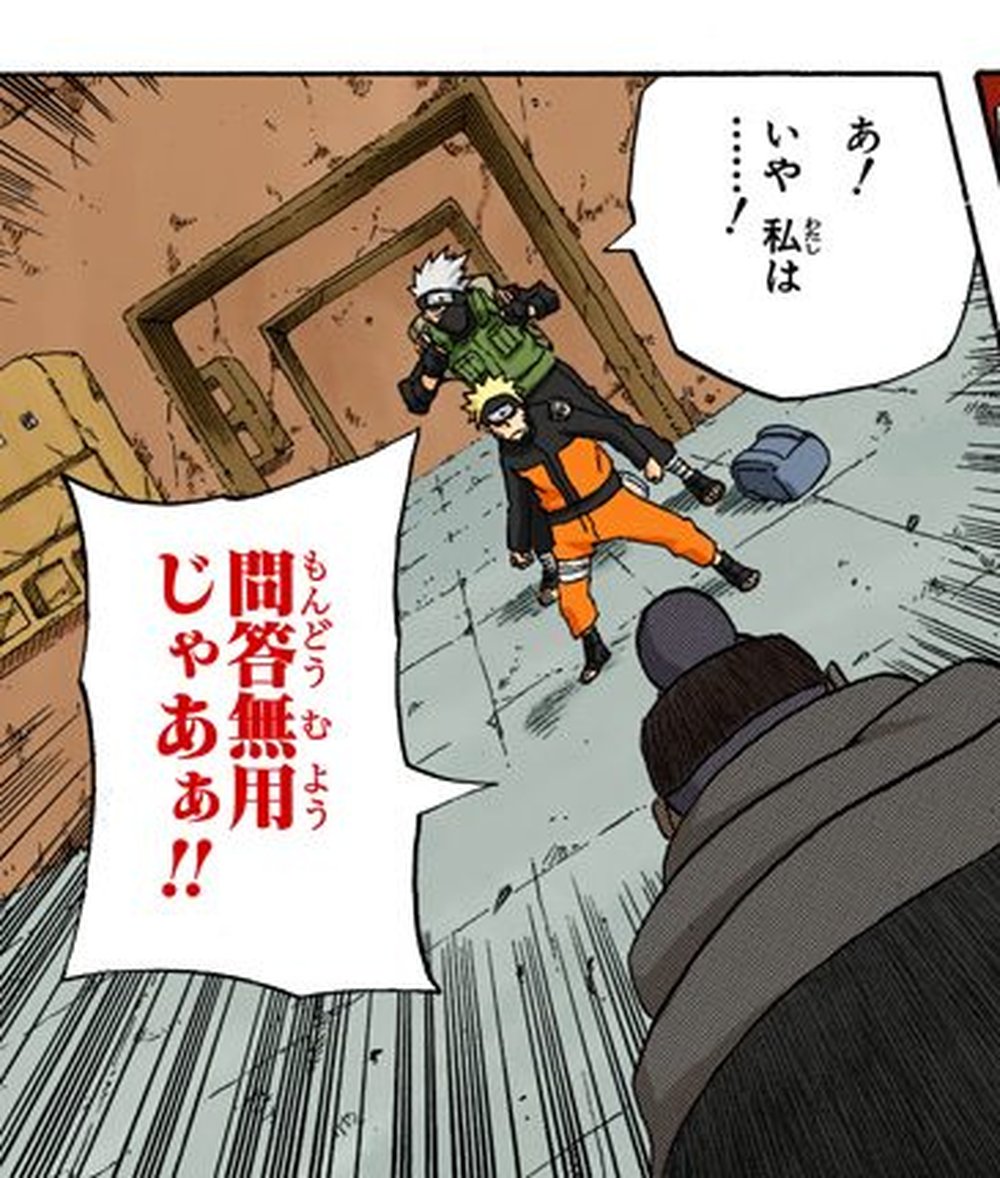
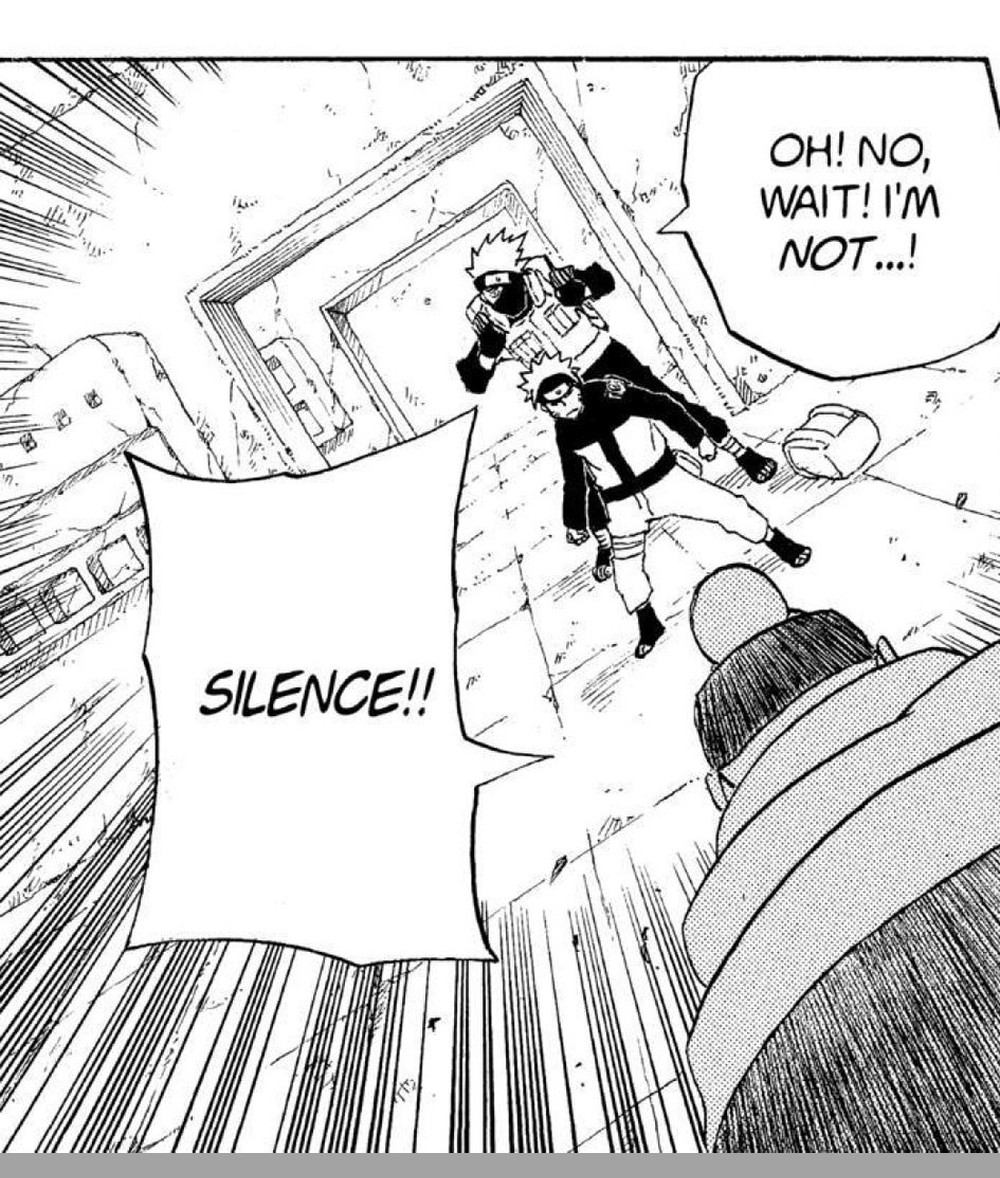
Wrong man. Kakashi is the White Fang's son, and he tries to say so, twisting away from her strike with his hands half-raised — 「あ!いや私は…!」 ("OH! NO, WAIT! I'M NOT...!") — while Naruto splutters 「カカシ先生にいきなり何すんだってばよ!」 ("WHY ARE YOU ATTACKING MASTER KAKASHI?!"). And into all this perfectly reasonable protesting, the grandmother roars:
「問答無用じゃあぁ!!」
Mondō muyō ja-a-a!!
VIZ's English edition prints one word: "SILENCE!!" (Vol. 28, p.183).
Grant the rendering its due first. As lettering, it is a small triumph of economy: four kanji in, one word out, and the word is imperious, theatrical, exactly right for a pint-sized elder conducting a grand mistaken vendetta at full volume. The scene is comedy, and comedy lives on timing; "SILENCE!!" detonates on the beat. But listen to what the Japanese actually does — because 問答無用 is not a demand for quiet. It is a verdict. And the joke underneath the panel is that this is the one fight in the arc that three seconds of question-and-answer would have dissolved — which is precisely what she is ruling out.
The Original
Take the four characters apart; both halves are worth owning.
問答 (mondō) is 問 "to ask" + 答 "to answer": question-and-answer as a formal, almost ceremonial activity. This is the old word for structured dialogue — the doctrinal debates of temple halls, the exam-style catechism, and above all the exchange between a Zen master and a disciple, the mondō famous enough that Japanese still says 禅問答 (zen mondō) for any cryptic, riddling conversation where the two sides seem to be trading koans instead of information. 問答 is talk with dignity: talk as an institution.
無用 (muyō) is 無 "without" + 用 "use, need, business": useless, unneeded, not wanted here. It is a productive little formula, and you have met its family on signs and boxes:
- 心配無用 (shinpai muyō) — "no need to worry"
- 他言無用 (tagon muyō) — "not a word of this to anyone"
- 天地無用 (tenchi muyō) — "do not turn over" (literally "top-and-bottom: no business"), stenciled on shipping crates
Bolt the halves together and you get 問答無用: "question-and-answer — useless." No verb, no subject, no hedge. Four characters coming down like a stamp on a document. The phrase's natural habitat is the period drama — it is what the samurai shouts in the instant before the blade clears the scabbard — and it keeps that archaic thunder in modern use. It even works adverbially: 問答無用で連れて行かれた, "they hauled him off without giving him a word in edgewise."
Grammar to steal: Chiyo's じゃ is the elderly/western copula manga issues to its grandmothers (her ワシ for "I" is the matching pronoun), and the stretched あぁ!! turns the stamp into a war cry. As vocabulary the idiom sits around JLPT N1 — 無用 alone is roughly N2 — but nobody learns 問答無用 from a list. You learn it from exactly this kind of panel.
VIZ's Choice
Both appearances of 問答無用 in the volumes we have on file, side by side:
| Vol. / p. | Speaker | Japanese | VIZ English |
|---|---|---|---|
| 21 / 89 | Raidō, Konoha jonin | 問答無用…か | NO POINT IN TALKING, EH? |
| 28 / 183 | Chiyo | 問答無用じゃあぁ!! | SILENCE!! |
Two occurrences, two opposite strategies — and the contrast is the whole lesson.
The Vol. 21 scene: Orochimaru's Sound Four are fleeing with a sealed barrel on their backs when two Konoha jonin bar the way. The enemies do not negotiate — curse-mark patterns simply start crawling across their skin. The scar-faced jonin Raidō reads that silence for what it is and names it: 問答無用…か — "so it's to be mondō muyō, is it." Then, aloud to the enemy: 「不意打ちでやられた前回とは違うぞ」 ("LAST TIME YOU SURPRISED ME WITH THAT ATTACK OF YOURS. THAT'S NOT HAPPENING AGAIN."), while his partner spits 「大蛇丸の玩具が…木ノ葉の忍をなめんなよ」 ("YOU'RE JUST PAWNS TO OROCHIMARU. DON'T UNDERESTIMATE THE SHINOBI OF KONOHA.").
That bare …か is only possible because 問答無用 is a coin — a fixed formula the whole culture recognizes. Raidō is not composing a sentence; he is holding the coin up to the light: ah, the old verdict. VIZ, with no coin in the till, mints prose instead: "NO POINT IN TALKING, EH?" — a perfectly accurate unpacking that reads as one man's on-the-spot observation.
So across two volumes the same four characters go out two doors: compressed to a one-word interjection in Vol. 28, explained into a nine-word sentence in Vol. 21. Each choice is locally sound. Between them, the formula itself — the thing the two scenes share — never reaches the English reader at all.
The Gap
A verdict becomes a noise complaint. 問答無用 does not order the other party to stop talking; it declares the negotiation phase over and force in session — a performative, like a judge adjourning court. "SILENCE!!" is a command about volume. Locally it works, but it blurs the sharpest irony on the page: Chiyo is not annoyed by Kakashi's words, she is ruling them inadmissible — in the one scene where admitting them would have ended the fight, since the man she is avenging herself on is the wrong generation of Hatake.
The coin melts. A yojijukugo is quotable because it is fixed: Vol. 21 proves it, with Raidō citing the formula in three syllables and a か. English has no such coin, so each translator-moment gets fresh, disposable wording — and the rhyme between the grizzled jonin naming his enemies' stance and the grandmother bellowing the same stance seven volumes later is silently deleted. This is the same loss-type as translation scatter: not a wrong word, but a shared word un-shared.
Eighty years of echo, gone. For Japanese readers, 問答無用 is haunted. In the standard account of the May 15 Incident of 1932, Prime Minister Inukai Tsuyoshi faced his assassins with 話せば分かる — "if we talk, you will understand" — and was answered with 問答無用、撃て: "no use talking. Shoot." The pairing has been shorthand for force silencing dialogue ever since. None of that stops the phrase from being period-drama bluster in a gag scene — that is exactly the register Kishimoto is borrowing for his flying grandmother — but "SILENCE!!" is loud without being old, and it carries no history at all.
What If
The menu and its prices, for Chiyo's bubble:
- "ENOUGH TALK!!" — the stock English battle-cry, and the closest functional cousin: it declares the talking phase over rather than demanding quiet, and it fits the bubble. Cost: generic action-movie flavor — no formality, no age, and nothing fixed enough for another character to quote.
- "THE TIME FOR WORDS IS OVER!!" — the full performative verdict. Cost: eight syllables where the Japanese spends four characters; the comedy beat sags while the sentence finishes.
- "SAVE YOUR BREATH!!" — snappy, idiomatic, aimed at the listener's futile explaining. Cost: coolly dismissive where Chiyo is at full boil, and it frames the futility as his problem rather than her ruling.
- For Vol. 21, keep VIZ's "NO POINT IN TALKING, EH?" — as a paraphrase of 問答無用…か it is honest and natural. Cost: the one thing it cannot carry is the set-phrase-ness — that Raidō is naming a known verdict, not describing a mood.
Notice the shared bill: every option either keeps the brevity and loses the ceremony, or keeps the ceremony and loses the beat. The Japanese phrase gets both because four characters of Sino-Japanese are ceremony at speed — a compression ratio English prose simply does not offer.
Take-away
問答無用 is what it looks like when a language keeps its verdicts pre-minted: an old word for dignified dialogue, an old word for uselessness, fused into a stamp that ends conversations by naming them. English can shout, and English can explain — VIZ does one of each — but it cannot hand you the coin.
Three rules of thumb to carry off this page:
- Parse X+無用 as a formula. 心配無用, 他言無用, 天地無用, 問答無用 — the pattern is "X: not wanted here." Meet it on a sign, a crate, or a battlefield and read it as a ruling, not a sentence fragment.
- A yojijukugo is a coin, not a clause. When translation meets one, watch for the two fates on display here: compression (one English word) or explanation (a full English sentence). Then check whether anyone elsewhere quotes the coin — that shared currency is what dies first.
- When you hear 問答, formal dialogue is on stage. 禅問答 for riddling exchanges, 押し問答 for a shoving match of words — and when someone rules the 問答 to be 無用, they are not asking for quiet. They are closing the court.
For more Zen furniture hiding in Naruto's everyday speech, see 正念場 — the "scene of right mindfulness" VIZ turned into fun, and for another set phrase that melted on contact with English, the patience-sack that splits in 堪忍袋 or the asura's battlefield inside 修羅場 — or browse the Naruto translation notes index. And for a four-character verdict from a different sea altogether — 自業自得, karma handing down its own sentence in One Piece — see our sister piece on jigō-jitoku.
Every Japanese and English line quoted above is a byte-exact capture from the cited editions — NARUTO―ナルト― Vol. 21 & Vol. 28 (Japanese) and Naruto (VIZ Media) at the corresponding panels — via our bilingual page database; see Sources below.