The Moment
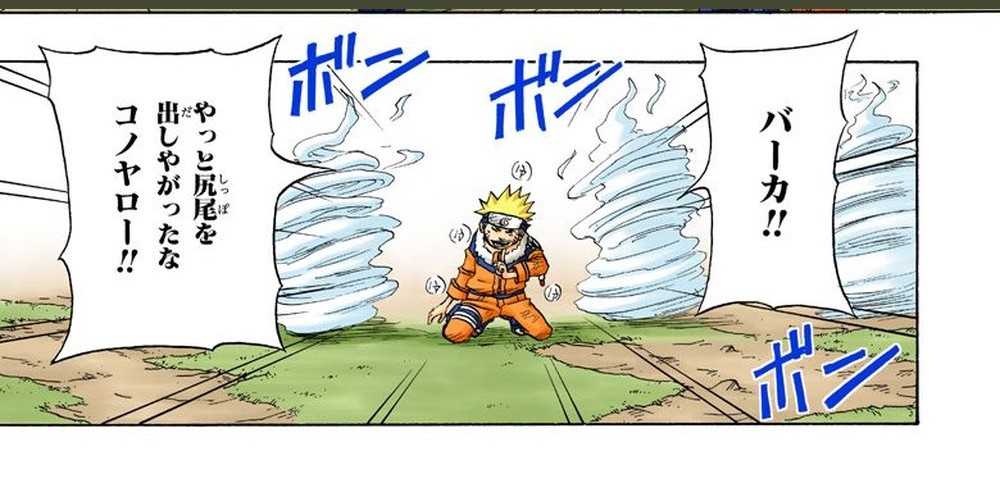
The Forest of Death, mid-Second Chunin Exam. The page before ours sets an ambush in motion: a group that looks, at a glance, exactly like Naruto's own team — a pink-haired kunoichi, a dark-haired boy with the Uchiha crest on his back, an older bandaged shinobi, a gray-haired genin in glasses — has just cornered a fallen figure. 「袋のネズミだな…」 ("NOW WHO'S THE TRAPPED RAT?") one of them says, and another adds, warmly, 「うまくいったわねナルト!」 ("NICE WORK, NARUTO!") — the trap, whatever it was, has apparently just worked.
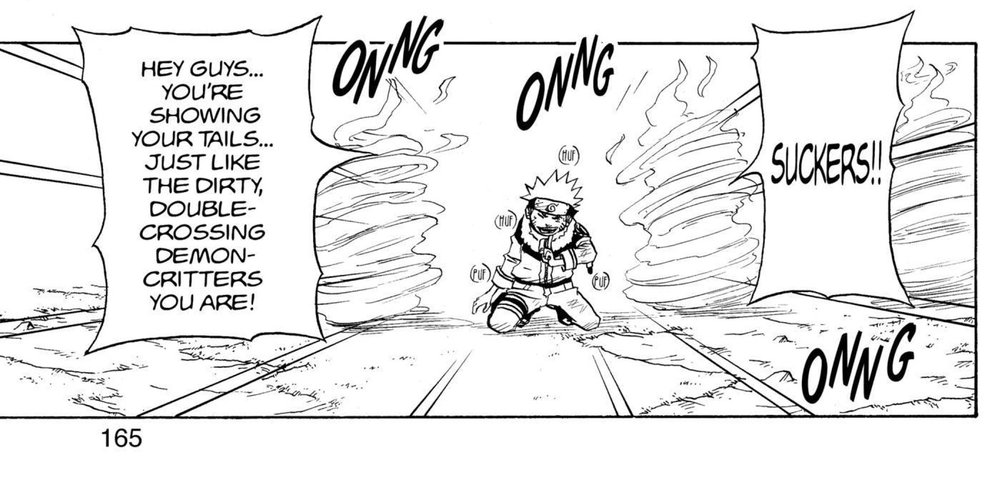
It hadn't. The next beat is confusion — 「こ…こいつら一体!!?」 ("WH-WHAT THE--?! N-NO WAY!"), 「バ…バカないつの間に…」 ("WHEN...? HOW DID THEY...?!") — and then, three simultaneous puffs of smoke (ボン, ボン, ボン) later, the "team" is gone. What's left kneeling alone on the forest path, unhurt, sweat beading, three collapsing tornadoes of dispelling chakra still swirling on either side of him, is the real Naruto Uzumaki. He grins and lets the enemy have it:
「やっと尻尾を出しやがったなコノヤロー!!」
Yatto shippo o dashiyagatta na, kono yarō!!
VIZ's English edition prints: "HEY GUYS... YOU'RE SHOWING YOUR TAILS... JUST LIKE THE DIRTY, DOUBLE-CROSSING DEMON-CRITTERS YOU ARE!" (Vol. 7, p.165.)
Grant the rendering its due first, because it earns more credit than most idiom translations in this series get: VIZ kept the tail. Where a translator reaching for the standard English equivalent — "showed your true colors," "tipped your hand" — would have quietly amputated the animal image at the root, this line keeps "tails," plural, right where a Japanese reader's ear would put 尻尾. In a manga literally built around nine-tailed and tailed beasts, that's either an inspired choice or a lucky one. Either way, it's rarer than it should be.
The Original
尻尾 (shippo) is a compound most Japanese speakers stopped parsing centuries ago: 尻 (shiri), "buttocks, rear end," plus 尾 (o), "tail," fused into a single irregular reading — しっぽ, not a straightforward kanji-by-kanji sounding. It's simply the everyday word for an animal's tail, the same word a Japanese child uses for a dog's or a cat's. 出す (dasu) is one of the language's most versatile verbs of exposure — 顔を出す, "to show one's face" (i.e., to show up somewhere); 手を出す, "to put a hand out" (i.e., to get involved, often where you shouldn't). 尻尾を出す, "to let one's tail out," sits in that same family: transparently literal at the word level, entirely figurative at the idiom level.
The figurative half comes from folklore, not grammar. Japan's kitsune (fox) and tanuki (raccoon dog) shapeshifter tales — setsuwa, kabuki, rakugo, centuries of them — all share one structural weakness: a fox or tanuki that transforms into human shape to walk among people always, eventually, fails to hide its tail. A gust of wind, an unguarded moment, and the disguise comes apart at that one seam. 尻尾を出す generalized out of that specific image so long ago that a modern speaker uses it about a lying politician or a cheating spouse without picturing an animal at all — it is as dead a metaphor in Japanese as "let the cat out of the bag" is in English.
The headline line stacks two more layers of hostility on top of the bare idiom. やがった is the past tense of やがる, a contemptuous auxiliary that turns any verb into something the speaker sneers at — not "you showed your tail" but "you had the nerve to show your tail." コノヤロー (kono yarō), "you bastard(s)," is the stock rough-masculine insult of shonen manga, needing no gloss in either language. As vocabulary, 尻尾を出す sits around JLPT N3 — common and idiomatic, well past survival Japanese, but nowhere near obscure.
VIZ's Choice
This idiom surfaces exactly once across the volumes on file — no scatter table to build, one sentence and one translator's decision to examine on its own terms.
The decision has two separate parts, and they deserve separate grades. The first — rendering 尻尾 as "tails" rather than reaching for the standard English idiom ("true colors," "real hand") — is the interesting one. It's not the safe choice; a translator confident the phrase is a dead metaphor would normally abstract it away, the way VIZ abstracts 因縁 or 呪印 elsewhere in this series into whichever English noun fits the sentence. Keeping "tails" is a bet that the literal image still does useful work — and in a manga about nine-tailed foxes and tailed beasts, it's a bet that pays off, even if nothing in this specific panel is actually about Kurama or the bijū.
The second part of the decision is the padding around it. Nothing in やっと尻尾を出しやがったなコノヤロー!! says "dirty," "double-crossing," or "demon-critters." VIZ invented all three to give the bare, resurrected image of "tails" somewhere to land as an insult rather than a non sequitur — because a literal tail, alone, doesn't automatically read as contemptuous to an English ear the way 尻尾を出す, alone, already does to a Japanese one via idiom-recognition. "Demon-critters" in particular is worth noticing: it's the closest thing in the English line to an explicit nod at the trickster-yōkai folklore the Japanese idiom is quietly built on, even though the word appears nowhere in the source.
The Gap
A dead metaphor gets read as a fresh one. In Japanese, nobody hearing 尻尾を出す pictures an actual tail — it's automatic, the way "caught red-handed" carries no image of blood to a fluent English speaker. VIZ's literal "showing your tails" resurrects the image for readers who have no idiom to recognize it by, so the line risks landing as a bespoke insult invented for these particular enemies — as if they, uniquely, have tails — rather than a stock phrase being quoted matter-of-factly.
The contempt changes address. やがった carries its sneer through pure verb conjugation; no extra word is spent on it. English has no equivalent auxiliary, so the venom gets rebuilt out of adjectives — "dirty," "double-crossing." The insult survives the trip; the grammatical mechanism that delivered it in Japanese is nowhere to be found in the English sentence that replaces it.
A four-beat bark becomes a paragraph. やっと尻尾を出しやがったなコノヤロー!! is short enough to shout in one breath, punctuated for speed. "HEY GUYS... YOU'RE SHOWING YOUR TAILS... JUST LIKE THE DIRTY, DOUBLE-CROSSING DEMON-CRITTERS YOU ARE!" is nearly three times the syllable count and reads like gloating commentary rather than a taunt snapped off mid-breath — the content survives; the rhythm of a boy showing off does not.
What If
Every option here pays for what it keeps.
- "FINALLY SHOWED YOUR TRUE COLORS, YOU BASTARDS!!" — the standard English idiom, natural and compact. Cost: no tail, no fox, nothing left for a Naruto reader's ear to catch.
- "THERE'S THE TAIL, SHOWING AT LAST — YOU RATS!!" — a tight, single tail image at roughly the right length. Cost: without folklore context, a bare "tail" can read as a strange insult rather than a recognized idiom.
- "SO THE FOX SHOWS ITS TAIL AT LAST, YOU BASTARDS!!" — makes the kitsune image explicit for readers who don't already know the idiom. Cost: "fox" is nowhere in the Japanese line — it imports the folklore rather than leaving it implicit, the way the original does.
- Keep VIZ's "tails," cut everything else: "YOU'RE FINALLY SHOWING YOUR TAILS, YOU BASTARDS!!" — matches やっと…やがったな…コノヤロー almost beat for beat. Cost: loses the "dirty, double-crossing" characterization that arguably does honest work explaining the contempt.
Take-away
尻尾を出す is a dead metaphor doing a live idiom's job: nobody saying it pictures an actual tail, any more than an English speaker pictures spilled legumes when secrets get out. VIZ's choice to translate it literally — "showing your tails" — is a small gamble that happens to pay off precisely because this particular manga is soaked in literal tails, from the Nine-Tails on down. That's not a translation rule so much as a lucky rhyme between an idiom's fossil and its story's subject matter.
Three rules of thumb to carry off this page:
- Check whether an idiom is still "alive" in the reader's mind before deciding how literal to go. A dead metaphor translated literally can accidentally resurrect an image the original speaker wasn't thinking about — sometimes for the better, as here; sometimes not.
- やがる is contempt with no vocabulary of its own. It rides purely on conjugation. Whenever a rough line escalates from plain past tense to やがった, expect the English to compensate with adjectives instead of grammar — look for where the sneer actually landed.
- A fox's tail is folklore's oldest disguise-tell. 尻尾を出す, 化けの皮が剥がれる, and Japan's whole kitsune/tanuki storytelling tradition share one seam: the transformation always fails at the tail. Once you know the image, half of Japan's shapeshifter vocabulary opens up at once.
For two more Naruto lines built on the same folk-religious and folkloric bedrock — one on the curse-vocabulary hiding inside a different kind of mark, the other on a grudge folklore says can outlive its owner — see 呪印, the curse-root family hiding inside "curse mark", captured just a few pages earlier in this same volume, and 怨念, the vengeful-spirit charge VIZ boils down to "hatred" — or browse the full Naruto translation notes index.
Every Japanese and English line quoted above is a byte-exact capture from the cited editions — NARUTO―ナルト― Vol. 7 (Japanese, colored digital edition) and Naruto Vol. 7 (VIZ Media) at the corresponding panel — via our bilingual page database; see Sources below.